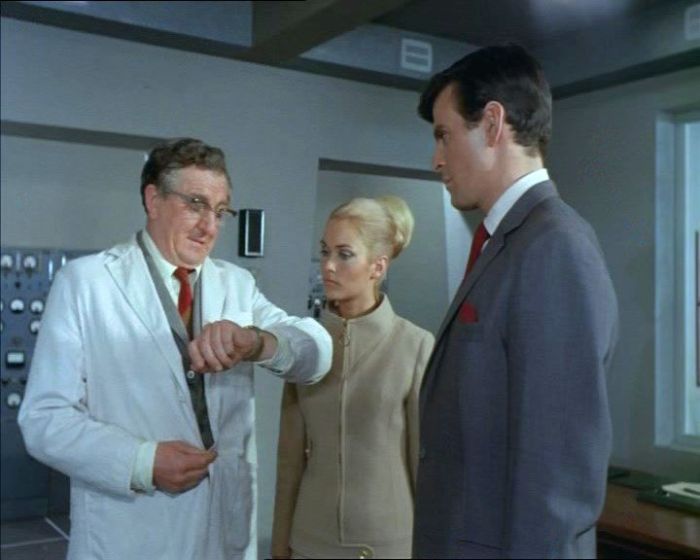
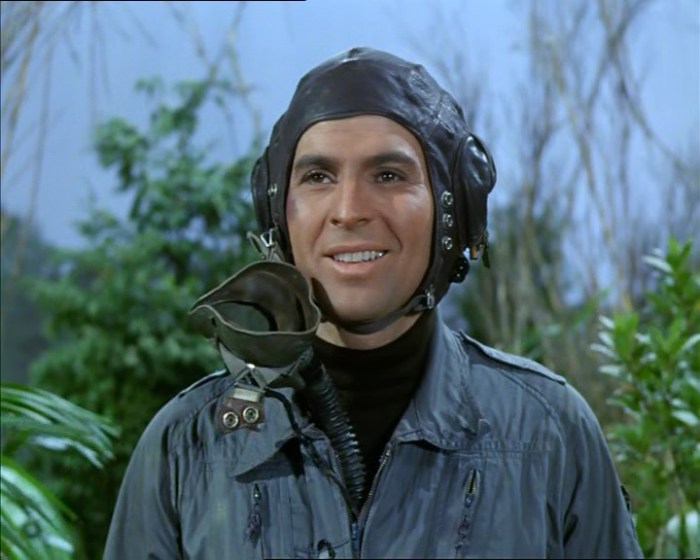
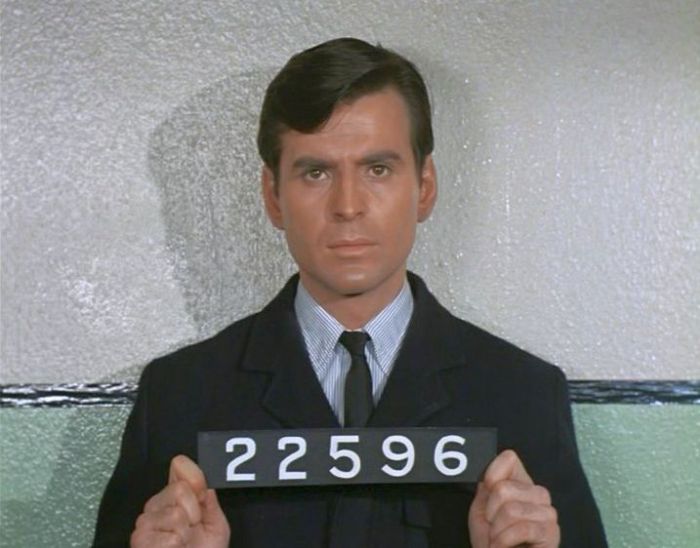
Peter Wyngarde – A Life Amongst Strangers by Tina Wyngarde-Hopkins

wyngarde

I’ve been a fan of Peter Wyngarde’s film and television work for a fair few years, but until now I didn’t really know a great deal about the man himself – apart from a series of oft-repeated tales (which no doubt grow more distorted every time they’re repeated).

Tina Wyngarde-Hopkins’ hefty tome (clocking in at over 500 pages) has been designed to rectiy this and although she’s obviously approached the book intent on righting perceived wrongs from various points in Wyngarde’s life, it still manages to paint a vivid picture of a charismatic, but often difficult, man.

Wyngarde-Hopkins first met Peter in the early nineties when she set up a fanzine dedicated to him. Over the years their bond grew closer as she became his assistant, companion and eventual soul mate. Drawing upon an impressive archive (letters, scripts, diaries, interviews) she’s been able to fashion a substantial biography where the subject is often able to chip in on the subject in hand.

His early years, as a prisoner of the Japanese in an interment camp in Shanghai, are vividly portrayed. There are lighter moments – organising theatrical entertainments – but also darker ones (the guards broke both his feet in order to discourage him from running about).  Wyngarde’s relationship with his parents – his mother looks to have been something of a flighty man-eater whilst he idolised his father (who died at sea in 1947) – is also touched upon.

Rather like his mother, Wyngarde enjoyed a healthy sex life (one of the things he’s – along his with acting – probably best known for). And as he attempted to establish a name for himself as an actor in post-war Britain, there were no shortage of opportunities for liasons.  Plus plenty of invitations which Wyngarde declined (from the likes of Noel Coward, Peggy Ashcroft and Bette Davis). It’s up to the reader to decide how much of this is credible – no doubt Wyngarde wasn’t above spinning a tall tale or two.

His years in provincial rep and his eventual emergence during the 1950’s as a familiar face on both the London stage and as an early television favourite are entertainingly sketched. The likes of Kenneth Williams and Orson Welles feature in some amusing anecdotes.

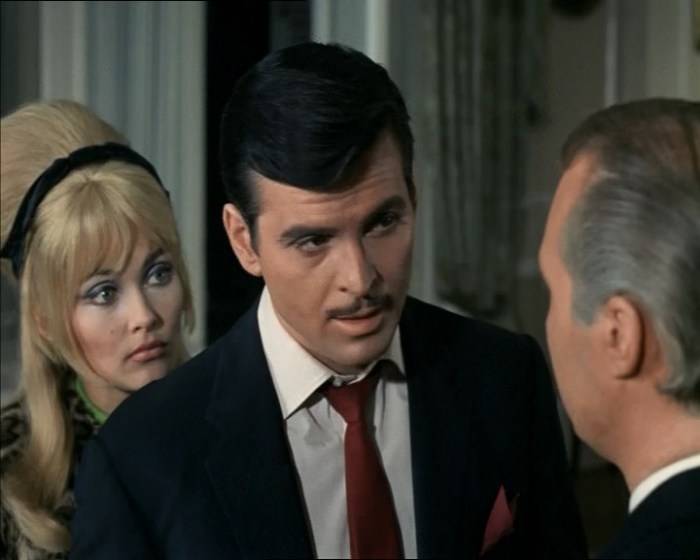
By the 1960’s Wyngarde was guesting in a number of cult television series which still endure to this day. Most notably The Avengers and the episode A Touch Of Brimstone, in which he played the Honorable John Cleverly Cartney, leader of a modern Hellfire Club. Wyngarde would later recall that Cartney’s whip cracking was very carefully choregraphed – one wrong move could have resulted in a serious injury for Diana Rigg.

His real ascent to cult fame would, of course, come with Department S and Jason King. Paid the princely sum of £336 for the first thirteen episodes (rising to £1,000 if the series continued past that point) Wyngarde seems to have earned the respect of many of the guest actors (Anthony Hopkins speaks warmly of his experience working with him on Department S) although it was a different story with his co-star Rosemary Nichols. More detail on this – or indeed production of both series – would have been welcome, as they’re dealt with rather quickly.

Two very different events during the seventies are still debated today by Wyngarde watchers. The first is his 1970 self-titled spoken word album, which included such memorable offerings as “Rape”. Judging by the eleven tracks not included in the final cut (including “Merry Sexmas”) it could have been a double album ….

A Life Amongst Strangers posits that RCA had hoped the album would be a flop, thereby allowing them to write it off as a tax loss. But unfortunately for them it turned out to be a success. That’s certainly an interesting spin on events.

In 1975 Wyngarde was fined £75 for committing an act of gross indecency in the public toilets at Gloucester Bus Station. Although he kept working, this dealt a devastating blow to both his career and public image from which he never really recovered.  Wyngarde-Hopkins remains convinced he was innocent (and that he was PERSECUTED! not prosecuted).  Throughout the book she’s also at pains to dismiss the numerous rumours concerning his sexuality – presenting Wyngarde as a firmly heterosexual character.

From the eighties onwards the work began to dry up, although there were still some notable credits, such as Flash Gordon (1980) and a guest role in a 1984 Doctor Who serial (Planet of Fire). Peter Davison would remember Wyngarde’s contribution to this story in his autobiography, although this still attracted Wyngarde-Hopkins’ ire (due to the fact he misspelt Wyngarde’s surname and omitted him from the index).

His final years, as his health began to falter, makes for bleak reading – although by the end you’re left in no doubt about just how much Tina Wyngarde-Hopkins loved him.

A Life Amongst Strangers offers a substantial portrait of Peter Wyngarde. As with all autobiographies and biographies the reader will have to decide just how accurate a portrait it is, but it certainly doesn’t skimp on detail.  Published by Austin Macauley, it’s well worth checking out.
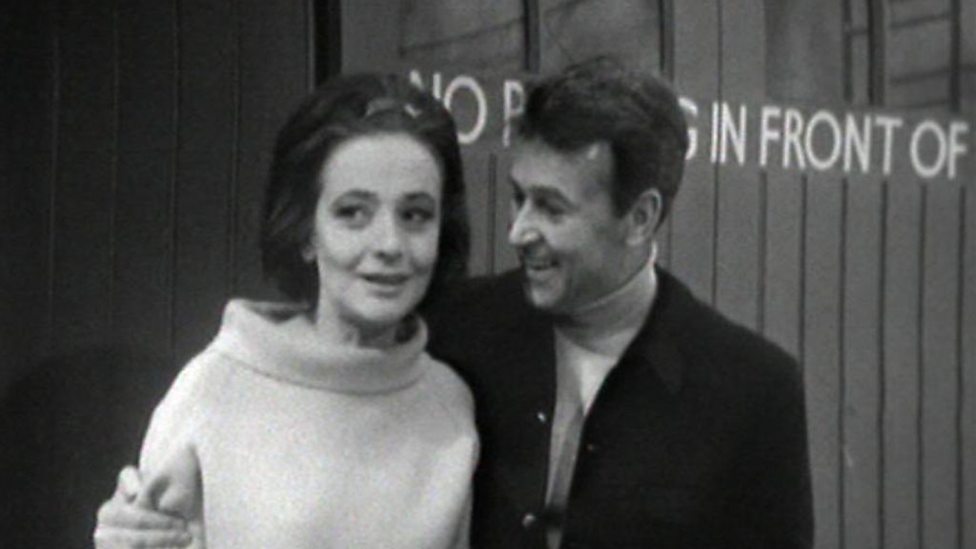
Doctor Who – The Chase. Part Six – The Planet of Decision

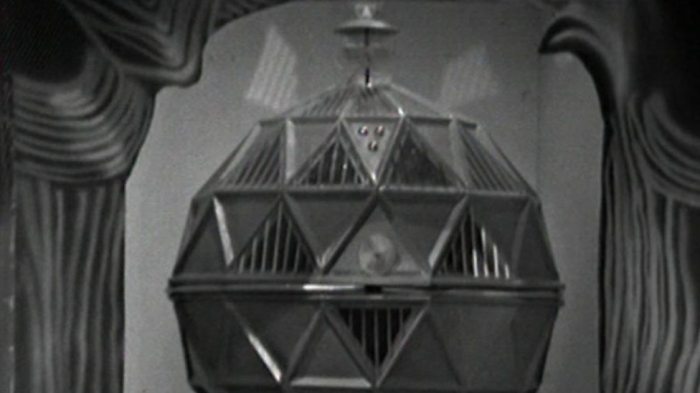
The Mechanoid takes the time-travellers up to the city.  The lift they travel in is incredibly quiet, which is either an intentional touch (to suggest how advanced the Mechanoids are) or it’s because Richard Martin forgot to add any sound effects.  Given all that’s happened so far, I tend to favour the latter possibility ….

It’s easy to see where a large part of the budget went.  The Mechanoids are substantial creations, although their sheer size and unwieldiness was a major factor in making this their only appearance.

The episode has a faint echo of The Daleks – the Doctor and his friends are apprehended by the strange inhabitants of a futuristic city who then imprison them – but the Mechanoids have quite different motives from the Daleks.

The Daleks are thinking creatures, acting on fear and racial hatred, whilst the Mechanoids are purely machines – they aren’t evil, they’re simply obeying their programming.  And if that means keeping people captive (albeit in comfortable surroundings) then so be it.

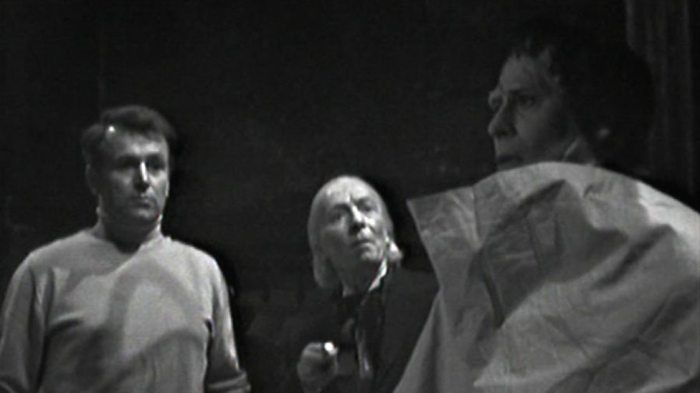
Steven Taylor (Peter Purves) has been a prisoner of the Mechanoids for several years.  Starved of any human contact during that time, his first reaction when he meets the Doctor and his friends is to wonder if they’re real.

This might suggest that his grip on reality has started to go, but we’ll soon see that he’s still a very resourceful young man.  After appearing as the hillbilly Morton Dill a few episodes earlier, Purves (now with a natty beard) returned to play a quite different character.

With the imminent departure of William Russell and Jacqueline Hill, Purves would go on to be the solid rock of the series during the next year or so.  William Hartnell remained the star (although there are points during series three, which we’ll no doubt touch upon in due course, where he’s rather sidelined) but his increasing health issues meant that he would come to depend on Purves, who would be invaluable in dealing with his variable moods.

One interesting point is that the Daleks refer to the Mechanoids as Mechons, due to the fact that all their dialogue was pre-recorded before this script element was changed.  Given the chaotic nature of the story it’s good there aren’t any glaringly obvious Dalek dialogue mis-cues (as happened in The Dalek Invasion of Earth).

The set-piece battle between the Daleks and the Mechanoids is impressive – an element of the serial which benefitted from being shot on film.  It’s got nothing to do with the Doctor though, who’s hot-footing it with the others down to the surface of the planet, courtesy of a very long rope.  Possibly Terry Nation already had visions of his big-budget Dalek series (in which they maybe faced off against the Mechanoids week after week) so was this ending something of a trial run?

So that just leaves the departure of Ian and Barbara.  Companion exits tend to happen in one of two ways – either their desire to leave is hinted throughout their final story (Susan or Victoria, for example) or, like Ian and Barbara, they only decide at the end of the story that the time is right to go.

The discovery of the Daleks’ abandoned time machine gives them a perfect opportunity to return to their own time (remember this was still the period when the Doctor had no control over the TARDIS) although the Doctor’s very dubious.

You’ve got to a feel a little for Hartnell here.  Although the Doctor’s obviously sorry to have to say goodbye to Ian and Barbara, William Hartnell was even more unhappy that William Russell and Jacqueline Hill were leaving.  Possibly this contributes to one of his most famous fluffs (he tells them they’ll end up as cinders floating around in “spain, err space”) if they use the DARDIS.

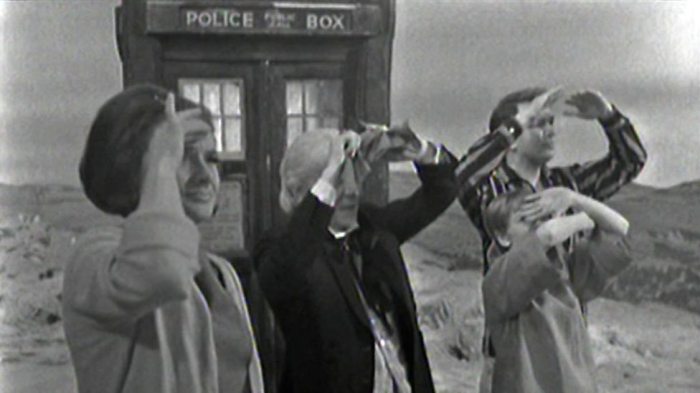
I love the photo-montage that shows their delight in returning to the 1960’s, especially Ian’s mock-horror at observing a telephone box!  They’ll certainly both be missed, as Ian and Barbara were the moral centre of the series (especially during the early stories) but it’s true that their place in the series was becoming slightly redundant.

By this point the Doctor was a much more rounded character, so he didn’t need other people to act as his conscience.  All he needed was a young girl to get into scrapes and a young man to provide a bit of muscle – a formula that would endure for the rest of the decade.

Doctor Who – The Chase. Part Five – The Death of Doctor Who

death-of-doctor-who

One of the frustrating things about The Chase is the fact that the script has some very good ideas which are then rather frittered away.  The robot duplicate of Doctor Who is a case in point – this could have easily been developed over a number of episodes, possibly with the audience unaware that a substitution had been made (which would have made the reveal all the more dramatic).

But as this didn’t happen, this part of the plot doesn’t really progress beyond the robot Doctor briefly menacing Barbara before its true nature is revealed to her.  Although there’s one plus point – since today’s episode was structured more effectively than the previous one, Hartnell’s able to play both the Doctor and his robot double in several key scenes.

There are still some close-ups of Edmund Warwick mouthing William Hartnell’s pre-recorded lines which doesn’t even remotely convince, but we do get a short battle between the real Doctor and his mechanical counterpart which is quite amusing.

Although The Chase isn’t the sort of script you really should spend a great deal of time thinking about, it’s always slightly irritated me that although the Daleks have now got a time machine they never seem to think it might be a good idea to find out where the Doctor is going to land next and then arrive before him  That’s what a time machine can do, for goodness sake!

Instead, Terry Nation seems to regard the TARDIS and DARDIS (only named in the script – popular fan opinion states that it stands for “Daleks are Rusty Dustbins in Space”) as purely linear machines, meaning that the Daleks are always x number of minutes behind the Doctor’s craft.  This is rather silly, but no more than the rest of the script I guess.

Anyway, mild rant over.  The Doctor, Ian and Barbara have arrived on the planet Mechanus, home of the Mechanoids (who are mechanical, do you see?).  Mechanus has the sort of jungle that Terry Nation always seemed to love – the flapping fungoids are an unforgettable sight – although it’s a lot more of a low rent environment than those we would later see in The Daleks Master Plan  or Planet of the Daleks.  Money was clearly running out, so it’s a mercy that the lighting is kept low (although Barbara and Vicki’s tussles with the fungoids are still hopelessly unconvincing even in this dim light).

The others are reunited with Vicki and after defeating the robot Doctor they ponder their next move (they can’t get back to the TARDIS, since the jungle is crawling with Daleks).  The dawn of a new day reveals the city of the Mechanoids in all its glory – it’s a shot not dissimilar to our first sight of the Daleks’ city on Skaro.

For those keeping an eye on the number of times that BBC television cameras wander into shot, then 21:14 into this episode gives us a good sighting of another one.  Although if you wanted to do a ret-con, maybe it was actually a new, special weapons Dalek ….

If this episode has somewhat meandered about, then the final twenty seconds or so – when we get our first sight of a Mechanoid – is worth waiting for.

Doctor Who – The Chase. Part Four – Journey into Terror

terror

Journey Into Terror (yet another generic Terry Nation episode title) is pretty poor stuff.  Technically it’s very sloppy (watch out for the camera at the top of the stairs about five and a half minutes in). There’s another problem a few seconds later when a Dalek is revealed.  But the Daleks haven’t arrived yet, so this prop shouldn’t have been in shot. Oops …..

The script had a rather confusing genesis.  Terry Nation originally conceived the haunted house as only existing in the imaginations of the four time-travellers (and there’s a remnant of this in the script since that remains the Doctor’s theory).  Nation then muddied these waters in the draft script when the Daleks announced that the TARDIS had landed in Transylvania – implying that the Doctor was preparing to meet the real Count Dracula.  In the end the script was redrafted to explain that everything they see is nothing more than an elaborate funfair attraction.

Which is closed.  So why is the power on and why are the various (very realistic) mechanical monsters moving about?  Also, why do they develop homicidal tendencies?  Maybe that was the reason why the attraction was closed down.  I love when Barbara asks Vicki if she thinks whether “there’s something strange going on around here?” That’s after they’ve both met Count Dracula, so it’s a fair bet that something’s not quite right!

By now, the pattern of events should be clear.  The Doctor and his friends arrive somewhere, look around and leave.  The Daleks then turn up (they’re always just a little behind the TARDIS) curse that they’ve missed the Doctor yet again and get into a tussle with the locals.  If the Daleks have a time-machine why are they always a few minutes behind the TARDIS?  This makes no sense, but The Chase isn’t a story that makes a lot of sense anyway.

A little wrinkle is added after Vicki is left behind (she’s forced to take refuge in the Daleks’ time machine).  It’s rather remarkable that the others don’t twig she’s missing straight away. Nation would do this again a decade or so later in the Blakes 7 story Seek, Locate, Destroy where Cally went AWOL for a long time before anybody noticed.

The Daleks’ next wheeze is to create a robot copy of Doctor Who.  It’s identical to him in every respect (at certain angles anyway, at others it looks nothing like him).  This is another of those script ideas that just doesn’t work.  Had Hartnell played both the Doctor and his double all the time (with split screen filming for the scenes where they meet) then they could have pulled it off.  But Richard Martin bizarrely elected to use shots of Edmund Warwick dressed as the Doctor, badly miming Hartnell’s pre-recorded dialogue.  Does this convince?  Umm, not really.

It’s true that split-screen would have probably been outside of the programme’s budget, but it’s baffling why the script wasn’t tailored to enable Hartnell to play all of the robot scenes at the end of this episode.  Instead, we have shots of Warwick miming, which then changes to a close up of Hartnell.  Hardly the most impressive of cliffhangers.

Doctor Who – The Chase. Part Three – Flight Through Eternity

flight

The opening scene in the Daleks’ time machine looks pretty impressive. The set (designed by Raymond Cusick) feels substantial and has some groovy 1960’s embellishments such as the spinning wall designs. It’s also populated with quite a few Daleks – true, at least one is a cardboard cutout and others are cannibalised from the Peter Cushing movie, but it all helps to create the impression of a decent fighting force.

It’s therefore a pity that one of the Daleks is rather hesitant (“umm err”) which rather dissipates this good start. This wasn’t scripted and seems to have been a gag dropped in during rehearsals. It’s another moment which chips away at the invulnerability of the Daleks, although there’s worse to come ….

The TARDIS next drops our intrepid time-travellers off at the top of the Empire State Building. This is the cue for a number of interesting American accents. The first comes from Arne Gordon playing the guide. If you’re bored with the story at this point you can always amuse yourself by counting the number of times he says “err”. Gordon had also played Hrostar in The Web Planet, although you’d be forgiven for not realising this. There’s no excessive hand movements or mutterings of “Zaaaarrbbiiii” for example.

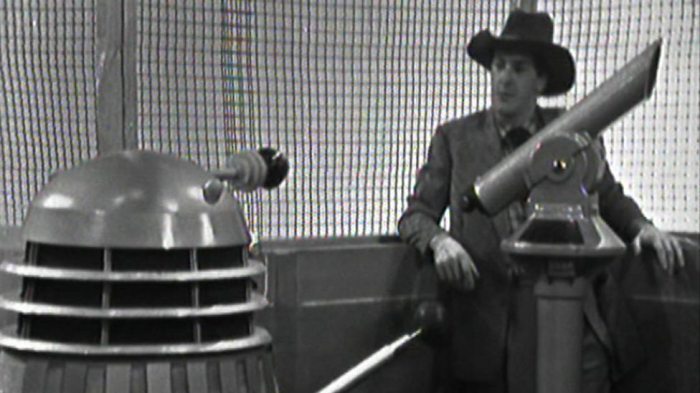
Next up is hillbilly Morton Dill, played by Peter Purves. As is well known, Purves’ small role so impressed Verity Lambert that she offered him the role of series regular Steven Taylor a few weeks later. Quite what she liked about Morton Dill is a bit of a mystery to me as Purves overplays horribly, although you could argue that The Chase is hardly the story where naturalistic acting is required.

I’d assume it must have been Purves’ off-camera persona which convinced her that he’d work well with Hartnell (and she was quite right as he would provide Hartnell with solid support during the next year or so).

Dill’s brief run-in with the Daleks is another instructive moment – he’s convulsed with laughter at their appearance and refuses to take them seriously. Had he then been blasted into nothingness it would have reminded the audience about the power of the Daleks (to coin a phrase). This doesn’t happen, so Skaro’s finest remain something of a joke.

Mercifully, we don’t spend too long in New York. The TARDIS is on the move again, landing the Doctor and his friends on an old-fashioned sailing ship. As with the Empire State Building sequence, it’s over and done with so quickly that only very superficial characterisation can be established.

A gag from The Romans – Ian is knocked out by one of his crewmates, this time Vicki – is reused and once again the Doctor leaves before the Daleks arrive. But whereas they couldn’t be bothered to deal with Morton Dill, here they’re in a much more bloodthirsty move and elect to exterminate all the crew.

This does give us some nicely shot film sequences, showing hapless crew members jumping from the ship into the sea (including, rather disturbingly, a mother and her child). As with the events in the previous episode, you have to wonder why the Doctor never seems to worry that almost everywhere he’s visiting is then obliterated by the Daleks. This is a throwback to the self-centered Doctor of season one, where his survival (and that of his companions) was his sole interest.

The reveal that the ship was the Mary Celeste is a rather groanworthy one, but at least it gives us an explanation for this age-old mystery. The crew and passengers were exterminated by the Daleks! It’s as good a solution as any other.

Doctor Who – The Chase. Part Two – The Death of Time

death

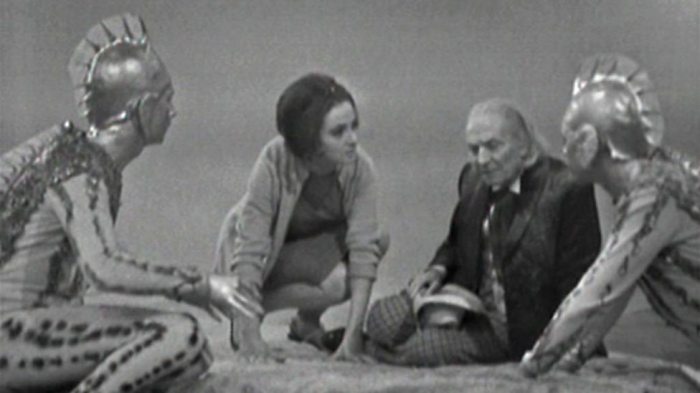
It’s pulpy sci-fi thrills all the way for the duration of The Death of Time. The appearance of the Aridians (they live on an arid planet, do you see?) isn’t a highpoint of the story as not only do they look ridiculous but they’re forced to deliver fairly uninspiring dialogue in a very stilted way.

These scenes are mainly of interest thanks to the appearance of Hywel Bennett as Rynian. Like Martin Jarvis in The Web Planet there’s a morbid curiosity in watching someone who’d go on to have a long and successful career looking ridiculous. With only a short amount of screentime the Aridians are very lightly sketched. They give the Doctor and his friends an account of their history, but since it’s not naturally delivered it feels like little more than info-dumping.

The Daleks present the Aridians with a stark ultimatum – hand over the Doctor or their planet will be destroyed. It’s no surprise that the Doctor’s able to escape but it’s slightly more of a surprise that he doesn’t seem to feel any obligation to the Aridians and is quite content to leave them to their fate. Because the Aridians are such pallid, comic-strip characters it’s hard to feel that invested about what happens to them, but it still feels a bit off for the Doctor just to beat a hasty retreat.

For those keeping an eye on the technical imperfections of the story, 16:45 in is a good one. For several seconds nothing seems to happen, then Jacqueline Hill is covered with unconvincing polystyrene rocks. It’s one of a number of moments that was crying out for a take two. A minute later, Richard Martin lingers over a shot of the Mire Beast. If you’ve ever seen it then you’ll know why that wasn’t a terribly good idea.

There’s now just one Dalek between the Doctor, Ian and the TARDIS. Do you get the feeling that they aren’t treating this Dalek with all due seriousness? Ian distracts the Dalek with the memorable call of “yoo-hoo! Dalek! Over here, friend!” whilst the Doctor gets in on the act with “yoo-hoo, Archie!” Dudley Simpson’s jaunty music doesn’t help to engender a sense of menace either. Treating the Daleks as comic characters is a dangerous road to go down as once you so it’s harder to recreate their sense of power.

And what exactly does The Death of Time refer to? Sometimes I get the feeling that Terry Nation just drew his episode titles from a hat, not caring that they sometimes bore no resemblance to the events of the script.

Doctor Who – The Chase. Part One – The Executioners

executioners

For those who regard Terry Nation as nothing more than a hack writer, The Chase must surely be exhibit A.  It’s easy to dismiss it as nothing more than six episodes of random nonsense, held together by the thinnest of plots (the Doctor is now the Daleks’ deadliest enemy and they’ve decided to hunt him down through all time and space.  Mmm, we’ll come back to that one).

It’s true that it’s not helped by having Richard Martin in the director’s chair.  Martin was the go-to guy for the big stories of season two, although it’s hard to see why.  He’s a decent director of film sequences, but much less assured when it comes to the multi-camera studio environment.  And since Doctor Who was largely recorded in the studio that’s something of a problem ….

If many of Nation’s story ideas are odd and/or silly (Morton Dill, the Haunted House sequence, etc) then Martin’s direction doesn’t help.  The Chase is one of the most technically inept productions we’ve seen so far – although whilst it’s true that the script was far too ambitious for the series at that time, with the right director (say Douglas Camfield) something could have been salvaged.

It’s no surprise that when The Daleks’ Master Plan was mounted the following season (which is pretty much The Chase 2) Camfield managed to produce a much more appealing effort (at least based on the evidence of the surviving episodes).

But having said all that, I find it impossible not to have a sneaking love for The Chase.  It’s shoddy and illogical but there are some moments of magic scattered throughout its six episodes.

The Executioners opens with the Daleks swearing vengeance on their arch enemy Doctor Who.  After only two meetings (and since the Daleks were apparently wiped out in the first one, who was keeping the records?) this is a bit hard to swallow.   I can understand why Nation did it – the personal angle is a decent one – but like the rest of The Chase it just feels a bit off.  Maybe it’s because it’s rather like a TV Comic story come to life.

The Doctor and his friends remain oblivious for the moment.  They’re relaxing in the TARDIS in a sort of lazy Sunday afternoon mode.  The Doctor’s tinkering with a piece of equipment he’s picked up from the Space Museum, Ian’s engrossed in a lurid book about space monsters, Barbara (being the sensible one) is doing some needlework whilst Vicki’s just bored.  They make a perfect family unit and it’s a charming little moment of peace before the mayhem begins.

The Doctor proudly demonstrates his new acquisition – a Time and Space Visualiser (it’s a time television which allows the operator to view any event in history).  Ian asks to see Abraham Lincoln deliver the Gettysburg Address (actually he doesn’t – he specifies a time, place and date and the Visualiser just focuses on Lincoln.  Clever that).

Barbara is curious to see the court of Queen Elizabeth and we eavesdrop on a meeting between her, William Shakespeare and Francis Bacon.  Vicki is keen to see the Beatles.  Ian’s dad dancing is a legendary moment and Vicki’s comment (“well, they’re marvellous, but I didn’t know they played classical music”) is an odd one.  Maybe in the future Vicki didn’t have access to the futuristic equivalent of YouTube and hadn’t already seen them (possibly there was no WiFi on Dido).

All this helps to pad out the episode, which you feel was Terry Nation’s first objective.  Simply find enough material to create a twenty five minute installment and worry (or not) about whether it was any good later.

Their television viewing comes to an end when the TARDIS lands on an arid, desert planet.  Vicki and Ian head off to explore, whilst the Doctor and Barbara relax and soak up the sun.  The Doctor’s clearly in a good mood as he starts singing.  Barbara, distracted by the sound from the Visualiser, asks the Doctor what the awful noise is.  Amusingly, the Doctor believes she’s turned into a music critic.  “I beg your pardon? Awful noise? That’s no way to talk about my singing!  Ha! I can charm the nightingales out of the trees.”  It’s not much of a gag, but Hartnell’s always good value whenever he’s given a comedy moment.

The Visualiser then shows us the Daleks.  And by a remarkable coincidence it’s honed in on precisely the moment when they announce their intention to target the TARDIS crew.  What were the chances of that, eh?  It’s interesting that the Terry Nation formula of not revealing the Daleks until the end of episode one wasn’t quite set in stone yet.  Not only do the Daleks appear right at the start (reprising the cliffhanger from the previous episode) but they also have a substantial scene mid way through.

This would have been a good point to end the episode on, but alas there’s still a little way to go (Vicki’s hysterical outbursts are especially odd.  Were they as scripted or had Maureen O’Brien just lost it?).  The cliffhanger’s just about worth waiting for though – a coughing, spluttering Dalek rising from the sand.

The Champions – Autokill

c1

Throughout the series many have tried, but nobody has been able to beat the Champions. Who could? Possibly only another (reprogrammed) Champion ….

The pre-credits sequence opens with a Nemesis agent, George Brading (Richard Owens), returning to HQ. So far so normal, but this doesn’t last as once inside he pulls out a gun and shoots Colonel Coulston (Bruce Boa) multiple times. It’s an orgy of violence that teeters on the ridiculous – the Colonel wobbles but he won’t fall down as Brading continues to fill him full of lead.

Tremayne gets a slap from Brading as he tries to stop his rampage and then a whole phalanx of Nemesis agents get involved. This short scene helps to finally flesh out Nemesis quite agreeably (for once we see that Richard, Craig and Sharron aren’t the only people who work there).

Like the shooting, the fight scene is choregraphed in a hyper-real way and concludes a pulsating pre-credits teaser that promises the audience fifty minutes of high-octane comic strip action.

Post credits, we drop into a faintly swinging party, where Richard and Sharron are handing round the nibbles and alcohol. Richard eyes a pretty girl, but another chap clearly wants her all to himself, so he decides to trip Richard down the stairs (a tad unfriendly that). Thank goodness for Richard’s cat-like acrobatic skills.  Mind you, the way he manages to keep his tray of drinks intact even after a highly athletic somersault is pushing the bounds of credibility somewhat.

As ever, there’s plenty of familiar faces to spot in the episode. Paul Eddington has already turned up in the teaser whilst Harold Innocent appears shortly afterwards.  Innocent is Dr Amis, a Nemesis doctor who favours dark glasses even when inside (well it helps to make him stand out and also hides the nasty bruise on his eye). Since the bruise is never mentioned you have to assume it was a genuine shiner and not applied via make up.

Brian Clemens’ second script for the series has a different tone from most of the series. Along with The Interrogation, it’s an episode where the stakes feel higher than usual (possibly because the series’ regulars are placed under maximum stress).  The only Geneva based story, it’s also of interest for the way that Tremayne is brought more into the centre of the episode.

After the initial orgy of action, the episode settles down for a while as the Champions play detective, doggedly retracting Brading’s steps. But there’s also an ominous feel developing as Klein (Eddington) sets out to target another operative and this time he’s aiming high by selecting Tremayne.

Klein is masquerading as a policeman (Eddington’s accent is interesting). You have to say that Tremayne is a little foolish to go off with him (hasn’t he ever heard about the dangers of accepting lifts from strangers?). Although in his defence, the baddies’ operation is clearly well funded since they’ve been able to take over a building and transform it into a police station. Complete with a pretty young woman holding a vase of flowers (although what she’s doing bringing the flowers out of the charge room is anybody’s guess).

A rogue Tremayne, now that’s a wonderful concept. A pity that the moment when the three Champions are forced to exercise maximum restraint against their boss is so short, but it’s still highly entertaining as stuntmen fling themselves around the office with wild abandon.

It’s nice to see that Sharron is the most forceful of our three leads. Whilst the boys are sitting back and almost admitting defeat, she’s keen to examine each and every angle, secure in the knowledge that Tremayne – now confined to a hospital bed and sinking rapidly – would do everything in his power to help them if the position was reversed.

Eric Pohlmann is Barker, the man behind the scheme to bring Nemesis to its knees.  We never discover why though – as happens often with The Champions, villains operate in a villainous way because that’s what villains do ….

The stakes are raised even higher when Richard falls into enemy hands. Pohlmann is good value as Barker pumps Richard full of drugs and begins to program him. His target? Craig of course.  Goodness knows where Barker was able to get those high quality b&w stills of Richard and Craig though.

The climax of the episode – Richard and Craig go multiple rounds against each other – is considerably more bloody than we’re used to.  Sharron isn’t left out of the action either (although Alexandra Bastedo’s stunt double is painfully obvious at times). I do like the little smile Sharron gives when she holds Richard steady for Craig to administer the knock out blow. Was this as scripted or an acting choice by Bastedo I wonder?

There are a few little things I could quibble about, but since this is the final episode (in Network DVD viewing order anyway) I’ll finish off this 2020 Champions rewatch on the most positive note and award Autokill five out of five.

c2

The Champions – Desert Journey

c1

El Hami is a small North African state which has become an important pawn on the international scene thanks to its bountiful supplies of cobalt. The Champions attempt to restore the Bey (Jeremy Brett) to the throne, but he’s reluctant to leave his decadent life in exile. Eventually (thanks to Sharron’s persuasive strong arm) he’s en route back to his people – but there are many dangers to overcome along the way ….

Yes, the story does feature a character called Major Tuat (Tony Cyrus). No sniggering at the back please.

Post credits, Sharron (in a swimsuit – sigh) takes an impressive dive off a high board and then enjoys a lengthy swim underwater. Several pool staff look on admiringly. Well you would, wouldn’t you?

Ooh, Sharron’s getting the pulse racing today – after her swimming antics she then turns up in Tremayne’s office wearing a very foxy outfit (Tremayne, Craig and Richard can only gape whilst the slinky saxophone on the soundtrack hammers the point home).  The reason for Sharron’s garb is obvious – if they can’t bribe the Bay to return, then Sharron will use other methods to persuade him.  Crumbs.

Jeremy Brett as the Bay. Now that’s a piece of casting which catches the eye. We first meet him at a swinging Rome party – it’s an absolute hoot, featuring loads of beautiful people jiving around in a decadent manner (or as decadent as you’d expect to see in an ITC series).

When Sharron turns up the fun really starts and although her role in this story initially seemed to be a sexist one, she acquits herself well – foiling an assassination attempt and duffing up Dave Prowse (anything’s possible when you’re a Champion). Sharron’s proactive day continues when she knocks out the Bay and carries him off. The carrying occurs off camera, which is probably just as well.

There’s a number of familiar faces in this story. Some, like Rudolph Walker, are uncredited, whilst the likes of Reg Lye and Roger Delgado are credited but don’t have terribly interesting roles. Always a pleasure to see Delgado of course, just a pity that he’s not playing a baddy today.

After Sharron gets the Bay aboard a small plane (Craig is piloting) her hair suddenly grows in a very impressive manner. She does look even more gorgeous with long hair, it has to be said.

c2

Desert Journey features a rather simplistic take on international politics, something which was fairly common in ITC adventure series of this era.  Nemesis seem quite content to organise a regime change in El Hami, no matter what the outcome might be, whilst the notion that once the Bay is restored to power all will be well seems a trifle optimistic.

Some stock location shots are mixed in with the studio desert action. I’m not sure where they came from, but it features three people who resemble Craig, Sharron and the Bay. The woman in the location footage has big hair, so that explains why Sharron has suddenly become so hirsute – presumably they wrote the story around the available footage.

The trek across the desert is quite effective, although fairly low on tension (you know that the Bay isn’t going to get killed mid way through the story). The slow transformation of the Bay – from hedonistic playboy to concerned ruler – works well, with Brett managing to overcome the limitations of the character he’s been given.

When the three stop to take some rest, Craig entertains himself by ogling a belly dancer whilst Sharron looks after the injured Bay (he’s taken a bullet in the shoulder from a sniper). I assume that Craig’s wild enthusiasm at her charms was a Stuart Damon ad-lib.

Desert Journey does drag a little towards the end, but Ian Stuart Black’s sole Champions script is still a good one. Partly thanks to the strong role for Alexandra Bastedo, I’ll give it four out of five.

c3

The Champions – Happening

c1

Richard is in Australia, having infiltrated a mysterious group who are doing dodgy things with an atom bomb that’s due to be tested soon. His attempt to round them up doesn’t end well, with the result that he loses his memory. Luckily he eventually comes to his senses, only to realise that he’s sitting right next to the bomb and the clock is (once again) ticking ….

We open in the Simpson Desert, which is apparently comprised of red sand (the ITC studio desert has a much more golden hue though). I rather like the cold opening – Richard confronting a group of baddies in a helicopter – although since he does so in such a smug way you know that something bad is going to happen to him. And so it does – they overpower him and he falls out. Ouch!

Post credits, Richard – cool as a cucumber – is shown demonstrating his super powers by jumping out of a burning building without hurting himself. This is a tad unfortunate as it makes you wonder why he couldn’t do that when he took his helicopter tumble.

Monty Berman always had a good eye. Apparently the fire was a real one that occurred just round the corner from the Borehamwood studios, so a crew was set out to take some shots and pop William Gaunt into the middle of the action.

Richard has gone it alone, not confiding in Tremayne, Craig or Sharron about exactly what he’s up to. Given he’s venturing out to the middle of nowhere that seems a little silly.  Still all three (yes all three) set off to Australia, partly to track him down and partly to observe the bomb test.

This is a bit of a red letter day – Tremayne getting out of the office for once. A pity it hasn’t happened before, and indeed it’s a shame that Anthony Nicholls hasn’t really been used more. Tremayne has generally functioned either as a device for moving the plot along or as comic relief (puzzled time and again by the incredible antics of his three top agents).

Happening doesn’t have a particular large guest cast, but Grant Taylor as General Winters and Michael Gough as Major Joss are both welcome additions.  For me, Taylor will always be the no-nonsense General Henderson in UFO (his General here isn’t a million miles away from his UFO character, albeit a little less grumpy).

Winters is looking forward to the bomb test – it promises to be incredibly powerful, but also ‘clean’ with very little radioactive fallout (this is presented to the audience as a good thing although Tremayne does sound a pessimistic note).

As we’ll see later, the faceless baddies have been doing things to the bomb, with the result that it’s now considerably dirtier than it was before. Odd that there doesn’t seem to be any sort of security around the bomb. That’s a tad careless.

Major Joss is the leader of the black hats, stranded in the desert after his helicopter is damaged. Although it’s not specified, given the accent of his superior (who breaks the news that they’re not going to send another helicopter in to rescue him) it seems that the Russians are behind this dastardly business. Mind you, it’s fair to say that Joss’ boss has the sort of accent that teeters on the edge of parody.

Jack MacGowran may not be a household name, but this Irish-born actor had quite the career (he’s possibly best known for his association with Samuel Beckett). MacGowran might not have been the obvious choice to play Banner B. Banner, an Australian prospector, but he gives an entertaining, if rather odd, performance.

Banner meets up with a still dazed and confused Richard, but their relationship seems fated to be a brief one after Richard succumbs to a snake bite. Richard then telepathically links with Sharron – was she the one responsible for bringing him back to life? It’s a striking scene – Richard in a hastily dug grave, getting covered with sand by Banner, before springing back into life and crawling out ….

Happening is an strange sort of story. The studio desert isn’t terribly convincing and Banner B. Banner apart, the guest roles aren’t very well developed.  Given that it was a Brian Clemens script you do expect a little more, but it’s still very watchable – Richard’s attempt to diffuse the bomb especially – so I’ll give it a rating of three out of five.

c2 

The Champions – The Final Countdown

c1

Field Marshall Von Splitz (Alan MacNaughtan) is released from prison after twenty five years, but repentance for his war crimes is the last thing on his mind. Still a fanatical Nazi, he immediately sets out to locate an atomic bomb which was jettisoned from a Heinkel during the dying days of WW2. Von Splitz plans to detonate it, thereby triggering a war between East and West. Can the Champions locate the bomb in time? The clock is ticking ….

The way the incidental music swells to highly melodramatic when Von Splitz makes his first appearance gives you an early indication that he’s a wrong ‘un.  The Nazi salutes proffered by Dr Neimann (Wolf Frees), Kruger (Derek Newark) and Heiden (Norman Jones) towards him is another subtle clue.

Actually, subtlety is not really a key part of this episode – you just have to sit back and enjoy the ride whilst not worrying about the plot specifics too much (although that won’t stop me of course).

Post credits, there’s a lengthy sequence of children playing in the snow. All very nice, but where are the Champions? Eventually we see Richard, attempting to dig his truck out of the snow, who dashes over to stop a young child from blowing himself up with a bomb. No, I’ve no idea what the bomb was doing just lying around in the field.

MacNaughtan was an actor of considerable presence. Von Splitz is something of a cliché character – the ice-cold Nazi – but MacNaughtan is still very watchable in the role. Derek Newark is entertainingly over the top when delivering his handful of lines whilst very decent actors like Basil Henson briefly feature (he suffers that most memorable of ITC fates – death by white car hurtling over a cliff for no particular reason). You really can’t grumble about the cast in this one as it’s also nice to see the likes of Morris Perry and Hannah Gordon.

Amazingly, Wolf Eisen (Henson), managed to survive the death crash (at least for a few hours) and so before he pegs out there’s just time for Richard to interrogate him. This seems a little harsh, although Tremayne later tells us that everybody else – the German police, Interpol, etc – has already had a go at him. Quite why Eisen’s ‘accident’ should have generated so many flags with the authorities is a slight mystery.

The notion that that Germans had developed an atomic bomb by the close of WW2 sounds a little far-fetched, but still credible. That it’s ended up lying quite happily in a German lake since 1945, maybe less so. The way the nasty Nazis manage to locate and extract it with embarrassing ease also requires some indulgence on the part of the viewer.

This is a story where the Champions’ superpowers only come into play late on. To begin with Craig, Richard and Sharron are all operating as ordinary detectives – interviewing suspects and doggedly following up clues – whilst  Von Splitz remains several steps ahead of them. The Final Countdown is also one of those Champions episodes which doesn’t feature a lot of quipping from the leads – fair enough, since there’s an atomic bomb floating about it’s probably not the time for merry jests.

A small piece of trivia – I think this is the first time we discover that Tremayne has a secretary (we don’t see her, just hear a disembodied voice on the intercom).

Craig is captured and given a thorough working over by Heiden. After slapping him around for a few minutes, Heiden asks him “who are you? Who are you?” which (thirty five minutes in) were Norman Jones’ first lines. Before then he’d just been called upon to loom menacingly in the background.

Richard rescues Craig (Sharron is forced to stay outside – which seems a little unfair). I love the entertaining punch up between Richard, Craig and the Nazis, even better is the way they both crash through the windows to confront Dr Neimann, who’s standing over the ticking bomb. Stuart Damon seems to go a bit Jimmy Cagney when Craig confronts Neimann.

Richard once again attempts to send Sharron away – is he afraid for her life or is he just a bit of a male chauvinist?

Their superpowers are no use when it comes to defusing the bomb so Craig has to use skill, ingenuity and some syrup. It’s a tense scene which concludes a very decent episode. Although it’s a shame that the Nazis are dealt with rather abruptly (Craig and Richard pulverise them in double-quick time) there’s not too much else to grumble about, so I’ll give this episode four out of five.

c2

The Champions – Nutcracker

c1

After a visit to the dentist, Lord Mauncey (David Langton) almost steals a file containing vital defence secrets from a secure Goverment facility. Although unsuccessful, the attempt raises several immediate concerns – such as why the previously upright Mauncey did something so out of character as well as the need for added security.

Major Duncan (William Squire), head of M7, enlists the Champions – asking them to steal the file, thereby proving that the current defence procedures are inadequate. Richard doesn’t take it out of the building, instead he memorises its contents. This then makes him a target ….

As so often, the ultra secret defence establishment we see today is hidden inside an apparently innocuous building – in this case a clothing store (Mauncey gains admittance by purchasing the correct tie!). Luckily, security is more watertight after that – he has to input a complex code on a keypad and then plays a nifty little tune on a keyboard before finally gaining access to the vault.

All of this, plus the fact that after he’s got the file in his hands the shutters come down and he’s gassed, do suggest that security’s fine as it is. But had that been so then we wouldn’t have had much of a story.

Post credits, Craig is a togged up as a cowboy and demonstrates his sharp-shooting skills. He of course comes out on top and can’t help but display a certain air of smugness.

William Squire would later have a lengthy stint in security (as the fourth ‘Hunter’ in Callan).  Duncan is therefore good training for him (the offhand way he says that Mauncey is undergoing interrogation and eventually will tell them the truth hints at the ruthless way the Section also operates).

Given that Mauncey was one of a select group of people to have the correct security clearance to enable him to access the file, asking the Champions – who don’t have this knowledge – to break in does seem slightly pointless. While Richard and Craig glumly discuss how they’re going to break the bank (neither are keen on the job) Sharron nips off to speak to Mauncey. He seems rather taken with her (no doubt the fact that she possesses a very pretty face is the reason why she was chosen for this mission).

Security at M7 doesn’t seem to be that good – considering that Mauncey is later murdered in his cell. Perhaps Duncan needs to stop worrying about the security of his top files and instead concentrate on a root and branch review of the entire department ….

The boys toss a coin to decide who will break into the vault (Richard loses and has to do the job). Sharron is excluded from this, much to her disgust, but you can sort of understand why – given that the ‘password’ involves purchasing a tie.  The break-in scene is a fairly tense one, although it can’t help but feel slightly like padding – now it’s been established that someone is keen to get their hands on these secrets, the story won’t advance until we meet them.

Richard is lifted immediately after leaving the vault. How did the black hats know where he was and what he was doing? Given that we’ve only met one member of M7, this particular mystery doesn’t seem that taxing (Nutcracker is a spy story told in a very linear way).

Right from the pre-credits, it looks obvious that the dentist – Warre (John Franklyn Robbins) – is decidedly dodgy, and although this isn’t confirmed until the close of the story, the reveal therefore won’t come as a surprise.  Warre’s brain-washing techniques are a story element that wouldn’t have seemed out of place in The Avengers.

It’s always nice to see David Langton and William Squire, but both are slightly underused. Nutcracker has all the elements for a top episode but something doesn’t quite click for me – a touch more mystery and a few red herrings might have helped.  The climatic fight is also something of a damp squib as it’s over almost as soon as it begins. And the fact we don’t have a tag scene means that the episode ends rather abruptly after this brief punch-up.

Having said all that though, Nutcracker moves at a decent pace throughout so I’m happy to give it a score of three and a half out of five.

c2

The Champions – The Gun-Runners

c1

A cache of Japanese weapons from WW2 are discovered in a Burmese jungle. They’re intercepted by a group of gun-runners who plan to sell them to international arms dealer Hartington (William Franklin). The Champions follow a winding trail which eventually leads them to Africa ….

For once we aren’t using the regular teeny-tiny jungle studio set to stand in for the Burmese jungle. This makes all the difference – being able to see natural light helps to create the illusion that the series has actually gone abroad. Anthony Chinn once again gets a few lines of dialogue but goes uncredited as one of the unfortunate Burmese soldiers machine gunned to death by the gun-runners. There’s no blood though, which makes this sudden orgy of violence a little more palatable.

Sharron (“Intelligent, beautiful”) is the star of this week’s post credits superpowers demonstration. Dressed to kill after a night on the tiles, she moves a car for a couple of drunk chaps. The fact she’s alone hints at her independent nature (although when she turns up at Nemesis HQ, Craig can’t resist leering in her direction).

Our three heroes head out to Burma. Sharron and Richard keep tabs on Hartington, who has a meeting with Nadkarni (a delightfully sweaty Wolfe Morris).  I do rather like Richard’s disguise (a pair of dark glasses) which is nicely inconspicuous when you’re sitting in a restaurant.

Meanwhile Craig talks to the police captain in charge of the case (a slightly hysterical Ric Young). These scenes chug along with a fairly low level of excitement, although William Franklin and David Lodge (as Hartington’s number two, Filmer) are always watchable, if rather underused.

Half way through the story I was still waiting for it to click into gear. More good actors (Guy Deghy, Paul Stassino) pop up, but the plot seems rather small beer.  Surely there must be arms shipments happening all the time, why is this one so special?

So you have to take your entertainment where you can – such as a few nice comic moments for William Gaunt or a highly unconvincing shot of Stuart Damon matted into some Burmese street footage. Things start to pick up when Craig meets Hartington – Craig getting squashed by a packing case directed at him by Filmer is nicely done (as is his athletic escape from the warehouse cellar).

If the audience might possibly be suffering from a faint case of boredom as the episode wears on, then this seems to be mirrored by the Champions (who are now back at Nemesis HQ). When the most exciting thing to happen for a while is the way they all manage to throw their Styrofoam cups into the waste paper bin, you know you’re in trouble ….

Thankfully things are slightly more energised once they head out to Africa. We may be back in the teeny-tiny studio jungle set, but there are compensations – such as a chimpanzee waking across shot or Sharron’s rather attractive jungle-wear.  I’ll dock them a point for another less than impressive matte shot though – those giraffes seem to be wobbling about a bit.

Hartington and his associates have also travelled to Africa but are less fortunate. Their plane crashes, although luckily the weapons are safe (as is Hartington). Mind you it’s impossible not to raise an eyebrow at his massive head bandage which looks rather silly.

Overall this is a fairly undistinguished effort from Dennis Spooner and is worth only a middling two and a half out of five.

c2

The Champions – The Mission

c1

Winthrop House Mission, located in deepest Surrey, seems to be just a refuge for vagrants and others down on their luck. Run by Dr Peterson (Anthony Bate), it’s actually the cover for a well oiled organisation – giving criminals a new life via the wonders of plastic surgery. Craig and Sharron masquerade as a couple of crooks requiring new faces but soon Craig learns that Peterson has a horrifying Nazi past …

The pre-credits sequence features nice turns from Harry Towb and Dermot Kelly as a couple of tramps seeking succour at the Misssion. Towb doesn’t last long though as he hits the dust before the credits roll (after poking around in a room where he shouldn’t have gone). His murderers are suitably off-putting – both bandaged up like Invisible Men – which serves as an intriguing teaser.

The three Champions are involved in the post credits superpowers demonstration. All recycled footage alas – Sharron fending off a couple of lecherous hitch-hikers, Richard going athletic in The Dark Island and Craig chasing a runaway van.

Craig – with the aid of a moustache and some faked newspaper reports – poses as an American gangster with Sharron as his suitably attractive bit of stuff. There’s a rare comic moment for Alexandra Bastedo during the scene where Craig speaks to a gaggle of reporters at the airport – as Craig pours out his story, Sharron is preening like a glamour model in the background!

This episode gives all three regulars a chance to ramp up the comedy. Bastedo is great fun as a glamourous gum-chewing moll, Damon slips into gangster mode very easily whilst Gaunt later amuses himself as a tramp (pairing up with Dermot Kelly). Richard’s inadvertent shower soaking also amuses.

I like the way the tone of the episode suddenly darkens after Craig recognises Peterson as a top ranking Nazi from the Dachau concentration camp. It’s a slight shame that this revelation comes to Craig via his superpowers though (possibly he’s memorised the pictures of every Nazi war criminal in the world on the off-chance he might run into them).

It just feels a little too contrived though, maybe discovering Peterson’s past through research would have been the better option. But if you begin to pick holes in the plot then you’d never end – the Champions stumble across Peterson’s operation with embarrassing ease, it’s difficult to believe that watertight gangster covers for Craig and Sharron could be set up so quickly, etc, etc.

Craig’s anger at Peterson’s past dissipates very quickly (his initial response is to forget the mission and simply act as executioner). A little more angst and conflict between Craig and Sharron about whether Peterson should live or die would have ramped up the drama of the episode quite nicely, but since the revelation is glossed over so quickly you wonder why it was raised at all.

Richard poses as a tramp and befriends Hogan (Kelly). Kelly’s excellent comic value even though his part is fairly small. Oh, and it’s remarkable that Richard stumbled across a vagrant who was able to take him back to Winthrop House.

On the plus side, we learn a little about the Champions’ biological makeup. Craig, Sharron and Richard all now share the same rare bloodgroup – which is presented as a major revelation.

Anthony Bate never gave a bad performance and is suitably icy and detached as Peterson. As touched upon before, many Champions villains tend to be fairly two-dimensional, but Bate is able to add a touch of light and shade to what could otherwise have been a rather cliche character.

The tag scene is rather silly – the Champions bring Tremayne back a present (a bottle of Hogan’s incredibly powerful hooch). By the way they all nip off pretty smartish you know exactly what’s going to happen (he’s going to try a sip and spit it out with an expression of disgust). And that’s exactly what happens. Poor Tremayne, his underlings really have no respect for him.

Another very competent script from Donald James, The Mission is worth a score of three and a half out of five.

c2

The Champions – The Body Snatchers

c01

Two journalists stumble across a bizarre research facility in Wales, run by a man called Squires (Bernard Lee). One of the journalists is killed on the spot but the other – Frank Nicholls (J.G. Devlin) – escapes and contacts his friend Richard Barrett. Richard investigates and quickly finds himself in deep trouble ….

We open with yet another highly unconvincing day for night shot (given the vagaries of the British weather, it’s a shame these scenes always seemed to be filmed when the sun was especially bright).

Frank’s a bit of a cold fish. After breaking in, he hears someone approaching but doesn’t think to warn his pal (Frank just nips off a bit sharpish). And isn’t he a bit old for this cloak and dagger stuff anyway?

Post credits, Craig uses his superpowers to free a child who’s got his head trapped in some railings. A handy skill.

The early part of the episode revolves around the mystery of General Patterson who may or may not be dead, but whose body has disappeared (it’s ended up in suspended animation in Squire’s establishment). At first it seems like Patterson will be an important part of the story but it turns out he’s nothing more than a Macguffin.

Why has Richard gone it alone in Wales? It seems pretty pointless, since he leaves an obvious trail which Craig and Sharron follow at Tremayne’s behest.

I was looking forward to the hotel receptionist sporting a nice Welsh accent but no such luck. We later see an uncredited Talfryn Thomas as a garage mechanic though, so that’s some consolation ….

And apparently the only trains running in Wales are steam ones. Well they do look nice.

Devlin gives a good turn as the doomed Frank. Even better is Bernard Lee as Squires (Squires kills Frank in a particularly nasty way – with petrol and some matches). Lee was always an imposing sort of actor and easily dominates every scene he appears in. He might have been battling demons at this point (his issues with alcohol are fairly well known) but was professional enough not to let it interfere with his performance.

Given this is a Terry Nation script it’s possibly not surprising it has some science fiction overtones. But construction wise it’s a slow burn – Richard spends the first half of the episode lurking about whilst Craig and Sharron are several steps behind him. We really want to see Richard and Squires face off, but it takes a long time before that happens.

On the plus side, William Gaunt gets to act mean and moody in a leather jacket before getting frozen for his pains, whilst the presence of Ann Lynn and Philip Locke helps to bolster the cast. I also never say no to a touch of Sharron in fighting mode. It’s also nice to see her cosplaying as the Fifth Doctor.

The plot’s a bit thin but there’s enough going on to award The Body Snatchers three and a half out of five.

c02

The Champions – The Survivors

c1

The death of three students in Austria catches the interest of Nemesis.  The locals believe that a nearby lake contains plundered Nazi loot, but when Richard and Craig investigate they find that the trail leads them to a cave and a madman intent on reversing the outcome of WW2 ….

Uh oh, the curse of the dodgy dubbing strikes again. In the opening scene my heart lifted when two very familiar faces – Donald Houston and Bernard Kay – appeared, but once Houston opened his mouth the spell was broken. Clearly it was felt that a German accent was beyond him, so he was given a little “assistance”.

Luckily a young Stephen Yardley was able to manage a credible Austrian accent (he plays one of the three students combing the lake for treasure) although he didn’t make it past the opening credits as Ritcher (Houston) machine-guns him and his two pals to a very sudden death.

Post credits, Sharron demonstrates her skills with a dart at a local village pub. It’s a rather strange little scene though, as it has a set up but then stops before any sort of pay off.

Our three heroes head out to Austria where they run into a shifty hotel keeper, Emil (Kay), who reacts with a start when he spies Sharron’s flippers (she wasn’t wearing them though, just carrying them). Thankfully Kay – always such a watchable actor – was allowed to keep his own voice. He doesn’t have much to do except cast shifty glances at Sharron, Craig and Richard but he still does that rather well.

Donald Houston was an actor I found it slightly harder to warm to. His performances could be quite variable (subtlety was never one of his strengths) so even undubbed he might have come across as a touch hammy (as he does throughout the episode when speaking with another actors voice).

Anyway, since only the boys go scuba diving, why was Sharron carrying their flippers? I have to confess that it would have been nice to see Sharron in a wetsuit ….

Ritchter and Emil are out hunting Richard and Craig by the lake. When Emil reacts in wonder at Richard’s gymnastic abilities (“he must have jumped at least thirty feet”) some suspension of belief is required, as what we see on-screen isn’t quite as impressive. Poor Emil then hits the dust (farewell Bernard Kay, it wasn’t much of a part but it was nice to see you).

A little over sixteen minutes in, there’s a lovely gag which tends to pop up in series of this era from time to time (it also occurred in an episode of The Rivals of Sherlock Holmes). The scene opens with a static shot of a snowy mountain range, only for the camera to pull away and reveal that it’s just a photograph at the entrance of the local mines! This has to be a deliberate tease (no doubt the audience would have both noted and appreciated this moment).

You have a love a story featuring ex-Nazis desperately longing to revive their golden years. It was a staple for many years (as late as 1988, the Doctor Who story Silver Nemesis was riffing on this theme) and The Survivors is a textbook example. Today’s prominent guest star, Clifford Evans, has a dual role – the nasty Nazi (Hans Reitz) and his mad brother (Colonel Reitz).

Sharron is sidelined for the early part of the story but springs into action when she karate chops Hans Reitz unconscious. It’s impossible not to notice the way she flings her coat over his head – that’s a handy trick to hide the fact that a stunt double has taken Evans’ place (fair enough though, you can’t really expect a senior actor to go flinging himself around).

Midway through the story it becomes obvious that something is hidden in the caves (which makes the red herring of the murdered students by the lake all the more baffling).  Mind you, that plot point seems quite sensible compared to the revelation that Colonel Reitz has been buried alive in the caves since 1945, growing madder and madder. Although since his uniform is spick and span and he’s clean shaven, he must have very decent washing and laundry facilities down there ….

This is a totally loopy concept, but you can’t help but love Evans’ full-throttle performance (just don’t think about the plot specifics too much). And just when you’re reeling from the revelations contained in a lengthy scene between Sharron and Colonel Reitz, we learn that the Colonel is the “good” German, buried alive by his evil Nazi brother who’s been waiting twenty five years for him and all the other troops also trapped with him to die off, so he can utilise the cache of weapons buried with them.

Crumbs. For the sheer chutzpah it took to create such a plot you have to tip your hat to Donald James. Utterly bonkers it may be, but I’ll give The Survivors an indulgent four out of five.

c2

The Champions – Project Zero

c1

A scientist called Dr Travis is shot and killed by the postmaster in a remote Scottish village. Travis was one of a number of notable scientists recruited for the mysterious Project Zero. Run by Dr Voss (Rupert Davies), its ultimate aim seems to be less than friendly – so Richard is ordered to infiltrate the group.  As you might expect, it’s not long before his cover is blown and his life put in great danger ….

My heart skipped a beat when the Nemesis map zoomed in on Scotland, but luckily we didn’t end up in Holy Loch. Deep breath, I don’t think they’ll be any submarines today.

Tony Williamson’s script is another one which seems to be riffing on familiar themes previously seen in The Avengers.  The hapless Travis (John Moore), fleeing from an unseen assailant, reaches the sanctuary of the village post office.  But the seemingly affable postmaster (Nicholas Smith) calmly guns him down in cold blood without a second’s hesitation. This concept of the deadly hiding behind the everyday and mundane is just so Avengers-ish.

Project Zero is an excellent story for spotting familiar faces – beginning with the very familiar face of Nicholas Smith. His Scottish accent is fairly passable, but then he only had a few lines of dialogue.

The post credits superpowers demonstration scene sees Sharron sampling a selection of wines (she’s instantly able to tell which year each wine comes from). Hard to imagine that the old folks in Tibet would have found that skill to be terribly useful, but they passed it on anyway.

Once we get past this spot of fun and games, Geoffrey Chater is the next very recognisable actor to make an appearance. He interrogates a man to death (who was primed with false information about Richard’s scientific qualifications).  I wonder if Nemesis knew that Voss and his associates were quite so ruthless? If they did then it helps to make Nemesis seem quite a sinister organisation (as per The Interrogation).

I like Richard’s disguise – a pair of thick glasses. He has a meeting with Forster (Chater) who recruits him to work on Project Zero. Their organisation is quite smooth – easily able to convince the scientists that it’s a Government sponsored project. Presumably some of them (like Travis) later learn the truth, although it’s not made clear what he discovered.

Nor do we know why Travis’ body was taken back to London and dumped in the street. Surely it would have made more sense (and been much less trouble) to drop it in the nearest Scottish loch?

Chater’s always good value when playing Government types (even faux ones) and a quick appearance by John Horsley doesn’t hurt either as he also always had an instant air of authority.  Jill Curzon (Doctor Who’s niece, Louise) pops up as a stewardess on Richard’s plane to Scotland – when she looms into the frame wearing a gasmask it’s a pleasingly jolting moment.

The big-name guest star was Rupert Davies (forever to be known as Maigret).  He’s pretty good as Voss – seemingly affable, but given what we know about Project Zero the audience is content to wait for the moment when he unveils his true colours (although Voss – like many other Champions baddies – isn’t the most complex of characters).

Project Zero doesn’t really feel like a Champions story to begin with. When Richard is in the process of being recruited by Forster, Craig and Sharron are in a car outside the building, listening in to their conversation via a bug. Why aren’t they using their superpowers?

And when Richard is swallowed up by Project Zero, Tremayne’s only answer is to set Craig and Sharron up as another couple of scientists and send them in after him.  Many other stories would have seen Richard using his powers to contact them first.

I’m also disappointed that when posing as scientists, neither Craig or Sharron pop on a pair of thick glasses. Oh, and the fact that all three succumb to the plane gassing is another oddity – previously we’ve seen them able to shrug off that sort of thing.

But when Richard is rumbled by Voss his special skills do start to come into play. There’s a good moment when Voss – attempting to force Richard to speak by the application of extreme noise – is discomforted to find that he’s not affected at all. The faint smirk given by William Gaunt at this point is a nice touch.

Richard, tagged with an explosive collar, is placed in a tight spot but luckily Craig and Sharron come riding to the rescue.  Sharron gets to retrace Dr Travis’ dash for freedom – right down to meeting the gun-toting postmaster. This time of course, things end rather differently and it’s very pleasing to see her indulging in a spot of fisticuffs for once.

Project Zero does have a few plot loose ends, but they aren’t too serious. Overall, the excellent guest cast (Peter Copley is another strong addition) helps to make the episode a cut above the norm. I’ll give it four out of five.

c2

The Champions – Reply Box 666

c1

An GPU agent called Semekin (George Roubieck) is murdered in his Jamaican hotel room. His pocket contains a curious newspaper clipping which reads ‘Wanted: A parrot that speaks Greek. Reply box 666’. Even more curious is the fact that the sixes have been changed to eights. Deciding that this must be a code, Craig travels to Jamaica in order to replace Semekin. And that’s when the trouble really begins ….

I do love the fact that if the brief stock footage clippage of Jamaica at the start of the episode wasn’t quite enough, the incidentals then decide to go into steel band mode – after all, every little helps. A real steel band pops along later just to hammer the point home.

Poor Semekin only manages to lock lips with the very winsome Cleo (Imogen Hassell) for a few seconds before her boyfriend breaks into Semekin’s hotel room and chucks a knife straight at his back. It’s a remarkable piece of marksmanship, although maybe that’s just because the camera angles were slightly askew.

Craig handles today’s superpowers demonstration scene. He’s out in the countryside with a blonde, leggy lovely (who doesn’t look too dissimilar to Sharron – hmm) and proves that finding a wristwatch dropped in the middle of a field is no problem when you’re a Champion.

The newspaper clipping leads Craig to a shop in Jamaica run by Nikko (George Murcell). I don’t know what Murcell’s had slapped on his face (some kind of orange boot polish maybe) but it doesn’t really help to convince that this British actor is actually Greek. Ah well, that sort of thing was par for the course with this era of television (the acting pool being somewhat limited).

If the sight of an orange Nikko is a little off-putting, then Jules (Anton Rodgers) is slightly more palatable – although his moustache can’t help but catch the eye. His silly accent is a bit of a problem too, but then this is a story with several silly accents ….

When I get to the middle of an episode, my thoughts often turn to plotting.  I can accept that Craig’s been sent in to pose as Semekin’s replacement, but why has no thought been given to stopping Semekin’s actual replacement turning up? Because this isn’t done, Craig’s quickly rumbled (and chucked out of an aircraft by Jules for his pains).

What’s rather nice (and unusual) is the fact that Jules is working with Corinne (Nike Arrighi), who proves to be rather more resourceful and cool in a crisis than he is. She’s the one who shoots Craig, takes over control of the plane and orders Jules to dump Craig with immediate effect.  Females in the Champions-verse are rarely so proactive.

This may be an episode which features Craig heavily, but Richard and Sharron aren’t totally ignored. Sharron’s the one who’s able to establish that Craig is somewhere out in the ocean (Richard’s not picking anything up at all – so it was lucky Sharron came along for the ride).

Sharron also proves her worth by pumping Jules for information. Although first Richard tells her to go back to her hotel room and change into something extra slinky before unleashing her feminine wiles on him. Jules is obviously instantly smitten (well, who wouldn’t be?). Their scenes together are slightly torpedoed by Rodger’s French accent though – the more he speaks, the harder it is not to think of Inspector Clouseau.

It takes a long time before the mystery at the heart of the episode (what is Jules searching for?) is revealed. And to be honest it’s not really that interesting or exciting, so we’re left with a faint feeling of anti-climax when the beans are spilled.

But the episode’s not a total write-off.  Sharron’s seduction of Jules is something of a highlight – especially when he gets her back to his hotel room and decides that a kiss would be nice.  As he moves in (and Sharron decides to lay back and think of Nemesis) we cut to a shot of Nikko shovelling food into his mouth.  We then go back to find that Sharron has hypnotised Jules.  Rodgers plays dazed and almost unconscious very well (as we’d see later in his career, he was a fine comic performer).

The irony is that even after all that effort, Jules didn’t tell her anything. So what have we achieved? Absolutely nothing. Still, as padding goes it was rather entertaining.

Craig washes ashore on an island and is discovered by Clive (Linbert Spencer).  Clive then just happens to lead him to the plane which Jules has been searching for. This is a spot of dodgy plotting that’s hard to beat whilst the tiny studio island also requires the viewer to be in a forgiving mode. Clearly Reply Box 666 was something of a cheapie – no location filming and presumably most of the sets taken from stock.

This isn’t the series at its best then, but it’s still entertaining enough, so I’ll give it three and a half out of five.

c2

The Champions – Full Circle

c1

An alleged British agent, Paul Westerman (Patrick Allen), has been remanded in prison after breaking into the Colombian embassy in London and photographing a series of secret plans (although the film can’t be found). Craig goes into undercover mode, posing as a fellow inmate, and together the pair escape ….

Sharron is the star of today’s post credits superpowers demonstration. Driving alone down a country lane (although when she stops for a moment, a crewmember’s reflection can be seen) she picks up a couple of male hitchhikers. When they spy her long, shapely legs they clearly think they’ve hit the jackpot, but our Sharron has other ideas.

Nemesis are cast in the role of peacemakers, attempting to heal the rift between Britain and Colombia. That’s nice of them.

Craig, oozing an aura of super cool, quickly befriends Westerman. Stuart Damon seems to relish the chance to play a slightly different role for once, especially when he’s acting alongside Patrick Allen (the man with the unmistakable voice). Allen’s performance is a highlight of the episode. Like many of the characters seen in The Champions, Allen’s only been given a lightly sketched role – but he manages to give each line an air of gravitas.

Another nice turn comes from the always dependable John Nettleton as Booker, the man hired by the Colombians to break Westerman out of jail. I adore his dry delivery of the line “you should take more exercise, it’s good for me” to the very shapely Sarah (Gabrielle Drake).

c2

It probably won’t escape your notice that during Sarah’s first scene the camera seems fixated on her bottom and legs (she’s enjoying a rigerous workout on an exercise bike at the time). Drake’s presence is some consolation for the fact that Alexandra Bastedo sits most of the episode out.

Sharron’s contribution to the story is negligible. Tremayne sends her to London to liaise with Craig and Richard and after a quick chat with Richard he sends her back to Geneva!

William Gaunt’s Irish accent (he briefly masquerades as an Irish prison padre) is a wonder to behold.

Plotwise, the episode is a bit muddy. If Westerman is such a top agent, it’s slightly hard to believe that he instantly trusts Craig. Surely he would have considered the possibility of a plant being put into his cell?

A good chunk of the episode takes place inside the prison, but there’s the sense that the story can’t really begin until Craig and Westerman escape. But one upside of this is the fact that the story picks up considerable momentum towards the end. This is where Booker takes centre stage as he tortures Craig (who has been misidentified as Westerman) in order to discover the location of the film.

Booker doesn’t seem at all surprised to learn that an American is working for British intelligence. This is another plot weakness (how fortunate that Westerman’s id, which he slips into Craig’s pocket, didn’t have a photograph).  And since Booker earlier asked Sarah to research Westerman’s arrest in the newspapers, we have to assume there were no photos there either.

But the eventual reveal of why Westerman broke into the embassy does feel satisfying and provides a decent conclusion to the episode.

Good performances from Allen and Nettleton (plus Gabrielle Drake managing to make a considerable impression with very limited screentime) all helps to earn this episode a mark of four out of five.

c3

The Champions – Shadow of the Panther

c1

We’ve already had witchcraft (possibly) in Cornwall so the next logical step no doubt is voodoo (possibly) in Haiti.

A group of international dignitaries are staying at the Kimberley Hotel. Sharron arrives and discovers that some of them are obsessed with a voodoo cabaret act called the Shadow of the Panther. All silly superstitious nonsense no doubt, but when Craig and Richard finally turn up, they discover Sharron in what appears to be a zombie-like state ….

Tony Williamson’s script bears some similarities to Donald James’ The Night People. Not only the superstitious aura that hangs over the episode but also the fact that it opens with Sharron going it alone before the boys turn up. This might just be a coincidence or possibly it was felt that since the formula worked well once it would bear repeating.

The pre-credits sequence tells us straight away that things are going to be odd today. It’s all wonky camera angles and incessant drums as a poor unfortunate runs for his life down a hotel corridor before being frightened to death by something. It’s short – just over a minute – but still effective in creating an ominous atmosphere.

We appear to be cost-cutting with the post-credits superpowers demonstration as Richard, Craig and Sharron are all seen in recycled footage.  Boo!

Sharron knew the dead man – scientist Ralph Charters – and is shocked to discover that his hair turned white just before he died. Fear? Mind you, it does look more like someone caked his hair with dye, which might be a case of sloppy make up (either on the part of the programme or his murderers). That’s a (maybe unintentional) clever little touch.

I do enjoy a bit of solo Sharron. She may lack the wise-cracking style of Craig and Richard but she’s always cool and calm in a crisis. For example, when contacting Tremayne she’s all business and is also easily able to deal with the oily hotel manager Prengo (a nice performance from Zia Mohyeddin).

The most recognisable guest star is Donald Sutherland, no stranger to ITC series of this era. He plays David Crayley, a journalist who discusses the strange goings on with Sharron. His character might exist partly to deliver a large chunk of exposition in a short space of time, but Sutherland’s initial whimsical byplay is still entertaining.

The fact they establish a connection in a very short space of time helps to give the subsequent scene where he appears not to recognise her a little more punch. Has he been zombified? Or is there another explanation?

If you like drums, then this is the episode for you. Some are on the soundtrack but others are higlighted as being diegetic, which is an interesting little touch.

Since virtually all of the episode takes place inside the hotel, Shadow of the Panther is clearly a bit of a cheapie. But this actually works to the advantage of the story – there’s something rather claustrophobic about being trapped with all those bongos and an ever increasing collection of zombies (a group of big-wigs, Crayley, Sharron).

The story has a few nice late twists (the reveal of the man behind the operation, for example). I also like the scene where Craig tangles with Sharron on the bed (crickey). It’s all good clean fun though – both he and Richard are slightly abashed to discover that Sharron was only pretending to be a brainwashed zombie. Craig’s innocent suggestion that she should come and look at his pillow is a comedy moment dispatched very well by Alexandra Bastedo.

It’s possibly best not to examine the plot specifics too closely. Why are all these influential types coming to this small hotel in Haiti? That’s key to the plan though, as they’re all then brainwashed and sent off to assassinate high ranking members in their own organisations. Hmm, not quite sure I see the logic in that either, even though the script does its best.

Never mind, if you relax and enjoy the ride then there’s plenty to enjoy here. Thanks to being a Sharron heavy episode, I’ll give it four out of five.

c2