Out of the Unknown – Welcome Home

welcome

Written by Moris Farhi
Directed by Eric Hills

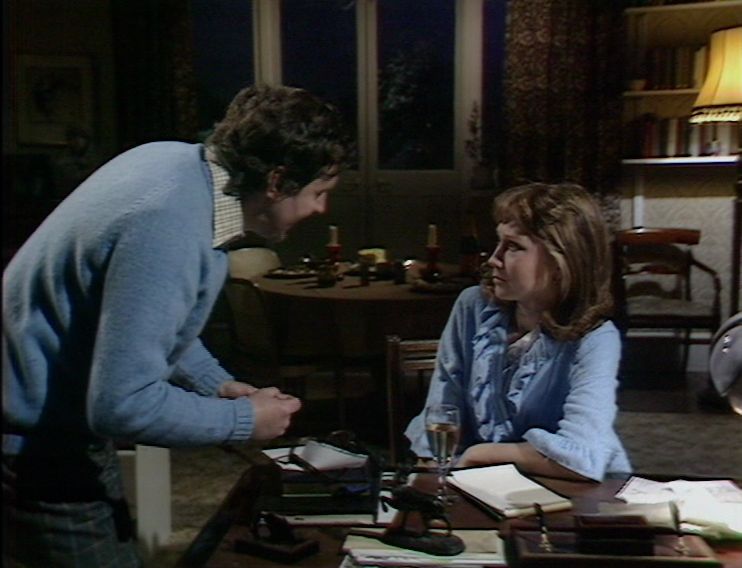
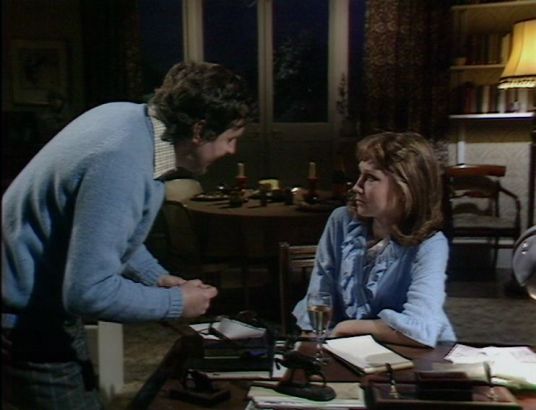
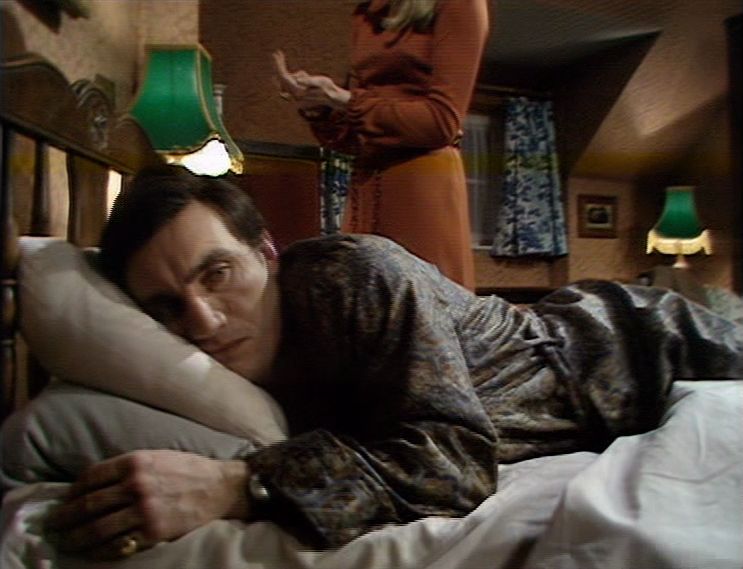
Following a serious car accident, Dr Frank Bowers (Anthony Ainley) has spent a long time convalescing in hospital.  Eventually, he’s pronounced fit, so he discharges himself and travels down to join his wife in the country.  Bowers’ wife Penny (Jennifer Hilary) has bought a cottage at Castleforge and he’s looking forward to seeing it for the first time.  But when he arrives, he’s astonished to find that Penny apparently doesn’t recognise him.  And the man she’s living with is also called Dr Frank Bowers (Bernard Brown).

Welcome Home by Moris Farhi has an interesting premise.  Anthony Ainley is very good as Bowers One, a man who appears to have found a cuckoo in his nest, whilst Bernard Brown is icily efficient as Bowers Two.

Bowers Two wants to use a new drug called DK-5 on Bowers One.  DK-5 makes the recepient very suggestable to false memories implanted by the user.  Bowers One surmises that it’s already been used on his wife and a number of other people, which has enabled Bowers Two to take his place.  But for what reason?  Bowers One considers a range of possibilities, including alien invasion.

Bowers Two produces evidence that Bowers One is actually called Peter Johnson, a psychopath who never recovered from the trauma of being scalded with hot water as a child by his father.  Bowers One does have these memories, but are they real or just implanted by Bowers Two with DK-5?

Moris Farhi drew inspiration from revelations about psychiatric experiments with mind-bending drugs that were carried out behind the Iron Curtain.  For example, he cited the reports of Vladimir Bukovsky which became public knowledge at this time.

The setup of Welcome Home is good, and Ainley is convincing as a man struggling to make anybody believe that he is who he says he is, but there’s no denying that the story doesn’t end well.  This is a pity, because up until the last five minutes or so, it’s been an intriguing mystery.  It’s just that the resolution of the mystery is far too implausible.

Next Up – The Man In My Head

The Box of Delights – Episode One – When The Wolves Were Running

box 01

Originally broadcast thirty years ago, The Box of Delights became an instant classic (it was awarded three BAFTAs in 1985 – Best Children’s Programme, Best Video Lighting and Best VTR Editing) and has remained an ever-present staple of many people’s Christmas viewing.

It was adapted by Alan Seymour from the novel published in 1935 by John Masefield.  The book was a sequel to The Midnight Folk which had been published in 1927 and also featured Kay Harker.  Other characters who return in The Box of Delights having first appeared in The Midnight Folk include Abner Brown and Sylvia Daisy Pouncer, so it’s intriguing to wonder whether the BBC ever considered adapting both novels.

Kay Harker (Devin Stanfield) is returning home for the holidays.  On the way he meets a strange Punch and Judy man, Cole Hawlings (Patrick Troughton) and two even stranger clergymen, Foxy Faced Charles (Geoffrey Larder) and Chubby Joe (Jonathan Stephens).

Both Cole Hawlings and the two clergymen seem to know a great deal about Kay.  By magic, possibly?  Quite why Charles and Joe decided to con Kay out of half a crown by playing Find the Lady (and then presumably steal his purse and watch for good measure) is a bit of a mystery.  Did Abner Brown (who we later discover employs Charles and Joe) ask them to target him or was it simply a piece of opportunistic thieving?

They also seem to have considerable powers (it’s not explicitly stated, but they appear to change from human form into wolves) and this is apparently confirmed by Cole Hawlings later, when he states that their new magic is sometimes too powerful for his old magic.

But Cole Hawlings has something they want – the Box of Delights.  It can make a Phoenix rise from a fireplace (a lovely piece of traditional animation) and also brings a photograph to life, allowing Cole Hawlings to make his escape.  This is another very impressive piece of work, particularly when the animated mule changes to a live one and then back again.  It’s easy to overlook just how tricky that would have been to achieve, especially when working with traditional animation.

Nowadays, the effects seen in The Box of Delights could no doubt be easily achieved with CGI, but there’s a certain undeniable charm about the effects they used here.  They may seem crude to some people, but they work – and thats all that matters.

Cole Hawlings tells Kay that “The wolves are running”.  He doesn’t elaborate too much on this enigmatic warning and elsewhere there are other oblique messages (delivered by an old lady with a ring who disappears at will and a mysterious man on horseback who tells Kay that “If you see someone … say someone is safe”).

At the end of the episode we get our first sight of Abner Brown (Robert Stephens).  Stephens is, from this first scene, mesmerising and remains (along with Patrick Troughton) the best thing about The Box of Delights.

Next Up – Episode Two – Where shall the ‘nighted Showman go?

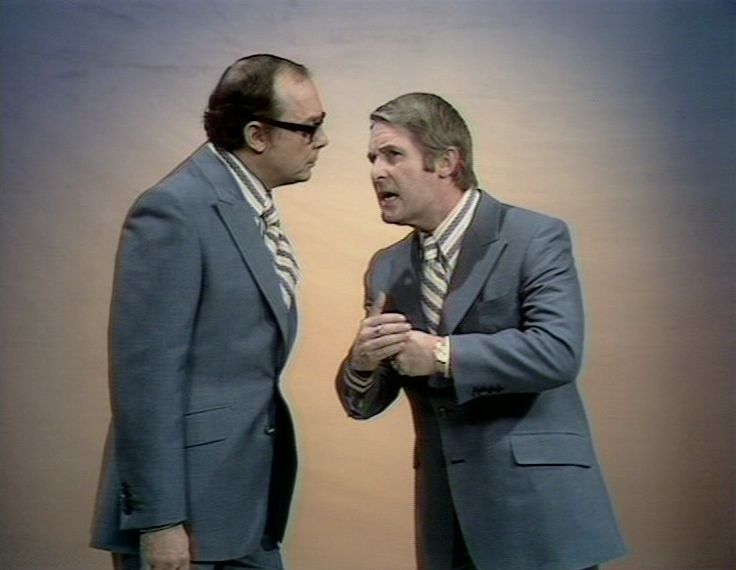
The Morecambe and Wise Christmas Show 1972

m&w 72

It’s astonishing to think that the responsibility for writing virtually all of Morecambe & Wise’s BBC shows (both the series and the Christmas specials) fell on the shoulders of one man – Eddie Braben.  Other programmes, such as The Two Ronnies, would employ numerous writers, enabling them the luxury of picking the best material from a large pool of talent.

But apart from the odd recycled sketch (such as the Grieg sketch from the 1971 Christmas Special) pretty much everything was down to Braben.  And given how well received the 1971 Christmas Show had been, the pressure was on to equal or better that.  Braben would later explain the strain this put him under.

The real pressure came when I was sat in front of that typewriter with all those blank pages and there was a deadline and there was nothing happening. That’s when you realised there were 20 million or 25 million people looking over your shoulder – all saying ‘make me laugh’.

In 1972 the pressure proved to be too much and Braben had a nervous breakdown.  Whilst he recovered, the scripting of the 1972 Christmas Special would be handled by Barry Cryer and John Junkin with Mike Craig and Lawrie Kinsley providing the Reindeer sketch and Morecambe & Wise contributing “additional material”.

It’s possible to detect right from the start just how much Braben will be missed this year.  The opening crosstalk sees Eric play a number of practical jokes on Ern (a buzzer in his hand, a flower that squirts water and a telescope that leaves a black mark around Ern’s eye) although Ern has the last laugh by presenting Eric with a present that squirts foam into his face.  It’s funny enough, but it’s difficult to imagine Braben ever writing anything like this.  One of Braben’s greatest contributions to the legacy of M&W was to change their crosstalk personas, as he would later explain –

I hadn’t liked their stage ­persona. Eric was too gormless, in my view. Ernie was too abrasive and hard-edged. Yet, at that meeting it was obvious there was genuine friendship and affection between them. There was humility and innocence, too. None of that was being shown in their work, so I reckoned if all that could be developed, it would show a different, softer side to ­Morecambe and Wise.

I came back with 30 pages of material with my vision of a new, reinvented Eric and Ernie. In a way, I was caricaturing the two men as they really were. I never told Eric and Ernie that this was really a showcase for their mutual affection, because I was afraid they might become self-conscious and spoil it. Ernie was delighted with his new role. ‘At last I’ve got something to perform,’ he told me.

Until then, Eric had always referred to Ernie as his Wellmaboy. So called because as the straight man, it was his job to draw the funny line out of Eric — ‘Well, my boy, so what happened next?’ Eric would be more worldly, but as the funnyman would still bounce off Ernie, who for years had been the archetypal straight man. Now, for the first time he would have a personality of his own — he would be a playwright; conceited, pompous, and vain.

The warmth developed by Braben is largely absent from the 1972 Christmas Show (it’s notable for example that there isn’t a flat sketch – a key Braben contribution).  But at least Kenny Ball and his Jazzmen are back, so it’s not all bad news.  The Reindeer sketch is a highlight (even if it’s recycling the dress-up idea from the previous year) with a surprise cameo from Bruce Forsyth at the end.

One area where it seems that inspiration was running low concerns the appearances of Jack Jones and Vera Lynn.  Both of their spots are identical – a chat, a song where M&W appear in the background to upstage them and then a song performed without interference.  It’s a winning formula, but to repeat it wasn’t probably the best idea.

We get two plays here – Dawn Patrol with Pete Murray and Victoria and Albert with Glenda Jackson.  Dawn Patrol would probably have been twice as funny had it been half as long.  Victoria and Albert is better, as it doesn’t outstay its welcome so much and there’s a nice song and dance at the end, ensuring that the show ends on a high.

Overall, the 1972 Christmas Show is something of a disappointment which serves to highlight just how important Eddie Braben had become to the M&W show.  Hopefully, normal service would be resumed in 1973.

The Morecambe and Wise Christmas Show 1971

m&w 71

The 1971 Morecambe and Wise Christmas Show is the one where everything came together.  Three consecutive sequences are all-time M&W classics and have been endlessly re-shown over the past four decades.

The show opens with Eric registering his appreciation of the audience. “Lovely audience. They’ve done us proud, haven’t they, the BBC. Not bad, considering they fell off the back of a lorry. I love them when they’re like this, all drunk. Beautiful”.  Eric and Ernie then discuss just how much the BBC values them.  It appears that Dick Emery is top-rated, with Ern below him and Eric right at the bottom (if the size of the tankards they receive are anything to go by).  Eric’s certainly dismayed with the size of his (“I’ve only got a little-un”).

The sight of M&W dressed as turkeys is something that lingers long in the memory.  Presumably they decided not to do a retake at the start (where Ernie almost falls over) as it would have dulled the audience’s appreciation of their initial appearance.  It’s broad stuff, but there are some good lines, such as Eric’s “I don’t fancy lying in a tin of hot fat, on me back, with a roast potato stuck between me knees”.

There’s something missing from this show – no Kenny Ball and his Jazzmen.  And frankly, Los Zafiros are no substitute.  Following that disappointment, we then move into the heart of the show.  The next thirty minutes or so (Glenda Jackson, Andre Previn, Shirley Bassey) are pretty much as good as it gets.

After Glenda indulges in some crosstalk with Eric and Ernie they launch into a big song and dance number, paying tribute to Fred Astaire and Ginger Rogers.  This initially concerns Glenda, who protests that she can’t dance a step, but she manages very well.

There’s also the chance to see some familiar BBC faces (Cliff Michelmore, Frank Bough, Eddie Waring, Patrick Moore, Michael Parkinson and Robert Dougall all make quick cameos).  By paying tribute to a song and dance act from the 1930’s, nobody could claim that Morecambe and Wise had their finger on the pulse of current trends, but frankly that’s not a problem.  There’s a timelessness to great entertainment (whether it’s M&W or Fred & Ginger).

Next up is Andre Previn conducting Greig’s Piano Concerto, soloist Eric Morecambe.  This sketch dated back to the mid 1960’s and was written by M&W’s previous writing team of Sid Green and Dick Hills.  It’s a little strange and indeed disappointing that they didn’t receive a credit for this at the end (which has led many to assume that it, like the rest of the show, had been written by Eddie Braben).

The obvious change from the original to the 1971 version is the inclusion of Andre Previn as the conductor (displacing Ernie).  This does mean that Ern has less to do, but as it’s Previn who makes the sketch so memorable, that’s unavoidable.  As is probably well known, due to his busy schedule Andre Previn was unable to take part in any rehearsals, which worried Eric who was convinced that this whole sketch (the centrepiece of the Christmas show) would be a disaster.

As it turned out, Previn had great comic timing and it’s possible to see the point at which Eric begins to relax (“Pow! He’s in. I like him. I like him”) and realise that he was going to be fine.  Another part of the sketch which works well are the shots of the orchestra in the background, who are visibly enjoying themselves as some of Eric’s lines (“Which one’s the fixer?”) clearly hit home.

Shirley Bassey’s appearance has a similar template to Nina’s appearance on the 1970 Christmas Show – a chat, a song in which her attempts to sing are sabotaged by a specially designed set which doesn’t behave and a song performed with no interference (although Nina’s was in a different order).  As M&W were masters of making rehearsed moves seem like ad-libs, it’s difficult to know if Shirley Bassey’s slapping of Ernie’s face was quite the surprise it appeared to be, but it’s a nice moment nonetheless.

Her performance of Smoke Gets In Your Eyes is another clip that’s very familiar from numerous broadcasts over the years, but it still seems as fresh as ever.  And she then gives us a cracking performance of Diamonds Are Forever.

After all that, the Robin Hood play does come as a little anti-climax, although Ann Hamilton is a winsome Maid Marion and Francis Matthews throws himself into the spirit of things as King Richard.

The 1971 Christmas Special was easily the most consistent of their BBC Christmas specials to date.  Could they equal or better it in 1972?

Out of the Unknown – Deathday

deathday

Story by Angus Hall, Adapted by Brian Hayles
Directed by Raymond Menmuir

Adam Crosse (Robert Lang) finds his life turned upside down when he discovers his wife Lydia is having an affair.  Lydia (Lynn Farleigh) is unrepentant and tells Adam that she’s not prepared to give her lover up – as he satisfies her in a way that Adam never could.

But she sees no reason for a divorce and believes that everything can carry on pretty much as before.  Her infidelity is the last straw for the mild-mannered Adam though and he brutally murders her.  He then puts his experience as a journalist to good use in order to produce the perfect alibi by creating an imaginary person called Quilter to take the blame.

Everything seems to be fine at first, Adam plays the bereaved husband very well and the police seem to be satisfied.  But then Quilter turns up ……

The only episode from the fourth series to be adapted from an existing story, Deathday was written by Angus Hall and dramatised by Brian Hayles.  It starred Robert Lang, who was one of those actors whose face and voice were instantly recognisable (even if their name might have been more of a mystery).

Rarely the leading actor in a production, he built a career out of well-played character roles.  Deathday allowed him the chance to tackle a meaty role and he certainly didn’t disappoint.  At first, the story seems like a very conventional murder mystery story as we know that Adam has murdered his wife, so the question seems to be whether or not he’ll be found out.

But as this is OOTU, there has to be some sort of weird twist – and this happens when Quilter (John Ronane) appears.  He’s someone who was created by Adam to take the blame for his wife’s murder, so how can he be here?  Further disorientating sequences (bizarre shots of naked secretaries at a weird approximation of Adam’s office) help to accentuate the feeling that he’s losing his grip on reality.

Although she only has a small part, Lynn Farleigh is perfect as Adam’s coldly practical wife who can see nothing wrong with cuckolding him.  John Ronane was an actor I was primarily aware of from Strangers, where he played a very conventional character.  Ronane is certainly not conventional here – his performance isn’t subtle, but it fits the mood of the story as events begin to run away from Adam.  Susan Glanville (as Joanne) is also effective as a woman that the newly liberated Adam picks up.  But she’s simply another step in his eventual downfall.

Deathday is a strong story, which although far removed from the SF tales which dominated the first three series, has a memorable plot and a satisfying climax.

Next Up – Welcome Home

Christmas Night with the Stars

Christmas Night with the Stars was a BBC staple, running between 1958 and 1972 (with the exception of 1961, 1965 and 1966).  The format remained the same – a familiar face would introduce specially made Christmas editions of popular BBC shows (each running for about ten minutes).

There’s several examples on YouTube.  The 1958 edition, features Tony Hancock amongst others and is introduced by David Nixon.

The 1964 edition features the likes of James Bolam & Rodney Bewes in The Likely Lads and Terry Scott & Hugh Lloyd in Hugh and I and is introduced by Jack Warner.

The Morecambe and Wise Christmas Show 1970

m&w 70

Ern’s less than delighted with Eric’s Christmas present to him – a pair of socks that Eric has just removed from his own feet.  When Ern complains that they’re still warm, Eric explains that he was airing them for him.  Ern’s present to Eric is much more impressive – a silver fob watch, although Eric isn’t pleased when he opens it up and it plays the Colonel Bogey march.

Later on, Eric plans to do something different – sawing a woman in half.  When he asks Ern to get into the box, Ern protests that he isn’t a woman, to which Eric replies, “I haven’t used the saw yet”.  Luckily, there’s a diversion – Peter Cushing turns up, still looking for his fee from his appearance as King Arthur several years ago.  It’s always a pleasure to see Cushing and they’d certainly get some mileage from this running gag over the years.  His appearance here gives Eric the chance to “saw a Peter Cushing in half”.

Kenny Ball and his Jazzmen perform Hello Dolly with a few changed lyrics welcoming Eric and Ernie back (my first thought was that this was something to do with Eric’s heart attack, but the dates don’t match so I’m not sure why Kenny changed the words).

The flat sketch features Eric cooking Christmas dinner for Ern and their guest Ann Hamilton.  Ann Hamilton was such a good utility player for M&W, able to pitch in and play a wide variety of roles over many years. There’s an interesting interview with her here.

Next, Eric and Ernie are joined by Eric Porter, much to Eric’s alarm (“A drunk’s just come on. Play it cool. Don’t worry about it”). Eventually they twig that he’s not a drunk but the famous actor Eric Porter, although Eric’s still not happy (“We don’t want him on. He was rotten the last time”). They then all perform a song and dance act, which allows Porter to demonstrate his hoofing skills. This was always one of the pleasures of the M&W show – watching familiar faces demonstrating unfamiliar skills.

Nina’s back and like Shirley Bassey the following year, she performs two songs – one straight and the other with “help” from Eric and Ernie.  She should have realised there’d be trouble when they told her they’d built a special set just for her …..

The stars keep coming, with a special appearance by John Wayne – although he looks a little different from his big screen appearances (see picture seven below).   And then a real star turns up – Edward Woodward.  It’s difficult to tell if he’s genuinely a little ill at ease or if he’s playing at being irritated – I’d assume the later, since numerous interviews over the years seemed to indicate that he had a healthy sense of humour.

He’s not come on to act though – instead he wants to sing, which he does (performing The Way You Look Tonight).  Although it’s something of a footnote to his career now, he had some success as a recording artist as well as a short-lived Thames series (The Edward Woodward Hour) where he was able to demonstrate his vocal talents.

William Franklyn joins Eric and Ernie for barely controlled chaos in the closing skit, loosely adapted from The Three Musketeers.

The 1970 Christmas Show was a step up from 1969, and the 1971 Show would be better still.

The Morecambe and Wise Christmas Show 1969

m&w 69

Compared to their later BBC Christmas shows, the 1969 Morecambe and Wise Christmas Show was a rather modest affair.  After reaching an early peak in 1971, they (together with writer Eddie Braben), obviously felt the need to try and make each successive Christmas show better than the last – with bigger production numbers, more impressive guests, etc.

But when the 1969 special was transmitted all this was in the future, so what we have here is basically an extended version of one of their normal shows.  There is a reason for this though – Eric was taken ill with flu during recording, so most of the programme was culled from material already taped for the upcoming series (this helps to explain why M&W don’t reference Christmas in their opening monologue).

But though it’s a patchwork effort, there’s still a decent roster of guests.  Fenella Fielding stars in the end play, whilst Frankie Vaughan, Nina, Sacha Distel, The Pattersons and Kenny Ball and his Jazzmen provide the music.  Five musical guests seems rather overgenerous (some are certainly better than others). For me, Nina and Kenny Ball are the pick of the musical acts.

Eddie Braben had started writing the Morecambe and Wise show in 1969, during the second series (following the departure of Sid Green and Dick Hills who had worked with M&W throughout the 1960’s up to this point).  As the second series was only four episodes long, the 1969 Christmas Show was still very early days for Braben, but many of the familiar traits were already in place.

Braben’s chief innovations were to turn Ern into a writer, giving a shape and form to the end of episode productions as well as softening the byplay between the two (the Green and Hills M&W tended to be rather more combative).

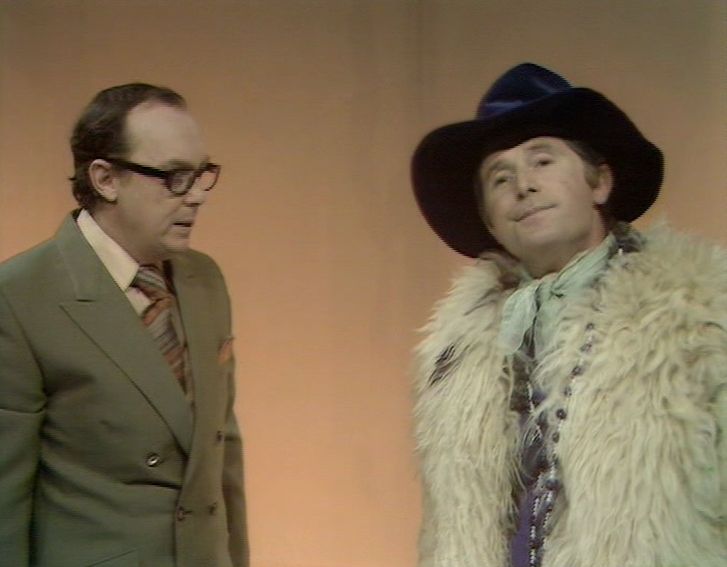
Chief pleasures in any Braben scripted M&W show always includes the opening banter and the flat sketch.  This opening sees Ern dressed in a hip and happening way.  Since by December 1969 the Swinging Sixties had run their course, he looks even more ridiculous than if he’d been dressed that way in 1967, which I presume is part of the joke (although from the modern perspective it’s possibly not as clear).

There’s plenty of great lines here as Ern tells Eric, “A couple of nights ago, I had a happening.  I freaked out in the King’s Road.  Pow!  I went to this discotheque.  I met this dolly bird and we really moved it!”.   Whilst Ern is chuntering away, Eric remains fascinated by his coat, “Does it tug when you go past a lampost?  Now, promise me one thing, Don’t ever go to the countryside wearing that coat.  If a big lusty farmer sees you, you’ve had it.  You’ll be dipped and sheared before you know where you are”. A be-wigged Diane Keen makes a brief appearance as a dollybird.

In the flat sketch, Ern is taking a bath and of course Eric has to interrupt.  Ern’s far from pleased (“You did this the last time I had a bath”) to which Eric replies, “You’ve got a good memory”.  Eric’s also impressed with Ern’s chest hair.  “By golly, aren’t you hairy?  That is hair, that, isn’t it?  Thick hair all over your body.  I wouldn’t have had a bath if I were you.  I would have got dry cleaned”.

Kenny Ball and his Jazzmen were a reguar feature on M&W’s shows dating back from their time at ATV earlier in the 1960’s and they’d continue to pop up during their BBC shows for a number of years.

The lovely Nina appears to sing Do You Know How Christmas Trees Are Grown? which had featured in that years James Bond film.  This begins a short-lived tradition (Shirley Bassey appeared on the 1971 M&W Christmas show to sing Diamonds are Forever).

Elsewhere, the ventriloquist dummy sketch is incredibly stupid, which probably explains why I like it so much.

Fenella Fielding is suitably alluring as Lady Hamilton playing opposite Ern (and Eric) as Lord Nelson.  The playlets did sometimes drag on a little (the John Thaw/Dennis Waterman one seemed to last forever) but this isn’t too bad and at least it allows Eric the opportunity to dress up as Long John Silver.

A modest start then, but the 1970 show would see the stakes raised as the Christmas shows began in earnest.

Out of the Unknown – This Body Is Mine

body

Written by John Tulley
Directed by Eric Hills

Allen Meredith (John Carson) invites his boss Jack Gregory (Jack Hedley) to his home in order to explain about his latest invention.  It’s a device that will allow minds to be swopped between bodies and Meredith and his wife Ann (Alethea Charlton) plan to put it to good use.

Ann drugs Gregory and then Meredith and Gregory swop bodies.  Once Meredith is in the body of Jack Gregory he plans to transfer a large sum of money from Gregory’s company (to recompense him for all the work he considers he’s been underpaid for).  But Meredith finds Gregory’s world is more complicated than he’d bargained for.

And Ann, who’s left at home with the personality of Jack Gregory in the body of her husband, finds that to be an intriguing combination ….

This Body Is Mine is a neat tale that boasts an impressive core cast.  It”s difficult to imagine three better players than John Carson, Jack Hedley and Alethea Charlton – and they certainly help to sell the story.  In the hands of lesser actors it possibly could have fallen a little flat, but not here.

Hedley manages to capture the indecision of someone trapped in a strange body and unsure quite how to proceed whilst Carson projects the bluff bravado of Jack Gregory perfectly.  He might be in someone else’s body, but he plans to enjoy himself, which includes availing himself of Ann Meredith.

I’ve always tended to picture Alethea Charlton with grimy characters (possibly due to her two Doctor Who appearances in An Unearthly Child and The Time Meddler) but here she’s much more upwardly mobile and Ann is the character who’s responsible for the outcome of the story.  She respects, rather than loves, her husband but she quickly comes to love Jack Gregory when he’s in the body of her husband.  And as might be expected, this isn’t going to end well for everyone.

Next up – Deathday

Out of the Unknown – To Lay A Ghost

lay

Written by Michael J. Bird
Directed by Ken Hannam

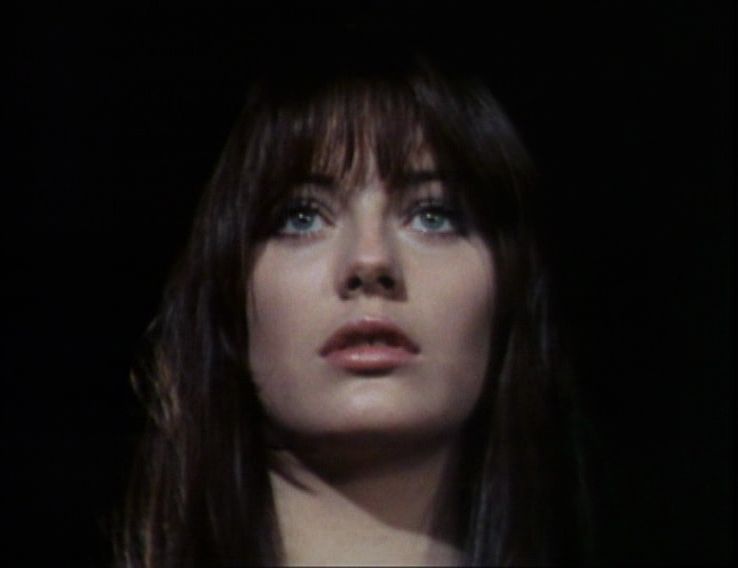
After Eric and Diana Carver move into their dream house in the country, Diana (Lesley-Anne Down) feels very happy, claiming a special connection to the place.  This pleases Eric (Iain Gregory) who is well aware of his young wife’s traumatic past.  Several years earlier, when Diana was still a schoolgirl, she was raped – and the effect of this experience is still felt very strongly by her (for example, she resists any sexual advances from Eric).

But their idyllic peace is shattered when they realise that they’re not alone.  The house is also inhabited by a ghost, which seems to have a special interest in Diana.  On several occasions Eric comes close to death at the hands of Diana (under the control of the ghost).  Paranormal specialist Dr Walter Phillimore (Peter Barkworth) is intrigued by the case, but warns Eric that both he and his wife are in danger if they remain in the house …..

The first surviving episode from the fourth and final series, To Lay A Ghost was written by Michael J. Bird, later to pen acclaimed series such as The Lotus Eaters, Who Pays The Ferryman? and The Aphrodite InheritanceTo Lay A Ghost has attracted a certain amount of notoriety over the years, and it’s not difficult to see why.

The story opens with scenes of the schoolgirl Diana being raped (although nothing graphic is seen, it’s obvious what’s happening).  Later in the story, Phillimore tells Eric that he’s been too considerate with his wife (implying that he should force himself on her).  Another implication is that the ghost (a 19th Century murderer and rapist called Thomas Hobbs) has been summoned due to Diana’s repressed desires.

This seems to be confirmed when Diana says to Eric that if he wants her to do something then he shouldn’t ask her – he should make her.  From this, Eric concludes that Diana enjoyed the rape and has subconsciously wanted it to happen again ever since.  Eric is unable to treat her roughly, so he leaves.  Diana is left alone, waiting on the bed for the ghost to appear.  Her last words are identical to those she spoke just before she was raped – which is a clear indication of what will happen to her after the credits have rolled (and explains the double-meaning of the title).

Apart from the controversial nature of the story, it’s a fairly static and underwhelming production.  The seventeen year old Lesley-Anne Down looks lovely (but is rather wooden) whilst Iain Gregory also gives a somewhat indifferent performance.  Things do pick up when Peter Barkworth appears, as he adds a touch of class to proceedings.

Whilst the ending is memorable (if somewhat questionable) the rest of the story is less engaging.  To Lay A Ghost isn’t totally without merit, but it’s certainly something that it’s difficult to imagine being broadcast on mainstream television today.

Next Up – This Body Is Mine

Doctor Who – The Feast of Steven

merry xmas

Originally transmitted – 25th December 1965

I can’t have been the only person to have the cockles of their heart warmed by the prominent sight and sound of William Hartnell in the new BBC Christmas trailer.  Of course, if they hadn’t wiped the tapes some forty years ago then we wouldn’t have had to have a shot of Hartnell from The War Machines matched up with audio from The Feast of Steven, but as it’s the season of goodwill we’ll let that pass.

That brief clip of Billy wishing everybody the compliments of the season made me think that The Feast of Steven would be an ideal addition to my Christmas television viewing.  I wouldn’t normally watch an individual episode of Doctor Who, but let’s be honest – The Feast of Steven has no connection to the rest of The Daleks’ Master Plan, so why not?

Indeed, as others have noted in the past, The Daleks’ Master Plan is a curiously constructed story.  The beginning and the end of the serial can be said to form one story, whilst the episodes in the middle are essentially The Chase Part Two.  And since it’s debatable whether The Chase was a good idea to begin with, the notion of a sequel is an interesting idea.  Within this second story, sits The Feast of Steven, an odd episode (yes, a very odd episode) all on its own – broadcast on Christmas Day 1965.

The fact it was broadcast on Christmas Day must explain the tone of the episode.  Presumably it was felt that 25 minutes of the Daleks exterminating all and sundry would be out of place – so instead we have something much lighter.  It’s difficult to believe that the original plan was to have the cast of Z Cars appear in the first section, but if they had it would have been a bizarre crossover, more in the nature of a Children in Need skit than a normal episode of Doctor Who.  But it does give us one of Hartnell’s best lines, when the Doctor describes himself as “A citizen of the Universe, and a gentleman to boot”.

After the Doctor, Steven and Sara extract themselves from the clutches of the police, the TARDIS drops them in the middle of Hollywood’s golden age, where they rub shoulders with the likes of Charlie Chaplin and Bing Crosby.  This section of the story is probably not best served by the lack of visuals (you can be sure Douglas Camfield would have had a few tricks up his sleeve).  There are a few memorable lines, though some (like Hartnell’s “Arabs”) are memorable for the wrong reasons.

And it ends with that line from the Doctor, wishing everybody at home a Happy Christmas.  A Hartnell ad-lib or something scripted? I’m not sure, but I do find it bizarre that some recons (although fortunately not the LC one below) have removed it.  This seems to be similar to snipping out the fast-talking Ogron (“no complications”) from the Day of the Daleks SE.  Don’t they know that you can’t re-write history, not one line?

Out of the Unknown – The Yellow Pill

yellow

Story by Rog Phillips, Adapted by Leon Griffiths
Directed by Michael Ferguson

Dr John Frame (Francis Matthews) is asked by Detective Inspector Slinn (Glynn Edwards) to examine Wilfred Connor (Stephen Bradley) who is accused of three murders.  Slinn isn’t sure whether the man is mad or simply the world’s best actor.

Initially it seems that Connor is in an advanced state of hallucination – he denies that he’s in Frame’s consulting room, instead he insists that both he and Frame are in a spaceship and that they’re colleagues.  Connor then states that he didn’t murder any people – instead he shot three space creatures.

Connor’s fantasy world should be easily dismissible, but Frame starts to doubt his own sanity as Connor knows things he really shouldn’t.  And when Connor tells him to take one of the yellow anti-hallucination pills (which Frame had never seen before) Frame does, with unexpected consequences.

The Yellow Pill was a short story by Rog Phillips, originally published in 1958.  It’s a fascinating tale, which asks us to consider what is fantasy and what is reality.  Leon Griffiths’ adaptation is more ambiguous than the original short story – as there’s more of a question about whether what we saw at the end was the “true” reality and if everything prior to that had been an illusion.  Phillips’ original story seemed to be clearer on that point.

The Yellow Pill is the third missing story from series three which now exists only as an off-air audio.  The audio has been matched to the available photographs from the production to produce a very decent reconstruction.  Because the majority of the story is set within one location (Dr Frame’s consulting room) and the cast is quite small, this benefits the reconstruction (a story with many locations, actors and effects would be more incomprehensible in this format).  The audio is very clear (although as with the others, there are the occasional off-microphone noises).

Whist Glynn Edwards (Slinn) and Angela Browne (Frame’s secretary and lover, Helen) both have some decent scenes, the bulk of the story is really a two-hander between Francis Matthews and Stephen Bradley.  Matthews was something of a national treasure and had a long and impressive acting career.  Bradley’s television career seems to have been much shorter (his first credit is in 1967 and his last in 1973) but they’re very much equals in this story.

Matthews gives a fine performance as someone who begins to doubt the reality of what he can see, hear and touch whilst Bradley plays his part with absolute conviction – even when handcuffed to a chair, he doesn’t deviate from the notion that he’s a man from the future.

Given the limited sets, small cast and lack of special effects, this might not be a typical OOTU, but it’s a gripping 50 minutes of drama, thanks to Francis Matthews and Stephen Bradley.

Next Up – To Lay A Ghost

K9 and Company: A Girl’s Best Friend

k9

Originally Transmitted – 28th December 1981

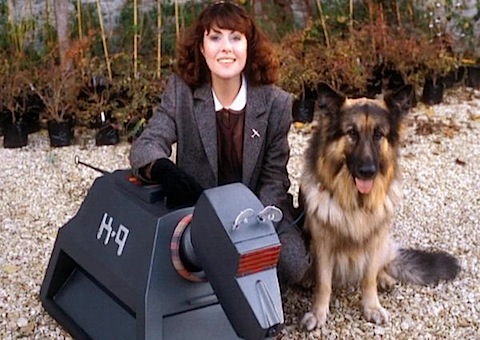
K9 and Company might be something of a guilty pleasure, but it’s a pleasure nonetheless.

When devising a spin-off series for K9, there were already two ready-made possibilities.  K9 Mk 1 was on Gallifrey with Leela, whilst K9 Mk 2 was journeying through E-Space with Romana 2.  Possibly neither Louise Jameson or Lalla Ward were interested in playing second fiddle to a tin dog, so this left the way clear for the return of Sarah-Jane Smith.

Elisabeth Sladen is, of course, the main selling point of K9 and Company.  And although we didn’t know it at the time, this was essentially the first of a two part story (the second, School Reunion, would follow a mere twenty five years later).

A Girl’s Best Friend is an odd story.  It’s full of red-herrings and innocent people acting in the most suspicious way (in order to con us into believing that they’re wrong-‘uns).  Colin Jeavons and Bill Fraser liven up proceedings with some interesting performances that teeter on the edge of credibility (and Jeavons later topples over completely).

Given that a running thread through the story is the mysterious disappeance of Aunt Lavinia, it’s a little anti-climatic to find out that nothing at all has happened to her.  And the reason why Brendan (Ian Sears) should be lined up for sacrifice is a bit vague – unless it was explained and I just drifted off for a moment.

Terence Dudley’s novelisation managed to put some more meat on the bones of the story (just likes his novelisations of Black Orchid and The Kings Demons) which proved that there was a decent tale buried here, but it just didn’t quite come over on television.

Out of the Unknown – The Little Black Bag

black bag

Story by Cyril M. Kornbluth, Adapted by Julian Bond
Directed by Eric Hills

Roger Full (Emrys Jones) used to be a doctor before he was struck off for killing a patient whilst under the influence of alcohol.  He’s still an alcoholic – but when a mysterious medical kit falls into his hands, he sees it as a way to make amends for his past misdeeds.

The black bag has accidentally travelled back in time from the far future.  It’s an amazing device, able to cure any known disease.  Roger comes to believe that it should be used for the benefit of all, although his business partner Angie (Geraldine Moffat) disagrees and their argument will have consequences for both of them …..

The Little Black Bag was written by Cyril M. Kornbluth and was originally published in 1950. Approximately twenty eight minutes of footage from this episode of OOTU exist – comprising scenes 9 – 23. There are 26 scenes in total, so both the beginning and the end of the play are sadly missing.

The material missing at the start is mainly concerned with revealing how the black bag was transported back in time. Mike (James Chase) is demonstrating a time machine that he’s built to Dr Gillis (Robert Dean) and Dr Hemingway (Dennis Bowen). After Mike leaves, the two Doctors decide to test it and place their medical kit inside. The bag duly vanishes, but then they realise they can’t get it back – and neither can Mike, since the time machine only works one way.

The missing material from the start of the story isn’t summarised on the DVD, which is a bit of a shame – although it’s fairly easy to pick up the thread of the story, as there are later scenes set in the future where they discuss the bag. Instead, the DVD version opens with a drunken Full being plied with drinks by Angie, who sees him as someone who can make her very rich.

Emrys Jones and Geraldine Moffat are centre-stage in this story and both give strong performances. Jones (who had played the Master in the Doctor Who story The Mind Robber the previous year) is convincing as a man who sees the bag as a chance to make amends for his past. Moffat contrasts nicely, as his partner who is only interested in profit (humanitarian gestures aren’t really her thing).

A brief audio clip from the closing moments of the story exists and this (together with reused video clips) have been used in order to create an ending. It’s a bit abrupt, but it does give a good idea of how the story concluded.

Next Up – The Yellow Pill

Porridge – The Desperate Hours

porridge 76

Originally Transmitted – 24th December 1976

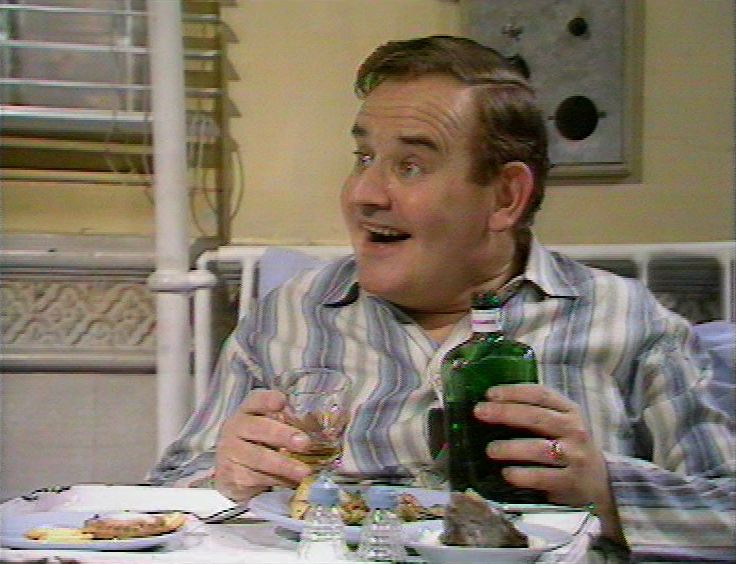
The second and final Porridge Christmas special splits rather neatly into two sections.  The first fifteen minutes or so follow Fletch and Godber’s illegal booze making activities and their attempts to interest their fellow prisoners in purchasing the fruits of their labour.  Two selections were on offer – the two-star and the five-star.  Upon sampling the five-star, Fletcher had very specific instructions.

Now, I must warn you, this should be sipped delicately like a fine liqueur.  It should not be smashed down the throat by the mugful.

Judging by their expressions, Warren, McLaren and Tulip found it powerful stuff – although quite what was in it was something of a mystery.  Next up was the two-star and Fletcher warned them that this wasn’t quite so smooth.

So go carefully, otherwise not only will you lose the flavour and the bouquet but you’ll also lose your powers of speech.

Sadly, their activities were discovered by Mackay who promptly marched them off to the Governor’s office.  The second part of the episode runs for about thirty minutes and it’s possible to believe that this was a normal episode which was expanded with the home-brew opening to produce this Christmas special.

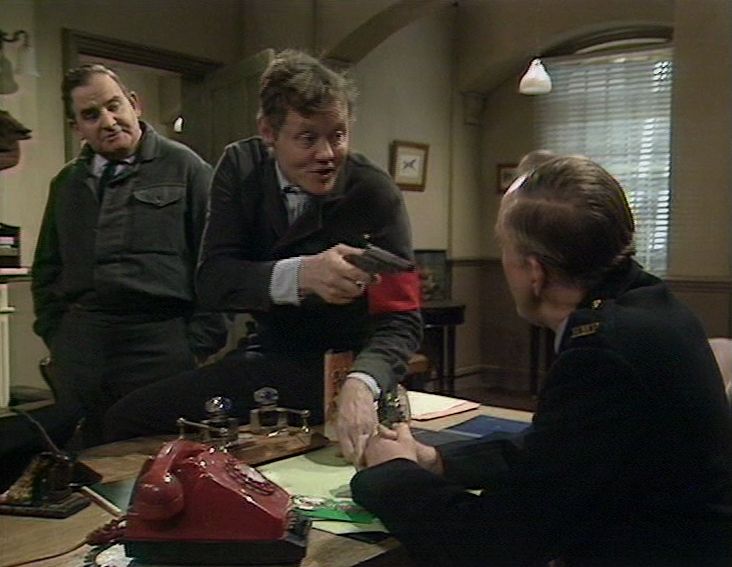
Things take an unexpected turn when the new trusty, Urwin (Dudley Sutton), takes Barrowclough, Fletcher, Godber and the Governor’s secretary (Mrs Jameson) hostage.   He has two demands for Barrowclough (“shut that blind and get me a helicopter”).  The first is easy enough, but the second is going to be more of a problem.

During the course of the siege we learn that Mr Barrowclough and Mrs Jameson are more than friends (something which Fletcher will no doubt make use of in the future) and we also discover a great deal about Urwin.  It’s a lovely performance from Sutton who really is the focus of the episode.

Urwin is a somewhat pathetic character.  Passed over for psychiatric treatment, it looks as if the system has driven him to this desperate course of action.  Eventually, Fletch is able to take his home-made gun off him (a tense and well-acted seen between Barker and Sutton).  Just prior to this, Fletch spells out to him exactly why he’s never going to make it.

There ‘aint no way.  The worst thing that could happen to you is if they say OK.  ‘Cos you know as well as I do that you’d never make it to that helicopter.  They got marksmen out there that can shoot a fly’s eyebrows off at 400 yards.  And if flies had other things they could shoot them off ‘an all.

Fletch shrugs off the admiration of Godber.  It was nothing, he says, since he knew that Unwin’s gun was a fake (it wasn’t, of course, which Fletch inadvertently demonstrates by shooting a hole in the ceiling!).

Less Christmas orientated than No Way Out, The Desperate Hours is a cracking episode, full of the usual witty banter and a fine guest turn by Dudley Sutton.

Out of the Unknown – The Naked Sun

naked

Story by Isaac Asimov, Adapted by Robert Muller
Directed by Rudolph Cartier

Earth detective Elijah Baley (Paul Maxwell) and his robot colleague R. Daneel Olivaw (David Collings) are sent to Solaria to investigate a murder.  Nothing unusual there, you may think, but Solaria is a closed community, with a deep distrust of Earth.  They also despise personal contact, preferring to communicate only by holographic projections.  And as Baley is unable to speak to anybody in person, this makes the case much harder …..

The Naked Sun by Isaac Asimov was originally published in 1957.  It was the second of Asimov’s robot novels, following the publication of The Caves of Steel in 1954.  Like the first book, The Naked Sun is a detective novel with a SF setting, so Robert Muller’s adaptation had to balance the dual themes of science fiction and detective fiction.

The taboos of the Solarian society are quite interesting, but they feel a little underdeveloped (probably due to the problems in reducing the novel down to a 50 minute television play).  The whodunnit part of the story works better, although again, given the limited time there’s not really the space to examine in detail the motives of all the possible suspects.

Paul Maxwell sounds pretty good as Bailey and the ever-reliable David Collings (last seen in Level Seven) does a decent job as Daneel, even though his part feels a little underwritten – there’s only a few occasions when the fact he’s a robot comes into play, for example.

The Naked Sun has a very strong supporting cast (Frederick Jaeger, Ronald Leigh-Hunt, Neil Hallett, Erik Chitty, amongst others) but the paucity of available photographs means that they tend to be somewhat anonymous.  Because of the lack of photos, composite images have been created (where the image of a character is overlaid onto a newly created background).  And since no pictures of certain actors (like Neil Hallett) exist from this story, headshots of them (from other productions) have been inserted into the new backgrounds.  This does mean that Hallett’s head is rather obviously perched on top of someone else’s body, which is a little distracting.

The audio isn’t too bad, although a little indistinct in places.  There are a few sections where no audio exists – so subtitles help to explain what’s happening during those parts.

Due to the lack of photographic material and the compromised audio, this is a slightly harder viewing experience than Beach Head and it’s undeniable that some of the complexity of Asimov’s original novel has had to be sacrificed in order to cut it down to a 50 minute teleplay.

Next Up – The Little Black Bag

Porridge – No Way Out

porridge 75

Originally Transmitted – 24th December 1975

Christmas is approaching in Slade Prison and Godber, for one, is getting into the spirit.  He’s encouraged by the number of cons who have congregated around the Christmas tree to sing carols, but Fletcher has to break the bad news to him.

They’re singing in order to drown out the noise of a tunnel that’s being dug in order to allow Tommy Slocombe to escape (“Yeah, that’s the big occasion around here.  It’s not the coming of our Lord, it’s the going of Tommy Slocombe”).  Genial Harry Grout (Peter Vaughan) is behind the escape, so everybody will have to play their part, as Fletcher so memorably puts it “If we are asked to assist, we are in no position to refuse are we?  Otherwise, we’ll wake up one morning and find two more things hanging on the Christmas tree.  Us”.

Fletcher plans to go away for Christmas by wangling a stay in the comfort of the prison infirmary.  But the doctor (Graham Crowden) is having none of it and packs Fletch off to the local hospital for some tests instead.  This allows somebody to slip Fletcher a package containing a blank passport, which is another piece of Grouty’s puzzle, but he still needs something else – a bicycle.  “Certainly” says Fletch.  “What colour?”.

Fletcher, Godber and Warren are able to relive the unfortunate Mr Barrowclough of his bike and Fletcher then professes ignorance when Mr Barrowclough asks him if he knows where it is (“Let’s get this straight.  You are saying that you came to work this morning as a cyclist and will be leaving as a pedestrian?”).

But all of Grouty’s plans seem to have come to naught after some petty pilfering means that the screws declare that Christmas will be cancelled.  This seems to scupper the escape plan but Fletcher has an idea.  Why don’t they let the screws discover the tunnel and whilst they’re busy congratulating themselves, Grouty can quietly spirit Slocombe away by another route?

Grouty agrees and Fletch is delegated to reveal the tunnel to Mr Mackay.  He wants to arrange that Mackay will literally drop right into it.  Unfortunately, it’s Fletcher who drops into the tunnel, right before the astonished eyes of Mackay, but this does mean that Fletch will be able to spend Christmas in the infirmary after all.

Mackay has one unanswered question and promises Fletcher a bottle of scotch if he’ll answer it.  What did they do with all the earth from the tunnel?  Fletch’s answer (“They dug another tunnel and put the earth down there”) is a killer final line.

The first of two Porridge Christmas specials, No Way Out adds another ten minutes to the normal running time, which allows for a few more gags but isn’t so long that it begins to feel drawn out.  That’s one of the problems with Christmas editions of sitcoms when they started to be produced in a 90 minute format – what works in 30 minutes doesn’t always work when extended to 90.  Thankfully, Porridge didn’t go down that route.

Harry Grout is probably the role that Peter Vaughan is most associated with, which is a little surprising when you consider that Grouty only appeared in a handful of episodes.  He is mentioned in a number of others though, so that his presence is always felt (even when he’s not actually seen).  Vaughan’s ability to play everything deadpan and calm is one of the reasons why Grouty works so well – he doesn’t have to raise his voice, just a word or a snap of his fingers will do the trick.

No Way Out is a hardy Christmas perennial, usually to be found each year on BBC2 and certainly receiving several airings on Gold.  Its familiarity might have dimmed a little of its power (and it’s difficult to rewatch it now without hearing the man with the irritating laugh in the audience) but it’s still a Christmas treat.

Out of the Unknown – Beach Head

beach

Story by Clifford D Simak, Adapted by Robert Muller
Directed by James Cellan Jones

Tom Decker (Ed Bishop) is a veteran of space exploration and at first, planet 0243/B seems to be just another regular mission.  0243/B is the 37th such planet that Decker has landed on, and on all the previous planetfalls he says that there has been “no discovery, no phenomenon, that has not had a logical or a technological cause or explanation”.

The job of Decker and his crew is to land, establish a Beach Head (a protective ring of steel) and then collect data about the planet which is then transmitted back to Earth.  But things begin to go awry after Decker starts to act oddly, which concerns Dr Jackson (Helen Downing).  Then the crew encounter a native life-form, who tells them that “You cannot leave. You will never leave. You will die here”.

Beach Head by Clifford D. Simak was originally published in 1951 as You’ll Never Go Home Again.  In many ways it works as a dark precursor of Star Trek.  Unlike Star Trek, the crew here are unable to deal with the “strange new world” which helps to highlight that the universe is a dangerous place and human intelligence won’t always win through.

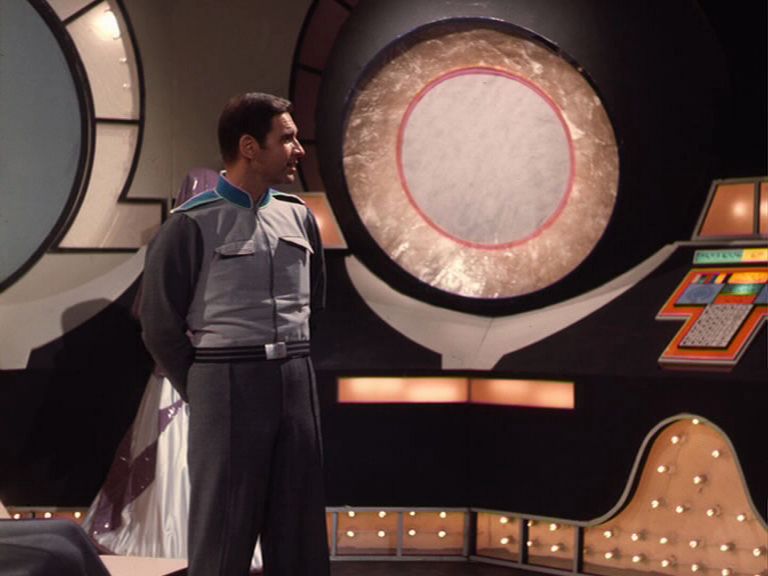
Thanks to his starring role in UFO I’ve always loved Ed Bishop and one of the chief pleasures of Beach Head is Bishop’s portrayal of Decker’s gradual disintegration.  I can’t put my hand on my heart and claim that Bishop was always the most subtle or nuanced of actors, but his performance works here, where probably a more naturalistic interpretation would have been less effective.

When the BFI announced they were releasing Out of the Unknown, it was a six disc set with no special features and no remastering.  Very quickly, they received a number of emails from people (like myself) who were pleased to hear that this classic series was finally getting an official release, but also asking if the various clips and audios which existed could be included.

The BFI were also contacted by professionals, such as members of the Restoration Team who had worked on the Classic Doctor Who DVDs (they were able to do a very decent clean-up job on the episodes).  Toby Hadoke contacted them on spec to see if they were interested in commentaries – the BFI were, and within a very short space of time Hadoke (and producer John Kelly) had pulled together an incredibly impressive list of commentators on a number of episodes.

If all this wasn’t enough (as well as a new documentary) the set includes four reconstructions of missing episodes, of which Beach Head is the first.  All four were created by Derek Handley and like all the other special features they had to be produced within a remarkably short time.

Given the time-frame, it’s a very impressive effort.  The number of publicity photographs that exist of Beach Head isn’t particularly large, so the same shots do have to be repeated again and again, but after a while the quality of the story carries you along – so this isn’t a problem.  The story also benefits from CGI work by Stuart Palmer, which helps to fill in some of the more visual sections of the soundtrack.

As for the soundtrack itself, it’s of pretty good quality.  It appears to be a microphone recording rather than direct input (so there are background noises on occasion) but given that until fairly recently it was believed that only a thirty second audio clip existed, the inclusion of a full audio is one of the many highlights of the DVD.

Whilst no recon can ever hope to totally recreate the original broadcast, Derek Handley’s reconstruction of Beach Head does give a very good impression of what it was like and whilst some people may find the reuse of stills to be a problem, it’s worth persevering with as it’s a chilling story, enlivened by Ed Bishop’s performance.

Next Up – The Naked Sun

The Good Life – Plough Your Own Furrow

plough

By 1975 John Esmonde and Bob Larby were a well-established writing team (responsible for hit series such as Please Sir!).  When creating The Good Life they started with pretty much a blank slate – they knew that Richard Briers would star (since the BBC were keen to have Briers appear in another sitcom) but everything else was up for grabs.

The first moment of inspiration came when Esmonde and Larby realised that both Briers and Larby were coming up to the age of forty – as Larby said, it was one of those “Oh God!” ages.  So it was decided that Briers’ character would be facing some mid-life crisis, but what form would this take?

Thoughts such as his character deciding to resign his job and sail around the world or live on a desert island were kicked around (though not terribly seriously) before they hit upon the idea of a man totally fed up with his job and the whole rat-race existence.  So he decides to “drop out” and become self sufficient.  This was a decent idea and the logical move would have been for him to sell his house and buy a place in the country.

But in a stroke of genius, Esmonde and Larby decided that Briers’ character (Tom Good) would do no such thing – instead his house and garden (in the middle of Surbiton) would be turned into a mini-farm, complete with animals, vegetables and all the other paraphernalia required.

With this initial concept decided, the rest of the small cast fell into place.  Felicity Kendall played Barbara, Tom’s long-suffering wife whilst Penelope Keith and Paul Eddington would be the Good’s long suffering next-door neighbours, Margo and Jerry.

Larby conceded that had Margo and Jerry simply been relentlessly negative then the series wouldn’t have worked very well.  Margo and Jerry might disapprove but they remain Tom and Barbara’s best friends and it’s the conflict between their friendship and their disapproval of the Good’s new lifestyle which drives some of the comedy along.

The first episode, Plough Your Own Furrow, is an interesting one.  It’s not wall-to-wall laughs, as there’s space when the characters (especially Tom) pause to reflect upon the course of their life so far.  Partly this may be because it was the first episode of a new series – as time went on, the audiences would become more attuned to the characters, the writing and the style of the programme and be more inclined to show their approval.

As the episode opens, we see Tom celebrating his 40th birthday.  He’s clearly a man searching for something which is, at that time, undefinable.

It’s quality of life.  That’s what I’m after.  If I could just get it right.  I’ll tackle it and get it right, as soon as I know what it is.

It’s plain that he isn’t getting any job satisfaction.   A whole host of small irritations are highlighted – such as the office car-park attendant knowing Jerry’s name, but not Tom’s (“I’ve really made an impact with you over the years, haven’t I?  Cor blimey, I’ve only been here eight years.”) and the fact there was an office cricket team but nobody thought to ask him (“We didn’t need to.  We got my dad to umpire”).

This is another indication that Tom is standing still at best or even moving backwards.  Everybody else in his department is in their twenties, so what does the future hold for Tom?  Jerry joined the company at the same time as Tom, but he’s ascended to the executive level whilst Tom remains stuck on the fourth floor, engaged in vital work such as designing a toy hippo to be included as a free gift in a popular brand of breakfast cereal.

Jerry spells it out to Tom.

We joined this company – what, eight years ago, wasn’t it it?  And do you know something?  I was frightened of you then.  You were a better draughtsman than I was and you had better qualifications than mine.  I was going to have to rely on pure cunning just to keep up with you.  Still, I needn’t have bothered, need I?  Cos look at us.  I’m up here and you’re down there, not getting picked for cricket teams.  And why?  Because you use about one tenth of your ability.  I have to use all mine and what I lack I make up with sheer, bloody crawling.

Then Sir (Reginald Marsh) joins Tom and Jerry (every time I type their names I assume that Esmonde and Larby picked those names as a tribute to a popular cat and mouse partnership) for a chat about his latest top-secret project.

The bubble has just come off the top of the think-tank and I don’t mind telling you that this is an absolute blockbuster of an idea.  It’s going to put our wildlife preservation series in the vanguard of world mouldings.  Our mould is going to be a giraffe! And Tom, I’m thinking of putting this giraffe on your plate.

Tom has the chance to advance his career with some “bloody crawling” but his hysterical laughter at the giraffe news scuppers this.  This is point when Tom finally realises the futility of his job (“You should have heard Sir.  You’d think he’d invented penicillin.  I couldn’t help laughing”).  There has to be more to life, but what?  Then Tom has a lightbulb moment, which he explains to Barbara.

I quit work and we become as damned near self-sufficient as possible.  We’ve got bags of garden, we grown our own food.  We keep some animals, chickens, a pig.  We produce our own energy, recycle rubbish.  We design the things we need.  I’ll show you what being a draughtsman is really all about.  Now , some things we can’t make, right.  Some things we can’t grow, right.  So we flog our surplus and buy stuff, and that’s without good old Medieval barter.  It’ll be damned hard work.  We won’t have much in the way of mod cons, but we might enjoy discovering what we can do without.  And we won’t need the world and his wife to give us the yea or nay.  It’ll be just us, doing it for us.  What do you think, eh?

This monologue is the essence of the series.  And Barbara’s reaction is interesting.  The camera cuts back to her on several occasions and her expression is, at best, neutral.  As it would have been incredibly unrealistic for her to instantly agree, even though it’s the middle of the night she puts on her wellies and walks up and down the garden until she finally decides that yes, they’ll do it.

This naturally results in a celebration – and as they dance in the fishpond the noise wakes up the Ledbetters next door.  We see Jerry, but only hear Margo (in this episode we don’t see Penelope Keith).  And the next morning Tom has been up good and early.  He’s sold his car and bought a plough, so he can start on the back garden and take the first step on the road to self-sufficiency.
Out of the Unknown – The Last Lonely Man

last

Story by John Brunner, Adapted by Jeremy Paul
Directed by Douglas Camfield

In the future, death no longer holds the same fear that it used to.  Now when people die, their personality and life experience are automatically transferred into the mind of a nominated host.  James Hale (George Cole) is a devoted family man with a wife and two children who’s already become the host of his late father’s personality (which he sometimes has to battle against) and he’s a staunch advocate of the process – known as Contact.

So when he meets Patrick Wilson (Peter Halliday) in a bar and learns that Patrick doesn’t have Contact with anyone he agrees to “take him on until he can can get fixed up with a friend”.  But soon it transpires that Patrick has had Contact with many people – all of whom terminated their link once they became aware of exactly what sort of person he was.  James attempts to do the same, but he’s too late – Patrick shoots himself and all of his thoughts are instantly transferred to James, who starts to act in a very uncharacteristic manner …..

The Last Lonely Man by John Brunner was originally published in 1964.  It was the second story by Brunner to be adapted for OOTU (following Some Lapse of Time from series one).  The Last Lonely Man is certainly the lesser of the two tales, as whilst it has an interesting premise the logical flaws are very apparent.

It is addressed in the story, but the notion of people inheriting multiple personalities is a bizarre one.  It must surely lead to schizophrenia or as in James’ case, we see his warm and friendly personality submerged by the less attractive characteristics of Patrick.  That’s the crux of the story, but his experience can hardly be an isolated case, can it?

There’s another odd scene where James and his wife Rowena (June Barry) go the cinema to see a film which was made in pre-Contact days.  Everybody (including James and Rowena) roar with laughter at the scenes of people dying – presumably because their thoughts wouldn’t be transferred to somebody else.  This just rings false – it’s difficult to accept that people’s personalities would change so much that they’d find death to be amusing.  There seems to be a satirical point that’s being made, but it doesn’t come over that well.

The Last Lonely Man was directed by Douglas Camfield, one of British television’s finest television directors between the mid 1960’s and the mid 1980’s.  But apart from a very striking opening sequence shot on film where we see a couple killed in a car accident (which we later learn was a government information film) there’s not a great deal of opportunity for Camfield to produce anything that noteworthy.

The rest of the story is studio-bound and fairly low-budget (the Contact machine looks uncomfortably like a hairdryer, for example) so it’s pretty much rescued by the cast.  George Cole (already a familiar face from films and television but still a decade away from his career-defining role in Minder) gives a fine performance as a decent, family man whose only mistake is to try and help someone.

Peter Halliday (cast a year earlier by Camfield in the Doctor Who story The Invasion) does play broader, but given that there had to be a clear divide between James and Patrick that’s reasonable enough.

Although the story doesn’t make much sense, it’s still worth a look for Cole’s performance.  However, given the range of stories that were made during the third series, it’s a bit of a shame that this is the only one to exist in its entirety.

Next Up – Beach Head