The attempt to establish a permanent Outdoor Centre picks up a little pace in this episode. Mr Hopwood has found the perfect place (the pupils already visited there in episode three). The owner of the property was impressed by the way the pupils helped to put out the fire during their last visit (although if he knew they were responsible for starting it in the first place he may not have been quite so understanding!)
But since he remains in ignorance, he’s happy to let the property for a nominal fee for the next year – provided the school can find the money to repair the derelict building. This, of course, is where the problems begin. Funds for extra-curricular activities have always been difficult to come by – and the early 1980’s was an especially cash-fraught time. Mr Keating, deputising for the (by now always) absent Mr Llewellyn doesn’t dismiss the plan out of hand, but it’s obviously going to be a considerable struggle to bring these plans to fruition.
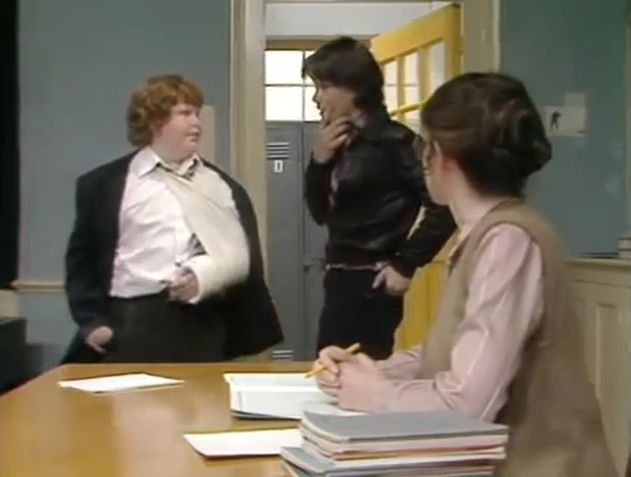
The main part of the episode revolves around Pogo’s money-making plan to establish his own school tuck shop (since the official one still hasn’t been approved). This does mean turning his mother’s kitchen upside down in order to keep making all the cakes he needs in order to fulfill his orders. When poor Mrs Patterson surveys the mess she says that whilst she was happy for him to make a few cakes she didn’t realise he’d be attempting to rival Mr Kipling!
Pogo and Duane’s free enterprise did have the tacit approval of Mr Sutcliffe, who was also a willing customer. In fact, the original clamour for alternative food arose after Mr Sutcliffe blocked Mr Garfield from arranging the tables in the canteen for lunch. Mr Sutcliffe was taking a drama class at the time and didn’t understand why the caretaker had to disrupt his class when it was only mid-morning. Mr Garfield, being the inflexible man he is, was happy to walk away and do it later – though this meant delaying the start of lunch and thereby creating a whole group of willing customers for the few cakes that Pogo and his friends already had on them (which they made earlier on in their cookery class).
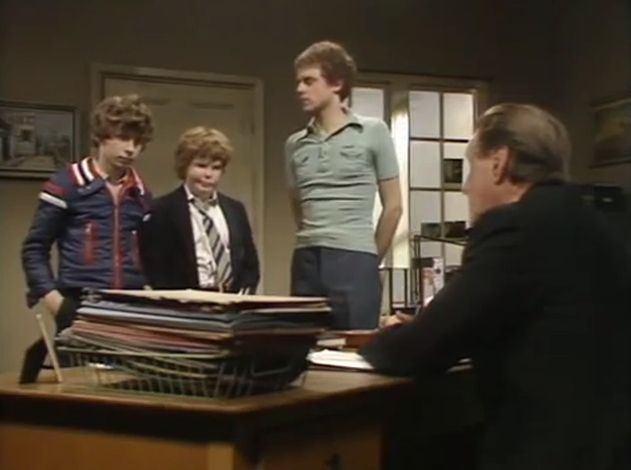
Sadly, Pogo’s tuck shop comes to an ignominious end after Mr Keating becomes aware of it. He starts by giving a dressing down to Mr Sutcliffe, who he says should really have known better, but then he has some good news. The school tuck shop will be going ahead – and Mr Sutcliffe, Pogo and Duane seem like the ideal people to help run it (they’re clearly not in a position to refuse).
And Mr Keating also has some not-so good news for Pogo and Duane – a series of detentions as well as an essay to be written by them entitled “the problems of private enterprise in an authoritarian society”!
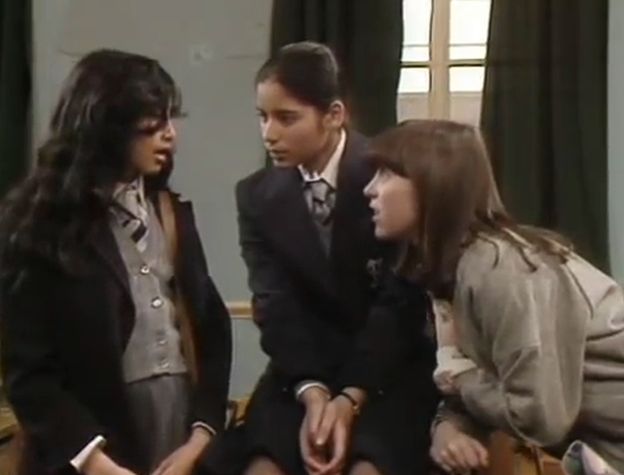
A new girl, Fatima Bibi (Belgit Gill), is placed in the care of Sudhanami Patel (Sheila Chandra). This seems to be because Fatima doesn’t speak any English and the assumption appears to be that Sudhanami will be able to communicate with her.
But it becomes clear very quickly that Sudhanami isn’t going to make any headway. Mrs Conrad (Margaret Stallard), the teacher responsible for working with pupils who need to increase their English language skills, is quick to grasp the gulf between Fatima and Sudhanami. Sudhanami comes from Uganda and Fatima hails from East Pakistan. The unconscious racism on the part of the other members of staff who’d obviously assumed they’d be able to communicate is never directly commented upon, but is clear enough.
Grange Hill has, from the first episode, been a multi-cultural school, but it’s rarely something that’s been a central part of any ongoing story. True, Benny did receive taunts about the colour of his skin in some of the early episodes, but he was also bullied because his family was poor. This episode is therefore notable since it attempts to deal with two thorny topics at once – the problems of how those newly arrived (like Fatima) integrate into British society but also how the people already established (like Sudhanami and her family) adapt to the culture around them.
Fatima is a one-shot character and won’t be seen again after this episode. This it’s a bit of a shame, since there would have been some mileage in showing her develop. But Sudhanami does remain a semi-regular for a while (up until the end of series four). She’s rarely central though, so this is really the one episode where she moves to the heart of the story.
Her father, Mr Patel (Minoo Golvala), wants to transfer her to an all girls school. He seems to be almost a caricature of a traditional Indian father – he hates the fact that she goes to school with boys, listens to pop music, etc. All this does rather beg the question as to why he allowed her to go to Grange Hill in the first place.
Although a strict traditionalist (he expects her to help in the shop and is reluctant to allow her to spend time with her friends outside of school hours) it’s clear that he does genuinely love her and has (or at least he believes he has) her best interests at heart. As for Sudhanami herself, she’s somewhat submissive and is happy to follow her father’s directions. If he decrees that she will take part in an arranged marriage sometime in the future, then that’s what will happen.
This may be an accurate, although not terribly progressive, portrait of the times – but it’s notable that as the series progresses we’ll tend to see children who will be much less prepared to toe the family line. Instead they’ll be keen to embrace all that Western culture can offer, irrespective of what their parents may say.
Although this is a fairly serious episode, there are a few lighter moments. Trisha and Cathy are aghast to find that Miss Mooney and Mr Sutcliffe are engaged – Cathy earlier remarked that Mr Sutcliffe “wouldn’t marry a thing like that”! Trisha and Cathy also attempt to teach Fatima some useful phrases such as “Flippin’ ‘eck” and “Shut yer mouth”.
Tucker’s artistic flair is put to good use again when he designs a cut-out figure for the school fair. The teachers line up to put their heads through the opening and have to suffer wet sponges being thrown at them. It’s all for a good cause, so they can’t complain, and naturally the pupils are delighted for the chance to take their revenge – especially on Mr Baxter!
The bicycle thefts are still continuing. Pogo decides to take the law into his own hands and organises a watch on the bike sheds (inevitably he ends up getting caught by Mr Garfield). Meanwhile, the girls are pursuing a more fruitful line of enquiry – they decide to visit the bike shop on the high street to see if any of their bikes are there.
Their presence is enough to spook the shop owner (who, as we have seen, has been receiving the stolen bikes) and it eventually sets in motion the chain of events which leads to the bike thieves and Madelin Tanner getting caught.
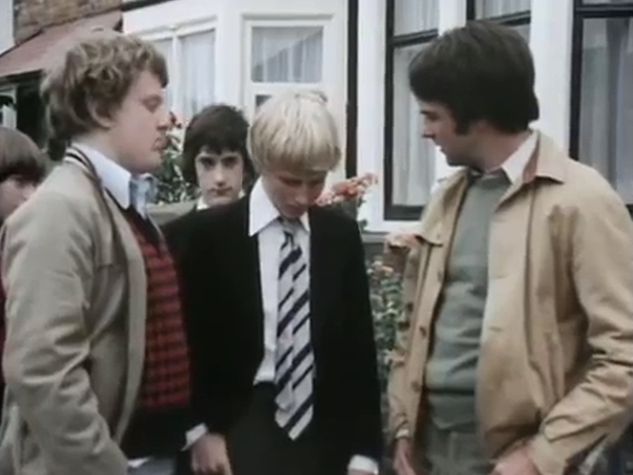
This takes place via a lovely film sequence. Tucker and his friends, with Mr Baxter, are returning from a cross country run whilst Pogo and his classmates are also returning to the school from the opposite direction (after a field trip to the local park). Spotting Tanner and one of the thieves (although they weren’t actually in possession of a stolen bike at the time, so it’s difficult to see what actual evidence could have been used to convict them) the two groups of children converge on the hapless pair.
Tucker manhandles Madelin Tanner, whilst Mr Baxter rugby-tackes the man and realises that he’s an ex-pupil. This would be Lesley Woods’ seventh and final appearance as Madelin Tanner and apart from three uncredited appearances on the Benny Hill Show she doesn’t appear to have made any further film or television appearances.
This episode is the first indication that the theft of Duane’s bike wasn’t an isolated incident. David Mitchell (Michael Mannion) proudly shows the others his new bike. It’s not actually brand-new – it was bought second-hand from a local bike shop – but it does look as good as new.
Duane is initially impressed, although he’s perturbed when he spots a familiar looking dent. The early evidence would indicate that the shop is receiving the stolen bikes, respraying and customising them, then selling them on. It seems rather foolish to sell the stolen bikes in the same area (and indeed this is a point made by the shop owner in the next episode – concerned that the bikes he’s receiving are local) but if they had been sent further afield then the plot couldn’t have been wrapped up so quickly.
It turns out that Madelin Tanner is involved, helping the thieves to steal the bikes. Although quite why they need her help isn’t clear, since all the bikes are parked in the bike shed and are ripe for the picking – even the ones with chains.
This is quite a busy episode, as apart from setting in motion the bike plot (which will be concluded in the next episode) we’re also introduced to Chris (Jonathan Warren) , the editor of the school magazine. He’s chairing a meeting with Mr Curtis who although he’s keen to stress that the school magazine is very much the pupil’s responsibility, still wants to see everything due for publication before the magazine is sent to the printers.
Naturally this doesn’t go down very well and cries of censorship are heard. It’s interesting that the school magazine appears to have been going for a while and was originally set up by the pupils with no staff interference or involvement. Quite how this happened is a bit of a mystery (presumably it can be explained as one of Mr Llewellyn’s more progressive policies) but now the staff are keen to ensure that no embarrassing material makes it into the public domain. We’ll come back to this story-line later in the series.
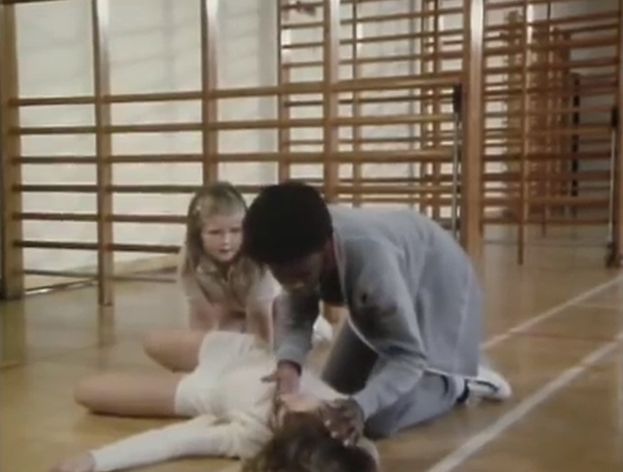
Lastly, Sally is taken ill during Miss Peterson’s gym class and rumours (spread by the irresponsible Anita) state that she’s dead. It’s been threaded through the early episodes that Sally hasn’t been well, so her fall from the gym bars doesn’t come as a complete surprise. Just prior to her accident, the soundtrack switches to an ominous heartbeat – it’s a familiar dramatic device, but even though it’s a bit of a cliche it still works well.
The question is, was Miss Peterson responsible? We’ve already seen that she pushes the girls hard – she doesn’t accept any excuses for non-participation in games (telling them that she expects them to still join in even if they have a broken leg!). This doesn’t please the games-shy Anita (Joanne Boakes) who mutters that she’ll tell her Gran about this (which seems to be her stock response to almost everything).
Happily, Sally turns out to be fine and we find out in the next episode that she has a weak heart which meant that an attack could have happened at any time and therefore Miss Peterson wasn’t to blame. And now that her plot-line is concluded, Sally vanishes, never to be seen again. Not an uncommon occurrence in Grange Hill (think of Simon Shaw from series two).
We also get our first look at Jill Harcourt (Alex Kingston) although she’s very much in the background here and won’t emerge into prominence until later in the series, when she starts menacing Susi to complete her homework.
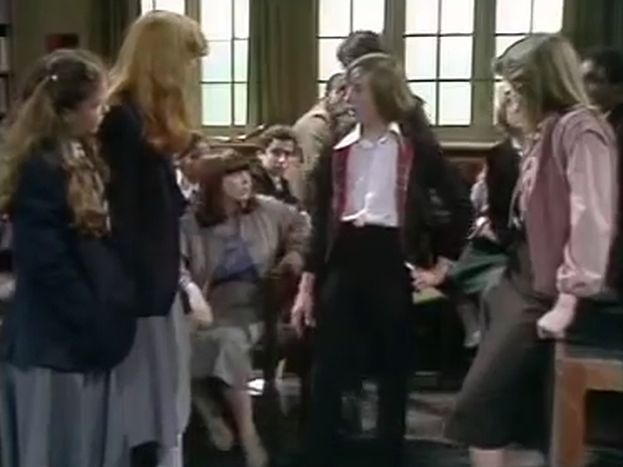
It’s time for the school council elections. Penny Lewis is the current rep but some people, like Trisha and Doyle, aren’t happy with her. Trisha and Penny are totally opposite characters – which brings a healthy dose of conflict into their relationship.
Trisha and Cathy are irritated about having nowhere to go during the lunch-breaks, so that’s one of the reasons why Trisha decides to stand as a council rep. If elected, she’ll request that the third-formers have access to common rooms, like the fifth-formers.
Doyle later makes the reasonable point to Miss Peterson that since there’s more girls than boys, any boy rep doesn’t stand much of a chance of getting elected. Miss Peterson counters that surely sex wouldn’t be the first consideration, whilst Trisha mutters that it’s all the boys ever think about!
But Doyle’s in the right place at the right time, as it’s been decided that having both male and female reps in each year would be fair. Doyle is elected third year boy rep (much to the disgust of Penny) whilst both Penny and Trisha are beaten by an unknown outsider. All of Doyle’s policies are good – they should be, since they were pilfered from both Penny and Trisha.
Before the results come in, there’s an epic fight between Penny and Trisha (Penny calls Trisha “a nasty two-faced bitch” which kicks off proceedings). Tucker has nothing to do whilst the argument between Penny and Trisha is bubbling away – but Todd Carty’s facial expressions are a delight and he goes a long way to stealing the scene.
Doyle’s victory will continue to rankle with Penny for the rest of series three, which makes it a fruitful source of conflict between the pair of them.
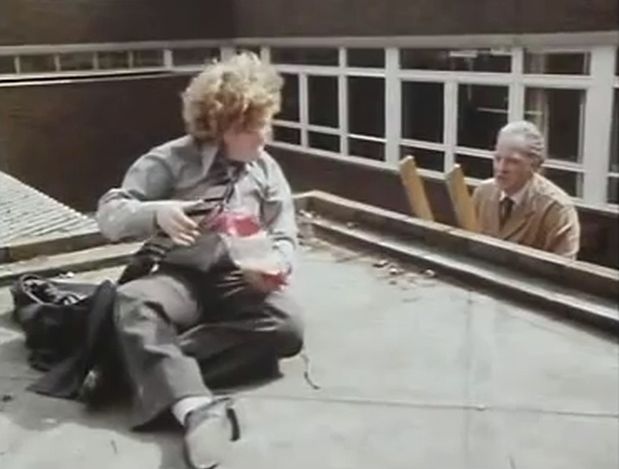
Elsewhere, Miss Mooney appears to be the worst possible science teacher. She finds herself distracted by the loss of her glasses (which were on her head all the time). Whilst she’s fretting about her glasses, there’s a small fire, which Tucker manages to put out. He’s later berated for this – yes he did put the fire out, but he started it in the first place! This seems a little unfair, as it was an accident, and if the pupils aren’t adequately supervised surely some of the blame should rest with the teacher.
Mr Hopwood (Brian Capron) makes his first appearance in this episode. Like Mr Sutcliffe, he’s a teacher who’s got the best interests of the children at heart – although he’s clearly no pushover. In his first scene he berates Andrew and Alan for giving Justin the birthday bumps, but after he’s done this he casually tells the class it’s far too nice a day to stay inside and suggests they might as well go for a walk.
They venture out to a piece of wasteland where, as part of their environmental studies, they look at the local wildlife. Alan nips off for a cigarette – which is the start of a long-running storyline that continues well into the fourth series. Since this brief ramble was a success, Penny and Susi ask Mr Hopwood if they can venture out into the proper countryside. Mr Hopwood agrees, so next week the trip goes ahead.
Naturally enough it doesn’t all go smoothly – Justin steps in a cowpat and Alan and Andrew cause a fire. Alan and Andrew head off into the forest to have a cigarette, but unluckily for them Penny and Susi are also there. Susi’s been complaining about her new bra, so Penny suggests they go somewhere quiet where she can look at it.
A comedy of embarrassing errors then occurs as the girls realise that they’re being inadvertently spied upon and the boys beat a hasty retreat – not knowing that their dropped cigarette was smouldering. It’s another example of Grange Hill’s moral tone – as the message is clearly spelt out that just one cigarette could quickly cause a blaze which might spiral out of control. But there’s a positive solution as the pupils rally round to help to put out the fire.
Susi, Penny, Alan and Andrew come to an understanding – the boys won’t tell anybody about Susi’s bra problems if they promise not to reveal how the fire started. Given how the relationship develops between Susi and Alan, it’s interesting that this episode ends with a glance between Susi and Andrew – hinting that there might be the spark (no pun intended) of attraction between the pair of them.
Tracey asks Duane how his father reacted to the loss of his bike. When he turns around she can clearly see – he’s sporting a black eye. Today this would have been developed as a major plot point, but here it’s just a fact and isn’t followed up. It’s not the first time during the early series that children either fear, or receive, domestic abuse from their parents. And as we’ll see later in this series, some of the teachers are also quite handy as well. It’s one of the clearest examples of how times have changed.
When the first year head Mr Curtis (Neville Barber) spots Duane’s black eye he asks how he came by it. When Duane tells him, all he does is sigh and lets the boy leave. He then shakes his head sadly at Miss Mooney and the matter is closed.
The friendship between Tracey and Duane is put under strain. Tracey finds herself teased by Karen, taunting her that Duane’s her boyfriend, whilst Duane becomes friendly (after a shaky start) with Pogo. We also see the first signs of Pogo’s acquisitive nature – he sees putty in the windows and decides to take it. The downside of this is that it makes the new windows fall out!
Whilst Tracey and Duane had been friends at primary school, different interests now push them into different directions – and eventually Duane will team up with Pogo whilst Tracey and Karen will become best friends.
At present, Karen is also friendly with Sally Forsyth (Sarah Summerfield). She’s complained of feeling ill and faint several times – this is another example of seeding a plot-point which will only come to fruition in a later episode.
The putty pilfering comes to an end after Mr Curtis impresses on everyone how dangerous it can be. But it’s put to good use by defacing the pictures of the teachers on the notice board. Mr Baxter, for example, is given a very fetching set of horns!
It’s the start of a new school year and Grange Hill is preparing itself for an influx of fresh first years. Mr Sutcliffe has spent hours going around the school putting up signs to help the newcomers, but unfortunately things don’t quite go to plan.
As with the notices seen in the very first episode, the arrows can be moved in the opposite direction – and Cathy does so here. When will people learn that it’s a much better idea to draw the arrows on! Mr Sutcliffe also attracts the ire of Mr Garfield and his colleague – since all the notices (affixed with sellotape) have damaged the walls. This allows Mr Sutcliffe to make some forceable points to both of the caretakers, about how a school exists to serve the interests of the pupils (leaving you with the feeling that all school caretakers would much prefer it if there were no children about …)
Amongst the influx of new arrivals are Michael Green (Mark Bishop) and Karen Stanton (Carey Born). Both are escorted to school by their older brothers, Benny and Andrew – but once they arrive things are very different. Andrew is overprotective to a ridiculous degree, which irritates the independent Karen no end, whilst Benny leaves the overawed Michael very much to his own devices.
The other main characters in the first form are Duane Orpington (Mark Baxter), Tracey Edwards (Amanda Mealing) and Douglas “Pogo” Patterson (Peter Moran). Out of this crop of newcomers, only Pogo and Duane would reach the fifth form – poor Karen and Tracey don’t even manage to make it to the second half of this school year!
This was a common problem during the series’ entire run – children would drop out for various reasons (exams, etc) and replacements would have to be drafted in. In series four, it’s clear to see that Tracey’s place was taken by Clare Scott (both of them were friends with Duane, for example) whilst Karen was replaced by Suzanne Ross.
On the teacher front, Miss Peterson (Cheryl Branker) attracts some casual racist comments from Doyle, although he’s wise enough to make them just out of her earshot. Our first sight of Miss Mooney – dropping a pile of textbooks with an annoyed comment of “bother” – is a characteristic introduction to someone who always seems slightly disorganised, but is also a first-rate teacher who cares for her pupils.
Since the first two series covered one school year, series three and four cover another – and in the gap between the second and third series the original influx of pupils have moved from the first form to the third. The only time this gap doesn’t quite work is when Trisha asks Sudhanami Patel (Sheila Chandra) why she’s still wearing school uniform, since it’s now been made optional. She’s had a whole (unseen) year to ask that question!
The theft of Duane’s bike seems to be an isolated incident, but we’ll see that the bike thefts become a running theme through the early episodes – culminating in Madelin Tanner receiving her long-awaited comeuppance.
Following his threat in the last episode, Abner Brown now seems determined to stop Tatchester Cathedral celebrating its Thousandth Christmas Midnight Service. He gains nothing from doing this, but since he seems fated not to have the Box of Delights it’s one way of getting a measure of revenge. Later, he decides to flood the dungeons when it’s clear he’s lost completely – which is the final sign that his grip on reality has gone.
He dispatches two creatures of the night (both created very nicely with traditional animation and mixed well into the picture) to prevent anybody getting to Tatchester – by road, rail or air.
Abner and Cole Hawlings face off. It’s at this point that Abner realises he’ll never possess the Box and so he decides to take everybody with him (by flooding the dungeons). Hawlings and Kay manage to escape and find Peter, Caroline Louisa and the Bishop along the way.
It has to be said, it’s a mystery why Cole Hawlings allowed himself to stay locked up for so long. He was able to create a key from nothing more than a piece of card and a stub of pencil, not to mention turning his hat into a motorboat – so maybe he just liked the underground ambiance?
Abner Brown’s final moments (as he sinks beneath the cold, dark water) is nicely shot and accompanied by a musical sting from Roger Limb that sounds not unlike the music he composed for Revelation of the Daleks the following year.
So, all’s well that ends well. Thanks to Herne the Hunter and the old lady everybody gets to the Cathedral in time for the service. After the adventure, this gives us time to catch our breaths – and it’s suitably Chrissmassy. It’s even more impressive when you realise that the service was shot during the day and at the height of summer, with black paper over the windows to hide the sunlight!
Not everybody is in favour of the ending, but it’s as good a way as any to conclude the story and bring Kay back to reality.
Thirty years on, The Box of Delights is still as enjoyable as ever. Whilst the production does occasionally overreach (particularly with the CSO effects) so much is right (the animation, the music and especially the actors) that it seems churlish to complain. It’s always a Christmas treat.
Beware of Yesterday is where we really see Abner Brown begin to lose his grip on reality. His obsession with finding the Box has driven the plot so far, but now even loyal henchman like Joe are beginning to question why he’s scrobbled so many clergymen (not to mention choirboys). Joe then mentions to Abner that the Church at Tatchester is due to celebrate the Thousandth Christmas Midnight Service this year and all the disappearances have stirred up a great deal of publicity. But Abner will brook no compromise –
If the Box is not delivered to me by midnight tonight, I will stop their precious ceremony if it’s the last thing I do!
Robert Stephens is gloriously deranged throughout the episode, whether he’s ranting at Joe or counting his jewels and debating whether to leave everybody (including Sylvia) behind. As I’ve mentioned before, it’s such a wonderful pantomimic performance (apt for the time of year) that really makes the story zing. I also love the idea that his alter-ego, the Reverend Boddledale leaves to deliver his Christmas lecture to the pensioners. It would have been lovely to see that!
Apart from showing us Abner’s continuing fruitless searches for the Box, the other major plot-thread concerns Kay’s quest to find a solution. The Inspector is still no use – he refuses to believe that the Reverend Boddledale (a man he knows well) could possibly be a criminal – considering Kay’s continual accusations to be nothing more than an “hobsession”. So Kay decides to try and find Arnold of Todi.
This won’t be easy – as Arnold is stranded somewhere back in time. Herne agrees to send an image of Kay (which will cast no shadow) back – and there’s a possibility that he will be able to return to the present unscathed, although there’s no guarantee.
Although Kay shouldn’t cast a shadow he clearly does (but then it would have been impossible to totally remove it) and he is successful in finding Arnold (Philip Locke) who lives in a fairly unconvincing world of CSO. It wasn’t uncommon for productions from the 1970’s and 1980’s to somewhat overdose on what CSO could do (and as we can see here, clearly couldn’t) and The Box of Delights certainly used CSO to the limit.
Kay wants Arnold to take the Box back into the past (despite the fact we’ve been told several times that it’s impossible to do so). Arnold’s not interested, so this whole sequence doesn’t really go anywhere (and could easily have been excised).
Kay does make it back in one piece and returns to spy on Abner. But he loses the Box – which is a problem since he’s reduced himself to only an inch in height. Abner has problems too – Charles, Joe and Sylvia are convinced that he’s going to double-cross them, so they decide to double-cross him first.
Next Up – Episode Six – Leave us not Little, nor yet Dark
Maria’s back – and she has a strange story to tell. She was scrobbled by Abner and his gang and offered the chance to join them. But Maria had a pretty low opinion of them and refused. Abner then asked her if she knew anything about the Box.
Although Maria denied any knowledge, Abner wasn’t convinced. Sylvia then had a suggestion. “You can soon find out if she’s telling the truth! Put her in the scrounger! You know what the scrounger is, my dear. We put you in it, and it has a thing in it that goes round and round. That is the scrounger. And presently you come out as dog biscuit”.
Maria’s interrogation is shot very nicely. The cell is quite small, with two barred windows (one either side) high up Sylvia appears first, on the one side and after a few minutes of fruitless questioning Abner appears at the other window (“Ladies, ladies! Do let us have unity”).
The list of Abner’s captives is growing – Cole Hawlings, Caroline Louisa, the Bishop and other assorted clergymen – so it’s somewhat strange that he then allows Maria to go free. In story terms it makes sense, since she has to return to the others to tell them what she knows, but it does somewhat dent Abner’s reputation as a criminal mastermind. Still, Peter gets scrobbled later on – so it’s a fair swop, I guess.
As this is the fourth episode of a six part serial, the story can’t really advance too far – therefore this installment has to mark time somewhat. But the last few minutes do fill in some of the back-story of Arnold of Todi (the original owner of the Box) and Cole Hawlings. Abner explains this to Joe, who is an odd choice since he’s always appeared pretty much clueless, but we can assume the information is more for our benefit than his.
Have you ever heard of Arnold of Todi? Arnold was a philosopher in the Middle Ages. Now … did you ever hear of a certain Ramon Lully? He also was a philosopher in the Middle Ages. They show his tomb at Palma. But in those days, a philosopher studied many things in his endless search for knowledge. Ramon Lully travelled all through Spain and France and over the Alps into Italy, just to meet this Arnold of Todi, and to offer him his Elixir of Eternal Life in exchange for Arnold’s magic powers, which were contained in the Box of Delights.
Arnold disappeared and he appears to be lost somewhere in the past – as the Box will allow you to travel back in time but you can’t take it with you (you need to find your own way back). Legend has it that Ramon Lully then took possession of the Box – and the image of Ramon Lully in Abner’s book is clearly that of Cole Hawlings.
So Ramon Lully is Cole Hawlings, a man who’s lived at least 700 years, knows the secret of eternal life and is also is the custodian of the Box of Delights. This revelation closes the episode and leads us into episode five
Director Renny Rye was keen to cast Robert Stephens as Abner Brown, although given his reputation as a heavy drinker, this was seen as something of a gamble. Rye got his way though and Stephens was no trouble at all – and it’s his brooding performance which adds so much to the quality of The Box of Delights.
Stephens’ Abner is a man constantly on the edge (with only Sylvia being able to restrain him). It’s not subtle (it veers towards melodrama at times) but it’s perfectly in tune with the tone of the story – and he contrasts well with the apparently servile nature of Charles and Joe. Frankly, whenever Robert Stephens is on the screen, he tends to act everybody else off it.
Abner’s partner-in-crime is Sylvia Daisy Pouncer (Patricia Quinn). She was formally Kay’s governess and has a low opinion of the boy. “That little ruffian. He was a child for whom I had the utmost detestation and contempt. A thoroughly morbid, dreamy, idle muff!”.
Events take an unexpected turn when Maria (Joanna Dukes) turns up at Abner’s rooms. Dukes gives a lovely performance throughout as a girl who appears to have been thoroughly influenced by the latest gangster films (“I’ve generally got a pistol or two on me and I’m a dead shot with both hands”). Is this the reason why Abner thinks she’ll make a good recruit and decides to scrobble her? Logically it doesn’t make a great deal of sense, but arguing about logic and The Box of Delights is rather fruitless.
The Christmas celebrations at the Bishop’s palace at Tatchester are delightful – and it’s a chance for the story to stop for a few moments to enable us to enjoy the Christmas mise-en-scene. But the news that they had a break-in during the party (Abner’s gang looking for the Box) highlights that danger isn’t far away.
Since Abner doesn’t know who has the Box (he discounts Kay as surely nobody would entrust such a precious artifact to a boy like that) he goes through all the other possibilities. It doesn’t seem to be the Bishop, so maybe Hawlings gave it to Kay’s guardian – Caroline Louisa?
Caroline Louisa’s disappearance en-route from London seems to suggest she’s been scrobbled by Abner, although a telegram for her seems to solve that problem. There’s still the question about what’s happened to Maria, but Kay and the others apparently forget about her and decide to sail Kay’s new toy boat instead.
Charles, Joe and some others are after them though, so Kay uses the Box to reduce them all in size, enabling them to sail the toy boat down the stream. It’s an endearing sequence (the CSO looks as effective as CSO always used to do, i.e. not always terribly convincing) but it does work – especially at the end when the boat and its tiny occupants are facing a literal cliffhanger.
Given the potency of his performance, it’s remarkable how small Patrick Troughton’s screen-time in The Box of Delights actually is. The majority of his scenes are in the first episode, whilst in episode two he only has one scene of importance before disappearing. He returns at the end of the sixth episode but does little of note.
Basically though, once Cole Hawlings passes the Box to Kay in episode two, his function in the story is over. And whilst he’s still vague about what’s actually happening, he does share one important piece of information – the Box isn’t his, it belongs to Master Arnold who appears to be stranded somewhere in the past.
After Kay and Peter witness the old man being scrobbled by Abner’s men, they report it to the Inspector (James Grout). The Inspector, of course, doesn’t believe a word of it, preferring to think that Hawlings was spirited away by some of his friends who were playing a prank on him. James Grout is lovely in this scene, as he is throughout the story. There’s a real warmth to his conversation with the children – he may disbelieve everything they say, but he’s never abrupt or unkind. It’s a staple of children’s literature that adults tend to not to believe anything the children say, forcing them to solve the mystery by themselves and the Inspector falls nicely into this pattern.
There’s a major sequence with the Box in this episode – Kay ventures into the wood to meet Herne the Hunter and both of them are transformed firstly into deer, then into birds and finally into fish. It’s a gorgeous example of animation that is enhanced by Roger Limb’s fine score. This sort of animation was never cheap, but it’s immeasurably to the series’ benefit that they spent the money – even if it does look a little the worse for wear on the 2004 DVD release. If the original elements still exist, it would be nice to think they could be restored one day for a special edition re-release.
The reason for this scene is obliquely explained to us by Herne. “Did you see the wolves in the wood? That is why we became wild duck. Did you see the hawks in the air? That is why we became fish in the pool. Now do you see the pike in the weeds?” Which seems to imply that there is danger everywhere, even in the Box – it’s not a safe haven.
One thing that the second episode has lacked is an appearance from Robert Stephens. We have to wait until the final scene before we see him – but even though he has only a brief moment of screen-time he still oozes villainy, which leads us nicely into episode three.
Where is that Rat? And where is the Box? As for the boy … that interfering, overreaching boy … reporting to the police, talking on telephones. What I won’t do to that boy!
Next up – Episode Three – In Darkest Cellars Underneath
Originally broadcast thirty years ago, The Box of Delights became an instant classic (it was awarded three BAFTAs in 1985 – Best Children’s Programme, Best Video Lighting and Best VTR Editing) and has remained an ever-present staple of many people’s Christmas viewing.
It was adapted by Alan Seymour from the novel published in 1935 by John Masefield. The book was a sequel to The Midnight Folk which had been published in 1927 and also featured Kay Harker. Other characters who return in The Box of Delights having first appeared in The Midnight Folk include Abner Brown and Sylvia Daisy Pouncer, so it’s intriguing to wonder whether the BBC ever considered adapting both novels.
Kay Harker (Devin Stanfield) is returning home for the holidays. On the way he meets a strange Punch and Judy man, Cole Hawlings (Patrick Troughton) and two even stranger clergymen, Foxy Faced Charles (Geoffrey Larder) and Chubby Joe (Jonathan Stephens).
Both Cole Hawlings and the two clergymen seem to know a great deal about Kay. By magic, possibly? Quite why Charles and Joe decided to con Kay out of half a crown by playing Find the Lady (and then presumably steal his purse and watch for good measure) is a bit of a mystery. Did Abner Brown (who we later discover employs Charles and Joe) ask them to target him or was it simply a piece of opportunistic thieving?
They also seem to have considerable powers (it’s not explicitly stated, but they appear to change from human form into wolves) and this is apparently confirmed by Cole Hawlings later, when he states that their new magic is sometimes too powerful for his old magic.
But Cole Hawlings has something they want – the Box of Delights. It can make a Phoenix rise from a fireplace (a lovely piece of traditional animation) and also brings a photograph to life, allowing Cole Hawlings to make his escape. This is another very impressive piece of work, particularly when the animated mule changes to a live one and then back again. It’s easy to overlook just how tricky that would have been to achieve, especially when working with traditional animation.
Nowadays, the effects seen in The Box of Delights could no doubt be easily achieved with CGI, but there’s a certain undeniable charm about the effects they used here. They may seem crude to some people, but they work – and that‘s all that matters.
Cole Hawlings tells Kay that “The wolves are running”. He doesn’t elaborate too much on this enigmatic warning and elsewhere there are other oblique messages (delivered by an old lady with a ring who disappears at will and a mysterious man on horseback who tells Kay that “If you see someone … say someone is safe”).
At the end of the episode we get our first sight of Abner Brown (Robert Stephens). Stephens is, from this first scene, mesmerising and remains (along with Patrick Troughton) the best thing about The Box of Delights.
Next Up – Episode Two – Where shall the ‘nighted Showman go?
Look and Read (1967 – 2004) was a long running BBC Schools programme that is fondly remembered by several generations of school-children.
Its aim was to help less developed readers gain confidence but the drama segments (each twenty minute episode would be a mix of studio based learning lessons and a continuing serial) ensured that the programmes appealed to most children.
The Boy From Space was the third in the Look and Read series, originally broadcast between September and November 1971 and was scripted by Richard Carpenter.
Carpenter had started his career as an actor and during the 1950’s and 1960’s he racked up an impressive list of credits on shows such as Z Cars, Softly Softly, Emergency Ward 10, No Hiding Place, Sherlock Holmes, Dixon of Dock Green and Strange Report. But by the late 1960’s he had decided to change course and become a writer.
His first series, Catweazle, was an instant success. Broadcast on LWT between 1970 and 1971, it starred Geoffrey Bayldon as a magician from Norman times who found himself adrift in the modern world and totally unable to understand many of the simplest things we take for granted.
Carpenter would continue to notch up an impressive list of writing credits over the next few decades (creating The Ghosts of Motley Hall, Dick Turpin and Robin of Sherwood, amongst others) and he also penned several further serials for Look and Read – Cloud Burst (1974) and The King’s Dragon (1977).
Turning back to the original 1971 broadcast of The Boy From Space, it comprised 10 episodes of 20 minutes duration. Although it was repeated several times up until 1973, sometime after that the tapes were wiped which meant that that only the drama inserts remained.
At this point in time the majority of BBC programmes were made and broadcast on videotape. Videotape was expensive and could be re-used, hence the reason why so many shows from this era are lost for ever – as periodically the tapes would be wiped so that new recordings could be made.
Film, however, could not be re-used, which explains why these sections of The Boy From Space remained in the archives.
In 1980 BBC Schools were looking around for a new Look and Read serial, so it was decided to use the material shot in 1971 along with newly created learning inserts. And as the original music was lost Paddy Kingsland from the Radiophonic Workshop was commissioned to write a new score.
Wordy and Cosmo
The 1980 series was presented by Phil Cheney as Cosmo with Charles Collingwood providing the voice of Wordy whilst Katie Hebb was the puppeteer who brought him to life. Derek Griffiths led the team of singers who performed the educational songs. The cast list from the 1971 drama inserts was as follows –
Anthony Woodruff as Mr Bunting
Colin Mayes as Peep-peep
Gabriel Woolf as Peep-peep’s father
John Woodnutt as the thin space-man
Loftus Burton as Tom
Stephen Garlick as Dan
Sylvestra Le Touzel as Helen
As with the 1971 series, it was broadcast over 10 episodes –
01 The Meteorite (15 Jan 1980)
02 The Spinning Compass (22 Jan 1980)
03 The Man in the Sand-pit (29 Jan 1980)
04 In danger! (5 Feb 1980)
05 The Hold-up (12 Feb 1980)
06 Where is Tom? (26 Feb 1980)
07 The Hunt for the Car (4 Mar 1980)
08 The Lake (11 Mar 1980)
09 Captured! (18 Mar 1980)
10 In the Spaceship (25 Mar 1980)
It’s fair to say that The Boy From Space is an odd viewing experience. The drama sections concern two children, Dan (Stephen Garlick) and Helen (Sylvestra Le Touzel) who, whilst out stargazing, spy an object plummeting to the earth. They decide to explore and discover a crashed space-ship.
Peep-peep
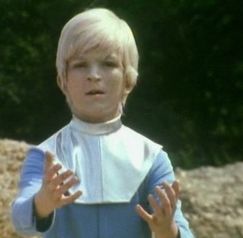
Amongst the ship’s inhabitants is a young alien boy christened “Peep-peep” by the children due to his backwards language. But there is danger from another alien who the children refer to as “the thin space-man”, played by John Woodnutt. He seems to have a hold over their new friend from space and this puts them all in danger.
Whilst this is obviously quite low budget, there’s plenty of merit here. The child actors are pretty good (Le Touzel would go on to have a lengthy career) whilst Gabriel Woolf and John Woodnutt are as solid as you would expect. Another plus point is the score by Paddy Kingsland. Anybody who loves early eighties Doctor Who music will find much to appreciate.
The thin space-man
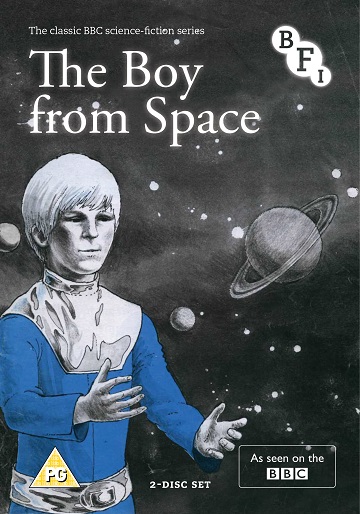
The educational inserts may be of less interest to some, but thanks to the comprehensive package prepared by the BFI, there are several different viewing options.
You can either watch the series as broadcast in 1980 or there’s an option to view just the drama sequences in a new 70 minute edit on the second disc.
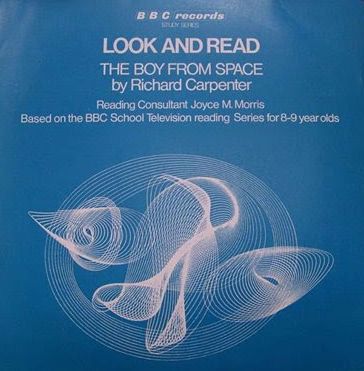
There’s also two versions of the BBC Schools LP recording. The first is the original audio, with narration from Wordy himself and the other marries footage from the show along with the LP audio.
The original LP sleeve
In addition to this, there’s Wordy’s Think-ups (animated lessons from the episodes), PDFs of the school brochures from both broadcasts and an interesting booklet which contains information about BBC Schools programmes in general as well as detail on the Look and Read series.
The DVD is part of the BFI’s Sci-Fi: Days of Fear and Wonder series of releases. Also available now is The Changes, with others such as Nineteen Eighty Four and Out Of The Unknown to follow later in the year.
The series by itself would have been a worthwhile purchase but the supplementary features mean that it’s an even more attractive package. It’s probably not to everyone’s tastes, but it’s nice to see the BFI releasing something slightly left-field like this. Hopefully there will be more to follow in the future.
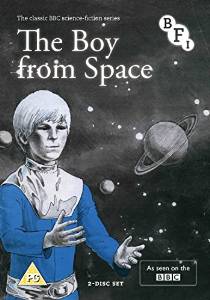
The Boy from Space is one of a number of British TV science fiction titles due to be released shortly by the BFI. Originally broadcast in 1971 as part of BBC Schools’ Look and Read strand, it has gained a certain cult status over the years.
Written by Richard Carpenter (Catweazle, Robin of Sherwood), the original broadcast tapes were wiped following transmission, although the Boy from Space drama inserts were retained.
This meant that when, in 1980, Look and Read were looking for a cheap new production, it was decided to use the original 1971 inserts with newly shot studio footage featuring presenters Cosmo and Wordy.
The two disc release includes –
The 1980 series (10 episodes, each running for 20 minutes).
A new feature length edit of the drama inserts (70 minutes).
An audio version of the 1972 BBC Schools LP (running time 55 minutes) narrated by Charles Collingwood (Wordy).
A new presentation, syncing audio from the BBC Schools LP together with footage from the television broadcast.




 Archive Television Musings