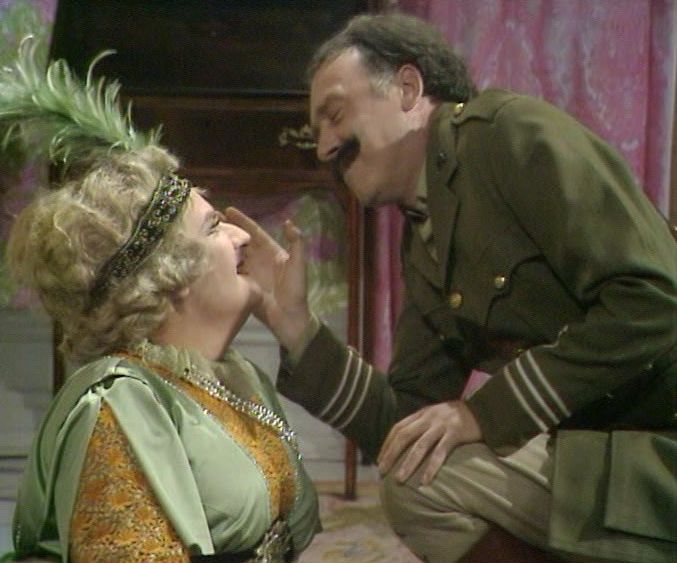
Fritz Braun (Barker) is a rather incompetent shorthand typist in the employ of Kaiser Wilhelm (Dennis Ramsden). The Kasier dismisses him and then decides that since he knows too many secrets he can’t be allowed to live. But the man he choses for the task, Captain Otto Von Diesel ( Graham Armitage), finds himself unable shoot his brother-in-law in cold blood. This presents a problem, Fritz needs to be dead whilst a sultry female spy called Lola is reportedly dead but it would be better if she was alive. This presents an obvious solution, why doesn’t Fritz drag up as Lola ….
After a couple of good episodes, Lola is a broad and fairly comedy-free farce. Although Barker would put on women’s clothing on numerous occasions during The Two Ronnies, it was never something he felt terribly comfortable with. His Lola is therefore a fairly broad creation (although the script by Ken Hoare and Mike Sharland didn’t really give him many opportunities for subtlety).
This studio-bound story flits between Germany and Paris and if the script is rather indifferent, then it’s possible to derive some enjoyment from the guest cast. Hugh Walters has a few nice moments as a German corporal, Graham Armitage impresses as Von Diesel whilst Freddie Jones plays it very broad (but there’s no other way with this script) as an English officer bewitched by Lola’s charms.The peerless Valentine Dyall has a small role as Lord Kitchener, posing for his famous portrait, complaining that his arm is going to sleep and taking more than a shine to Lola.
David Jason’s early career was very much intertwined with Barker’s. Jason’s respect and admiration for Barker has never been in doubt (to him, Barker was always “the guvnor”) and it’s plain that Jason considered his work with Barker, especially during the 1970’s, as something of a comedy apprenticeship – a chance for him to watch the master at work and learn from him.
Jason aged-up to play Dithers the gardener in Hark At Barker (1969 – 1970) and His Lordship Entertains (1972). His old-age make-up would also come in useful when he appeared as Blanco in Porridge (1975 – 1977). So it wouldn’t be until Open All Hours (1976 – 1985) that he was finally able to play a regular role of his own age opposite Barker.
The Odd Job also sees him act without aged make-up, as he appears as Clive, a man desperate for any odd jobs (“engines you want de-clogged or television sets, I mend typewriters and washing machines you know”). Arthur Harriman (Barker) does have a job for him – removing the scabbard from a samurai sword. Arthur can’t take the nagging from his wife Kitty (Joan Sims) any more, so has decided to take his own life. But when faced with the sword (plus Clive’s graphic description of hari-kari) he finds it impossible to do it himself, so wonders if Clive would do this odd job for him ….
Arthur is a meek, mild and fairly monotonous character whilst Clive (thanks to Jason’s comic tics and Northern accent) rather commands the screen. Given that Clive is by far the showier part, it’s interesting that Barker chose to play Arthur instead. This may be because, coming from an acting background, he didn’t have the ego that some comedians possessed and so wouldn’t have minded that Jason was earning more of the laughs.
Written by Bernard McKenna, who’d earlier penned several instalments of Hark at Barker and would later write several of Jason’s early sitcom efforts, A Sharp Intake of Breath and The Secret Life of Edgar Briggs, it’s a simple, but effective concept which is given a twist when Arthur and Kitty are reconciled. This means that he no longer needs Clive’s services, but convincing the enthusiastic Clive to halt his murderous plans proves to be a little tricky.
Part two is where we see Clive really begin to treat this odd job with gusto. He’s a man of limitless invention – for example, putting hydrochloric acid in Arthur’s milk so that his cereal disintegrates, setting up a tripwire which catches an unfortunate milkman instead, and almost managing to shoot Arthur in the park (instead some garden gnomes are dispatched).
It’s always nice to see Joan Sims, even if she has little to do, and the appearance of Derek Ware (playing the milkman) is a sure sign that something nasty is going to happen. Ware was one of those select band of stuntmen (along with the likes of Terry Walsh and Stuart Fell) who would become so ubiquitous that their arrival on screen was a clear indication that mayhem wouldn’t be far behind.
It’s a pity that The Odd Job only exists as a black and white film recording (due to the ITV colour strike) as I’ve no doubt that the location work in the second half would look rather better in colour. But no matter, it’s always a pleasure to see Barker and Jason together and whilst the final twist may be obvious it’s also satisfying. This tale would later be revived as a 1978 film with Jason reprising his role and Graham Chapman replacing Barker. Chapman’s involvement makes it an interesting Python curio, but I think that The Odd Job works best in this twenty five minute format.
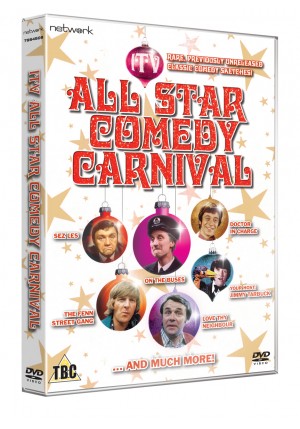
Network will release the 1972 & 1973 editions of All Star Comedy Carnival in December.
An annual television event for five years from 1969, All Star Comedy Carnival was ITV’s annual ‘Christmas bonus’ – presenting viewers with brand-new sketches from the network’s most popular sitcoms of any given year. A highlight of the festive viewing period, only two editions still exist: those for 1972 and 1973.
This set presents both complete shows, comprising specially written festive sketches for thirteen classic series:
• LOVE THY NEIGHBOUR • ON THE BUSES • CHRISTMAS WITH WOGAN • NEAREST AND DEAREST • THIRTY MINUTES WORTH • SEZ LES • THE FENN STREET GANG • FATHER DEAR FATHER • MAN ABOUT THE HOUSE • MY GOOD WOMAN • BILLY LIAR • SPRING AND AUTUMN • DOCTOR IN CHARGE
SPECIAL FEATURE: The Dustbinmen: All Star Comedy Carnival sketch from 1969.
The Phantom Raspberry Blower of Old London Town, thanks in part to the later Two Ronnies remake, is one of the more interesting segments of Six Dates With Barker. The Six Dates version was written by Spike Milligan whilst the Two Ronnies remake was credited to Milligan and A Gentleman (an indication that Barker had a hand in reshaping the original concept in order to fill out the expanded running time of the Two Ronnies serial format).
Unsurprisingly there’s more than a touch of Goon Show humour about this one. If the rumours are to believed, then Milligan originally planned it as a film which would have featured himself, Harry Secombe and Peter Sellers – but these plans were abandoned due to Sellers’ film commitments.
After the somewhat laboured comedy of The Removals Man, Phantom is a joy right from the start. Milligan’s eye for the absurd is given free range with numerous sight and dialogue gags. One of my favourites revolves around Sergeant Bowles, who’s played by different actors of various builds. One Bowles might enter a room directly behind Inspector Alexander (Barker) only for another to be seen in the next shot. It’s stupid, but it works.
Barker plays several other roles (including dragging up as Lady Penelope Barclay-Hunt). Lady Penelope ends up so shocked by the Phantom that her face turns black and her hair white (not something you’d see today of course). The identity parade is another exercise in total ridiculousness – as we see a topless Scotsman, a Chinaman, a black Chelsea pensioner, a vicar and an upper class toff (played by the lovely Moira Foot, who’d earlier been equally unconvincing – in a comic way – as a newspaper urchin).
With concerns that Queen Victoria may be targeted, a number of male officers with no resemblance at all to her Majesty are drafted in to impersonate her (Pat Gorman is amongst their number). Another favourite moment is the meeting of the heads of the Commonwealth, who feature a number of dummies amongst their number, including one who has a pumpkin for a head and another who sports a balloon instead! Moira Foot, who’d also appeared alongside Barker as Effie the maid in Hark at Barker, once again provides a touch of glamour, this time as the pneumatically enhanced Maureen Body.
The later Two Ronnies remake might have seen the addition of many more gags (as well as enjoying the comic talents of Ronnie C) but the compact Six Dates with Barker version is highly entertaining in its own right. A pity they didn’t spin this one off into its own series, had Milligan been able to keep up this stream of comic invention it might have worked very well.
Having transferred over to LWT from the BBC, along with Ronnie Corbett and David Frost, it wasn’t surprising that Ronnie Barker’s talent for playing numerous different characters quickly earned him a series of one-off playlets, Six Dates with Barker, which aired during 1971.
The premise of the series is straightforward – each twenty five minute episode is set in a different year (mostly the 20th century, although the final one – All The World’s A Stooge – ventures into the year 2774AD) and sees Barker tackle a set of diverse characters. Possibly it was hoped that one or more of them would prove popular enough to spin off into a series – it did happen with this one, although it took seventeen years until Clarence reached the screen (and then on the BBC).
The Removals Person is such a one-joke premise that it’s highly doubtful Clarence would have ever gone ahead had Barker not been so keen to make it. At that late point in his career, Barker was a comedy heavyweight who was pretty much able to do as he pleased. Barker clearly saw untapped potential in Hugh Leonard’s The Removals Person and wrote all six scripts of Clarence himself (under the pseudonym of Bob Ferris). He wasn’t averse to recycling Leonard’s jokes though ….
Here, Barker plays Fred, although visually he’s pretty much identical to the later Clarence. Josephine Tewson, as in Clarence, is Travers, a maid who attempts to limit the damage caused by the myopic removals man and then slowly falls in love with him. The year is 1937 and whilst the rest of London is busy celebrating the Coronation, Fred and Albert (Christopher Timothy) have a job to do – pack up all the belongings from a swanky flat and transport them over to Southampton.
Albert (Timothy essays possibly not the most convincing Cockney accent ever heard) has other ideas as he wants to pop off for an hour or so to watch the procession, which leaves Fred in sole charge. We’ve already had a quick look at the world through Fred’s eyes (blurry to the point of blindness) so nothing that happens subsequently should be a surprise. For example, he mistakes a post box for a Chelsea pensioner, believes that Travers is a coat stand and decides that the unhappy Miss Angela (Gillian Fairchild) is a standard lamp.
How much this appeals will probably depend on how well disposed you are towards the numerous (lack of) sight gags. Fred is rather crude and not terribly sympathetic, conversely Tewson is rather appealing as Travers, a woman so obviously lonely that she responds to Fred’s charmless overtures. Gillian Fairchild soars over the top as Miss Angela, but this is mainly a two-hander between Fred and Travers.
The Removals Person is diverting enough, but it’s chiefly of interest because of the eighties revival – taken on its own this is pretty average fair. The shocking amount of tape damage on the VT master is quite notable, it’s quite unusual to see something in such poor shape.
Broadcast on the 25th of December 1973, The Glories of Christmas boasts a host of familiar faces. John Bluthal, Dora Bryan, Patrick Cargill, Diana Coupland, Les Dawson, Arthur English, Gerald Harper, Kathleen Harrison, Melvyn Hayes, James Hayter, Gordon Honeycombe, John Laurie, Alfred Marks, Bob Monkhouse, Pat Phoenix and Patrick Troughton were amongst those making an appearance (although some were very brief). But the undoubted star of the show was Princess Grace of Monaco and it was a considerable coup that Yorkshire Television were able to recruit her.
We open with the Beverley Sisters and the Batchelors taking it in turns to sing excerpts from Christmas favourites. If you can keep a straight face as the Batchelors sway their way through Rudolph the Red Nosed Reindeer then you have more self control than I do. This sets the tone for the show – a selection of middle-brow entertainment that in some ways seems a lot further back than 1973.
The music hall setting of part one reinforces this – in quick succession we see the Scottish tenor Kenneth McKellar, Francis Van Dyke and his violin, Janet Baker singing Cherubino’s Aria from Mozart’s The Marriage of Figaro and Rostal & Schaefer tickling the ivories. Let’s stop for a moment and consider that ITV decided this was just the sort of thing audiences wanted to watch on Christmas Day afternoon. You certainly wouldn’t see anything like it today (especially the young boy blacked up as a golliwog) which makes it a window into a vanished television age.
Much more worthwhile is part two – The Glories of Literature – in which the cream of the British acting and entertainment profession make fleeting appearances as some of Charles Dickens’ immortal characters. John Laurie is a perfect Scrooge, Gerald Harper is a fine Mr Jingle whilst Les Dawson is an interesting Mr Micawber (for some reason he chose to play it as W.C. Fields). Dora Bryan has an amusing few lines as Sarah Gamp and Patrick Troughton reprised his role as Mr Quilp (albeit for twenty seconds or so). It’s a great pity that his original turn as Quilp (from the 1962 BBC adaptation) is wiped – maybe one day it’ll return from a dusty overseas archive. We can but hope.
Part three sees Princess Grace read the story of the nativity, which serves a reminder that The Glories of Christmas was produced by ITV’s religious department. The visual representation of the story is either charming or shoddy (depending on how forgiving you are). Everything is studio-bound and very false-looking, but maybe they were aiming for the slightly unreal feeling of a school nativity play. Or it could just be that they lacked the budget to shoot on location.
The Glories of Christmas is a real curio that’s certainly worth a look (if you want to track it down it’s on the Les Dawson at ITV – The Specials DVD).
In March 1979 Eric Morecambe suffered his second heart attack. Told at one point that he only had three months to live, it was a slow road to recovery. His illness meant that a traditional Christmas Special was out of the question, so instead Thames gave us Christmas With Eric and Ernie. This was essentially an extended interview conducted by David Frost which also saw a few special guests (Des O’Connor, Glenda Jackson) popping by to indulge in some banter.
It’s always a pleasure to see a relaxed Morecambe and Wise just sitting around chatting. Eric is quite notably “on” for the early part of the interview, constantly looking to crack gags, but there are a few moments when he’s in a slightly more reflective mood.
“All comedy is based on fear” he says at one point. Ernie then comments about tough houses – playing the Glasgow Empire and going off to the sound of your own footsteps. Both of them delight in reminding Des about his disastrous time at the same theatre (he was so intimated by the audience that he fainted). Morecambe and Wise went on the next week and offered the audience their impression of Des. “Good evening, ladies and gentlemen <thud>”.
It’s not a detailed career-spanning retrospective, although Frost does ask about the early days, enabling Ernie to give us a rendition of Let’s Have a Tiddly At the Milk Bar, which is a nice moment. There’s a clip from the ATV years, which sparks some interesting comments from Eric about how his comedy persona had changed over the years.
Des O’Connor is on hand to receive some good-natured abuse from Eric and Glenda Jackson provides a link to the classic BBC years (not surprisingly there’s no clips).
They end with Bring Me Sunshine and the appearance of Janet Webb to take all the applause is a nod back to former glories. The Parkinson interview from the 1970’s probably has the edge on this one (a pity it wasn’t included on the BBC Christmas Specials DVD) but this is still a joy.
Having jumped ship from the BBC to Thames in early 1978, this was their second special for ITV (the first was broadcast in October 1978). Somebody who didn’t travel with them, at least to begin with, was Eddie Braben – so the show was written by Barry Cryer and John Junkin with additional material by Morecambe and Wise themselves.
The lack of Braben, and possibly having to work with producer/director Keith Beckett (who had produced the October special but still must have been an unknown quantity), might explain why everything feels a little laboured.
There’s the occasional ironic nod back to their BBC shows – most notably when they introduce Anna Ford and proceed to indulge in a trademark top hat and tails dance. The joke, such as it is, is that this isn’t Ford but a lookalike – as becomes obvious when every opportunity is taken to shield her face from the camera. Given that they were never short of real celebs, it’s an odd sequence – possibly a topical gag that hasn’t travelled down the decades too well?
The biggest waste of talent revolves around Leonard Rossiter’s appearance. Things start promisingly with some decent cross-talk in front of the curtain – Rossiter tells them he’s not working here, just passing through on his way to the BBC. Eric then mutters they might not be far behind! All three then drag up as the Andrews Sisters and mime to Boogie Woogie Bugle Boy. And that’s it – the mere fact that they’re dressed as the Andrews Sisters is presumably supposed to be hilarious (but alas, no).
It’s not all bad though. There’s a nice flat scene with Frank Finley and the sequence with Eric, Ernie and the Syd Lawrence Orchestra is good fun. The big moment is reserved for the end, as Harold Wilson pops round to the flat. Irrespective of whether he’s funny or not, the novelty of seeing an ex-prime minister interact with the boys is worth the price of admission alone. The look on Eric and Ernie’s face as Wilson receives a tumultuous round of applause from the audience is lovely to see and Wilson’s a good sport – receiving Eric’s jibe that he’s actually Mike Yarwood (and doing an impression of Tommy Cooper!) with equanimity.
Overall it’s pretty patchy stuff. M&W still obviously had the audience’s affection, but they weren’t always well served by Cryer and Junkin’s material.
Although the BBC had the jewels in the light entertainment Christmas crown during the majority of the 1970’s – The Two Ronnies, Mike Yarwood and Morecambe & Wise – ITV weren’t totally bereft, as they had the considerable talents of Stanley Baxter.
Baxter had established himself on the BBC with a number of series between 1963 and 1971, but then jumped ship to LWT in 1972 where he remained for the next decade. His programmes were quite expensive – big production numbers and his penchant for playing multiple characters were two of the reasons why. And it was partially cost that saw him fade away from television (as executives decided they could no longer afford him). But the change of the comedy landscape in the 1980’s, which had seen casualties like Benny Hill, could also have had something to do with it.
When pondering whether Baxter could have continued into the mid to late 1980’s, you have to say that Stanley Baxter’s Picture Box, broadcast on the 26th of December 1976, was of its time. Stereotypes are certainly in evidence, such as the Jewish BBC newsreader. “Here is the news at nine, but for you – eight forty five.” He also blacks up towards the end in a sequence you could never imagine receiving an airing today.
An early highlight is the Philip Marlowe sketch which sees him approached by Cinderella. Baxter plays all the characters – Marlowe, Cinderella, Prince Charming and the Ugly Sisters. It’s notable that split-screen photography wasn’t used – instead we either focus on one person or if another’s in shot then they’re only seen from behind (played by a double). One of the drawbacks with Baxter playing everybody is that he never had anyone else to react against, so he’s reliant on the editing. But it’s pretty good here and although there’s some painfully obvious lines, there’s some good ones too. “People from my past flashed before my eyes. Until they got booked for indecent exposure.”
There’s a fair amount of focus on the BBC. Apart from the newsreader we also see The Bruce Fosdyke Show (“tonight at 11:45 if you’ve absolutely nothing else to do”). The Fosdyke sequence doesn’t outstay its welcome and contains several decent brief gags (such as Baxter dressed as Nana Mouskouri and Sharri Lewis and Lambchop as they’ve never been seen before).
An appeal on behalf of the inhibited from Faith Douche provides a good opportunity to exhume some old favourites. “I was strongly against sex on television, because whenever I tried it I kept sliding off the top of the set”. Elsewhere, Baxter’s amusing as Noel Coward and also impresses as Jacques Cousteau who’s decided to explore the murky depths of Margate.
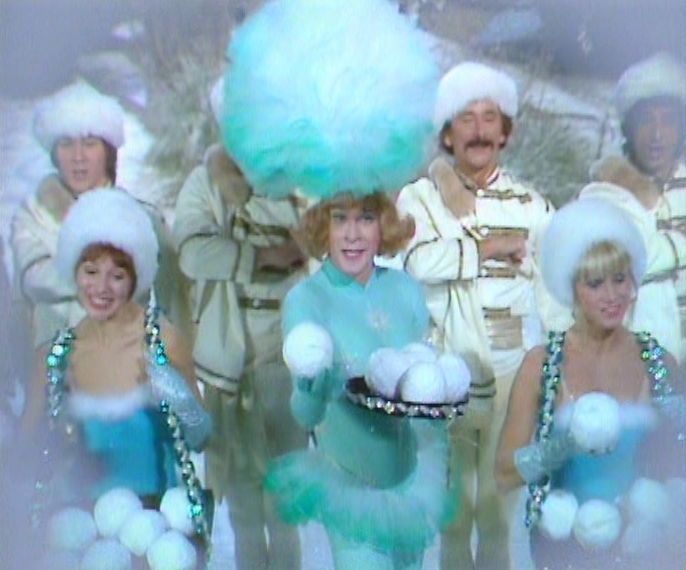
Girl on the Cover tells the story of the obese Lois Latnick who’s turned into a cover beauty for the magazine Harpie’s Bizarre. Lois’s fatsuit is rather crude compared to what could be achieved decades later, but the heart of the sequence is when she’s transformed into a beauty (or at least as beautiful as Baxter as could ever hope to be!) and we launch into a series of musical numbers which close the show.
Written by Ken Hoare with additional material from Baxter, Barry Cryer, Iain McIntyre and Neil Shand, Stanley Baxter’s Christmas Box is good, bawdy fun.
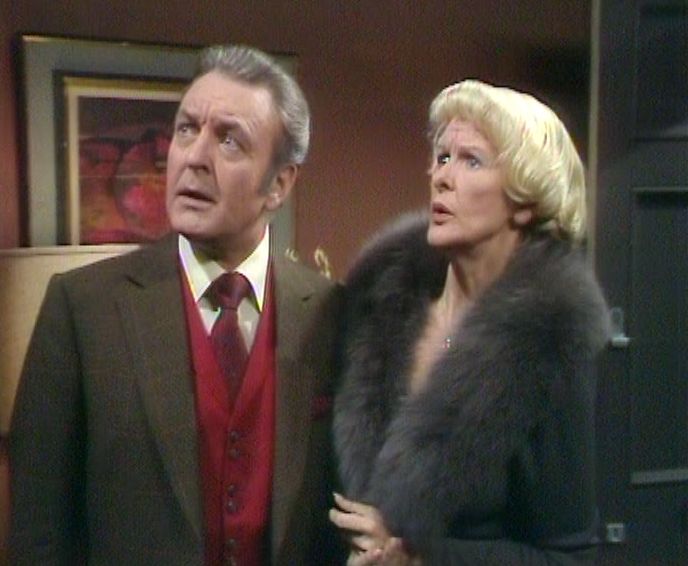
Two’s Company was a culture clash comedy – Dorothy McNab (Elaine Stritch) is a rich American and Robert Hiller (Donald Sinden) is her superior English butler. Their differing natures are spelt out in the opening credits (which seem to go on forever).
Running for four series between 1975 and 1979, Two’s Company‘s strength is the banter between Stritch and Sinden. Take that away and there’s not a great deal left – the writing is amusing enough but it’s hardly top-tier sitcom fare. But the first series had clearly been successful enough for A Kind of Loving (the opening episode of series two) to receive a Christmas Day airing in 1976.
The relationship between Dorothy and Robert is made clear by their choice of presents to each other. Dorothy is underwhelmed to receive an LP of Elgar’s Enigma Variations whilst Robert is equally unimpressed with an LP by Jelly Roll Morton. Once they swop, then they’re much happier. Although both presents were unsuitable, there’s no malice in their choices – possibly they genuinely wanted to widen the others musical horizons (although it was doomed to failure). This sets the tone for their general interaction – both indulge in a subtle form of one-upmanship, with honours (in this episode) ending up even.
The plot of this one is quite simple. Both say their goodbyes on Christmas Eve as they head off in different directions (Dorothy to Paris and Robert to the country). But both were fibbing and had planned to spend a quiet Christmas at home (Robert in the comfortable downstairs portion of the house) with convivial company. As both of them have now returned that creates something of a problem. And when Robert’s friend Gillian (Geraldine Newman) takes an interest in Dorothy’s friend Nigel (Derek Waring) that just adds to the tension. And then Dorothy’s cousin Clarence (John Bay) turns up …..
Clarence is your stereotypical, loud, crass American – constantly referring to Robert as “Jeeves” much to his disgust. Dorothy’s no more pleased to see him and when Gillian and Nigel leave together that means Dorothy, Robert and Clarence are fated to spend Christmas together.
Bay was married to Elaine Stritch, but he was a decent actor so his appearance here wasn’t just nepotism (it’s not his fault that Clarence was written as such an irritating person). Geraldine Newman and Derek Waring were both very experienced performers and they help to give the episode a bit of impetus.
Donald Sinden’s spot-on comic timing, even with the fairly thin material, is worth watching and he has a decent foe in Elaine Stritch. Not a classic series, but a passable way of spending twenty five minutes.
The Wedgewoods Beryl Calvert Jimmy Jewel Marie Valentino Johnnie Wager, Union Man Buddy Greco
First up are the Wedgewoods, a wholesome singing group. They’re a vision in blue velvet and the highlight of their song must be when the camera pans into the audience to show us a man clapping with such grim determination that it’s possible to imagine there’s a gun pointing at him off camera!
Next is ventriloquist Beryl Calvert. She’s quite well-spoken, whilst her doll sports a broad Liverpudlian accent. It’s a decent act, although it only attracts polite laughter from the audience. Beryl certainly doesn’t leave any stone unturned when attempting to tug at the heartstrings of the punters though (similar to the way that Keith Harris and Orville would later work).
Buddy Greco makes a brief appearance and he’s far from impressed with the piano he’s been given. When he tells the chairman he requires a grand piano, he’s told that it’s the grandest they’ve got. It’s not what he wants to hear, so he kicks the piano over and leaves the stage. This forces Bernard to fill in, with the assistance of a drunk from the audience (played by Jimmy Jewel).
Jewel was a veteran British variety performer, who had enjoyed a thirty year partnership with his cousin Ben Warriss, before they went their separate ways in the late 1960’s. After the split, Jewel would continue to rack up an impressive list of film and television credits well into the 1990’s. At the time of this Wheeltappers appearance he would have been best known for the ITV sitcom Nearest and Dearest, where he appeared alongside Hylda Baker (famously, the pair detested each other in real life).
His comic talents are rather wasted here, as the “joke” is that Bernard and Jimmy perform a song which appears to get a rapturous reception. But what they don’t realise is that the applause is for the stripper who’s appeared behind them. So they continue to give encore after encore, whilst the stripper (Marie) takes off another item of clothing. How long can this joke be stretched out? Quite a way, it has to be said.
After the break, we’re launched into the middle of Valentino’s act. It’s a compelling turn – although it might just be the ever-so shiny jacket that piqued my interest. If you’ve ever wondered how Colonel Bogey would sound on the accordion when played in different countries, then this is the turn for you. Valentino, born Jackie Farn, has enjoyed a long and successful career, rubbing shoulders with a host of showbiz greats (including the Beatles). His official website, modestly called King of the Music is worth a look.
After a fairly laughter-free turn from Johnnie Wager, it’s a relief to learn that they’ve found Buddy Greco a decent piano and he’s returned to close the show. Born in 1926, Greco is still going strong – a survivor from a classic era of music. In the 1960’s he appeared with the Rat Pack and is a veteran of numerous Las Vegas engagements. He brings a little of that glamour to the Wheeltappers, although the performance is slightly wonky – not necessarily his fault, since the band do seem to be playing different songs at the same time!
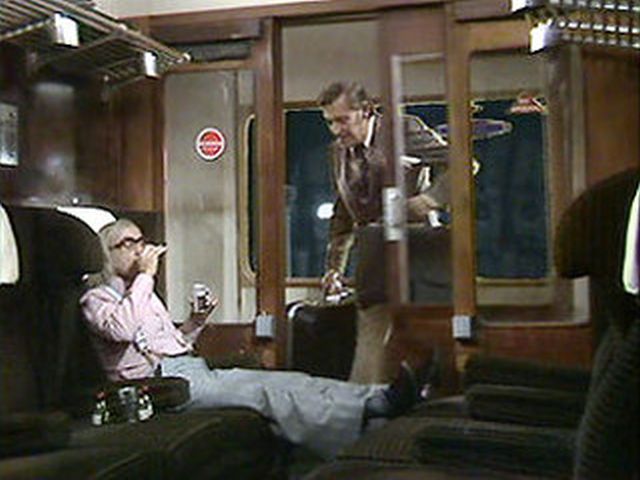
Albert Cakebread (Warren Mitchell) has had a good day at York Races. On the train back to London, he flashes his winnings (over two thousand pounds) in the bar and offers to buy everyone a drink. This catches the attention of one of the passengers, Basil Trenchard (Gerald Flood).
Later on, Trenchard, along with two other people (played by Alister Williamson and Robert Dorning), asks Albert if he fancies a friendly game of cards to while away the journey. Albert agrees, as does another passenger in the carriage (a businessman played by Robin Parkinson). In order to keep things fair, Albert asks the imposing figure of the Bishop (Lockwood West) to deal the cards.
It’s obvious that Flood and his two friends are con-men who plan to fleece the ebullient Albert out of his winnings. Each hand reduces Albert’s money little by little, so that by the last hand he desperately stakes everything he has The others do as well and it seems that Trenchard is going to walk away with the lot. But amazingly, it’s the mild-mannered businessman (Parkinson) who actually has the winning hand and he scoops the whole pot. The twist is that he, Albert and the Bishop are also a gang of con-men (who have managed to outfox the other three by being a little more subtle).
Big Deal at York City boasts an interesting performance from Warren Mitchell who affects an accent which I believe is a West Country one. Why he didn’t use his more familiar London tones is a bit of a mystery, unless it was supposed to lull the three marks into believing him to be a country bumpkin. His character certainly comes over as something of a simple, trusting soul (although as we see that isn’t the case at all).
Gerald Flood (bad King John, or at least something that looked like him, in the Doctor Who story The Kings Demons) is rather good as the card-sharp who spies what he thinks is an easy mark, only to be taken to the cleaners himself. Another solid performance comes from Lockwood West as a man of the cloth who seems to gain a great deal of knowledge about poker as the game goes on!
Although Mitchell’s accent and slight overplaying is a little distracting, Big Deal at York City is an entertaining twenty-five minutes that brings the Galton and Simpson Playhouse to a close. Although the quality of the series was a little variable, the first-rate casts in each episode do help to sometimes lift the material. It’s not Hancock or early Steptoe standard by any means, but it’s certainly worth a look.
I Tell You It’s Burt Reynolds takes place in the living room of a typical family home. The arrival of Jim (Leonard Rossiter) is enough to send the kids to their room (“he never stops talking”) although the adults are less fortunate. They’re just about to watch McMillan and Wife and although Jim tries to tempt them with the football on the other side, he settles down to watch it as well.
Jim is an insuffrable know-it-all. This starts when he tells Joyce (Gillian Rayne) about the deficiencies of her television set. “You know your colour’s all wrong? There’s too much red. You can’t watch it like that, it looks like he’s been boiled.” Granny (the peerless Patricia Haynes) is old enough to speak her mind. “What’s he want to keep coming round here for?”
After they manage to prevent Jim taking the television set apart with a screwdriver, he keeps quiet for a moment. But it doesn’t last long, as he spies a familiar face just behind Rock Hudson. What, he wonders, is Burt Reynolds doing in an episode of McMillan and Wife? Everybody else tells him that it’s not Burt Reynolds and indeed that it looks nothing like him, but Jim is convinced. “Course it is. Don’t tell me I don’t know Burt Reynolds when I see him.”
Thanks to Leonard Rossiter, this is the best episode of The Galton and Simpson Playhouse and it’s fair to say that few comic actors would have been able to deliver such a tremendous performance of ever-increasing hysteria.
Although Burt isn’t listed in the TV Times or on the end credits, Jim isn’t going to give up, despite the fact that nobody else cares. Calls to Yorkshire Television and the Daily Telegraph (Jim disgustedly tells them he’ll be buying the Daily Express from now on) are fruitless – so he decides the only way to settle this is to call Burt Reynolds in Hollywood. Incredibly he gets through, but when Burt doesn’t give him the answer he wants, is Jim finally going to admit defeat? Of course not!
Twenty years later, this was remade with Paul Merton in the main role. The two series of Paul Merton in Galton and Simpson’s … are interesting. Merton was always on something of a hiding to nothing, since many of the episodes were television classics (such as the various Hancock episodes selected, including The Radio Ham and Twelve Angry Men). The Paul Merton I Tell You It’s Burt Reynolds is fine, but it really doesn’t work without the full-throttle attack of a top comedy performer like Rossiter. The Galton and Simpson Playhouse was very fortunate to get a performer at the top of his game, as he was able to wring every last comic drop out of the scenario.
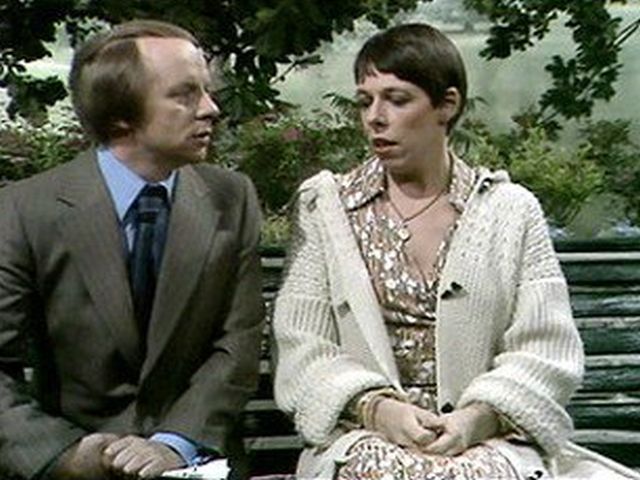
Variations on a Theme is an interesting concept. It’s essentially two very short one act plays with the same actors (John Bird and Frances de la Tour) and the same setting (a park bench) In both cases the story develops from the same line from de la Tour’s character – “Robert’s found out” – and both stories have a twist at the end.
In part one, the two are lovers – meeting in the park after their afternoon of passion the previous day. The bombshell that Robert (her husband) has found about their relationship strikes fear into the heart of Bird’s character. She consoles him that he had to find out sometime, which he disagrees with. “We only met yesterday. Some men get away with it for years. Some men never get found out at all.”
Bird’s character is particularly anxious, since Robert is a television wrestler (the Streatham Strangler) who’s well known for his violent temper. Another cause for concern is what the scandal will do to him – as chairman of the Marriage Guidance Council it’s more than a little embarrassing. “I’m expected to save marriages. You came into my office yesterday for advice. Two hours later we were in bed together, people aren’t going to understand that.”
John Bird is excellent as the twitchy adulterer, constantly looking over his shoulder in case Robert’s lurking in the bushes nearby. Frances de la Tour is equally good as a woman seemingly possessed of a deep passion. However, the twist is that after he’s paid her £5000 to keep his name out of the divorce proceedings, she moves onto the next park bench where it’s clear that there’s another mark who she’s also enjoyed a one night stand with (and presumably she’ll be conning him out of a similar sum of money).
In part two, the pair are a married couple and Robert is their son – who’s found out about the facts of life from a friend. Bird’s character reproaches himself. “It’s a father’s responsibility to tell his son about these things. I failed that boy. I had it all planned about how I was going to tell him. I mean it’s only three months since I brought the rabbits home.” Although, as de la Tour’s character points out, the rabbits were both female, which was a bit of a problem.
It quickly transpires that Bird’s character, despite being a psychiatrist, has something of a hang-up when it comes to sex – so he’s very reluctant to broach the subject with his son. He then wonders if Robert ever saw the two of them in bed. de la Tour’s character thinks not, but Bird’s character isn’t convinced since “you usually have a pillow over your head and I have my eyes shut.”
Eventually he decides to employ a course of aversion therapy on Robert and then bring up the subject in a couple of years time. She then reminds him that it’s Robert’s birthday the following day – when he asks how old he is (nine or ten he thinks) she informs him that he’s twenty three. As they leave the park together, they discuss appropriate presents (she thinks a cowboy suit would be right, whilst he thinks a railway set would be ideal).
Again, Bird and de la Tour are excellent in another two-hander. Had either of the two story ideas been stretched to the whole twenty-five minutes it probably wouldn’t have been as memorable an episode. But spinning two totally different plots from the same opening is what make this stand out a little from the norm.
Richard Burton (Roy Kinnear) is an airline steward who returns home to find a Dear John (or rather a Dear Richard) letter from his wife. She’s left him for another man, but in-between informing him that his dinner’s in the oven and that his spare uniform is at the dry-cleaners, she goes on to tell him not to “blame yourself in any way for what has happened. You’ve been a good husband and I’ve nothing to reproach you for, which makes it even harder to do what I’m doing.”
This is an obvious blow and he desperately needs to find somebody to pour out his troubles to. The problem is that nobody’s interested – as his so-called friends seem to regard him as something of an encumbrance, to put it mildly. After finding no useful information from his mother-in-law, he calls “good old Harry, one of the best.” Harry desperately conjures up an excuse to avoid talking to him – Richard seems like a nice enough fellow, but Harry gives the impression that he’s a crashing bore that no-one wants to spend any time with.
Possibly part of the reason for his lack of social success is his complete inability to appreciate the problems of others. Later on, we seem him conducting a lengthy conversation on the phone with another friend, Jack, who he’s stunned to discover is burying his wife the next day. He then remembers that Jack did mention this fairly important fact earlier on (Richard’s call has lasted over an hour) but Richard’s so wrapped up in his own world of pain that he has little empathy for anybody else’s grief.
Encounters with a barman (Robert Gillespie), a vicar (Frank Gatliff) and a phone-in host (Alan Freeman) don’t go well either and it seems that nobody wants to listen to him. He then receives a call from a man in a phone-box (John Clive). This is the man who his wife was originally going to run off with (which raises the interesting question as to how many men she was seeing!) and he’s just as upset as Richard to find she loves another. Richard cams him down and tells him to pour out his troubles – as it’s good to talk these things through.
Naught for Thy Comfort operates in familiar Galton and Simpson territory. Burton, like Hancock or the Steptoes, is something of an outsider from the normal run of society. And like them, he’s not always the most sympathetic of characters, although this changes right at the end when, ironically, he takes a great interest in the welfare of his wife’s former lover. Is this because he understands the pain that occurs when nobody will listen to you and therefore he’s able to derive some comfort by offering a sympathetic shoulder to cry on, even when it’s for a man who’s cuckolded him?
Roy Kinnear was something of a British comedy legend and his casting certainly gave the episode a lift. There’s not many belly-laughs here, but it does raise a smile or two.
Charles (Charles Gray) and Peter (Freddie Jones) operate under a strictly fixed routine. Friends since childhood, they went through the army together and now share the same house. Charles likes to organise everything and as they enjoy their regular evening drink at the pub, he outlines how he sees the week progressing. Friday night sounds particularly exciting. “In here for our usual and then off home and wash our hair. I’ll wash yours and you can wash mine, I never get all the soap out otherwise.”
Then Peter drops a bombshell – he’s getting married on Saturday. This throws Charles into a spin, how can Peter get married when they’ve got the laundrette to do? Peter is firm though, he’s in love and he’s going to be married at 12.00 noon on Saturday.
Charles continues to be baffled that Peter could desert him, after all they’ve been through. “After thirty five years, school chums, brother officers, comrades-in-arms, joint lease-holders of a maisonette and an allotment – which we were going to manure on Sunday.”
But Peter wants to break free from his routine existence and do something very different. He tells an increasingly appalled Charles that he and his wife-to-be will be “staying in South America. We’re taking a raft up the Amazon, right into the rainforest.”
If all this sounds very unlikely, then there’s a good reason why – Peter’s made it all up. There’s no girlfriend, no marriage and on Saturday he’ll be locked into the same old routine. He then confesses to Charles that he created this wild fantasy in order to try and break the monotony. Charles agrees that they should try and do something different, but it’s clear that they never will.
A bittersweet tale, Cheers is pretty good stuff, although there are a few awkward moments which do firmly place it in the 1970’s. Charles is disgusted to see a black woman on the arm of one of the other pub regulars (Nicholas Courtney). He mutters that such a thing shouldn’t be allowed and he declares that “I’d like to know where he gets his money from, I’m sure he’s a mercenary.” Awkward though this is, it’s always nice to see Nicholas Courtney and whilst it’s not a large part, he makes the most of it.
Charles is also amazed to learn that people consider that he and Charles are a couple of “poofs”. The fact they do everything together (including washing each others hair) has clearly not gone unnoticed by the other pub regulars (who call them “Pinky and Perky” behind their backs) but Charles doesn’t understand this at all. “I don’t believe it! I don’t look anything like a poof.”
Freddie Jones gives a lovely turn as a middle-aged man yearning for escape from his humdrum life whilst the always solid Charles Gray is suitably bluff as another middle-aged man who lives for exactly the routine that drives Peter up the wall. If anything changes, you can tell that Charles simply wouldn’t be able to cope.
If the scripting of The Galton and Simpson Playhouse so far hasn’t always been the sharpest, the star-quality of the actors has been enough to hold my interest. Cheers is another good example of this.
One major theme running throughout so much of British comedy during the 1970’s was that of sexual frustration. The Carry On’s, Benny Hill and Les Dawson’s Cosmo Smallpiece are just some examples of the typically frustrated British comedy male. Richard Briers as Henry Fairlane in Swop You One Of These For One Of Those is someone who fits snugly into this niche as well.
The 1960’s may have been the decade of sexual revolution, but for some (and especially Henry) it seems to have totally passed them by. He spends his time in the office ruminating on the clothes the secretaries wear. “Shouldn’t be allowed to walk around the office dressed like that. They’re asking for it, they really are. Trouble is, they don’t ask me for it.”
He’s happily married, but his eye is certainly roving. When one of the secretaries (Linda Hayden) wonders why he should bother to play around, he tells her that “I’m not old enough to turn it in. I should be playing around, it’s natural. I mean it keeps you young and healthy, it gives you a better disposition.”
Linda Hayden
Briers is perfect as a twitchy forty-something who’s desperately yearning for new horizons. And as luck would have it, his colleague Roger Gresham (Henry McGee) has the answer – an invitation to a wife-swopping party. You couldn’t really get any more 1970’s than that! Henry’s keen, but Roger tells him that he has to make sure he brings his wife along – no wife, no entry.
Come the night of the party and Henry’s been separated from his wife – he lost her at Belsize Park tube station. Roger refuses to let him in without her, so he has to keep a lonely vigil outside, watching enviously as numerous other couples gain admittance. The frustration part is key to the comedy – Henry has to remain constantly unfulfilled, otherwise the joke doesn’t work.
Eventually, Henry’s wife Linda (Jan Waters) does turn up – just after Henry stepped away from the door. Roger’s delighted to see her and and instantly lets her in (after some hesitation she throws herself into the party with gusto).
So by the time the party’s over, Linda’s had a great time and poor Henry’s been stuck outside the whole time. Henry, like so many comedy characters from this decade, is forced to constantly have his nose pressed to the glass, watching others enjoy themselves.
Richard Briers gives a very nice turn and Henry McGee (a familiar Benny Hill stooge) makes an impression as one of the oldest swingers in town. It’s also good to briefly see the imposing figure of Peggy Ann Clifford. She made a memorable non-speaking appearance in The Missing Page episode of Hancock’s Half Hour as the woman who watches Tony mime the plot of a particularly exciting book.
Swop You One Of These For One Of Those is a step up from Car Along The Pass and is, if nothing else, a good time-capsule of the period.
Ray Galton and Alan Simpson’s writing career started in the late 1940’s (when they were both confined in the same tuberculous sanatorium) and it continued for the next thirty years – coming to an end with this series. After The Galton and Simpson Playhouse was transmitted in 1977, Alan Simpson retired from scriptwriting whilst Ray Galton carried on, working with several other collaborators (such as Johnny Speight).
Galton and Simpson, are of course, best known for Hancock’s Half Hour (six radio series and six television series), Hancock (their seventh and final television series written for Tony Hancock, featuring classics such as The Bedsitter, The Lift, The Bowmans, The Blood Donor and The Radio Ham) and Steptoe and Son.
Following Tony Hancock’s decision to fire them as his writing team, the BBC offered them carte-blanche to write about anything they wished, and so the Comedy Playhouse series was born. One episode, The Offer concerned two rag and bone men and it seemed to have potential – out of this came the long-running Steptoe and Son.
YTV’s The Galton and Simpson Playhouse seemed to be a conscious nod to this series, as the programme clearly emulated the style of Comedy Playhouse (one off comedy playlets featuring some of the best acting talent around). It’s a pretty decent effort for them to bow out on, as whilst it’s fair to say that their writing heyday was in the 1950’s and 1960’s, this series isn’t completely without merit.
Having said that, it’s a shame that it kicked off with Car Along The Pass, easily the weakest of the seven shows. Henry and Ethel Duckworth (Arthur Lowe and Mona Washbourne) take a cable-car trip in the Swiss Alps. Henry hasn’t enjoyed his holiday at all and things don’t improve when the cable-car stops when it’s only half way across. The passengers are told that repairs will take a few hours, so naturally Henry (since he’s an Englishman) decides to take charge.
Henry Duckworth has faint echoes of Lowe’s most famous comedy character (Captain Mainwaring from Dad’s Army). Both are rather pompous and incredibly proud of their country of birth, but Mainwaring is also a basically decent man (plus he has the rest of the platoon to keep him in check). Duckworth is just a blinkered bore, with no redeeming qualities whatsoever.
There’s plenty of comic potential in taking a disparate group of people and trapping them in a confined space – after all, Galton and Simpson did this to great comic effect with the Hancock episode, The Lift. But Car Along The Pass is a very pale imitation. Had Henry learnt anything about his fellow passengers, or himself, then it might have been worthwhile – but his worldview remains the same at the end as it was at the start.
He’s dismayed to find there’s only a few British people aboard and even more upset to discover that means he’s surrounded by foreigners. The one that seems to cause him the most pain is a smooth-talking German, Heinz Steiner (Anton Differing). Steiner is something of an anglophile and professes a love of rugby (which he played whilst at public school in England). When Steiner asks if Duckworth attended public school, the Englishman is reticent. “That, um, is something that we never ask in England. We just know.” Predictably, Ethel spoils the moment by saying she didn’t think Henry played rugby at Witham Grammar, she though he played football instead.
Steiner wonders if Henry has visited Germany. Yes, he says, in 1945. The presence of French and Italians gives him further scope to restate the superiority of the English. During this, it’s hard to decide whether we should be laughing at him or with him. It’s the Alf Garnett problem, I suppose – some of the audience will probably agree with his sentiments whilst others will view him as an out-of-date dinosaur.
My affection for Arthur Lowe means that I can find some merit in this (although you have to dig deep) and Anton Differing is very good, but to be honest, Car Along The Pass is pretty poor stuff.
After something of a gap (mainly due to Network negotiating a new ten year licencing deal with ITV Studios) it’s pleasing to see a number of archive television titles are listed as forthcoming on their website.
Whodunnit? – Series Five is particularly welcome – it’s a lovely slice of 1970’s nostalgia with many familiar faces (both on the panels and featured in the playlets). After a somewhat shaky start (I love Edward Woodward but he was never best suited to the role of panel-game host – see series one for evidence of this) the programme was firmly in the groove by this time, helped no end by Jon Pertwee. As ever with Network, there’s always the possibility that release dates will slip, but at present it’s scheduled for release at the end of April 2015.
Doctor Who star Jon Pertwee is your host in this highly popular, light-hearted panel game which invites viewers to play detective – pitting their wits against a panel of celebrity sleuths to solve a fictitious murder mystery.
Devised by comedians Jeremy Lloyd and Lance Percival, the show’s brilliantly original formula presents short dramas laden with clues – and a few red herrings – to be pieced together by the panellists who, having grilled the suspects, point the accusing finger at the likely felon…
A star-studded guest panel for this volume includes Prunella Scales, Connie Booth, Liza Goddard, Terry Wogan, Dinah Sheridan, Patrick Mower and Jimmy Jewel; Françoise Pascal, Kate O’Mara, Josephine Tewson and Denis Lill feature among the casts.
The Three Degrees The Krankies Brandy Di Franck Bill Haley and the Comets Martin and Sylvia Konyot Ronnie Hilton
The first turn up on stage tonight are The Three Degrees who perform I Like Being A Woman. The group had formed in 1964, although the 1974 incarnation didn’t include any of the original members (over the years the line-up would see quite a few changes – some fifteen women have been one of the Three Degrees at one time or another).
The 1974 line-up consisted of Fayette Pinkney, Valerie Holiday and Sheila Ferguson. Shortly after this appearance, When Will I See You Again would top the UK charts for two weeks and it would herald a run of successful singles which would continue for a number of years. It’s a pity then that their Wheeltappers appearance wasn’t later in the year, as I Like Being A Woman is nice enough, although fairly forgettable.
There are two points of interest though, first is at 1:35 when they all bump into each other (they won’t be the only act to find performing on that tiny stage to be a bit of a problem!) and the second is the interesting spoken-word section, which must have gladdened the hearts of a certain section of the audience.
You know, women’s liberation is cool.
I mean, it had it’s good points and it’s bad points.
But you know sometimes… I just want to be loved,
And that’s why I become your slave.
I don’t want to be your equal, I just want to be a part of you.
All you gotta do is treat me like you treat yourself.
Next up are The Krankies. They’d spend the 1970’s working clubs like the Wheeltappers before moving onto mainstream television in the late 1970’s and 1980’s. They always seemed to be a staple fixture on Crackerjack (CRACKERJACK!!) at one time, for example.
Even though wee Jimmy Krankies’ cross-dressing antics only has a limited amount of comic potential, you have to admire the career they were able to build out of it. This Wheeltappers appearance is fairly typical of their comic shtick – Ian Krankie is attempting to tell a few jokes and sing a song but he’s prevented from doing so by a small boy in the audience. This is our Jimmy, who clearly has the audience’s sympathy as he tells them his mother doesn’t love him (awwww). The closing part of their act (where Ian treats Jimmy as a ventriloquists doll, swinging him around) is quite impressive and does raise a few laughs.
After somewhat fading from view, the revelation that they used to be swingers put them back into the spotlight a few years ago – and the fact that the likes of The Telegraph reported it is an example of how times have changed (it would be hard to imagine them running showbiz stories like that a few decades earlier).
Following the stripper Brandy Di Franck (yes really!) there’s the main treat of the show – Bill Haley and the Comets. Although Haley’s time at the top was quite short (his main chart success came between 1954 and 1956) his influence was far-reaching and thanks to a handful of classic singles he remains a significant figure in the development of rock and roll.
He gave the audience at the Wheeltappers exactly what they wanted – two of his biggest hits (Shake, Rattle and Roll and Rock Around the Clock). The only mystery about his appearance is why he wasn’t the headliner – c’mon it’s Bill Haley!
Next act on stage are Martin and Sylvia Konyot, who attempt to provide a touch of class with their dancing, although this is somewhat sabotaged by the fact the one of them is usually face-down on the stage. Not a bad spesh act which obviously took a good deal of training in order to execute the moves.
Tonight’s headliner is Ronnie Hilton, who rather cruelly (but accurately) is introduced by Bernard like this. “Ladies and gentleman, if there’s ever a nuclear attack then it’s all round to the next artist’s house. Because he’s never had a hit for years”.
Ronnie Hilton had a successful recording career in the 1950’s as a middle-of-the-road crooner. He built his career on recording cover versions of successful American songs. Hilton wasn’t the only artist to do this as back in the fifties it was the song – not the singer – that was king. His biggest hit, No Other Love (originally recorded by Perry Como) made number one in 1955, but by the early 1960’s the hits had dried up – so like many others before him, he took to touring the club circuit.
On the evidence of this appearance, he had become a decent club singer – although as he never had any particularly identifiable songs it does mean that the show ends with a bit of a whimper. Alas, if only they’d put Bill Haley on last!













 Archive Television Musings