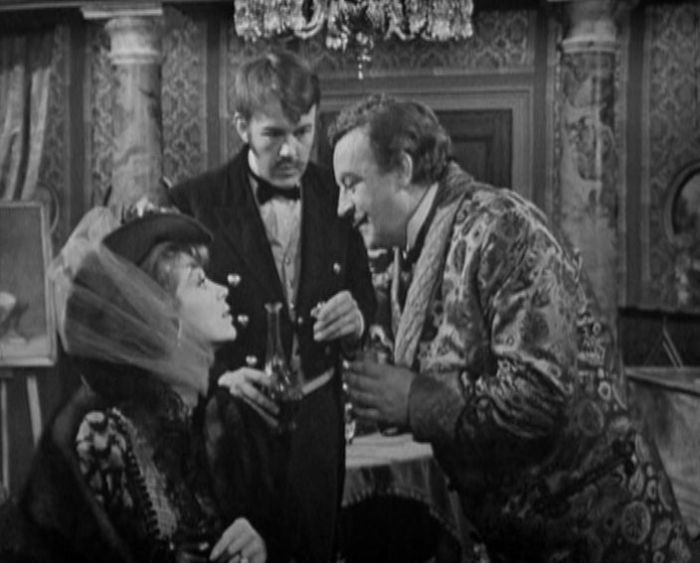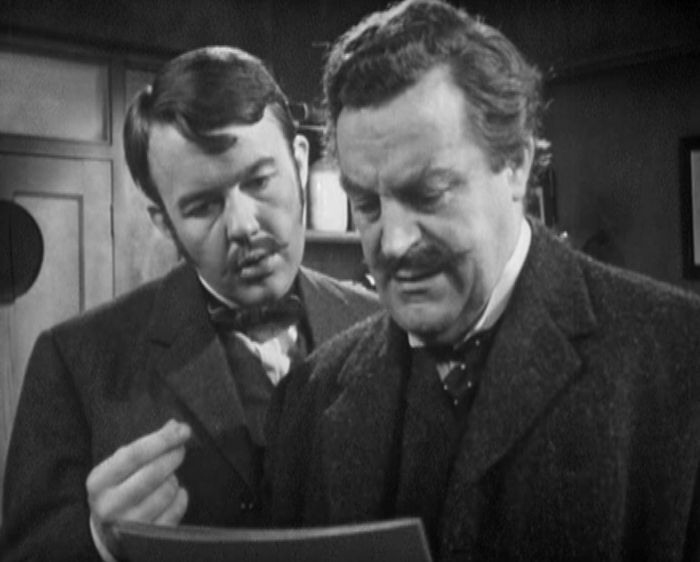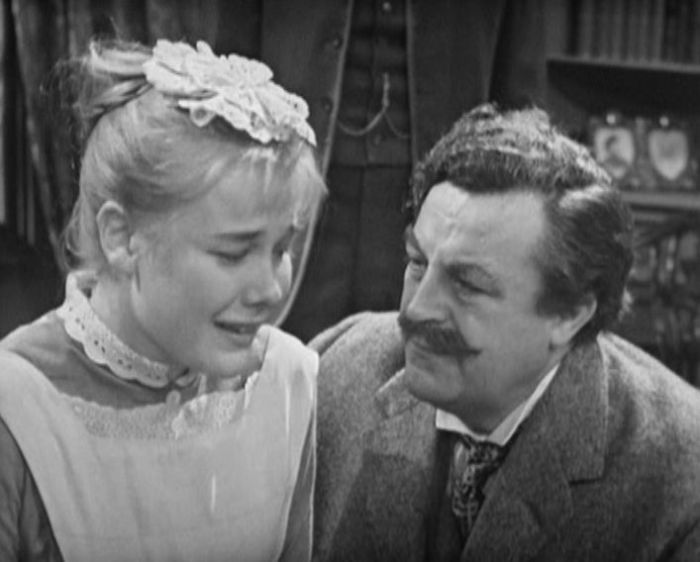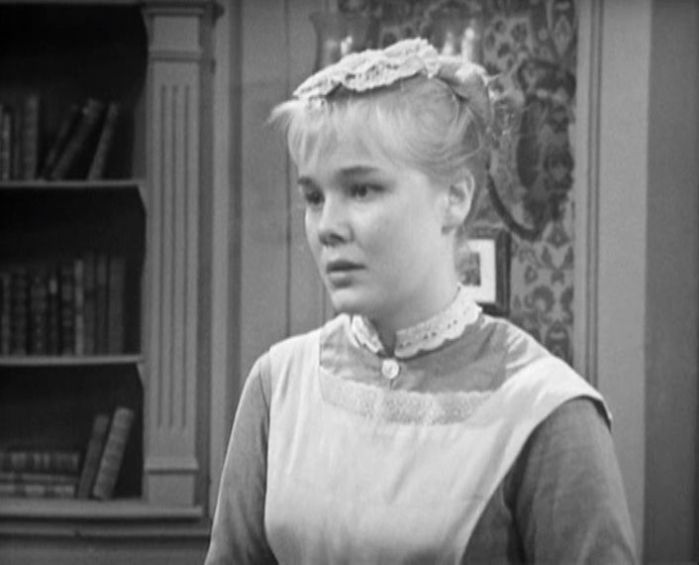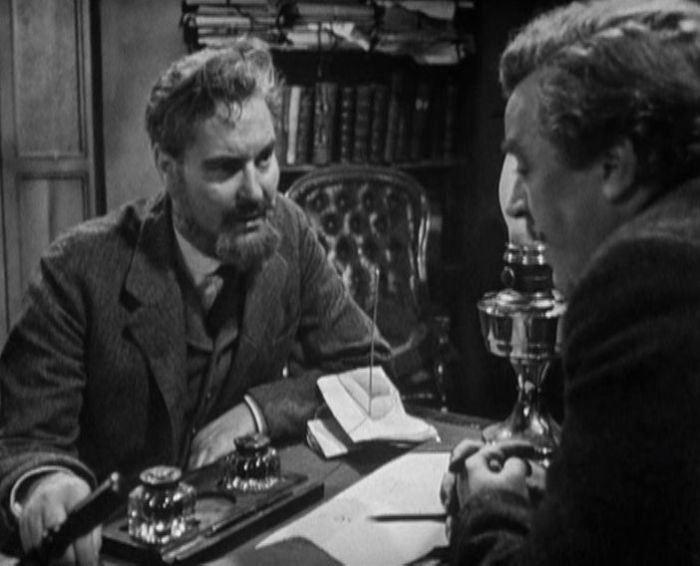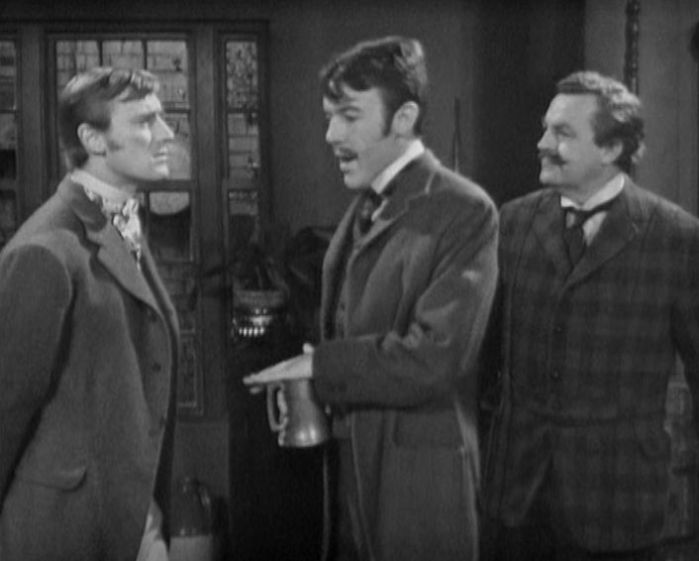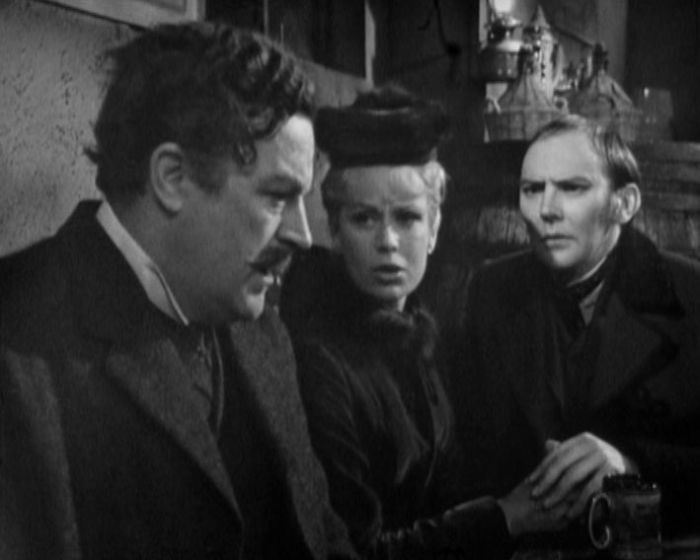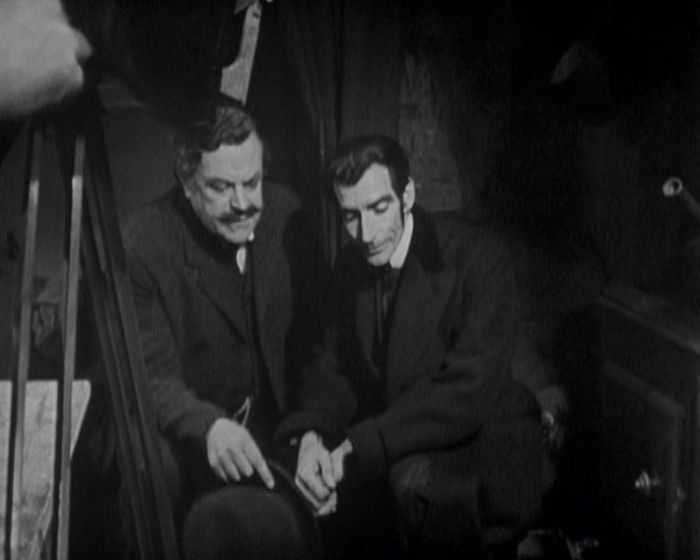
Gideon’s Way – Boy with Gun

gun 01

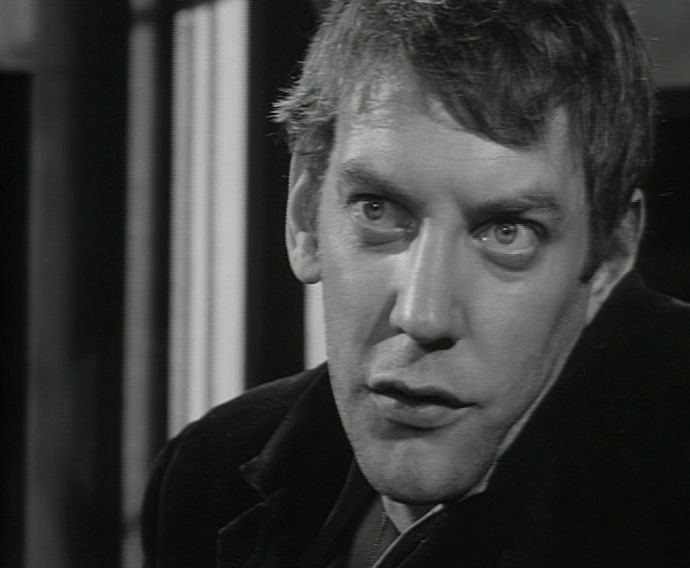
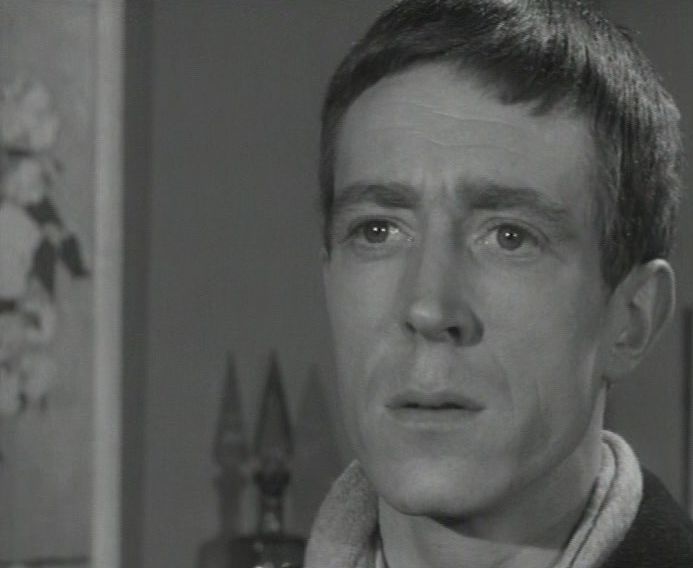
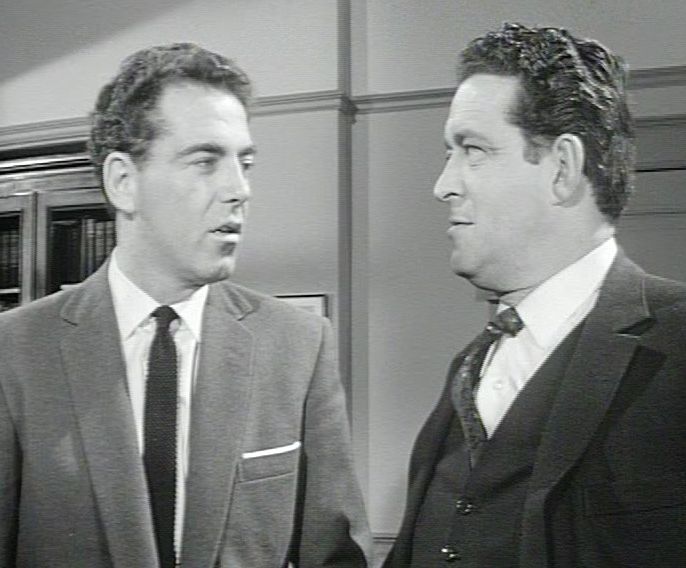
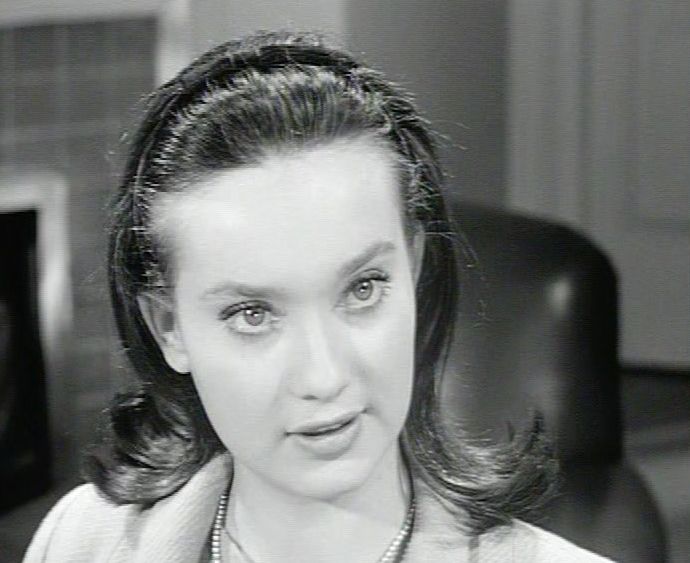
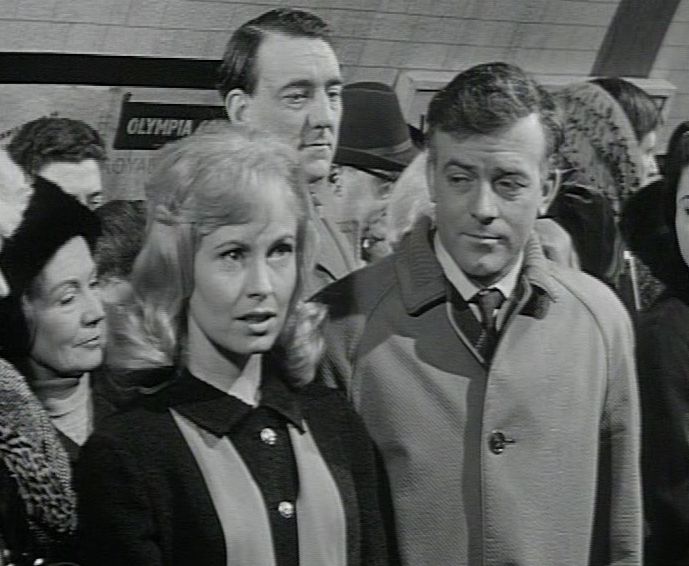
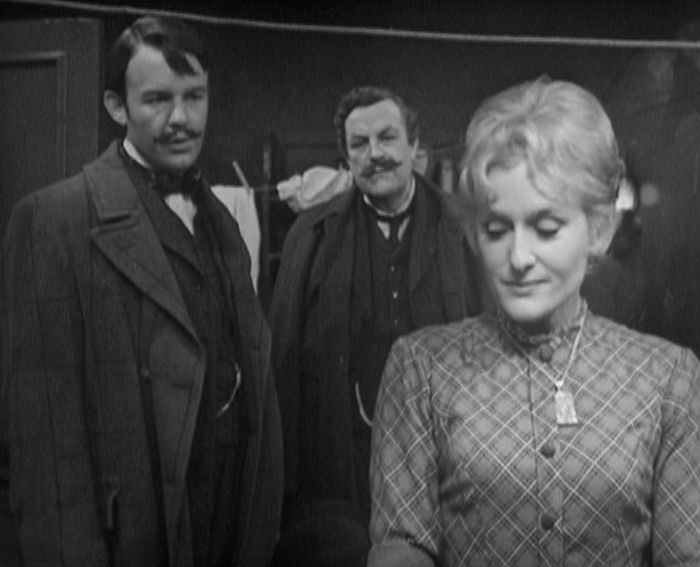
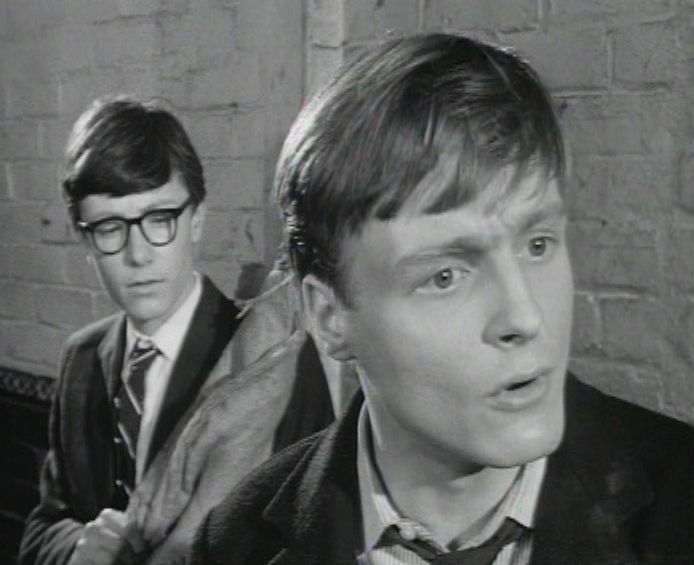
Chris Kirk (Howard Knight) is a quiet, bespectacled boy of fifteen who finds himself corned by three toughs of his own age, led by the knife-wielding Mick (Roger Foss).  Mick wants Chris’ rifle and after a struggle the gun goes off.  Mick falls to the ground, apparently dead, whilst Chris flees the scene.

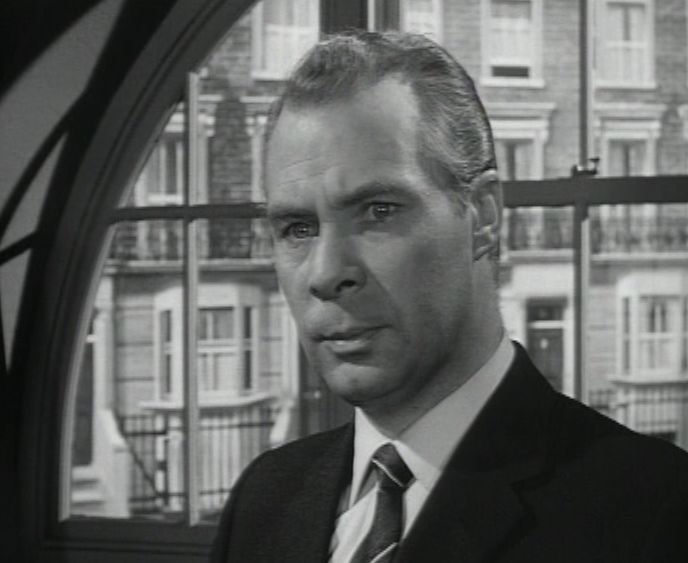
Chris isn’t the sort of boy you’d expect to be tangled up in a shooting case.  His father, Dr Kirk (Anthony Bate) is the local police surgeon and a well respected man.  The reaction of the local Inspector, after Dr Kirk tells him that his son was responsible, speaks volumes.  He simply can’t believe it – after all, nice middle-class people don’t go around shooting other people.

Anthony Bate was an immaculate actor who I can never remember giving a bad performance.  His credits are too numerous to mention, but I’ve previously written about his turns in the likes of An Englishman’s Castle and Tinker Tailor Soldier Spy (both series are undeniably enriched by his playing).  He’s also first-rate in the classic Out of the Unknown episode Level Seven.  Dr Kirk is another well crafted creation – a cold, cold man who is indirectly responsible for the mess young Chris finds himself in.

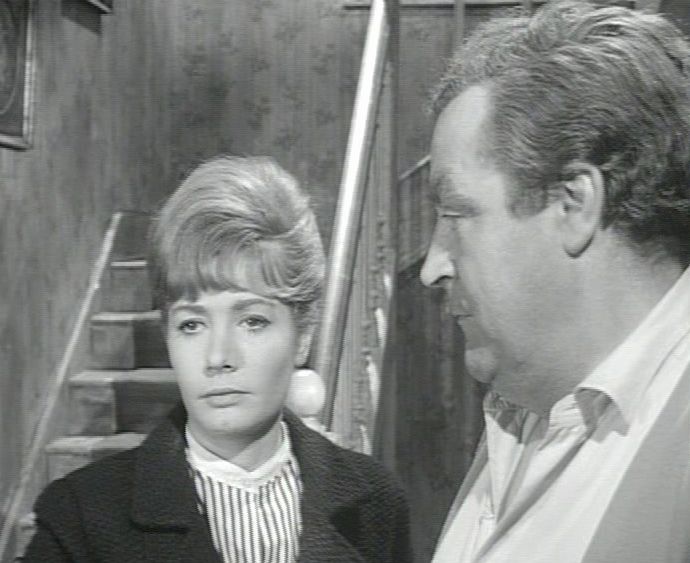
Dr Kirk is pained that Chris takes no interest in sports and would sooner bury his head in a book.  He dismisses the boy as effeminate and then tells his wife Helen (Ruth Trouncer) that it’s mostly her fault anyway – she wanted a girl so (in his eyes) she’s stunted his development. Husband and wife have a blazing row, expertly performed by Bate and Trouncer (which is notable as it’s played at a more intense level than is normal for the series).

Helen concludes the argument by telling her husband that the reason he wants Chris to be a real man is because he isn’t one himself.  It’s a wonderful piece of character development which lays the character of Dr Kirk bare.  But this isn’t the whole story, as later Gideon remembers the time when Dr Kirk risked his life to save an injured policeman.  Gideon’s story helps to demonstrate that whilst the man may have many less than admirable traits, he (like all of us) is a more complex character than might first be supposed.

Kirk gave his son the gun because he’s been trying to interest him in various manly pursuits – hunting, shooting, fishing.  Of course, this doesn’t explain why Chris was carrying a loaded gun around the streets of London, which remains a slight weakness of the story.  The point where Mick is shot is also worth looking at – did Chris shoot him deliberately or did the gun go off by accident?  It’s possible to make a case for both, although it has to be said that anybody who walks around with an unbroken rifle is simply asking for trouble.  It’s also odd that when Chris goes on the run he takes the gun with him, why would he do that?

Mick isn’t dead, although his condition is serious.  His anxious parents, Tim (George Sewell) and Mary (Mary Quinn) wait anxiously at the hospital for news, as Tim vows vengeance on Chris.  I’ve always loved George Sewell but since the character he’s playing is Irish, he’s operating a little out of his comfort zone, meaning that every time he opens his mouth I find it hard to take him seriously.  Quite why Tim couldn’t have been played with Sewell’s authentic East-End tones is a bit of a mystery.

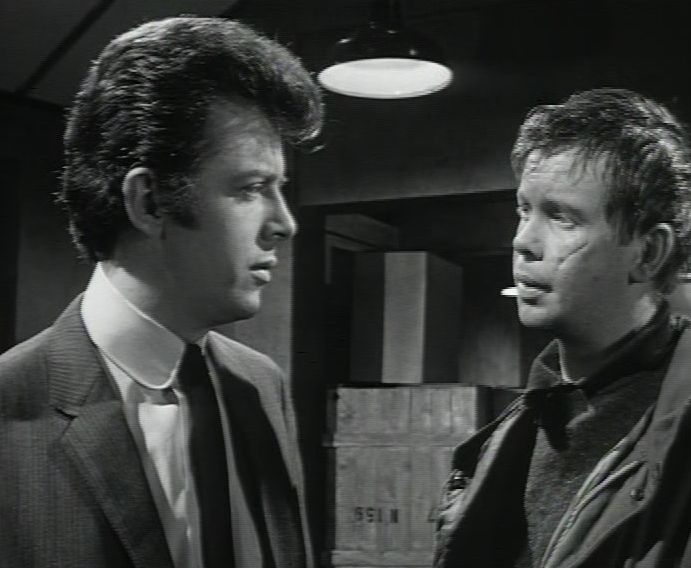
After Chris goes on the run he’s befriended by Vince Kelly (Michael Craze), a Borstal escapee.  Chris’ mother tells Gideon that her son is a lonely child – shunned by the boys in his area – so he latches onto the friendly Vince with alacrity.  Craze’s breezy naturalistic playing is a delight.  He’s the diametric opposite of Chris – whilst Chris has had everything, Vince has had nothing – but there’s no resentment from the Borstal boy.  He simply accepts Chris at face value, understands that he too is in trouble and makes an instant connection.

Mick’s father, Tim, is the one with the resentment.  In a memorable scene, he confronts Gideon and tells him that he knows the police won’t try too hard to find Chris – after all, Dr Kirk is a member of the establishment and they always look after their own.  “My boy never really had a father. For ten years I was sewing bags in Dartmoor for the Regent’s Street fur job. The Kirk boy’s had everything. Good school, clothes, family background the lot. And what happens? My boy’s walking along, minding his own business, doing no harm to nobody, and the Kirk kid blasts him with a shotgun.”  Even allowing for Sewell’s interesting Irish accent this is good stuff, capped off when Gideon tells him that his son wasn’t quite the innocent party his father has made him out to be.

Vince is an irrestable dreamer, who’s sure that his elder brother Ches (Michael Standing) will be able to spirit them out of the country. As they hitch a ride to Ches’s flat, Vince continues to express his respect for the fact that Chris was able to shoot a man. It’s therefore fairly obvious that Vince isn’t the brightest, but Craze manages to make the boy both vunerable and appealing.

It slightly beggars belief that Chris eventually finds himself pretty much back where he begun, meaning that a local petty criminal (played by the wonderful Joe Gladwin) is able to pop round the corner and tell Tim that the boy who shot his son is hiding in the area. This is the excuse for Sewell to dial his Irish accent to eleven and it also shows Chris levelling his gun at the struggling Ches and Tim. So although Chris has been somewhat painted as a victim, this moment is another indication that his sense of morality is rather skewered.

The ending – as Gideon and the others confront Chris, who’s still armed – is very interesting. Dr Kirk is on the spot, and everything seems set up for him to be the one who talks the boy down. But this doesn’t happen and it’s Vince who’s finally able to bring the stand-off to a peaceful conclusion. Father and son do walk off together though, which suggests that maybe, over time, there’s a chance for them to rebuild their shattered relationship.

As ever, good playing from the guest cast helps to enrich an already strong screenplay by Iain MacCormick.  MacCormick’s screen credits aren’t terribly extensive (he died, aged just 48, in 1965) but his contribution to Gideon’s Way was notable.  Boy With Gun was his fifth and final script, whilst the others (especially The Nightlifers, The Alibi Man and The Thin Red Line) are amongst the best that the series had to offer.
gun 02

Gideon’s Way – The Millionaire’s Daughter

millionaire's daughter

Alan Blake (Don Borisenko) is a handsome, smooth-talking conman who’s well known to Gideon.  So when the Commander learns that Blake has begun a relationship with Nina Henderson (Lans Traverse), the daughter of millionaire businessman Elliot Henderson (David Bauer), he’s very interested.  And following Nina’s kidnapping, Gideon’s interest only grows …..

The Millionaire’s Daughter opens with Blake and the Hendersons disembarking from the cruise liner which has carried them from New York to London.  During that time Nina has become totally besotted with Blake and it appears that her parents are equally impressed.  Elliot, supposedly a hard-headed businessman, later tells his wife Felissa (Lois Maxwell) that he prides himself on being a good judge of character and that Blake is a fine young man.  Uh, oh, he got that a bit wrong!

Gideon’s Way was a slightly atypical ITC film series as most of the others (The Saint, Danger Man, Man in a Suitcase, The Champions, The Baron, etc) appeared to have been crafted very much with foreign sales in mind.  Lew Grade, the boss of ITC, had clear views about what sort of shows would sell in the foreign (especially American) market.  Globe-trotting action (even if it was all filmed on the back-lot at Borehamwood with the help of a palm tree or two!) and an American star, or co-star, usually didn’t go amiss.

But Gideon’s Way, with its very British (and London feel) didn’t fit this pattern at all.  Having said that though, it’s possible that it did find a receptive overseas audience, as there were many who rejected Grade’s formula and believed that series which made a point of their Britishness tended to do well.

The Millionaire’s Daughter certainly seems to be designed to push some of those buttons as early on we see Blake and Nina enjoy a whistle-stop tour of many of London’s top tourist attractions (they feed the pigeons at Trafalgar Square, walk past Buckingham Palace and view the Houses of Parliament).  Alas, Nina’s happiness is short-lived after she’s chloroformed by Blake.

Erica Townsend (Georgina Ward) and Philip Guest (Donald Sutherland) are the other members of Blake’s gang.  Erica swaps clothes with the unconscious Nina, so that she and Blake can create the illusion that Nina returned to her hotel later in the day.  Erica seems to have a few qualms about this, leading Philip to drawl that “you’ve got to baby.  I look awful in high-heel shoes.”

Given Donald Sutherland’s later career, it’s hard not to be drawn to his performance – but even if he’d faded from view a few years later, I think his turn as Philip would still be regarded as one of the best things about the episode.  Sutherland gives Philip an edgy intensity that is totally mesmerising – he’s so obviously a loose cannon, teetering on the edge of sanity.  Philip spends most of the episode advocating that they kill Nina (Blake and Erica take the opposite view) and it’s possible to believe that he’s capable of carrying out his threats.  But when Nina later attacks him in an abortive escape attempt, it’s telling that Philip just crumbles and has to be led away by Erica.  So given how unstable Philip appears, it’s a little surprising that he’s the one left to guard Nina – but his non verbal actions (such as the way he gives her an extra dose of chloroform) certainly help to ramp the tension up.

Georgina Ward has a less showy role but still catches the eye.  Although at times she seems vulnerable, she’s also often shown to be in command (she – not Philip – makes the ransom demands, for example).  But in many ways she’s just as much a victim of Blake as Nina is.  Gideon explains that the only reason he sought her out was for her resemablance to Nina.  And the fact that Blake’s run out on them (taking Fellisa’s diamonds) proves his point.

Lans Traverse has a slightly thankless role, since Nina isn’t really allowed to be much more than a easily duped mark, but David Bauer and Lois Maxwell fair a little better.  Bauer was an American actor who moved to Britain and became a familiar television face.  Authentic sounding American actors were quite rare in Britain during the 1960’s so it’s no surprise that Bauer prospered.  Canadian born Lois Maxwell will forever be known as the original (and best) big-screen Miss Moneypenny, but like many other actors – including Bauer – she was no stranger to the numerous ITC series that were flourishing at this time.

The relationship between Elliott and Felissa is put under great strain following the kidnapping.  Elliott is happy to leave matters to Gideon but Felissa is haunted by the kidnapper’s threats that they’d kill her if the police were involved.  All ends well, but not before both characters have been put through the wringer a little.

Gideon’s his usual efficient self.  There’s not really too much memorable material for John Gregson in this one – so possibly his best scene comes early on, as he’s seen relaxing at home.  His older son, Matthew (Richard James), is reluctant to speak to his (girlfriend?) on the phone, because his parents are in the room.  “I can’t talk now, older generation you know?”  John Gregson’s expression is pricless, as is Daphne Henderson’s (she makes it plain that Kate knows just how much this statement will irriate her husband).  Lovely stuff!

David Keen gets to tangle with Erica later on and his method of restraint – putting an arm around her waist – is an unusal one.  And after everything’s sorted he seems to have an eye for young Nina too.

Had it not been for Donald Sutherland this episde may have fallen a little flat, but his twitchy, edgy performance certainly helps to keep the interest up.

Gideon’s Way – The Reluctant Witness

witness

Red Carter (Mike Pratt) and his brother Syd (David Gregory) run a successful stolen car ring.  Their success sticks in the craw of Tiny Bray (Frederick Piesley) though.  Tiny spent four years inside for a crime he didn’t commit, thanks to Red, and the thought of revenge has obsessed him ever since his release.

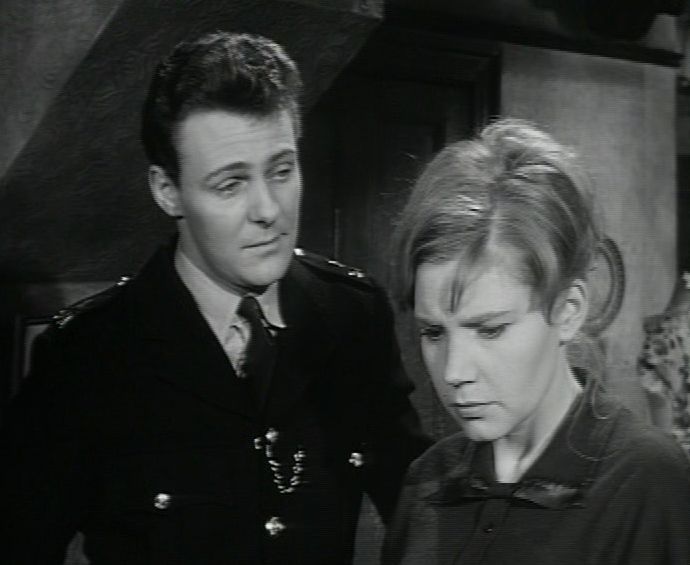
Tiny is one of Gideon’s top informers – but Syd caches up with him before he can spill the beans to the Commander.  The younger Carter brother dishes out a savage beating and Tiny later dies from his injuries.  There was an eye-witness – Rachel Gulley (Audrey Nicholson) – but she’s a quiet, shy girl who’s reluctant to speak out.  However, the local beat copper, PC John Moss (Trevor Bannister), has a plan …..

The Reluctant Witness is packed full of incident and interest.  Like a number of actors, Mike Pratt made two appearances in Gideon’s Way, playing different characters.   Red was the more substantial role and Pratt certainly holds the viewers attention.  Elder brother Red is clearly worshipped by the younger Syd.  But Red’s not only older, he’s also wiser (at least during the early part of the story) as it seems more than likely he wouldn’t have lost his temper with Tiny, as Syd did.

In contrast, Syd is portrayed as violent and reckless.  An insight into his personality is given during a party thrown by the two brothers.  Syd is slightly rough with his female companion and remains unrepentant – the clear implication is given that his treatment of the opposite sex is often far from chivalrous.

The party scene also has one of my favourite Gideon/Keen moments, as the officers gatecrash the swinging hop to sow a little discord.  They tell the brothers a fairy story – all about a stolen car ring – although there’s no happy ending (they drop the bombshell that Tiny’s dead).  Gregson and Davion work really well here.

You might wonder why Tiny was Gideon’s informant or indeed why the Commander is involved in such a low-key murder.  It’s a fair question, but for once there’s a good reason – Tiny was the only man convicted by Gideon who he later discovered was innocent.  If Gideon’s never been responsible for convicting anyone else who wasn’t guilty, then that’s a remarkable (if slightly unbelievable) strike-rate.  So Gideon feels obligated to get involved (not that he usually needs an excuse, he just tends to pitch in!).  But with Rachel hesitant to speak up, how will they obtain a confession from Syd?

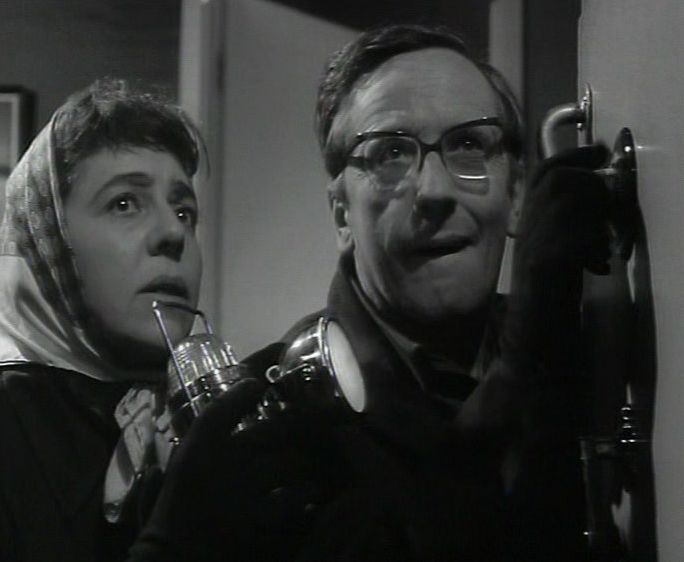
This is a fairly unusual episode of GW, since a generous amount of screentime is given over to a uniformed copper.  Trevor Bannister, forever Mr Lucas in Are You Being Served?, is the fresh-faced man on the beat.  He gives a lovely performance as the friendly beat bobby who’s been carrying a torch for Rachel for some time.  Their relationship hadn’t really got past the “good morning” stage, although there’s no doubt that he’s smitten.  The way that he stops the traffic to allow her to cross the road is a good example of this.

The only criticism I have of Audrey Nicholson’s performance as Rachel Gulley is that several times the script tells us that she’s plain and mousy.  Eh?  She’s a lovely looking girl!  But it’s true she’s something of a downtrodden waif, thanks to her domineering mother (played to great comic effect by Patricia Burke).

Mrs Gulley is a man-eater, plain and simple.  She tells Rachel to pretend to be her younger sister, as she doesn’t want her latest date to know that she’s old enough to have a grown-up daughter.  Later, when the relationship between Rachel and John deepens, Mrs Gulley is invited to tea with Rachel, John and John’s mother.  The tone is set when she asks for something a little stronger than tea – both John and Mrs Moss look a little askance at this, but politeness dictates that they don’t comment directly.  Alas, things go downhill from there, but John isn’t bothered – he tells Rachel that he wants to marry her, not her mother.

John’s plan to catch Syd is a decent one.  Gideon, Keen and John lie in wait at Rachel’s house and when Syd calls round – threating her to keep quiet or else – they’re in a position to overhear everything. But Rachel will still need to testify and this is the point in the story where Red starts to become a little unhinged.  Earlier, when he sent Syd round to threaten the girl, he was quite clear – no excessive violence.  But after Syd is arrested he changes his tune – now he wants the girl dead.  As he says himself, Syd’s all he’s got in the world, so he’ll do anything – including murder – to protect him.

However, Rachel escapes his clutches (quite why he didn’t send more men after her is something of a mystery).  This means that he has to make an even more desperate gamble – attempting to hijack the prison van.  He must clearly love his brother, although it might have been a good idea for at least one of his gang to tentatively ask if this was altogether wise.  No matter, it concludes the story in an exciting way and there’s a nice twist which totally knocks the wind out of Red’s sails.

Mike Pratt, Trevor Bannister and Audrey Nicholson are three reasons why this episode is a favourite of mine.  The other supporting players are far from shabby though and there’s familiar faces to spot, such as Gretchen Franklin (playing Tiny’s wife).  The eagle-eyed may also spy an uncredited Peter Purves as one of Red’s gang.

It’s getting a little predictable to keep on saying how good this series is, but it’s true nonetheless and The Reluctant Witness maintains the high standard.

Gideon’s Way – The Great Plane Robbery

plane

Terence Bailey (George Baker) has organised what seems to be the perfect crime – a million pounds in gold bullion, hijacked from a Russian plane.  Bailey remains confident that he’s covered all the angles, but then cracks begin to show amongst his gang …..

The Great Plane Robbery is something of a pun title, which would have been obvious to most of the audience at the time (The Great Train Robbery had occurred the previous year, 1963).

What’s remarkable about the plane robbery is just how straightforward it is.  There seems to be no security at all, either on the plane or at the airport.  They were carrying a million pounds in gold, for goodness sake!  You’d have assumed there would have been the odd guard lounging around, but no.  So Bailey’s right-hand man, Frank Dobson (Edwin Richfield) and the others are pretty much able to scoop it out of the plane at their leisure.  And even when the people in the airport control tower spot there’s a robbery taking place, all they can do is stare through their binoculars and sound the alarm.  The police are obviously a long way away, because Dobson and the others are easily able to make their escape before anybody turns up.

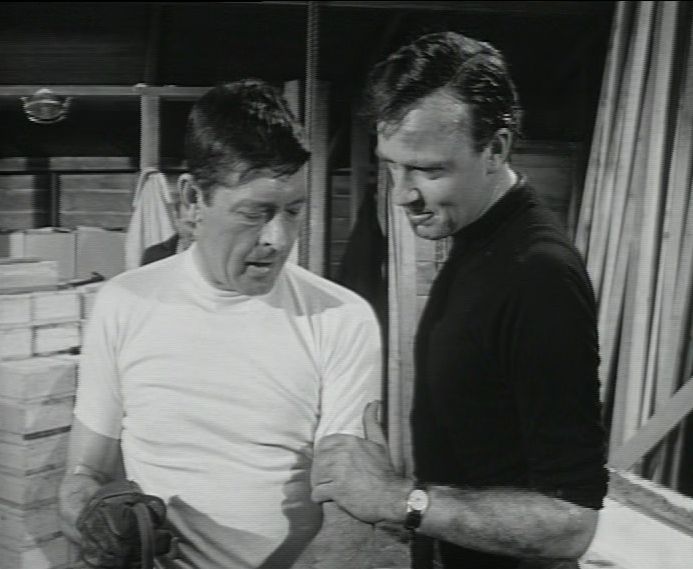
Edwin Richfield graced many a series with his presence (UFO, Doctor Who, The Avengers, Z Cars, Dixon of Dock Green, Adam Adamant Lives!).  He’s perfect as Bailey’s trusted second-in-command, who becomes rather disenchanted when a newcomer, Harold (Jeremy Burnham), turns up.  Harold is somewhat fey and camp and this doesn’t seem to go down well with Dobson (after Harold rests his hand on Dobson’s arm, he angrily tells Harold that he doesn’t like people touching him).  But that doesn’t seem to be the only reason why Harold irritates him – Dobson has enjoyed his time as Bailey’s closest confidant, but now there’s a newcomer who knows more than he does.  Their simmering discontent will later have serious consequences for Dobson ….

Jeremy Burham’s something of a renaissance man, not only an actor (including The Saint, The Avengers, Randall and Hopkirk and The Persuaders!) but a writer as well (Bergerac, Inspector Morse, The Gentle Touch, Minder, The Professionals, When the Boat Comes In, to mention but a few).  He helps to liven up the middle part of the episode, which otherwise might have sagged a little.

For me, this is one of the less essential GW episodes, and it only really succeeds because of the quality of the cast (as well as a few entertaining sequences which we’ll come to in a minute).  George Baker is certainly one of the reasons why it works as well as it does.  Much later he’d become very well known for playing a detective, but in the early part of his career he did a nice line in criminals, as he does here.  Bailey is a confident, cultured man.  He treats everybody around him with a casual air of indifference – he’s top dog and he knows it.  Of course, it’s his air of superiority which makes his eventual comeuppance all the more satisfying.

Memorable moments include young Malcolm and Gideon clashing over the best way to deal with the malfunctioning television.  Gideon is convinced he knows best, but Malcolm does know best and manages to restore the picture.  As with most of Giles Watling’s scenes throughout the series, this has no impact on the plot – it’s simply a nice character moment that helps to humanise Gideon.  Police officers, especially senior ones, with stable home lives are a rarity on television and whilst there’s an undeniable sense that their family set-up is simply too idealised to be true, it works nonetheless.

A quite different sort of family can be seen when we visit one of the gang, Kautsky (George Murcell).  His wife (played by Freda Bamford) is a remarkable creation, with big hair and a fag dangling from her lip.  And their son, Sid (John Hall), is remarkable too.  Although Hall was only in his early twenties when this episode was made, he looks a good deal older – meaning that it’s hard to take him seriously as the rebellious teen he’s written as.  His long hair is a bit of an eye-opener too.  Long hair for men isn’t really something that we’ve seen too often on GW – as touched upon before, the series has more of a fifties sensibility than a sixties one.  However, it’s not really the hair that’s an issue, more of the fact that it just looks so false (it surely must have been a wig).  If you can watch Hall’s performance and not think of Peter Sellers in What’s New Pussycat then you have more self control than me.

Not the best that the series can offer then, but it still has its moments.

Gideon’s Way – The Thin Red Line

thin red line

Commissioner Scott-Marle (Basil Dingham) and Gideon have a meeting with General Sir Hector McGregor (Finlay Curie).  Sir Hector still commands the Commissioner’s old Regiment and Scott-Marle regards the old man with barely concealed awe.  Even Gideon is impressed (“old hell-fire Mac” as he calls him).

Sir Hector is a worried man.  The Regiment’s pride and joy – the Balaclava Silver – is being stolen piece by piece and replaced with good quality fakes.  Sir Hector wants the culprit caught, but the honour of the Regiment is uppermost in his mind.  So Gideon has to work unofficially to bring the culprit to book – and the burning question for him is whether one of the upstanding officers and gentleman could be responsible.

It’s possibly coincidental, but The Thin Red Line has something of the feel of Redcap (ABC, 1964-1966).  Like Gideon, Sergeant Mann (John Thaw) was an outsider who frequently had to battle against the superior nature of the officers under investigation.

Gideon’s lack of enthusiasm for this job is very plain.  He’s too polite to tell Sir Hector so (and his respect for authority means that he’s not going to be openly critical to his superior) but the thought of giving the Regiment preferential treatment is something that obviously rankles a little.

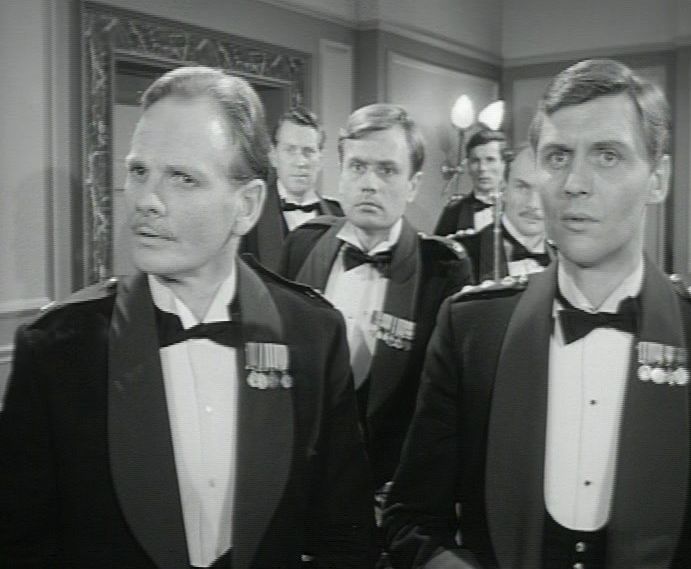
Sir Hector is presented as something of a man out of time – he believes in the honour of his officers, simply because they are officers and gentlemen.  But Gideon is not prepared to take anything on trust and tells them that they, like everybody else, will be investigated.  This leads to one of the most entertaining scenes in the episode, as the superior Major Donald Ross (Allan Cuthbertson) leads the others in pouring icily polite scorn on the Commander.  Although Gideon mentions to Ross that he commanded a Regiment during the war, that doesn’t impress the Major at all.  “Oh, in war lots of very strange people become officers.”  The arrogance of the professional soldier (who no doubt viewed the influx of new officers during WW2 with horror) is beautifully expressed here.

There’s not enough time to examine the characters of many of the officers in detail – so the focus is mainly on Ross.  Allan Cuthbertson was a very familiar face on British film and television screens between the 1950’s and the 1980’s.  Equally at home in drama or comedy (a memorable appearance in Fawlty Towers and a stint as Tommy Cooper’s straight man, for example) he gives his usual assured performance as the rather shifty Ross.

It’s quickly revealed that Ross owes a substantial sum of money to the well-heeled bookmaker ‘Bookie’ Barton Smith (Donald Pickering) and he has to face the humiliation of his wife’s public affair with a brother officer, Captain James Murray (Michael Meacham).  But the pain of being cuckolded quickly fades when he realises that he can threaten to divorce his wife, thereby destroying Murray’s career in the Regiment when he names him as the guilty party or he can force Murray to pay off his gambling debts.  Murray plumps for the latter, although the revelation that Ross is broke does tend to rule him out as a suspect.

To be honest, the culprit’s identity is probably not the most taxing mystery in the world.  Sir Hector’s grandson, Captain Robbie McGregor (John Cairney) dotes on the old man and has been selling off the silver in order to make Sir Hector’s last years a little more comfortable (Sir Hector gambled away his fortune and Scottish estates many years ago).

We’re invited to look kindly on Robbie’s motives, but although it’s true that he didn’t steal the silver for himself, it’s all still a little odd.  Robbie bemoans the fact that a brave old man like his grandfather is broke, but then nobody knew the truth about Sir Hector’s finances.  It seems inconceivable that the Regiment wouldn’t have looked after him, so Robbie’s theft could be less about his grandfather and more about making a statement.  He tells Gideon that he regards the Balaclava silver with loathing.  To him, the silver is a dead reminder of the Regiment’s past.  With it, the Regiment remains backward looking, always concentrating on their great victories from previous centuries.

The end of the episode is nicely underplayed, as Gideon leads Robbie away.  Although not explicitly stated, it seems obvious that Robbie will face the full force of the law – exactly what Sir Hector didn’t want to happen.  But although Gideon did seem to agree with Sir Hector that his investigation would be unofficial, this ending tells us that Gideon’s duty to the law overrides all other considerations.  In this way, we can compare Gideon’s sense of duty and honour to that of Sir Hector – just as the old man has his own set of values, so the Commander has his.

We never find out Sir Hector’s response to the revelation that his grandson was responsible for stealing the Balaclava Silver, but it’s not difficult to guess.  To the General, honour is everything – so this might very well be a blow from which he finds it impossible to recover.  It’s an uncomfortable thought that Robbie’s love for his grandfather will, in the end, be the cause of a great deal of pain.

This episode isn’t one that’s adapted from John Creasey’s novels, which may explain why the plotting feels slightly loose.  For example, late on, suspicion briefly falls on Sir Hector after Gideon discovers that he’s penniless.  This makes no sense at all – if Sir Hector was responsible, why would he have asked Scott-Marle and Gideon to investigate?  It’s also slightly hard to swallow that nobody (apart from Robbie) is aware of the perilous state of the old man’s finances.  By his own admission, at one time Sir Hector was a major landowner – so how was he able to sell off his land, properties and other possessions without anybody realising?

The Thin Red Line is one of the best-cast episodes of GW.  Finlay Currie, already in his mid eighties at the time, gives a nicely judged performance as the General.  Allan Cuthbertson is, as previously mentioned, first-rate and Donald Pickering oozes upper-class disdain in his trademark fashion.  Mary Yeomans only has a small role as Ross’ philandering wife, but she still manages to make quite an impression.  And if a Scottish Regiment of this era didn’t feature Gordon Jackson then I’d feel somewhat cheated.  As Sgt McKinnon he’s only in a couple of scenes, but his presence is a reassuring one.

If you want to read more about the episode, then I can recommend this wonderfully detailed post on a new blog called You Have Just Been Watching.

Gideon’s Way – The Prowler

prowler

Gideon is under pressure (thanks to negative newspaper reports) to catch a mysterious masked prowler who’s been terrorising London.  So far he hasn’t hurt any of his female victims – he’s simply cut off locks of their hair – but Gideon is concerned that violence and murder might be the next items on his agenda.

The prowler, Alan Campbell-Gore (David Collings), is a troubled young man.  He may come from a wealthy and titled family, with a mother – Lady Campbell-Gore (Fanny Rowe) – who dotes on him, but it’s obvious that the balance of his mind is disturbed.  He still pines for Wendy, his dead girlfriend, and it’s his inability to come to terms with her death that proves to be his downfall  …..

Robert S. Baker and Monty Berman had already successfully brought the Saint to the small screen, thanks in no small part to the talents of Roger Moore, and with Gideon’s Way they were once again tasked with the problems inherent in transferring a literary creation to the small screen.  Because ITC liked to sell their products worldwide, this meant that excessive violence, for example, would be frowned upon.  It’s well known that the Saint had to be rather watered down from the amoral, anti-hero of the original books – emerging in the television series as the affable globe-trotter familiar from Leslie Charteris’ later novels (which tended not to be as highly regarded as the earlier books).

Revisiting John Creasey’s Gideon novels, it’s easy to see that a similar retooling took place.  The Prowler was adapted from Gideon’s Night, published in 1957, and it offers a subtly different story experience.  To begin with, Gideon opens by musing on how his marriage went through a rocky patch a few years ago (in contrast, the television couple never seem to have a single argument).  Lemaitre is also suffering from domestic strife, as his “bitch” of a wife is blatantly conducting affairs with numerous men.  A little character development like this would have been good for the television Lemaitre as Reginald Jessup, despite being a regular, has a fairly thankless role – mainly existing to line feed both Gideon and Keen.  As for the prowler, he’s instantly made much more sinister after it’s revealed that he strangles his victims (as opposed to the television prowler who simply clips off a lock of their hair).   Other themes in the novel – such as a murderer of young children – were unsurprisingly never adapted for the series.

Returning to this adaptation, the opening few minutes – as Alan pursues his latest victim through a foggy London street – are highly evocative, although there may be some (especially if you equate fog with the stories of Sherlock Holmes) who might regard this scene as something of an anachronism.  Not so.  Fog and smog continued to be a problem in London well into the 1960’s.  The worse case was the great London smog of 1952 which killed thousands and although the problem declined during the 1960’s, it was still there.

The Prowler makes no effort to keep Alan’s identity a mystery.  We know very early on that he’s the guilty man and Harry Junkin’s screenplay makes short work of explaining why this is so.

His continuing love for his dead girlfriend, a recent stay in a clinic (following a breakdown) and the suffocating love of his mother are all factors.  Although Lady Campbell-Gore no doubt feels she’s acting in his best interests, her domineering personality is precisely what he doesn’t need.  After one of the attacks, he pleads with somebody to help him – but since he’s alone in his bedroom, help is not forthcoming.

Clearly he’s reluctant to speak to her about his mental problems and although her actions  – telling him he’s not fit to work yet, ripping up a picture of Wendy – are, in her mind, meant for his own good it doesn’t work out that way.  And when he does later pluck up the courage to try and explain, she dismisses him with short shrift.  No member of their family, she tells him, has ever suffered from insanity.  It’s therefore clear that the reputation and standing of their family name matters more to her than the anguish of her son.

Director Robert Tronson was an experienced hand, active in television between the 1960’s and 1990’s.  A partial list of his credits – The Saint, Man in a Suitcase, Public Eye, Callan, The Power Game, Manhunt, Father Brown, Juliet Bravo, Bergerac, All Creatures Great and Small, Rumpole of the Bailey – reads like a list of some of the best series that British television has ever had to offer.  The Prowler was his sole GW credit, but thanks to the source material he was able to make his mark.

Tronson uses a number of tricks to illustrate Alan’s disturbed state.  The incidental music, whilst verging on the over melodramatic at times, is slightly unusual (thanks to the instruments used) which gives this episode a unique feel.  He also elects to shoot scenes from Alan’s POV – which allows us to see the world from inside his head.  Some of these moments – for example, Alan witnesses the torn photograph of Wendy reassemble itself – clearly can’t have happened, so this is an obvious sign that the way he observes the world is filtered through his own grip on reality.

This was only David Collings’ second television credit (following an edition of The Wednesday Play earlier that same year, 1965) but he’s very watchable as the troubled Alan.  Collings would later find something of a niche playing disturbed and damaged individuals, of which Alan is an early example.  Although the script seems to tell us that Alan isn’t responsible for his actions, it also poses the question as to whether the system is set up to give him the help he needs.

Alan staggers his way over to Wendy’s old flat, but naturally doesn’t find her.  Marjorie Hayling (Gillian Lewis) now lives there and treats the strange man who barges into her rooms with kindness and compassion.  He explains that he was Wendy’s fiancée – she knows that Wendy killed herself and gently asks him if he knows why.  He doesn’t and this may be one of the reasons why he tortures himself.  Marjorie agrees to go out with him, although she’s aware that he’s deeply troubled.  During this scene Alan shows himself to be personable, articulate and lonely.  It’s not an act – he’s all of these things – which makes his other compulsions even more of a tragedy.

The climatic part of the story – Alan is hunted through the dark streets by the police and eventually turns up at Marjorie’s flat – ramps up the tension, as he holds her hostage with a knife.  But had he not felt cornered, would this have happened?  It’s a question to ponder (since his later slapping of Marjorie is the first intended violent act we’ve seen him carry out).  The siege comes to an end, but Alan’s ultimate fate is not disclosed.

An unusual, but impressive, episode – thanks to David Collings.

Gideon’s Way – The Alibi Man

alibi

Bruce Carroway (Jack Hedley) might be England’s greatest motor racing driver, but he’s a rotten businessman.  Jeff Grant (Geoffrey Palmer) co-owns a garage with him and is shocked, after checking the books, to find there’s a substantial sum of money missing.

Grant confronts Carroway, but gets nowhere so he decides to head for the police station.  A fight breaks out and Grant is clubbed to death.  Along with his trusty mechanic Eric Little (James Culliford), Carroway creates an alibi which places him far from the scene at the apparent time of the murder.  But Gideon smells a rat …..

The episode opens with some vintage (or at the time, current) motor racing action.  Hedley, via rather unconvincing back-projection, is shown winning yet another race.  Possibly the most noteworthy aspect of the sequence is how relaxed Jack Hedley looks as he drives his car around the circuit.  From the casual expression on his face you’d have assumed he was simply out for a Sunday drive!  I’m sure that steering a racing car of this era took just a little more concentration.

Hedley, probably best known for his later portrayal of the Senior British Officer in Colditz, is excellent as the amoral Carroway.  He may be a fine driver, but as a man he’s severely deficient.  We see him treat his wife with contempt (telling her she’s as much fun as a broken hip) and isn’t too kinder to his mistress, Marjorie Bellman (Jennifer Daniel).  Marjorie is a bought woman – she lives in a beautiful flat, paid for by Carroway – but it’s plain she’s not a gold-digger.  She really loves him, although it’s doubtful whether he’s capable of responding in kind.

It’s nice to see a young Geoffrey Palmer, although we don’t see him for long, as after a fairly brutal fight (for Gideon’s Way anyway) he gets clobbered.  If Carroway’s shown to be a poor businessman, then he’s not much better as a murderer.  He tells Eric to smash one of the windows in the office in order to give the impression of a break-in, but neither thinks of actually entering through it – meaning that the police (thanks to the undisturbed dust on the ledge) quickly work out that no-one came through that way.

Carroway also tries the old clock trick, which I’m sure never works outside of detective novels.  He turns the clock to just after 9.00 pm and then smashes it – so anybody finding it will automatically think that was when the crime must have been committed.  And since he and Eric plan to be somewhere else at that time, they therefore have a cast-iron alibi.  Except that it’s obvious to Gideon and the others that the clock has been deliberately destroyed in order to create such an alibi.

In some ways, this works as a proto-Columbo.  Gideon strongly suspects that Carroway is guilty, and the audience knows he is, but he lacks any evidence.  So the Commander has to keep chipping away at Carroway, trying to push him into revealing his true nature.  But the ending of this one is most atypical for Gideon.  Normally we see the Commander always get his man (or woman) but here there’s a much more open-ended feel – which is unusual for the series, but more accurately reflects real life.

As I’ve said, Hedley is perfect as Carroway and Jennifer Daniel is also strong casting as Marjorie, the woman who loves him but also (since she knows he went to meet Grant) proves to be something of a problem.  A young Nicola Pagett also pops up, as Marjorie’s younger sister Cathy.

The relationship between Carroway and Eric is an intriguing one.  Eric’s badly scarred thanks to a bad motor racing accident some years previously, but he’s indebted to Carroway as he was responsible for pulling him from his burning car.  It’s therefore understandable that Eric will do almost anything for Carroway including murder (he disposes of Marjorie).  But Eric’s comment, just as he’s dispatching the unfortunate Marjorie, is quite telling.  He says that the old days (just the two of them – Carroway and Eric) are now back.  It’s only a throwaway moment, but the possibility that Eric wants a deeper relationship seems quite plain.  Quite what the womanising Carroway would make of Eric’s feelings is anyone’s guess.

Another strong story with a first-rate guest cast.

alibi 02

Gideon’s Way – Gang War

gang

Jerry Blake (Ronald Lacey) and his gang plan to muscle in on the territory of Frank Romano (Ray Brooks).  Romano runs a protection racket, collecting tributes from local shopkeepers, although his wife Lollo (Jane Merrow) wonders if it’s really worth the trouble.  As she tells him, after he’s split the proceeds amongst the members of his gang there’s hardly anything left.

Lollo has something much more ambitious in mind.  Henry Waldo (Frederick Bartman) is a middle-aged bank worker who’s crazy for her and doesn’t know that she’s married.  He’s responsible for the transportation and destruction of surplus bank notes and she finds it very easy to persuade him to tell her when and where the next delivery will be.  So Frank and Jerry team up – with the prize being some four hundred thousand pounds …..

Gang War is such a wonderful time capsule of the period that I find it impossible to watch without a big grin on my face.  The scene is set right from the start – as we see Jerry and two of his compatriots swagger down the street.  As they walk along the pavement they knock into innocent passers by and this action (together with the brassy incidental music) immediately brings to mind the later Monty Python sketch Hells Grannies.  Was the Python sketch directly influenced by this episode?  I don’t know for sure, but it seems likely.

Roland Lacey had a good career (sadly curtailed by his early death) playing misfits and Jerry – who sports a wicked looking scar – is another notable addition to this hall of fame.  Jerry begins his reign of terror by wrecking the shop of an inoffensive Italian barber (who’s played in such a “whatsa matter you?” way as to be very unbelievable) and later moves up a gear by knifing Sammy, one of Frank’s key men.

Frank, like Jerry, has a club as his base of operations.  This means there’s opportunities for oh-so mid sixties incidental library tracks to be played on the jukebox, which ramps up the atmosphere as both men call their gangs together for periodic meetings.  One of Frank’s gang is Weasel (played by Louis Mansi).  Mansi, later to be a regular in Allo Allo, is very recognisable (one of the joys of this era of television is that so many faces, even the bit-part actors, are instantly familiar).

Ray Brooks was something of a sixties icon and he’s another major plus point in the episode’s favour.  Frank starts off as the man in charge, but it doesn’t take long before Lollo makes him realise just how small and petty his ambitions are.  As Frank lounges around their flat in a rather natty dressing gown he slowly begins to see the possibilities of Lollo’s manipulation of Henry – although he doesn’t like the thought of his wife making eyes at another man.

Alas, Henry is a bit of a wimp, and indeed the move away from the gang war to focus on the robbery is something of a misstep, although Frank and Jerry do end up settling their differences in a very permanent way (via a lovely piece of noirish night-time filming).

On-screen violence is kept to a minimum.  Frank whacks one of his men in a face with a billiard ball and there’s the knifing, but apart from that it’s a fairly bloodless gang war (at least until the climatic shoot out).  The stabbing of Sammy (Keith Bell) is a nicely crafted moment though – the camera is placed low on the pavement which then creates an interesting angle after he slumps to the ground.

A generous helping of location filming helps to keep this one clicking along at a very decent pace.  Incredibly enjoyable.

Gideon’s Way – Subway to Revenge

subway

James Lane (Donald Churchill) is a mild-mannered accountant who’s spent the last few months attempting to pluck up the courage to speak to his attractive colleague Ellen Winters (Anne Lawson).  He finally gets his chance when a mysterious stranger (Brian Pringle) attempts to shove him under a subway train.  Ellen is convinced he was pushed deliberately, whilst James insists he slipped.  Although he’s delighted that he’s finally broken the ice with Ellen he’s also highly embarrassed that she’s making such a fuss.  She won’t give up though and goes all the way to the top – right to Commander Gideon ….

The first notable thing about the subway scenes is how unconvincing the stock shots of trains and crowds are – they have a very different feel, meaning it’s hard not to mentally shout “stock” every time they appear.  The second notable thing is that the mysterious stranger (who we later learn is called John Stewart) only gives James a very feeble push.  If he’d have given him a proper shove then it would have been curtains for James.  Stewart is a well-built chap, so this makes the sequence a little unconvincing.

Brian Pringle doesn’t utter a word as Stewart, but he looms very menacingly and remains a foreboding presence throughout the episode.  An early clue that he may not quite be the full shilling is given when we see him smooth down one side of his hair – a nervous gesture that seems to have become a ritual.

To be honest, James is such a feeble specimen that it’s remarkable a lovely young lady like Ellen takes any interest in him.  He’s disinclined to speak to the police himself and is angry (or at least as angry as he ever gets) after Ellen does.  At one point he threatens to put her over his knee, to which Ellen only smiles – which opens up a whole other avenue that we’ll not go into here!

Ellen’s not the first to catch Gideon’s attention with a case that appears trivial but turns out to be more important than it first seemed.  She’s more proactive than most though, as she turns up unannounced at his home and pretty much barges into his living room as he’s relaxing.  Gideon, thanks to John Gregson’s affable playing, doesn’t seem terribly put out though and he soon learns that there’s more to this case than meets the eye.

James and Ellen both work for Chinnery Chemicals and Keen, after a little digging, discovers that three other employees (Martha Robson, Alec Harvey and William Venables) have all died in tube accidents during the last few months. Nobody seems to have even considered that their deaths may have been connected, something which stretches credibility to breaking point.

Martha Robson committed suicide after she was discovered to have embezzled five thousand pounds from Chinnerys.  Harvey and Venables (along with James) were responsible for discovering this, so it doesn’t take the greatest detective to work out that somebody’s out for revenge.  Gideon pays a visit to Robson’s father (played by Esmond Knight).  Knight (a man with an incredibly impressive list of film and television credits) gives a powerful cameo as a man who lived his life through his daughter.  It becomes clear that his intense controlling nature (he attempted to forbid her any contact with the outside world) was, in part, responsible for her death.

Had he been a more reasonable man, maybe Martha would have been comfortable to ask him for a loan so that she and Stewart (revealed to be her fiancé) could have set up house.  But Robson wanted to keep her all to himself and so presumably she felt compelled to steal.  Director Roy Ward Baker maintains tight close-ups on Knight and Gregson during this scene, which – especially with Knight – helps to ramp up the pressure and tension as we see Robson somewhat crumble before our eyes.

One interesting production quirk occurs about twenty minutes in as Gideon questions James and Ellen.  Several pick-up shots must have been done some time after the main filming as Donald Churchill’s haircut is so different that it’s initially very jarring.

Although James is so irritating that I can’t confess to being that concerned about his fate, Ellen is much more appealing as the damsel in distress and stars in the closing scene as Stewart wraps his fingers around her throat.  Anne Lawson doesn’t have that many screen credits, but thanks to appearances in series like The Saint and Espionage (both available on DVD) she’s probably quite familiar to the archive television fan.  Another Anne Lawson performance worth checking out is in the Out of the Unknown episode The Midas Plague.

Gideon’s Way – The Wall

wall

Netta and Michael Penn (Ann Bell and Richard Carpenter) are a young couple very much in love.  At present they’re forced to live in a single room but dream of owning a house of their own.  So when Michael wins seven hundred pounds on the football pools, it seems their dream will come true.

But Michael makes the mistake of mentioning his win to his landlord, Will Rikker (John Barrie).  Rikker, a violent and unpleasant man, asks Michael for a loan of one hundred pounds and when Michael refuses he attempts to steal the money anyway.  Michael discovers him and a fight breaks out – brought to a conclusion when Michael hits his head on the fireplace and is instantly killed.  Rikker’s now got the money, but he also has several problems – he has to dispose of the body, pacify his wife Liz (Megs Jenkins) who learns of his crime and deal with the suspicions of Netta, who can’t understand why her husband suddenly seems to have left her …..

John Barrie would spend a great deal of the 1960’s playing two very different policemen.  Firstly, he was the Victorian Sergeant Cork (between 1963 and 1968, although some of the later episodes had been recorded some years prior to their eventual transmission) and then he moved into the modern age to play DI/DCI Hudson in Z Cars (during 1967 and 1968).  Because of this, it’s a nice change to see him on the other side of the law for a change, and Will Rikker is a splendidly villainous creation.

From the first moment we see him it’s plain that he’s simmering over with resentment and anger.  He snaps at his wife, takes a drink (even though it’s fairly early in the morning) and threatens the Penns dog with violence.  Liz reminds him that the Penns pay them to look after the dog whilst they’re at work, but this cuts no ice with Rikker.  Leslie Norman’s direction favours close ups – especially during the aftermath of the fight – and this works very well as Rikker’s sweaty, anxious face tells its own story.  And with a large part of the episode taking place inside the house, the close-ups also help to add a degree of claustrophobia.

If we have many verbal examples of Rikker’s character, there are also non-visual clues too.  The rooms he shares with Liz are shabby in the extreme, whilst Netta and Michael’s room is spotless.  So whilst the young couple have clearly taken the trouble to ensure that their living environment is as pleasant as possible, Rikker simply doesn’t care about his.  Presumably if he’s got enough money for drink then he’s not too bothered about outward appearances (which is also reflected in his unkempt dress sense).

Richard Carpenter would later be better known as a writer, penning the likes of Catweazle, Dick Turpin and Robin of Sherwood, but during the 1960’s he pursued a successful acting career with a string of appearances in many popular series of the day.  Michael isn’t too much of a part – not really requiring a great deal from Carpenter – but even with his limited screen-time he manages to make Michael seem a likeable and decent chap, which gives his death a certain impact.

It’s Ann Bell who has to carry the second half of the episode, as she continues to puzzle over her husband’s absence.  She reports his disappearance to the police but they don’t seem too interested to begin with, not really surprising since there’s nothing to go on.

Given the sort of storyline this is, where no crime – at least initially – seems to have occurred, Gideon and the others exist very much on the periphery.  So there’s the opportunity to dwell a little on Gideon’s home life (he’s forgotten his wife’s birthday) whilst at work he berates his subordinates for errors in other cases.  None of this impacts on the main plotline, but something had to be found for him to do, otherwise it would have been a thin week for John Gregson.  Gideon does get involved later on, after Netta pleads with him to investigate the case, although Netta herself (and her dog, Skipper) are really the ones who first work out that Rikker is the guilty party.

Thanks to John Barrie’s monstrous performance and Ann Bell’s equally good counter-performance as the innocent ensnared by Rikker’s machinations, The Wall is one of the best of the series.

Gideon’s Way – How To Retire Without Really Working

retire

Robert and Margaret Gresham (Eric Baker and Joyce Grant) might appear to be a perfectly respectable middle-class couple, but they’re also successful career criminals.  Robert’s pulled off one job a month for the last twenty years – each crime nets him some two hundred pounds, which is enough for him and Margaret to live quite comfortably.

But, as he confesses to Margaret, he’s beginning to lose his nerve – which is exacerbated when Gideon comes sniffing around.  He decides to retire, but since neither of them have ever held down an honest job, how will they survive?  So they decide to do just one more job – and this will be a major crime, one which Gideon will never think of connecting to them …..

Eric Barker first made his name as a radio comedian during WW2 and later moved over to both films and television.  He had his own television series – The Eric Barker Half Hour – as early as 1951 and he also featured in several of the early Carry On films.  Those films were scripted by Norman Hudis, who also penned this episode (one of three Gideon’s he was responsible for).

From his opening scene there’s an obvious comic feel about Robert Gresham.  His smash-and-grab is rather bungled (he drops the brick) and he’s also spotted by the shop owner.  Since, by his own admission, he’s carried out some 240 crimes (and only been caught once) this seems rather sloppy.  Although as he says, it could just be a symptom of middle age and a loss of nerve.

Unlike some of the other criminals in Gideon’s Way, we’re invited to identify with Robert and Margaret.  They may be lawbreakers, but they’re the old-fashioned, old-school type of criminal.  They also command Gideon’s respect – he’ll catch them if he can, but it’s plain he’s also got a sneaking admiration for them.

Gideon becomes aware of Robert’s latest crime in a rather roundabout way.  Gideon and Keen are called to a house where the gloriously named Shorty Fleming (Jack Rodney) is holed up.  Shorty is another minor-league villain who’s jumped up into the big-time and, armed with a gun, he attempts to take Gideon hostage.  John Gregson is at his commanding best here, as we see Gideon inexorably approach the quaking Shorty and coolly disarm him.  He’s lucky that Shorty didn’t blow a hole in him (the scene is quite reminiscent of George Dixon’s demise from The Blue Lamp) so either Gideon’s a good judge of character or he took an incredible risk.

Gideon is startled to see Robert Gresham pass by in a Rolls Royce as he stands outside Shorty’s house.  Shorty’s subplot is designed to show what happens when you attempt to punch above your weight – a lengthy jail term awaits.  It doesn’t take a mind-reader to work out that this is exactly the fate that awaits the Greshams, and since they’re obviously devoted to each other it will break their hearts to be separated.  This pains Gideon, which surprises Keen – to him they’re only criminals.

William Mervyn is his usual excellent self as Mr Pater, a major league villain who is able to exploit the Greshams, whilst David Keen is, for once, unlucky in love.  He tells Gideon that he had the means and the motive, but not the opportunity!

How To Retire Without Really Working boasts fine performances from Eric Baker and Joyce Grant but there’s something of a lack of tension.  In other series they might have got away, but since the criminals in Gideon’s Way almost always get run to ground, the episode concludes in a predictable way.

Man in a Suitcase – Brainwash

image

McGill is lured into a trap by Colonel Davies (Howard Marion-Crawford) and his associate John (Colin Blakely).  Davies was, until 1958, the white leader of an African nation called Iquala.  Following a coup he was ousted and remains a bitter man.  He knows that McGill, at the time working for American intelligence, was present in Iquala and wants him to sign a confession confirming that the coup was organised by American and British intelligence. McGill proves to be a tough nut to crack though ……

Brainwash features a character that wasn’t an uncommon one for ITC adventure series of the time.  Variations of Colonel Davies can be found in series such as Danger Man and The Saint – men who don’t realise that their time has passed and that the days of the British empire are long over.  When Davies asks McGill what he believes Iquala now stands for, he’s far from impressed by the American’s reply of “democracy”.

Whether McGill was involved in an American plot to oust Davies is irrelevant – we know that McGill will never betray his people by signing the confession (even though they abandoned him) and it’s also plain that Davies is little more than a tired (and sick) man.

John’s motivations remain nebulous for a while.  Although nominally subservient, he clearly sees himself as the power behind the throne.  He also enjoys his work – John is a sadist and delights in attempting to push McGill over the edge by whatever means necessary (drugs, sleep deprivation, etc).  At one point he discusses how, back in the old days, his methods of gaining information were much cruder but just as effective.  He then provides us with the statement used so often during the decades – he was only ever obeying Davies’ orders.

The other main character is Judy (Suzan Farmer).  Initially presented as little more than a maid, it’s later revealed that she’s Davies’ daughter.  She clearly loves her father, but is conflicted when she sees how McGill is suffering.  As for McGill, he regards her as a possible way out and threatens to kill her.  In a key scene, he strangles her whilst John looks on, amused, from a hidden observation point.  This poses several questions – would McGill really have killed her or was John right when he later told Davies that Judy was never in danger?  It’s very possible to believe that John would have been happy to sit and watch McGill murder the girl.  And it’s also notable that few other ITC stars would have acted in such a brutal manner.

As for McGill, he’s put through the wringer as the episode proceeds and Bradford is typically good at showing McGill’s gradual disintegration (as he becomes unkempt, sweaty, bruised and blooded).  The eventual revelation – that the dying Davies wants to be murdered by McGill and become a martyr – is a decent twist which confirms just how deluded the former leader of Iquala has become.  And for McGill there’s no particular victory, he’s just content to stagger away still alive.

Sergeant Cork – The Case of the Gold Salesman

gold

Eli Klein (Derek Francis) is a moneylender who’s not averse to turning a tidy profit wherever and whenever he can.  So the arrival of a mysterious stranger (who we later learn is called Carlyon) intrigues him, especially when Carlyon offers to sell him gold at well below the market price.  This seems far too good to be true, so Klein makes his way to Cork to ask for his assistance.  But Cork knows and distrusts Klein of old – why has he approached him?

Cork continues to explore methods of categorising felons.  He offers Bob an apple and then tells him that teeth marks, like fingerprints, are a good way of making an identification. Although how many people leave teeth marks at a crime scene is open to question!

Derek Francis’ first screen credit was in 1958 – when he was thirty-five – but whilst he may have been a fairly late starter (although he’d enjoyed a healthy stage career prior to this) he racked up an impressive list of both film and television credits during the next twenty five years or so (he died in 1984, aged 60).  Francis was equally adept at playing both comedy and drama (one of my favourites was his turn as Nero in the Doctor Who story The Romans in 1965).  Klein is also something of a comic character, although Cork does slightly disprove of him (as a moneylender, he’s driven desperate people to suicide).  It’ll come as no surprise to learn that Francis plays Klein as very broadly Jewish – the cliche that moneylenders must be Jewish is a well established one, a pity that Julian Bond’s script adheres to this stereotype.

John Woodvine (Carlyon) is an actor with considerable presence.  His film and television career (like Francis’) started in 1958, although Woodvine continues to act today (his most recent credit was 2015).  Some of his more memorable appearances include New Scotland Yard, The Tripods, Edge of Darkness and Knights of God.  His role in this story is small, but memorable.

The Case of the Gold Salesman is a Cork episode with a definite comedic edge.  Cork’s plan to catch the conmen includes leasing a house and posing as an interested buyer.  No surprises that Inspector Bird becomes positively apoplectic when he learns about this – the extra expense of a servant’s uniform for Bob and a nice smoking jacket for Cork doesn’t help either!

Julian Bond’s script takes its time to put all the pieces into place.  Cork’s masquerade as the gold buyer only takes place during the last fifteen minutes, so prior to that we’ve ambled through a number of (admittedly quite entertaining) character scenes – Klein and Cork, Bird and Marriott etc.  The meeting between Bird and Marriott is noteworthy, as Bob finally receives confirmation (much to his relief) that his probationary period is over and he’s now a fully fledged detective.

But all this preamble is worth it to see Cork relaxing in his smoking jacket, being attended to by his faithful servant Bob.  The scene between Cork and the bewitching gold agent Tamara Andreyev (Jill Melford) is lovely – for once Cork seems to be slightly on the back foot, probably because alluring females aren’t really his thing.  After he bids her farewell, he mutters to Bob that Henry Irving has got nothing to worry about!

It’s not the most interesting of cases (the fake gold scam is dealt with very perfunctorily) but the character interaction between the regulars and the guest cast more than makes up for this.

Sergeant Cork – The Case of Ella Barnes

ella

At first, the death of Ella Barnes looks like a simple case of drowning – but Mrs Sinkins (Wynne Clark) isn’t convinced.  She’s a member of the women’s protective league and had persuaded Ella to give evidence at a House of Lords enquiry into sweated labour.  Could the girl have been murdered to prevent her from attending?  Cork and Marriott venture into the slums of the East End to find out the truth.

Ella had worked at a sweat shop run by Brandel (Robert Cartland) who tells them that she was the ringleader of a recent strike.  All the other girls were fired and replaced with even cheaper (non English) labour but Brandel, for some reason, chose to take Ella back.

Although Brandel’s workshop is a pretty desperate place, Cork doesn’t rush to condemn him.  “In a way he’s just as much a victim as the people he employs. Brandel and the thousands like him who run these workshops don’t think they’re doing anything wrong. To turn out a cheap product you’ve got to have cheap labour. If you don’t turn out a cheap product you don’t survive.”

The cheapness of life is made clear after Cork speaks to several of Ella’s former work-mates.  One of them, Barbara Ellis (Rosemary Ashford), tells the Sergeant that she’s known several girls who’ve been fished out of the docks, so finds it hard to express sorrow over Ella’s death.  Mrs Brandel (Isa Miranda) later sums up the hopelessness of East End life.  “Work, work, work, for what? To eat, then more work. Maybe she’s more happy where she is. There is not much happiness here.”

Like many of the episodes we’ve already seen, as the victim is dead at the start of the episode Cork and Marriott (as well as the audience) have to build up a picture of them from the testimony of witnesses.  Whether they’re a saint or sinner will be determined from the facts they can uncover.  The news that Ella was four months pregnant, and her husband Alfred Barnes (James Kerry) had been absent for six, could be a vital clue (or it could just be a red herring).

The Case of Ella Barnes, like the earlier episode The Case of the Soldier’s Rifle, has a light dusting of social history (poor working conditions) but once again this is subordinate to the whodunnit part of the story and it’s true that Eric Paice’s script never quite succeeds in developing the misery and desperation of the sweat shops as fully as they could have been.  The guest cast is decent, although there’s a lack of stand-out performances.  But the solution to the mystery is well handled – the identity of the guilty party seems obvious, but things are not always as they seem ……

This is a fairly run of the mill episode then, although it’s enlivened by the usual high-quality production design (designer Anthony Waller creates a series of dock-based workshops in the studio very effectively) and there’s also some nice banter between Cork and Bob.

Sergeant Cork – The Case of the Public Paragon

paragon 01

Mrs Manley (Yvonne Coulette) returns home to find a mysterious man standing over the body of her husband.  Gerald Manley was a man of some substance (he was a member of parliament) so when it’s discovered that he’s dead it’s no surprise to find Cork is assigned to the case.

The opening scene is pitched at an intense level.  Mrs Manley’s maid Jenny (Natasha Pyne) becomes hysterical after the body is discovered and has to be slapped hard by her mistress.  Had time permitted it would have been a good idea to do a retake – the scene would have played better if the performances had been ratcheted down a little.  The guest appearance of a microphone boom is another problem that a retake could have rectified.

Sir Gervase Walworth (Jack Gwillam) pays Manley a fulsome tribute. “He was a man carved out by destiny for a brilliant career in politics. He was the soul of gentleness, the essence of integrity and the truest friend a man could have. Manley was a paragon.”  Cork doesn’t react to this, but when Walworth tells him that Manley didn’t have any enemies, the Sergeant counters that he hasn’t dismissed the possibility he was killed by a friend!

The nasty underbelly of seemingly respectable Victorian society is the theme of the episode, so it’ll come as no surprise to learn that Manley is not the paragon he’s been painted to be.  Cork and Marriott find a stash of photographs in Manley’s study and Bob reacts strongly to them.  “Those are pretty disgusting. I don’t mind a bit of honest sex but those … they’re enough to turn your stomach. They’re sickening.”

Manley had attempted to take compromising photographs of his maid Jenny (Walworth was also in attendance).  Although Manley’s now dead, Walworth is very much alive and he uses his considerable influence to remove Cork from the case.  Cork, of course, won’t be dissuaded and he continues digging – revealing a web of prostitution that’s linked to some of the most important people in the land.

When Cork confronts Walworth, he attempts to justify his actions.  “These girls, what are they? Street arabs. Bred in ignorance and reared in poverty, they’d jump at the chance to earn money.”  Cork counters that corruption comes from those who offer it.  John Barrie is at his implacable best in this scene.

The Case of the Public Paragon was an early screen credit for Natasha Pyne (she would later be a regular in the popular sitcom Father Dear Father) and despite her youth – she was seventeen at the time the episode was recorded – it’s an impressive performance.  Jack Gwillim had a very decent cv (film appearances included Lawrence of Arabia and A Man for all Seasons) and whilst he’s cursed with rather unconvincing facial hair (something of a continuing problem for the series) he also gives a fine turn.  Sir Gervase Walworth is initially presented to the audience as an honest, upright man (just like his friend Manley).  But as Cork’s investigations continue, it becomes clear that both reveled in the corruption of teenage girls and Walworth ends up a broken man.

The first of eight Cork scripts by Bill Craig, this is a powerful and rather disturbing story.

paragon 02

Sergeant Cork – The Case of the Soldier’s Rifle

rifle.jpg

The army are called in to keep the peace during an industrial dispute – but when one of the strikers is shot dead it falls to Cork to investigate.  However, what appears to be a straightforward case turns out to be much more complicated.

Cork is the only man for the job, according to Supt. Nelson.  This irritates Inspector Bird who offers to lead the investigation himself – the way Nelson hurriedly turns down his kind offer is a clear indication that Bird (whilst Cork’s superior in rank) is decidedly his inferior as a police officer!  After Cork leaves, Bird has to grudgingly admit that he’s a decent officer, but believes (as does the audience, no doubt) that his abrasive manner will not go down well with the army bigwigs.  Nelson does give Bird another reason as to why he chose Cork.  Apart from his undoubted investigative qualities, Cork’s public profile continues to rise and his verdict, when reprinted in the newspapers, will carry more weight than most.  It’s another indication that the Sergeant enjoys something of a celebrity status, although it’s not something he trades on.

Like Cork and Marriott, the audience comes to the investigation with no knowledge as to exactly what happened.  Although the episode opens with the strikers confronting the army, when the shot was fired the camera was elsewhere.  Was the murdered man an agitator (as Major Edwards says), in the wrong place at the wrong time or killed for another reason?  Edwards (Basil Henson) makes his position clear from the start.  “The army doesn’t have to give reasons for what it does, it conducts its own investigations and I advise you to leave well alone before you find yourself in trouble. Clear?”  No surprise that Cork isn’t at all intimidated and instead continues to ask questions.

The murdered man, Strong, had been keen to stand up for his rights.  His brother Alf (John Boyd-Bent) makes this point forcibly to Cork and the union leader Ned Fisher (Charles Morgan) agrees (Morgan would become a very familiar face in the later run of the series, he returned for a lengthy spell as Supt Rodway).  The resentment felt between the workers and the management is spelled out by Fisher.  The workers were striking for an extra four-pence a day – and with the fruits of their labours (luxury furniture) being sold for a healthy profit, this seems a reasonable request.

Although Major Edwards and Cork didn’t exactly hit it offer when they first met, they do reach a rapprochement after Cork proves that the private soldier who claimed to have shot Strong couldn’t have done so.  Strong was killed by a revolver bullet, not one fired from a rifle, and the soldier had lied to cover up that he’d lost his rifle in the melee.  So could the factory owner Charles Robinson (Neil Arden) be responsible?  His dislike of Strong was well known and his death certainly seemed to meet with his approval.  If not Robinson, then Cork will have to cast his net even wider – maybe one of Strong’s fellow strikers pulled the trigger?

It’s probably not too surprising that the murderer turned out to be someone close to home – Cork was a fairly traditional series and a straightforward theme of social unrest would have been rather outside the series’ remit.  Instead, we have a reasonably satisfying whodunit with a light dusting of social history (poor working conditions, the army called in to keep the peace, etc).

The Case of Soldier’s Rifle was the second of two scripts by Bill Macllwraith (the first was The Case of the Two Drowned Men).  Interestingly, Macllwraith would later work on another Victorian detective series – Cribb.  Based on the novels by Peter Lovesey, it would be easy to imagine that Lovesey had been influenced by Cork (although he’s never said so).  But for anyone who enjoys Cork, Cribb is also well worth your time.

John Boyd-Bent (Alf) gives a rather broad performance, as does Jane Wenham as Strong’s widow, Ivy.  I wonder if this was more down to Macllwraith’s scripting, since The Case of the Two Drowned Men also had its fair share of histrionics?  The whodunit angle isn’t as satisfying as some of the other episodes, as the characters aren’t as well drawn (so don’t invite our sympathy or interest) but it’s still an amiable enough way to spend fifty minutes.


Sergeant Cork – The Case of the Sleeping Coachman

coachman

The Case of the Sleeping Coachman opens with Cork attempting to pack his suitcase.  He and Bob are heading down to Wiltshire to investigate a murder, the news of which seems to please Cork’s landlady Mrs Fielding (Carmen Silvera) who tells Bob “that’ll be nice for you. Make a change to do your investigations in the country, won’t it?”  This opening scene serves several purposes – Mrs Fielding’s curiosity about the reason for Cork and Bob’s trip allows them to make a none too subtle info dump but it also shines a rare light on Cork’s off duty life.  We see that he appears to be a hopeless organiser when it comes to simple matters like buying socks (he’s constantly being chivied about such things by the kind-hearted Mrs Fielding).  It’s also characteristic that we see Bob lounging around with his feet up, not concerned in the slightest that Cork is rushing about frantically.

They’ve been sent to investigate the murder of Nellie Bishop, a servant girl in the employ of Sir Henry Melrose (Mark Dingham).  Sir Henry is dismissive of the Scotland Yard men, and his son George (Philip Bond) is even more so.  Bond (father of Samantha) was good at playing disinterested, upper-class types and George is no exception.  His open contempt for Cork and Bob is shown when he insists they use the servant’s entrance (instead of entering through the front door).  Cork, of course, comes in through the front regardless!

Sir Henry is allowed a few minutes for his character to be well established.  He has a complete and unshakable belief in his own authority and this makes it clear that as soon as he and Cork meet, sparks will fly.  When Cork is asked why he didn’t enter through the servant’s entrance he casually mentions that only last month he had the privilege of entering Windsor Castle by the main gates.  It’s an indication that Cork is something of a public figure – earlier on this was confirmed by Lady Melrose (Beatrice Kane) who mentioned that she’d read about several of Cork’s more prominent cases in the newspapers.  When Sir Henry leaves, Inspector Armstrong (John Harvey) makes his feelings known to Cork.  “We’ve been treated as children or usurpers, never as responsible police officers.”

The first meeting between Bob and George is another nicely written and played moment.  At the same time that Cork was upstairs, irritating Sir Henry with his questions, Bob was downstairs in the servant’s hall, enjoying a hearty meal and seeing what facts he could learn from the servants.  When George arrives, bristling with indignation and flourishing a riding crop, he assumes Bob is a friend of one of the servants and asks him, none to politely, to leave.  Bob refuses and George then sees that he’s wearing a Winchester school tie.  It’s the same school that George went to and it staggers him to learn that Bob is a policeman (“on probation” mutters Cork).  The unspoken inference is that the police-force is no job for a gentleman.

After questioning Nellie’s parents and some of the servants, Cork makes an astute observation.  “I’ve got a feeling we’re travelling back into history. Fifty, a hundred miles away, the world is changing so fast you can’t keep pace with it.  Yet here, it’s like a book isn’t it? The lord of the manor, the arrogant son, the peasants on the estate. As though you’d frozen a calendar.”

Cork manages to get under the skin of both George and his sister Victoria (Rosalie Crutchley) to say nothing of the constant irritation he causes Sir Henry.  His relentless enquiries are one of the key pleasures of the episode and everything culminates in a classic drawing room scene as he brings the family together to reveal the murderer.

There’s plenty of good performances to savour – including Philip Bond and Rosalie Crutchley (the incestuous relationship that’s hinted between them is an interesting one to see in a popular drama of this era), John Harvey (sporting an impressive set of whiskers) and Patricia Clapton as Sarah the maid (who Bob takes something of a shine to).  All this, plus another outing for Cork’s special country suit!

Sergeant Cork – The Case of the Persistent Assassin

persistent

Prince Frederick of Sileasia (Garfield Morgan) has arrived in London for a three day visit.  Sileasia, a small country bordering Russia, is a potential political hotspot which would be ignited by Frederick’s assassination.  Cork is assigned the task of keeping him alive.

Prince Frederick is strong-willed and initially disdainful that he’s in any danger.  This is a dramatically obvious choice, as an unpredictable subject is much more interesting than a compliant one.  Morgan, a familiar television face (well known for playing Haskins in The Sweeney) gives an icy turn as the Prince.  It’s not the most nuanced of performances but as the episode progresses we do start to peel away the layers of Frederick, the man.

The studio-bound limitations of Cork are more evident in this story than some of the others – the first assassination attempt is a good example of this.  Frederick walks to the window and is lucky to avoid a rifle bullet.  After the shot is fired the camera focuses on nothing for a few seconds before we cut back to the action.  This was always a hazard of multi-camera studio recording – since editing had to be in done in real-time it was easy to miss something.  The small amount of recording time meant that retakes only tended to occur when something went dramatically wrong, so whilst this looks a little clunky it clearly wouldn’t have been judged important enough to merit recording the scene all over again.

At one point Cork mentions that he plans to consult the dynamite section.  Terrorist attacks with dynamite and other explosives weren’t uncommon during this period (see here for some real life examples) and The Case of the Persistent Assassin serves as a painless history lesson.

Frederick tells Cork that he wishes to return to his country and end the division and bloodshed.  Irene Stone (Liane Aukin) who attempted to blow him up with a bomb sees him in quite a different light.  “You butcher! You murdered my three brothers because they tried to speak against you. You put my mother and father in jail. You’ve turned Sileasia into a prison house!”  It’s quite telling that Frederick doesn’t attempt to contradict her – although it’s unlikely he would have recalled Irene’s family, he acknowledges that many innocent people have suffered in the past.  It does pose the question as to whether he’s quite the benefactor he claims to be – this is firmly answered at the conclusion of the story.

With Cork and Bob somewhat pushed into the background, this is one of the lesser episodes of the first series.  The telerecording is notable for a black blob that’s present during most of the episode.  It’s not quite as distracting as the fly that wanders across one of the telerecordings of The Avengers but it comes close.

Sergeant Cork – The Case of the Slithy Tove

tove.jpg

The death of an ex-villain called Trumble provides Cork with a puzzling mystery to unravel.

Trumble was well known to Cork and the news of his murder is greeted with sadness by the Sergeant.  His attitude is in sharp contrast to Inspector Bird, who views Trumble’s modest house with distaste and asks Dr Stuart (Robert James) “what is a case like this to do with people like us?”  Trumble’s death has caused unrest in the East End and the police are struggling to maintain order.  This also irks Bird.

The arrival of Cork changes things.  Unlike Bird, he’s happy to talk to the unruly crowd and he tells them that Trumble was just as much his friend as he was theirs.  His bluff way does the trick and the crowd disperse – although it’s noticeable that Bird doesn’t acknowledge this.

Cork brings the police photographer Perryman (John Junkin) to the crime scene.  This is something else that irritates Bird – why waste resources on such a squalid case?  Cork reminds him that photography is now becoming standard (a sign that the police are slowly beginning to embrace modern technology).  Fingerprints, one of Cork’s hobby-horses, are also mentioned, although Bob reminds him that they can’t be used in evidence.

Rex Firkin spent most of his career working as either a producer (Emergency Ward 10, The Planemakers, The Power Game) or an executive producer (Budgie, Upstairs Downstairs) but he did direct from time to time.  His sole Cork credit is unusual, as he didn’t have a production role on the series (unlike most of the other programmes he directed).  Based on the evidence of this episode it’s a pity he didn’t direct more.  The opening scene is especially interesting – the camera moves from the street (studio-bound, naturally) into Trumble’s house and then back out again.  Following Trumble’s death the camera follows a young urchin (John Barnham) as he ducks out of sight (Firkin is able to make full use of Anthony Waller’s well designed street set).   Sound effects (horses’ hooves, barrel organs) also help to create the illusion of a busy thoroughfare.

The Case of the Slithy Tove has a very strong guest cast.  Ann Lynn is vulnerable as Trumble’s daughter Nora and the always dependable Robert James has a decent role as Dr Stuart.  It’s a pity that James never returned as the doctor as he would have been a good semi-regular,  but James does have two further Cork credits (playing different characters).  Peter Fraser (probably best known for playing David Campbell in the Doctor Who story The Dalek Invasion of Earth) is slightly wooden as Nora’s fiance, Sam Manners and whilst it’s always nice to see  John Junkin, he has little to do as Perryman.  Bruce Beeby, who amongst various roles played Mitch in the radio serial Journey into Space, is the enigmatic Lake.

The identity of Trumble’s murderer is a mystery until the end.  Cork, who’s fond of quoting poetry during the episode, declares that he’s a slithy tove. Earlier, for the benefit of the audience, he’d explained that “a slithy tove is a slippery customer, it’s only when you turn your back you’re sure he’s behind you. Face him and he’s faceless.”

Cork does eventually run him to ground, but the story he has to tell is unexpected.  This leaves something of an open ending – Bob asks Cork what he plans to tell Inspector Bird, but Cork doesn’t answer.  It was common for Sherlock Holmes to decide at the end of a case that no further action would be taken, but he was a private individual and not bound by the law.  Would Cork feel it was his duty to report everything he knew to Bird or would he decide that things were best left as they are?

The first of eight Cork scripts by Bruce Stewart (who would later pen three of the four Timeslip serials) The Case of the Slithy Tove is another very enjoyable series one episode.

Sergeant Cork – The Case of the Respectable Suicide

respectale

By all accounts Mr Bertram was a pious, god-fearing man – so why did he commit suicide?  Cork is asked to investigate and discovers that even the most respectable-looking people can have secrets …..

The Case of the Respectable Suicide allows us to take a peek behind the veneer of Victorian respectability.  Although our first sight of Bertram is his lifeless body, the reading of his will allows the audience to grasp his character very quickly.  To his servants he leaves an engraved bible and five shillings to be donated to the charity of their choice.  To his estranged wife Sarah (Joy Stewart) he bequeaths his “bible and instruments of self discipline in the earnest hope that inspired by the one and spurred on by the other she may yet turn away from the life she has led and stand before the throne of judgement a repentant sinner.”

The main beneficiary of Bertram’s will is his housekeeper Mrs Holland (Diana King) who is left the house and the residue of his estate.  This is a powerful motive for murder, although Sarah must also be considered since Bertram refused her a divorce and she’s been “living in sin” for the past five years.  But his death means that she’s now free to remarry.

Bertram wasn’t quite the man he seemed to be though.  Just before he died he’d read the front page of a scandal magazine called The Pillory which had a headline alleging he’d assaulted a child twenty years ago.  The facts beyond this are never elaborated upon, although several characters read on and express various emotions.  The owner of The Pillory, the Reverend Septimus Barrow (Norman Scace), is an interesting chap.  He maintains that he prints such stories in order to smite the Lord’s enemies whilst the cynical Cork is of the opinion that he runs nothing more than a crude blackmail operation.  This front page never made it to press, so Cork wonders if it had been given to Bertram to encourage him pay hush money in order to suppress it.

It’s possible to view Bertram as a hypocrite – keeping a public face of piety whilst hiding this skeleton in his cupboard.  But his estranged wife Sarah shows true Christian compassion towards him.  She’s suffered more than most from his actions, but has come to see that he’d spent the last twenty years attempting to make amends for his one lapse.  Unfortunately he chose to do this in such a harsh and uncompromising way that he’d poisoned their marriage almost as soon as it had begun.

Diana King was an incredibly experienced actress with numerous television and film credits.  She’s very watchable as Mrs Holland, someone who appears to have much in common with the respectable Mr Bertram.  Although it’ll probably come as no surprise to learn that she has secrets as well ….

Stand-out performance in the episode though comes from June Watts as Betram’s maid Polly Read.  Watts only had a handful of credits between 1961 and 1966 and it’s a mystery why she never enjoyed a much longer career.  It’s clear that Polly knows more about matters than she’s letting on and from the time Cork enters the house he plays with her, rather like a cat plays with a mouse.  This is first seen after he observes her listening at the keyhole during the will reading – he proceeds to question her in the hallway and every time he asks a question he moves towards her, forcing the girl to retreat.  It’s an effective way of making what would otherwise be a fairly static scene into something more visually interesting.  Later, Bob catches her trying to burn the scandal paper and she’s marched off to the station for questioning.  Once she’s told them all she knows we see Cork’s softer side as he throws her a coin for her bus fare home.  Although Polly is a fairly conventionally written character, Watts makes something of the role and certainly lifts the story up a level.

At the start of the episode we meet Inspector Bird (Arnold Diamond).  Bird has nothing to do with the main story, but it’s the first time we’ve seen any of Cork’s superiors and it’ll come as no surprise to learn that he enjoys an uneasy relationship with the testy Sergeant.  Bird is presented as a bean-counter – always fretting that too much money is being spent – whilst Cork bemoans the fact that lack of resources are hampering his investigations.  That Bird has no confidence in Cork’s progressive attitude is made clear when the Inspector tells him that microscopes don’t catch villains, policemen do.

This was the first of Julian Bond’s eight scripts for the series.  Bond would contribute to many popular series of the era (The Saint, Ghost Squad, Redcap, Public Eye, Armchair Theatre, Out of the Unknown, Upstairs Downstairs) and this story is up to his usual high standard.  Possibly not the most taxing mystery ever, but it’s a joy to watch for several reasons – not least for the continuing relationship between Cork and his willing young disciple Marriott.