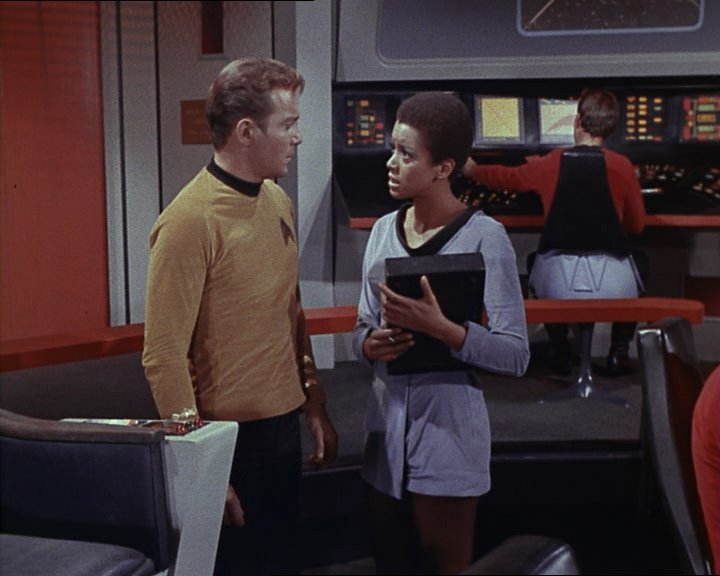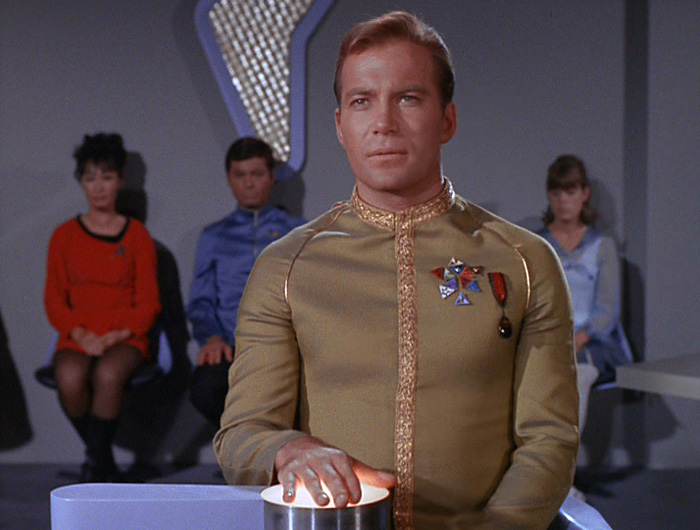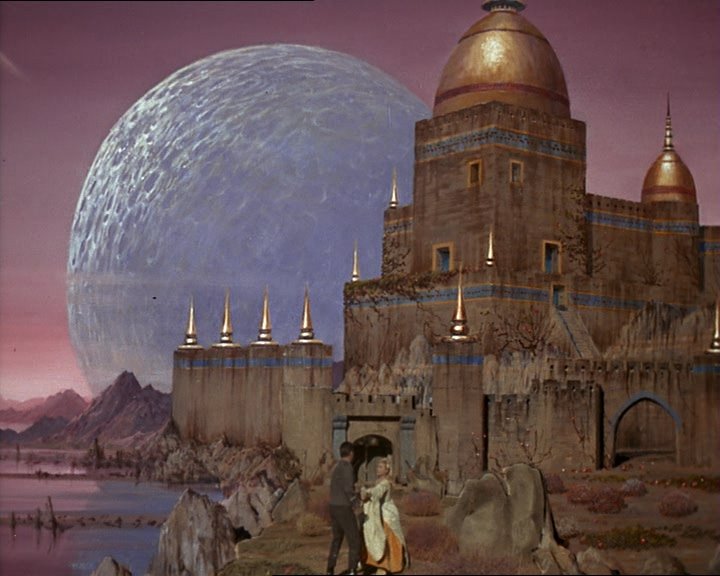
Star Trek – A Taste of Armageddon

dvd_snapshot_29.55_[2019.11.08_18.33.31].jpg

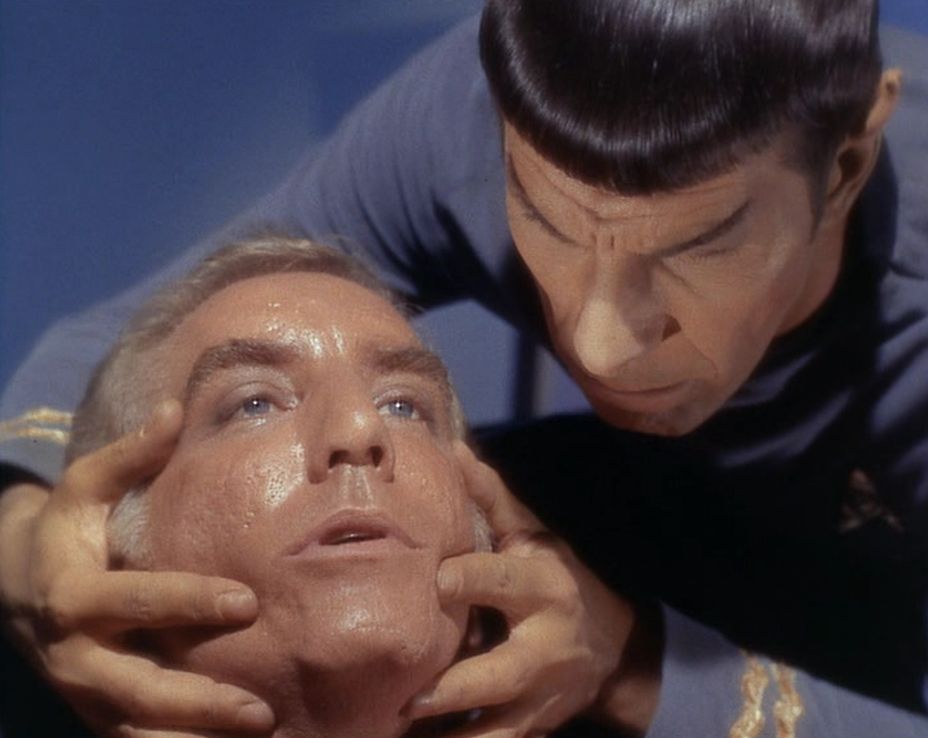
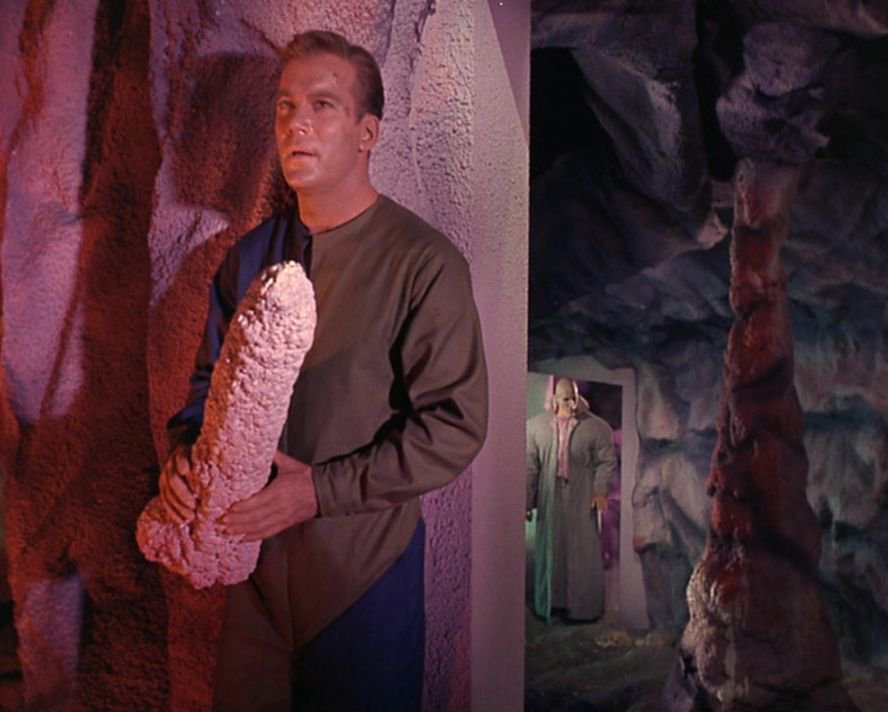
The Enterprise has travelled to Eminiar VII. Onboard is Ambassador Robert Fox (Gene Lyons), a man desperately keen to establish diplomatic relations with this mysterious and isolated planet. Kirk and a small landing party beam down, but whilst the locals are initially polite, the situation doesn’t stay stable for long.

Eminiar VII has been at war with a neighbouring planet, Vendikar, for five hundred years. The attacks may only be virtual (plotted by computer simulation) but the casualties are horribly real. Once the lists are totalled, the victims of each pretend attack have twenty four hours to present themselves to the nearest disintegration chamber.

The Enterprise has been declared a casualty of war, which means that every man and woman onboard is effectively dead ….

A Taste of Armageddon has an intriguing science-fiction concept, the problem is that it’s difficult to imagine any civilisation actually carrying such a crackpot scheme through (and for five hundred years no less).  We’re told that three million people are sacrificed each year – multiply that figure by five hundred and it becomes even harder to believe.

I’m also mildly amused by the fact that each disintegration chamber only takes one person at a time.  This must mean there has to be tens of thousands of them dotted around the cities – which is possible, if a little odd.  Surely after five hundred years they would have come up with a more efficient way of culling their population.

Possibly if the war had only lasted twenty years or so and the casualties had run into the thousands rather than millions each year it would have been easier to stomach.  But science fiction often likes to play with big concepts (it rather comes unstuck here though).

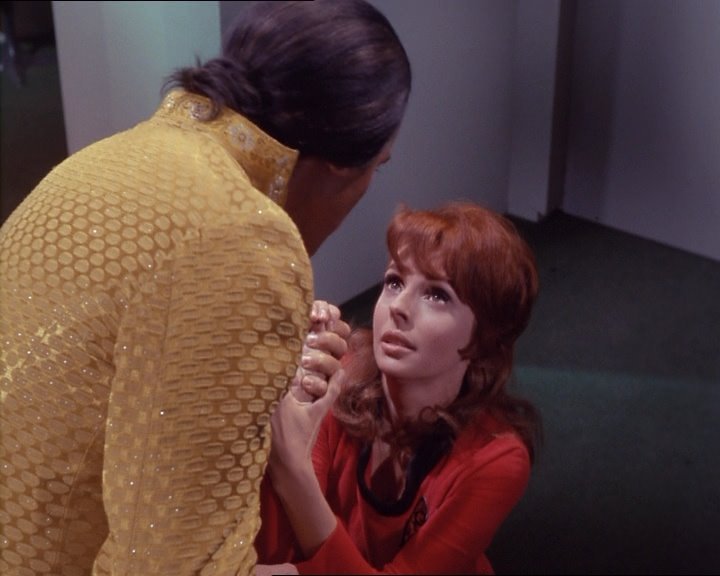
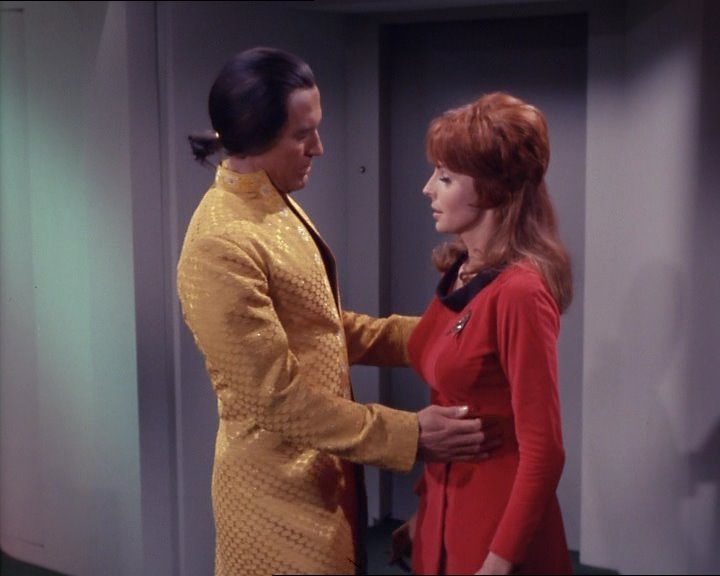
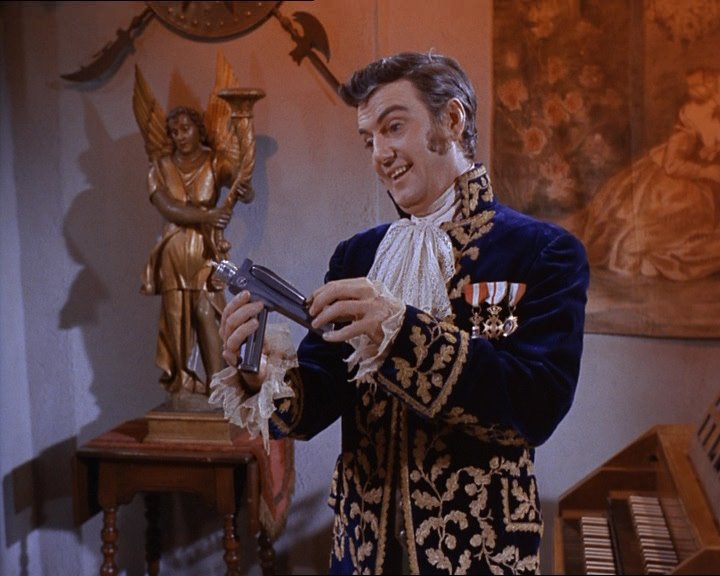
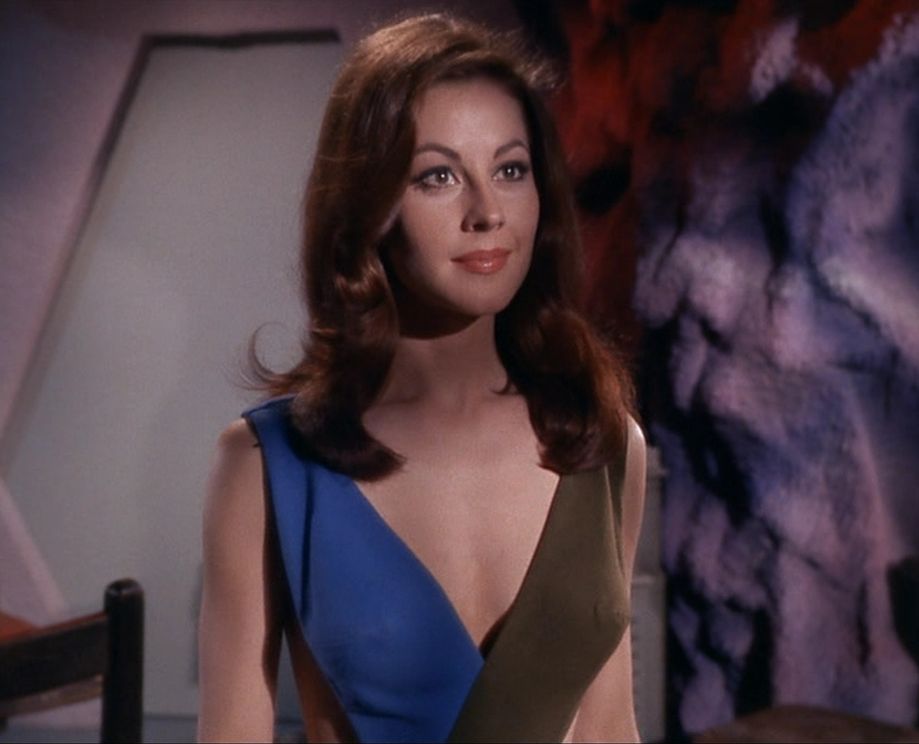
The fact that Eminiar VII is the planet of the silly hats is another problem, as is the total absence of any representatives from Vendikar.  Apart from a number of non-speaking extras, Eminiar VII is represented by two people – the ruler Anan Five (David Opatoshu) and the rather attractive Mea 3 (Barbara Babcock).

This is obviously a bit limiting in terms of creating a picture of a rounded civilisation – Opatoshu is fine as the smoothly silky diplomat who nevertheless will do whatever it takes to keep the war on a level footing but Babcock is rather wasted in a role that doesn’t really go anywhere.

It’s not all bad though. Scotty being left in charge of the Enterprise is a real treat.  As we’ve seen before, he’s a man who’s cool in a crisis (and is easily able to hold his own against the pig-headed Fox).  Scotty’s mournful remark that “the haggis is in the fire now” after Fox threatens to send him to a penal colony for disobeying his orders is such a stupid line that I can’t help but love it.

William Shatner is a bit more staccato than usual, although Kirk does have some good scenes towards the end of the episode as he attempts to bluff Anan Five into capitulating by threatening to destroy the planet (or was he not bluffing?).  Leonard Nimoy is also the recipient of a few nice little character moments, which helps to enliven the middle part of the episode.

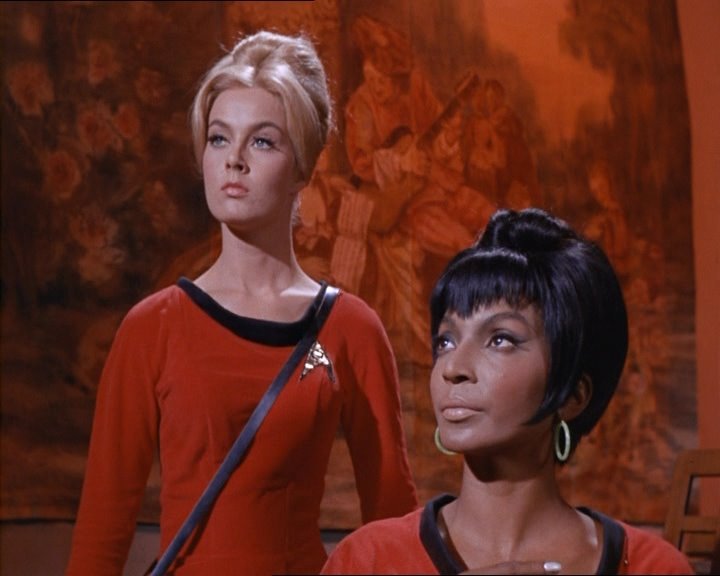
The three redshirts who accompany Kirk and Spock down to the planet are incredibly anonymous. Yeoman Tamura (Miko Mayama) did catch my eye, but then she was very pretty ….

As I’ve probably said before, I like my Star Trek to err on the cynical side. A Taste of Armageddon fits the bill nicely in this respect – Ambassador Fox is a man prepared to do anything in order to establish diplomatic relations with Enimiar VII.  Even if it means using force, no doubt.  This paints the Federation less as an altruistic organisation dedicated to peaceful exploration and more as a military outfit keen to grab a foothold in a strategically important area of space.

Provided you don’t think about the plot too deeply, this is an episode that flits by in a very agreeable way.  Yes, everything’s wrapped up a little too neatly – a five hundred year war sorted out by Kirk in a few minutes – but that’s the nature (and one of the drawbacks) of episodic television.

dvd_snapshot_20.23_[2019.11.08_18.32.53].jpg


Star Trek – The Return of the Archons

The Return of the Archons mixes together several story ideas which even this early on feel like Star Trek archetypes (computers with ideas above their station and an alien civilisation modellIng their architecture and fashion sense on the Earth).

The show has already established that the galaxy is a vast, lonely place.  That the USS Archon (which provides us with the reason why the Enterprise has journeyed to Beta III) was reported missing nearly 100 years ago bears this out.

It seems that if you get into a scrape out here then it’s best to use your own ingenuity as no-one is going to come riding to your rescue. Maybe that’s one of the reasons why Kirk feels justified in taking the law into his own hands.

Unlike Miri, which mentioned how strange it was that an alien society had aped the fashions of Earth, Archons quite wisely ignores this.  The real-world reason (it’s cheaper to use an existing backlot and costumes off the peg than it would have been to construct an alien town and create space-age fashions) is obvious, but it’s not really a problem.

In Tomorrow is Yesterday, Kirk was happy to beam down to present day Earth in his Starfleet uniform. But here the landing party makes much more of an effort (donning  appropriate period clothes).  A small touch, but it’s an indictor that this episode has a more serious tone.

The festival – a strict period of time where the usually docile inhabitants of Beta III are allowed to rape and murder at will – is a bizarre concept.  It certainly helps to give the episode a little extra spice.

There’s plenty to chew over in the script, although much is open to interpretation.  Is the mysterious and all-powerful Landru supposed to be a critique of organised religion?  The monk-like robes worn by Landru’s chosen ones, the Lawgivers, would suggest so.

But it’s also possible to read Landru as a piece of anti-communist propaganda. “Your individuality will merge into the unity of the good, and in your submergence into the common being of the body, you will find contentment and fulfilment. You will experience the absolute good”.

Nineteen Eighty Four looks to have been an inspiration as well (for the festival, see the two-minute hate – a somewhat more condensed, but similar, idea).

The way that McCoy and Sulu are brainwashed into total obedience is very jarring, especially Bones – who has always been the epitome of good-humoured common sense. Sulu – who gets the Landru treatment in the pre-credits teaser – is gifted a brief scene in which he’s required to do a spot of acting. It seems to have been quite a while since Sulu has done anything interesting.

Archons is the first episode to mention the Prime Directive, but Jim is quick to find a loophole. When Spock reminds him that the Prime Directive forbids interference in other civilisations, Kirk snaps back that the rule “refers to a living, growing culture. Do you think this one is?”.  That’s something of a fine distinction.

Kirk feels entirely justified in destroying Landru, since it means that democracy will be brought to a society which has been suffering under an autocratic ruler. But we’ve seen throughout history the problems caused when civilisations are tampered with. Sometimes with the best of intentions, sometimes not.

Star Trek would make several coded references to the Vietnam war throughout its three year television mission.  The series tended to be rather fluid (depending on the sensibilities of the specific scriptwriter) about whether American involvement there was a good or bad thing.  Archons is one where you feel that they’re firmly in the pro camp. 

Kirk doesn’t waste any time asking the inhabitants of Beta III whether they’d like to remain under the rule of Landru.  He’s decided their future for them and that’s that ….

Harry Townes gives a nice performance as Reger, one of the few not to follow the will of Landru. It feels rather contrived that Kirk and the others are directed to him with such alacrity – but the story needed someone like Reger to quickly fill the viewers in about how Beta III functioned. 

Return of the Archons doesn’t exactly have a watertight plot (just what is the point of the festival?) but everything is played with conviction and that helps to keep things ticking over nicely.


Star Trek – Tomorrow Is Yesterday

Tomorrow Is Yesterday has a wonderfully disorienting pre-credits teaser. Most episodes to date have opened with a shot of the Enterprise orbiting the planet of the week. But today we begin on twentieth century Earth, which means that for a few moments it’s possible to believe that the wrong channel has been selected and this isn’t Star Trek  after all …

Normal service is resumed after we see the Enterprise (a little wobbly, it’s true) moving through the sky. But an intriguing mystery has been established. How and why have they travelled back through time?

There’s a mundane reason for this atypical opening (the episode was originally planned as the second of a two-parter, following The Naked Time) but no matter, it still works.

The reason why the Enterprise has taken a trip back to the 1960’s won’t detain us for too long (something about the effects of tangling with a high gravity black star).  It makes little sense, but then neither does the way they return to their own time. A little more on that later.

Briefly the episode has a serious and downbeat tone. Captain John Christopher (Roger Perry) is a US pilot sent to investigate a mysterious UFO (which of course is the Enterprise). Beamed aboard, he’s aghast to be told by Kirk that they can’t return him  – he’s glimpsed the future and so could cause untold damage to the timelines if he went back.

There was scope for an interesting story to be crafted out of this dilemma – how Christopher would have adjusted to life in the future – but this wasn’t that episode. Spock quickly realises that they have to send him back (Christopher’s unborn son will become an important figure in the development of space travel) and so the romp begins.

It’s easy to see how the basic plot was recycled for Star Trek IV: The Voyage Home. There’s no whales, but the concept of Kirk and co carrying out a secret mission on contemporary Earth, bamboozling hapless officials as they go, feels very similar.

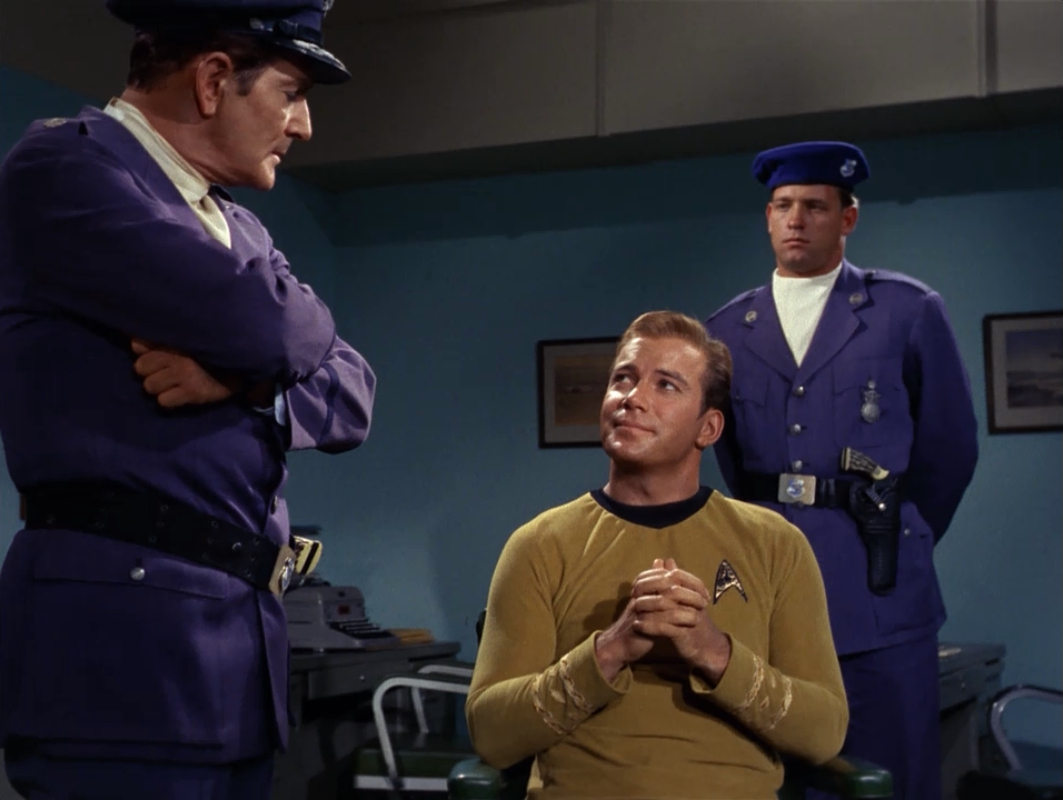
Kirk and Sulu beam down to the airbase, intent on removing all photographic evidence of the Enterprise’s existence. Kirk gets himself captured, but not before William Shatner has indulged in a fight with several soldiers that’s played purely for laughs. His later interrogation is pretty chuckleworthy too (especially the comment about his uniform). Shatner’s clearly having a ball in these scenes.

If it wasn’t obvious that Tomorrow Is Yesterday was the series’ most comic offering to date, then the soundtrack tends to hammer this point home at every available opportunity. For example, whenever Kirk talks to the computer (which now has a female personality and is deeply in love with him). Yes, it’s that sort of story.

If the reason for the Enterprise’s arrival in the twentieth century lacks a little logic, then that’s nothing compared to the plan cooked up by Spock and Scotty to get them back to where they belong. Best not to worry about this though, just go with the flow. The reset button solution does solve the problem of Christopher (not to mention another hapless individual who also got beamed up) but it’s also a massive contrivance.

Mind you, there are some episodes where I find plot-holes to be annoying and others (like this one) where I’m inclined to be more forgiving. Tomorrow Is Yesterday is frothy, uncomplicated fun and therefore impossible not to enjoy.

Star Trek – The Alternative Factor

Some Star Trek episode titles conjure up strong images. Mention Arena for example and visions of Kirk and the Gorn slugging it out man-o-lizard instantly comes to mind. Others like The Alternative Factor are a bit more of a mystery. That is until we’re a few minutes in and I realise that it’s the one with Lazurus (Robert Brown). Uh oh, we’ve got a bumpy ride ahead ….

To begin at the beginning. There’s a fine example of throwing yourself about acting (to simulate extreme turbulence) during the pre-credits teaser. Most science fiction series required this skill, but The Alternative Factor is an object lesson in how it should be done.

Continuing to watch the series in production order throws up some interesting storytelling quirks. This is the second episode in a row where Kirk gets very gung-ho, ordering a red alert and convincing himself that an invasion is just round the corner.

The episode also reiterates the notion that it’s a big galaxy out there. The Enterprise is required to face a mysterious phenomenon (which may be natural or could be alien-made) alone – no other ship will be able to reach them in time.

This is partly budget related of course, but it also works from a story-telling point of view. The way that Kirk and his crew are cast in the roles of pioneers, exploring uncharted terrority, raises the stakes (there’s no starbase to run to when the going gets tough).

The production was affected by John Drew Barrymore electing to leave the role of Lazarus at the last minute (during the first morning of filming in fact). Robert Brown, drafted in as a very hasty replacement, therefore had a tough task, so we should cut him some slack.

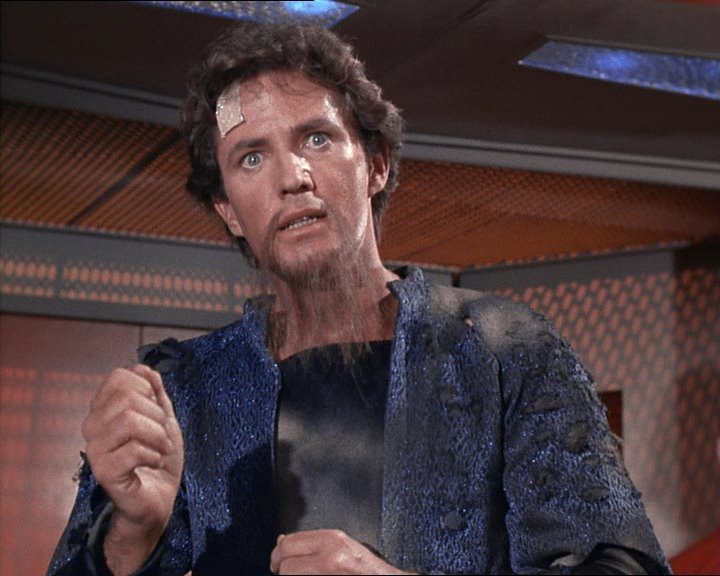
Brown’s performance is very full on (to put it mildly). But he could only work with the material he was given. The script is … not good. There’s some interesting concepts at work – Lazarus is at war with an anti-matter version of himself – but the realisation is a very muddled. After a while my attention tends to drift as Lazarus simply isn’t that engaging a character. A little of his fire and brimstone raving goes a long way with me.

There are still some incidental pleasures to be found though. I love the wonderfully blunt way Spock tells Lazarus that he’s lying. It seems rude, but Spock is able to explain this away with logic (of course).

Also noteworthy is the appearance of a black female lieutenant who isn’t Uhrua. Lt. Charlene Masters (Janet MacLachlan) doesn’t have the largest role, but at least Masters isn’t as feeble as some of the wilting Enterprise females we’ve seen so far this year.

Earlier drafts did feature her more prominently though. A romance between Lazarus and Masters might have been interesting, but that was one of many ideas which ended up getting cut (the interracial angle was a concern to the network).

Oh, and Bones referring to himself as a humble country doctor is delightful.

Overall, this isn’t very good at all, but then you can’t strike gold every week. Indeed, given the fact that the first season ran for twenty nine episodes it’s remarkable that the general quality remained very high.

Star Trek – Arena

Arena begins in a rather jolly way, but this mood doesn’t last. Jim and Bones are both licking their lips in anticipation of their visit to a colony planet called Cestus III. The Commodore (an old friend of Kirk’s) is renowned for the quality of his food and drink (Spock, of course, doesn’t join in with their banter).

This moment of levity is all the more effective for the way the episode sharply gear-changes after Kirk and co beam down and discover that Cestus III is a total ruin. By great good fortune (or plot contrivance) there’s a survivor. Kirk is keen for McCoy to keep him alive – but more because he has vital information about the attack, rather than out of any concern for his well-being.

Kirk might seem a little cold here, but it’s a good indicator of his military training kicking in (something which he hasn’t had to use too often during this first season, Balance of Terror being a notable exception). 

The tension ramps up a little more after Sulu reports that the Enterprise is under attack. Another nice Kirk character beat is shown here – he tells Sulu not to lower the shields in order to beam them back. That could leave the Enterprise vulnerable and the ship has to take precedence over individual lives. The needs of the many …

The early part of the episode, operating rather like a war film, is very atypical of the series to date. Most of the adversaries faced so far have either been singular (Charlie, the Salt Monstet, the Squire of Gothos) or abstract (the virus in The Naked Time).

The relentless barrages faced by Kirk and the others (very decent explosions, clearly this episode had a healthy budget) creates a feeling of dread as see see Kirk’s small gang getting picked off by their unseen adversaries.

Arena could have remained on Cestus III, but instead the remains of the landing party are finally able to beam back up (the alien vessel has disengaged). This feels a little pat, but no matter – the preamble is over and we’re now heading into the heart of the story.

It’s interesting the way that Kirk (based on very little evidence) is convinced that the alien’s intention has to be invasion. Spock seems to struggle with this concept for a few seconds before loyally agreeing with his captain.

Kirk decides that if they pursue and destroy the alien ship then the other aliens won’t dare to move against them in the future.  Mmm, okay. I can see a few flaws with this line of reasoning, but given the way the story plays out that was no doubt intentional

Kirk, still reeling from the destruction of the colony, appears to have vengeance on his mind. But he also tells Spock that “it’s a matter of policy”, which suggests that he’s not just acting from bloodlust (he’s also obeying standing Starfleet orders).

Kirk’s attempt to blast the alien vessel comes to naught after he and the captain of the other ship, a race we now discover are called the Gorn, are plucked from their respective vessels by the all-powerful Metrons.

The Metrons are somewhat irked to discover that their section of space has been invaded and have decided that Kirk and the Gorn should face each other in single combat. The winner’s ship will be allowed to leave, the loser’s ship destroyed …

It’s usually around this point that I have a hankering to watch the Blakes 7 episode Duel.

When Kirk disappears from the bridge, Uhura lets out a piercing scream. Not the behaviour you’d expect from a trained professional, but it fits with the series’ general treatment of females to date.

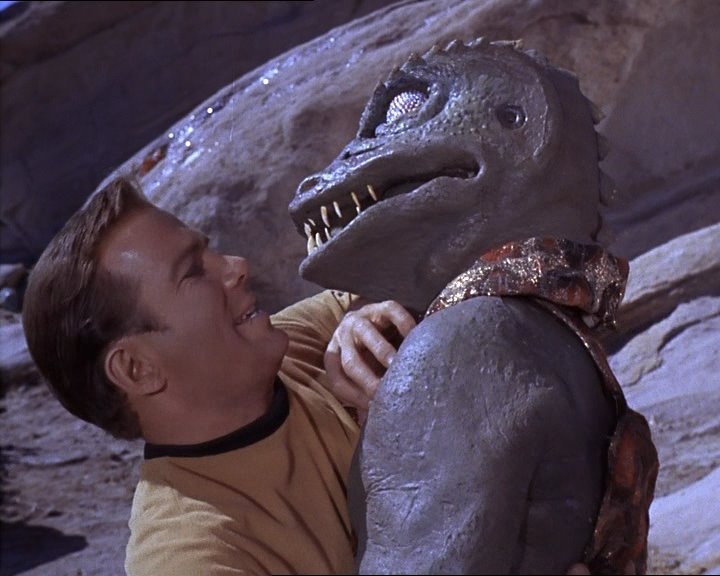
And then we meet the Gorn. He looks a bit silly doesn’t he? Maybe it’s all the grrrring and chuckling, or possibly it’s the fact his mask looks a little too much like a mask. His little tabard, which barely covers his alien modesty, is also worthy of a mention.

I have to confess that this is the point in the story where my attention starts to wander, especially since the Gorn isn’t a great conversationalist (at least to begin with). Shatner puts his all into the action scenes (surprisingly his shirt doesn’t get ripped) and also does his best to convince us that the lightweight rocks he tangles with actually weigh a ton. That’s something they can’t teach you in acting school.

Eventually Kirk and the Gorn are able to communicate. Once they do so it’s remarkable how the Gorn becomes less of a monster and more of an individual. The moral of the story then follows – aftet sparing the Gorn’s life, Kirk has proved to the Metrons that mankind might just have a future. Kirk’s refusal to allow the alien ship to be destroyed is another mark in his favour.

But Kirk is still shown to be a flawed hero. His initial desire to destroy the Gorn ship could have triggered a war. Whilst Kirk strong-arms it down on the planet, Spock and McCoy – watching events on the scanner screen – are able to discuss the nuances of their situation. Were the Gorn acting in self-defence on Cestus III? If so, their actions would be a little more understandable.

But that doesn’t explain who sent the faked messages which lured the Enterprise to the destroyed colony. The Gorn? That suggests a degree of cold-blooded calculation which doesn’t square with the Gorn’s claims that the human colonists had invaded their area of space and they only attacked them in self defence (which is a shaky enough argument anyway). Maybe this plot point got overlooked during the various rewrites.

The very silly-looking Gorn is a bit of a problem and the moral is ladled on rather thickly, but there’s still plenty of interest to be found in Arena. Generally anything with Gene L. Coon’s name on it is a sign of quality (I don’t think he should shoulder all the blame for Spock’s Brain).

I still prefer Duel though. It has Isla Blair for one thing …

The Jewel In The Crown, Southall, Middx by Johnny Speight (1985, unscreened pilot)

jewel.jpg

It’s fair to say that Johnny Speight remains a rather controversial figure, more than twenty years after his death.  The news that the recently established UK streaming service BritBox will not carry Till Death Us Do Part has brought his name to the fore once again. Although this, to be honest, is a bit of a non-story. At present, the list of archive television from the sixties, seventies and eighties not on BritBox dwarfs the small amount which is …

With Till Death, the argument (a pretty convincing one) has always been that whilst Alf Garnett often espouses bigoted and racist opinions, the series – and the other regular characters – are laughing at him, not with him.  This defence was also (less convincingly) used for Speight’s LWT sitcom Curry and Chips, in which Spike Milligan (browned up as Paki Paddy) joined his old friend Eric Sykes for a short lived series which was mired in controversary right from the start.

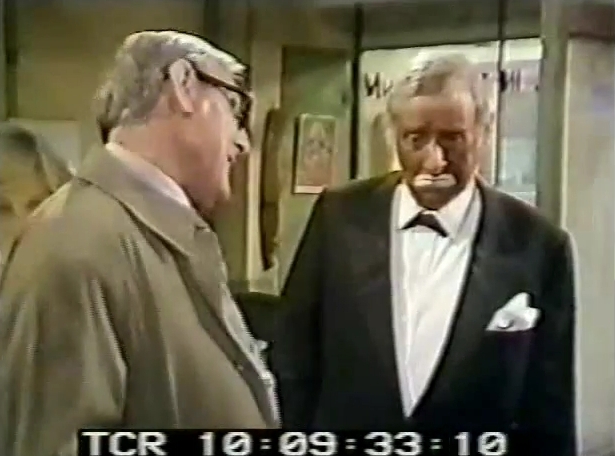
Milligan clearly enjoyed browning up as he later played Mr Van Gogh, an illegal Pakistani immigrant, in The Melting Pot which was written by Milligan and Neil Shand.  Only the pilot was transmitted, the remaining six episodes have remained locked up in the BBC’s vaults for over forty years.

Given all this, what were the chances that a mid eighties BBC pilot featuring Sykes and Milligan (once again browned up) and written by Speight would prove to be a roaring success? Clearly very slim ….

Watching The Jewel In The Crown now, it’s interesting for many reasons – not least the fact that it’s precisely the sort of programming which alternative comedy was supposed to have killed off.  Of course, the notion that alternative comedy was always some sort of positive cleansing force has to be taken with a pinch of salt. Not all trad comedy was bad, not all alternative comedy was good.

Anybody looking to claim that The Jewel In The Crown is a satire on racism will have their work cut out for them. In the first few minutes Spike explains to Eric why he’s opened a crummy café whilst caked in brownface. “All those Pakistanis come over here and steal our jobs, right? Well, I’ve opened up a Pakistani restaurant and I’ve blacked myself up every night and I steal some of their bloody jobs”. Eric looks perplexed but doesn’t issue a challenge, so the point is allowed to stand.

The thirty five minutes aren’t without some merit though.  Even allowing for the fact that Spike’s Irish accent comes and goes at will, Spike Milligan and Eric Sykes are always worth watching (even if it’s slightly sad that they didn’t seem to have any issue with Speight’s script).

The fact that they’re playing versions of themselves is also interesting (there’s a gentle dig from Spike about the fact that Eric’s spent twenty years making the sitcom I Love Hattie). There might have been some merit in developing this theme had the pilot by some miracle generated a series. And Josephine Tewson and Keith Smith (an old colleague of Spike from his Q days) both add a little touch of quality, even if they can’t do anything with the script either.

I haven’t been able to source a great deal of info about this pilot, save for the usual rumblings that it was never broadcast due to “political correctness”. It’s probably more to do with the fact that it was horribly misjudged and not really very funny.  As a curio it’s certainly worth a look, but it’s hard to see it as any sort of missed opportunity.

Star Trek – The Squire of Gothos

We’re treading familiar territory in today’s episode – Kirk and the others facing someone with godlike powers (just like Where No Man Has Gone Before or Charlie X) – but The Squire of Gothos still engages and maintains a high level of interest from beginning to end.

A big part of this is down to William Campbell’s performance as Trelane (it’s an excellent guest turn – one of Star Trek‘s best).  Like Charlie, Trelane increasingly acts like a petulant child, which makes the final reveal (he actually is a sort of child in a man’s body) all the more satisfying.

Living in a sumptuous mansion decorated with twentieth century objet d’art (as well as some highly recognisable Star Trek memorabilia) Trelane toys with Kirk and the others in an amused, but disinterested way.  He can freeze people or alter matter at will, but these examples of his power may just be the tip of the iceberg.  We don’t learn a great deal about him – who or what he actually is – but this isn’t a problem. Indeed the fact that he’s such a nebulous character makes him all the more intriguing.

The way that Trelane places a cheery message – “greetings and felicitations” – on the Enterprise’s scanner screen is a wonderfully jolting moment.  The Enterprise in general, and the bridge in particular, always has the feeling of a safe haven – so to see it breached in such a casual way informs the viewer that today’s adversary is no run of the mill type.

Trelane is a keen student of Earth’s history, especially the wars, and expects Kirk to share his interest. “I want to learn all about your feelings on war and killing and conquest. That sort of thing”.  Of course Kirk doesn’t have a similar love of battle, but the episode doesn’t handle this in a heavy handed way (later iterations of Trek might have been a little more on the nose when discussing the way that today’s Earth people are obviously much more enlightened than the savages of the twentieth century).

Trelane and Kirk eventually fall out, seemingly because of the attention Tremane shows to Yeoman Teresa Ross (Venita Wolf). But in fact Kirk is only using Teresa as an excuse to test the limits of Trelaine’s abilities. 

This week’s fairly disposable female Yeoman, Teresa doesn’t really push forward the depiction of women in the Star Trek universe. Changed into a sumptious ball gown by Trelane, Teresa is relegated to the status of a decorative object, something which is confirmed when Trelane tells Kirk that they “fight for the attention, the admiration, the possession of women” (Teresa looks very nice but hardly says a word). 

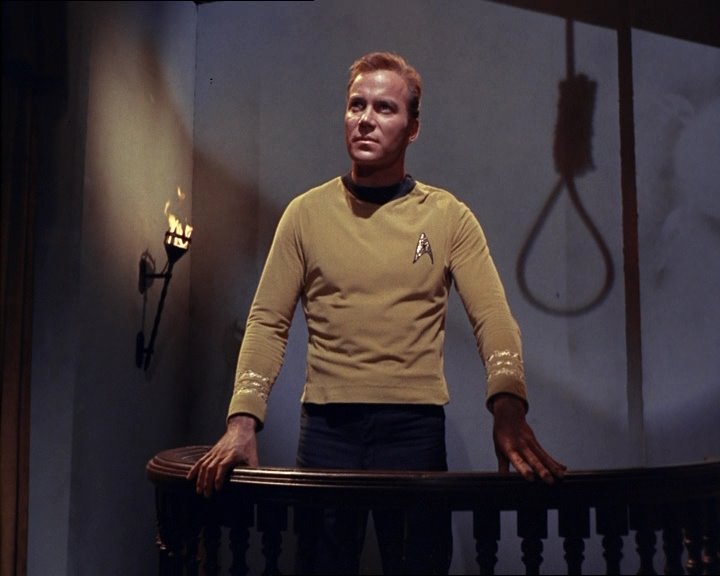
Kirk being placed on trial by a vengeful Trelane works well. This is partly down to the enthusiastic way a be-wigged Campbell bangs his gavel, but also because of how simplistic the staging is. No doubt this was partly budget related, but the image of Kirk in the dock with a silhouette of a noose behind him is still a striking image.

Given Trelane’s unimaginable power, Kirk was never going to beat him in a fair fight. But the episode’s conclusion doesn’t feel like a cop out. In fact, the way that Trelane’s brittle bravado is pricked by his unseen parents (“stop that nonsense at once, or you’ll not be permitted to make any more planets”) is a very satisfying way to wrap things up.

Although primarily a Kirk story, Spock is also well served by Paul Schneider’s script. I especially love his confrontation with Trelane. “I object to you. I object to intellect without discipline. I object to power without constructive purpose”.

If I was one of those people who enjoyed making lists, then The Squire of Gothos would be pretty high up on my favourite episodes list.

Star Trek – Shore Leave

shore1.jpg

Shore Leave is a highly enjoyable slab of fantasy. It’s best not to worry too much about the plot specifics, just sit back and enjoy the ride.

Star Trek had ventured out of the studio a few times by this point, but mainly the location work hadn’t gone any further than the readily accessible back-lot sets. So this makes the glossy visuals of Shore Leave appear especially startling (no doubt the viewers appreciated the sunny vista just as much as the tired Enterprise crew). It’s certainly a change from the series’ more regular diet of identikit studio-bound planets.

Although Star Trek is probably fixed as a science fiction series in most people’s eyes, it wasn’t afraid of a touch of fantasy (although Shore Leave goes further than most stories in this respect). Eventually a rational explanation is given for all the weirdness (it’s the work of a highly advanced civilisation who conveniently live off-screen in a massive underground complex) but that’s a fairly cop-out resolution.  

If the network been prepared to embrace the fantasy concept it would have been interesting to have left the story resolution a little more opaque.

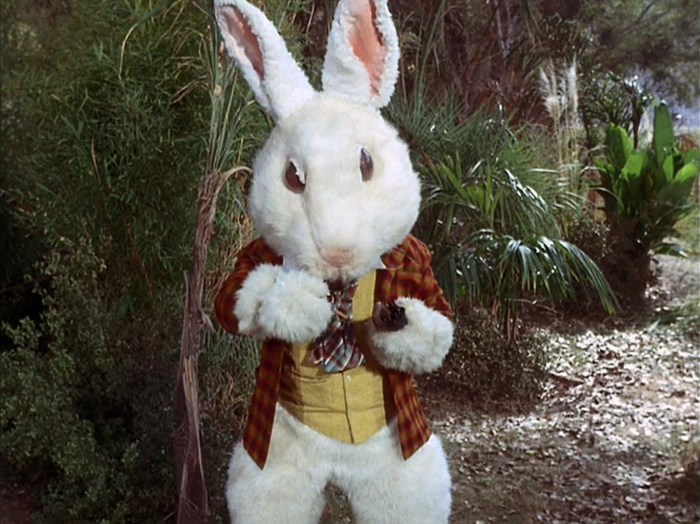
Very early on we’re primed to expect the unusual today. Bones’ encounter with a large bunny rabbit checking his watch is one of those magic Trek moments whilst Sulu has an entertaining tussle with a Samurai warrior. But the meeting between Yeoman Barrows (Emily Banks) and Don Juan feels much more problematic.

It’s easy to believe that Barrows’ part was originally written for the now departed Janice Rand, who was often at the mercy of predatory men.  Barrows is discovered in a dishevelled state with her clothing ripped, explaining that “it was so sort of story book walking around here, and I was thinking, all a girl needs is Don Juan”. We’re left with the uncomfortable implication that on some level Barrows had invited this assault.

Kirk needs to be cajoled by both Spock and McCoy to partake of some shore leave, even though his iron constitution is feeling the strain. There’s a gorgeous comic moment during the pre-credits sequence where we see a weary Kirk receiving a massage from (he thinks) Spock. But it was actually Barrows doing the work (which Kirk seems oddly disappointed about). There’s so much slash fiction fodder there ….

When he does beam down, Jim quickly embraces the planet whole-heartedly (casually dismissing the fears of another member of his away team). This is mainly because he runs into one of his old flames, Ruth (Shirley Bonne).

No doubt he finds that meeting up again with the cocky Finnegan (Bruce Mars), the bane of his Academy days, to be much less welcome.  Finnegan is (or more accurately, supposed to be) Irish, which means that the incidentals suddenly go into diddly-de overdrive.  This is not a good thing. But as compensation there’s a spot of classic Kirk shirt-ripping when he slugs it out, man to man, with Finnegan.

Bones is also having a fine old time, strolling through the woodland with the rather attractive Yeoman Barrows.  He seems keen to replace Don Juan in Barrows’ affections, but his advances come to an abrupt halt after he’s impaled by a lance wielding knight on horseback.  This sudden explosion of violence is very jarring – could McCoy really be dead?

Maybe he was, but the amazing restorative powers of the mysterious aliens who run this planet-sized theme park are able to patch him back together with very little fuss.  As mentioned before, you have to embrace this sort of plot contrivance in order to get the maximum enjoyment out of the episode.

McCoy seems no worse for his brush with death – squiring two lovely young ladies with a beaming grin on his face, it’s not difficult to work out what he’s going to be doing with the rest of his leave. And if not with them then maybe with the obliging Yeoman Barrows.

If you like your Star Trek grim and serious then the frivolity of Shore Leave might not appeal.  Personally, I’ve always been partial to a bit of whimsy so it’s always a pleasure to revisit this one.

It’s just a shame that William Shatner’s rash offer to wrestle a tiger (he felt it was just the sort of thing to add a little spice to the story) wasn’t taken up.  If he’d avoided being mauled to death, it would have made the episode just that little bit more special ….

shore2.jpg

Star Trek – Court Martial

court 1

Court Martial sounds like a winner (Kirk on trial) but sadly the finished episode is somewhat flawed. Don M. Mankiewicz’s draft script received a fairly drastic rewrite from story consultant Steven M. Carabatsos whilst post-production editing moved or cut various scenes (with the result that vital chunks of the plot feel like they’re missing).

Mankiewicz’s original premise – a cheap story confined to a single set – was opened up by Carabatsos but it’s debatable whether this actually strengthened the story or not. Although I do have a fondness for the concluding act – silly though it is ….

During an Ion storm, Kirk is forced to jettison a research pod containing Lieutenant Commander Benjamin Finney (Richard Webb).  Kirk maintains that the Enterprise was on red alert at the time, but the computer reports that the ship was only at yellow alert.  Kirk’s apparent perjury is enough to trigger a court martial.

An obvious weakness with this episode is the fact that we know everything’s going to work out in the end for Kirk, despite the evidence appearing to be completely damning.

But there are some good moments – such as the way Kirk’s old Academy pals give him the cold shoulder or the moment when Kirk angrily reacts to Commodore Stone’s attempt to sweep the matter under the carpet by asking him to resign.

As the court martial wears on, a battle plays out between Kirk and the computer. We’re told that “computers don’t lie” so it seems that Kirk must be the one who’s lying.  The conflict between man and machine crops up time and again in science fiction (just think how often Jon Pertwee’s Doctor berated the limitations of the machine mind).

This is a decent part of the episode (even the logical Spock is forced to admit that computers aren’t infallible). Indeed, the original drafts pushed this concept even further – originally the computer was shown to be sentient and had taken a strong dislike to Kirk, deciding all by itself to falsify the evidence.

Less successful is the allegation that Kirk jettisoned the pod out of a sense of malice. Evidence is brought to show that Finney’s career was seriously downgraded by Kirk, but we never believe for a moment that Jim would have acted at all incorrectly.  Indeed, Spock steps up to tell the jury that “it is impossible for Captain Kirk to act out of panic or malice. It is not his nature”.

By now you’ve probably realised the truth – an embittered Finney is alive and (sort of) well.  Having faked his own death and corrupted the computer, purely to bring shame and disgrace on Kirk, he’s now hiding in the bowels of the Enterprise.  Umm, okay.  Clearly Finney is far from the full shilling at the moment. Kirk ventures down to Engineering alone in order to face him.  Why? Because it makes for good drama I guess.

But although the logic of the story has thoroughly unravelled by this point, we can still enjoy the Kirk/Finney face-off.  The taunting Finney (“your own death would mean too little to you. But your ship .. it’s dead .. I’ve killed it”) is excellent value.  Finney – by attempting to target the Enterprise – has clearly chosen Kirk’s weak spot (and his one true love).

The inevitable fight then occurs. Whilst the pair are facing off, I like to simultaneously goggle at the obvious stunt doubles used whilst also marvelling at how easily Kirk’s shirt gets ripped. This always happened to him ….

Elisha Cook Jr. adds a touch of class to proceedings as Samuel T. Cogley,  Kirk’s defence attorney.  Although the way he abruptly vanishes before the end of the story is an illustration of messy editing fracturing the narrative flow.  As is a late voice-over from Kirk which attempts to paper over some of the other story cracks.

At one point Finney’s daughter looks to possess a vital piece of the puzzle (after talking to her, Cogley appears to have found a new line of defence) but it’s never made clear in the transmitted episode what this might be. A scene with her and Cogley returning to the Enterprise was filmed, but then cut. This is a pity (although it’s present in James Blish’s novelization).

Joan Marshall as Lt. Areel Shaw is rather watchable. An old flame of Kirk’s, she just happens to have been assigned to the court martial as its prosecutor. Starfleet (which is actually named for the first time in this episode) is clearly a small world ….

Court Martial is enjoyable enough (everybody looks very nice in their dress uniforms) but isn’t quite the finished article.  No matter, normal service will be resumed shortly.

court 2

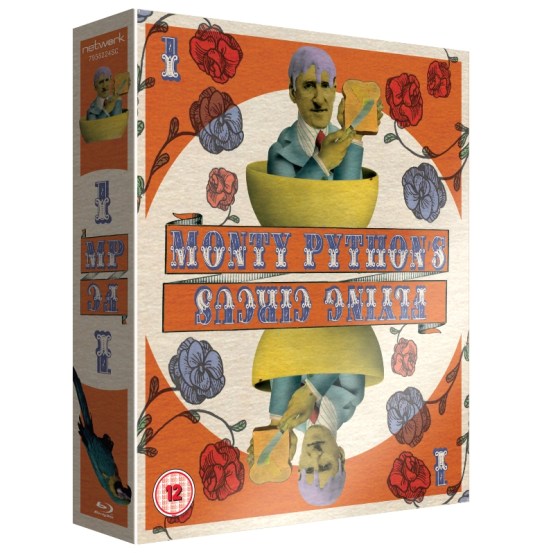
Monty Python’s Flying Circus – Series One. Network BD/DVD Review

It probably won’t have escaped your notice that 2019 marks the 50th anniversary of Monty Python’s Flying Circus. There’s already been a flurry of interesting Python related material released – such as At Last The 1948 Show and Do Not Adjust Your Set from the BFI – but now the series itself debuts on BD from Network.

The previous DVDs (Sony, 2007) were perfectly serviceable, although disappointingly bare bones in terms of special features.  The Network releases, in addition to theIr improved picture quality, also promise a slew of interesting bonus material (mainly additional studio footage and film offcuts).

Series one of Monty Python feels quite traditional, at least to begin with. Sketches such as The Funniest Joke In The World and The Mouse Problem have very definite beginnings, middles and ends.  The first transmitted episode (Wither Canada?) also introduces us to a key Python trait – mixing highbrow and lowbrow culture (the Picasso cycling race).

It’s Kandinsky. Wassily Kandinsky, and who’s this here with him? It’s Braque. Georges Braque, the Cubist, painting a bird in flight over a cornfield and going very fast down the hill towards Kingston and… Piet Mondrian – just behind, Piet Mondrian the Neo-Plasticist, and then a gap, then the main bunch, here they come, Chagall, Max Ernst, Miro, Dufy, Ben Nicholson, Jackson Pollock and Bernard Buffet making a break on the outside here, Brancusi’s going with him, so is Gericault, Ferdinand Leger, Delaunay, De Kooning, Kokoschka’s dropping back here by the look of it, and so’s Paul Klee dropping back a bit and, right at the back of this group, our very own Kurt Schwitters.

Although this is the sort of sketch which has tended to label the Pythons (in certain quarters at least) as elitist, it’s not really. You don’t need to have heard of all the artists described by John Cleese (in his best breathless commentators voice) in order to appreciate the strange juxtaposition of a group of artists attempting to create new masterpieces whilst also indulging in a hectic cycle race.

What’s remarkable about revisiting this first series is discovering just how packed it is.  Later on the Pythons would slow down a little in terms of producing top-rate material (they also started to delight in stretching out jokes long beyond their natural conclusion) but to begin with there’s an abundance of strong sketches.
p1

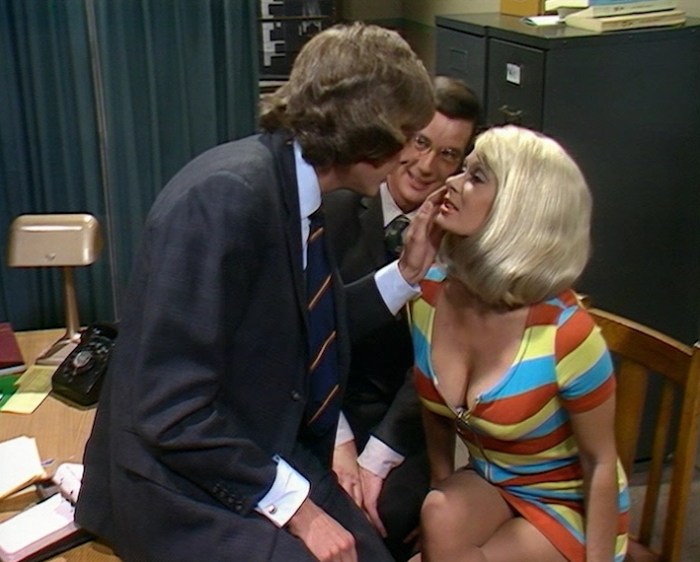
The hen-pecked Mr Arthur Putey, Arthur ‘Two Sheds’ Jackson, Whizzo Butter (“you know, we find that nine out of ten British housewives can’t tell the difference between Whizzo butter and a dead crab”), Bicycle Repair Man, Dirty Fork and Nudge, Nudge all show up within the first three shows.  As does the Working Class Playwright, an early example of Graham Chapman’s ability to inhabit a character (it’s also an excellent showcase for Terry Jones’ drag skills).

Self Defence Against Fresh Fruit is another favourite of mine, whilst Confuse A Cat has a slew of very odd images (such as a penguin on a pogo stick) which suggests that the Pythons were beginning to stretch their creative legs.

Crunchy Frog (“oh, we use only the finest baby frogs, dew-picked and flown from Iraq, cleansed in the finest quality spring water, lightly killed, and sealed in a succulent, Swiss, quintuple-smooth, treble-milk chocolate envelope, and lovingly frosted with glucose”) is the highlight of the sixth episode whilst the seventh – You’re No Fun Anymore – spins the series off into a different direction.

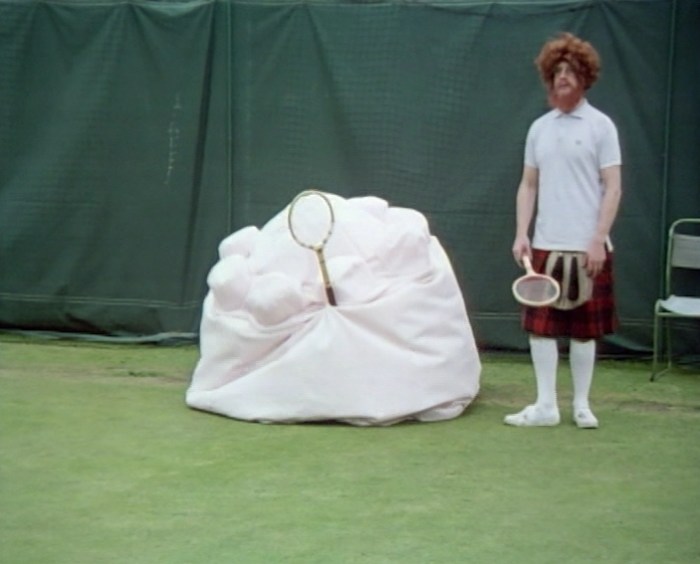
After a few throwaway early sketches, the bulk of the running time is devoted to a single sketch – an alien blancmange is desperate to win Wimbledon and so transforms all Englishmen into Scotsmen (as it’s well known that the Scots can’t play tennis). That’s not something you see every day.
p2

Show eight – Full Frontal Nudity – is a fascinating one.  It demonstates how the Pythons were increasingly playing with the form of sketch comedy (Graham Chapman’s Colonel appears at regular intervals to stop “silly” sketches whilst the Pythons were also beginning to question on-screen the quality of their own material).

This wasn’t new though. Spike Milligan (“what are we going to do now? What are we going to do now?”) had already thoroughly deconstructed the way a sketch was traditionally performed and concluded in his Q series.

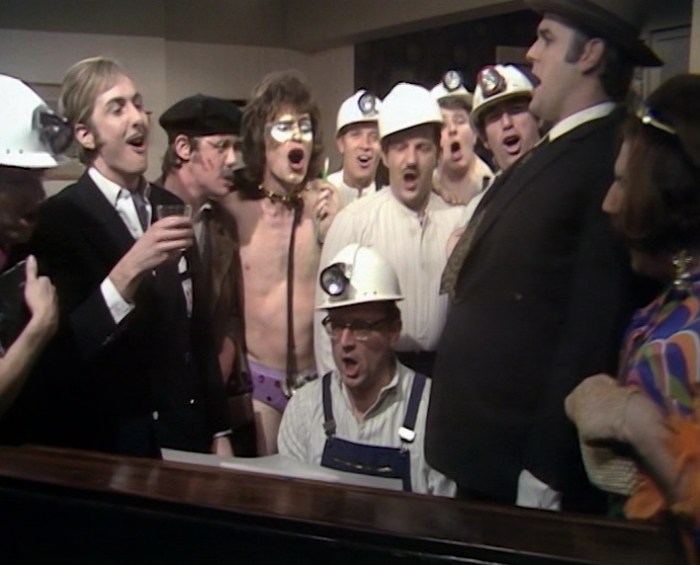
This mockery (or self-indulgence) only works if there are some strong sketches in the show.  Luckily, Full Frontal Nudity delivers with Buying A Bed and Hell’s Grannies as well as an amusing skit concerning a dead parrot.

It’s interesting that even this late on in the first series, sketches were still being played out to polite, but not ecstatic, audiences.  Once Python become a cult, the studio audiences tended to be packed with very receptive younger viewers (rather than – as legend has it – confused old dears who were convinced they were coming to watch a real circus).  It’s slightly jarring to see the Dead Parrot sketch receiving a fairly muted response (compare and contrast this to the hysteria generated whenever it was later performed live).

p3

The eleventh show – The Royal Philharmonic Orchestra Goes To The Bathroom – is quite noteworthy as it seems to point the way ahead to the more fragmented Python of series two. There’s still good material (Inspector Tiger) but you also have the likes of Interesting People (which is best described as free-form).  In some ways this show feels like the Beatles’ White Album – bitty and incomplete, but still rewarding.

Llamas, Lumberjacks, a vicious parody of David Frost (It’s A Tree), Adolf Hilter contesting the Minehead By-Election, The 127th Upperclass Twit of the Year Show, Ken Shabby and Albatross (“course you don’t get bloody wafers with it”) are just a few of the later series one highlights.

Restoration

Both the film inserts and the studio material have received a thorough overhaul. The film sequences now look considerably more colourful and vibrant compared to the washed-out versions used on the 2007 DVDs. As the for the studio footage, the Sony DVDs were quite noisy whilst the new remaster looks quite smooth. The difference on the VT isn’t as dramatic as the film upgrade, but it’s still noticeable.

Extras

Studio outtakes from Sex and ViolenceFull Frontal Nudity and The Ant – An Introduction. The untitled tenth episode features extended film material with Ron Obvious and clean end titles.

In total, there’s over half an hour of material. Some of it (from Sex and Violence) escaped onto YouTube a few years back, but the majority was new to me. I won’t describe it in any detail as I’m sure people will want to discover it for themselves. There’s some nice little bits and bobs though and I look forward to seeing what nuggets the later releases unearth.

The digi-pack release comes with a book by Andrew Pixley. The check discs I have didn’t include that, but based on his previous works for Network I think we can safely assume it will be both incredibly detailed and impeccably researched.

Conclusion

Monty Python’s Flying Circus series one is top class. This seems an obvious statement, but sometimes it feels like Python is more analysed and debated than it is watched and enjoyed. For me, it’s as good now as it was the first time I saw it (the 1989 repeats, where it was already treated in certain quarters as something of a museum piece).

There’s plenty that’ll be familiar, even to more casual viewers, but there’s also a good deal that’s still striking and surprising. Like the Beatles, the Pythons enjoy a monolithic reputation which irks some – but like the Fabs they thoroughly deserve their iconic status.

Monty Python’s Flying Circus series one is released by Network on the 4th of November 2019 on both BD and DVD.

The limited edition BD digi-pack (featuring Andrew Pixley’s book) can be ordered here.

The standard BD and DVD (which includes all the special features included in the digi-pack apart from the book) can be ordered here and here.
p4.jpg

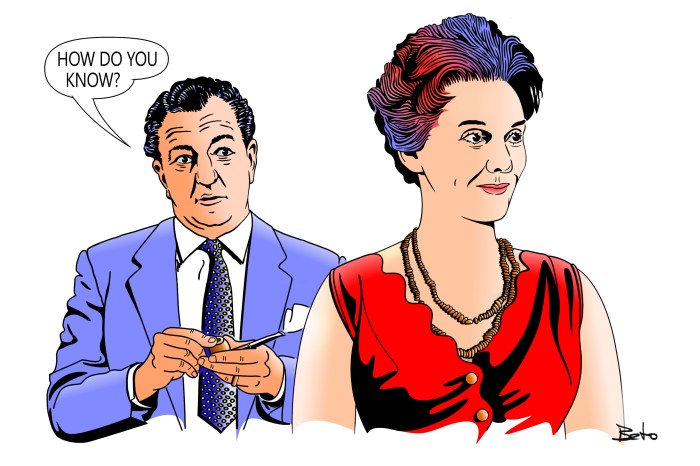
Helen Shingler – Madame Maigret

Maigret Couple Davies Shingler

Friend of the blog Berthold Deutschmann has written this interesting article (in addition to supplying an impressive piece of artwork) about Helen Shingler, who played Madame Maigret in the classic 1960’s BBC series
According to the latest dates on the Internet, Helen Shingler (“Madame Maigret”) recently celebrated her 100th birthday, on August 29th, 2019. I have found just one birthday greeting. Actually, I read somewhere that she would belong to a list of “forgotten actors”. I was taken aback by that. And Rupert Davies would be a “forgotten actor”, too. I don’t believe it! At least in Germany both are still known as the ideal tv Maigret couple. In fact, from the DVDs you might get the impression, the Maigrets are still in deep love, even after many years of marriage. This is played so convincingly, that a friend of mine believes there could have been a real relationship between the two actors. I do not agree with her, because I think, both were absolutely loyal to their own familiy.

As for the Maigret tv series, Mrs. Shingler’s desire was to have a bit more influence on the solution of the murder cases of her tv husband, Chief Inspector Maigret. I know of just one case in which she really can help him, shown in the episode “The White Hat” (German version: “Madame Maigret als Detektiv”). Gererally, she remains the housewife in the Maigret flat at Richard Lenoir Boulevard in Paris, but still she is absolutely essential for “Monsieur Maigret”. He would not be the successful Sureté commissaire without her at his side, or in the background, at home. On the writing desk in the commissioner’s office at Quai des Orfèvres there is put up, quite obviously, her framed picture.

For my comic-style illustration I had a scene in mind, in which Madame, for the time being, happens to know more than Monsieur, perhaps some fine detail that could be helpful to solve the current crime mystery. I hope you will like my work.

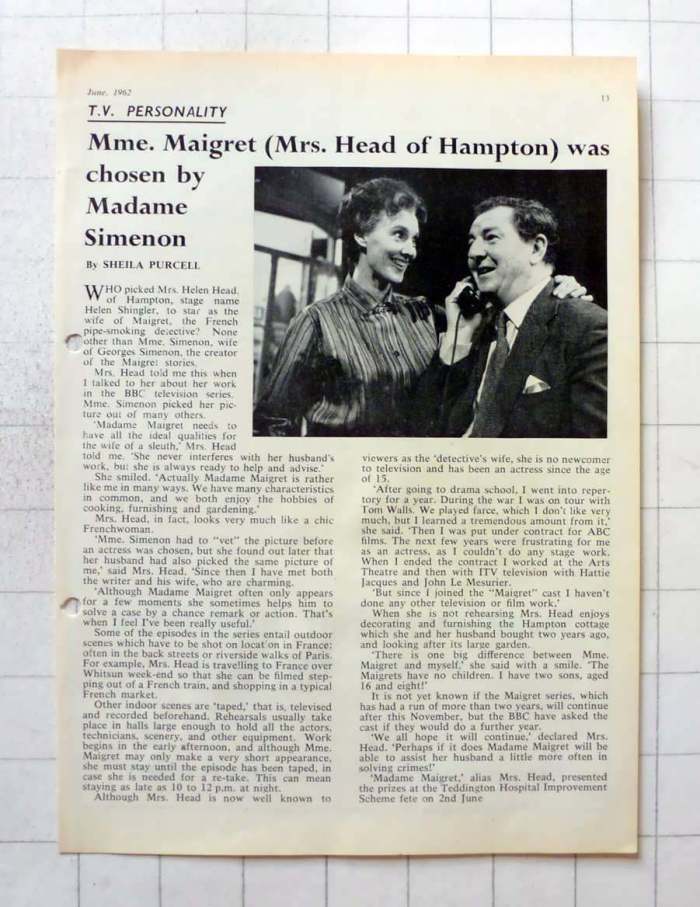
Below is an interview with Helen Shingler, conducted by Sheila Purcell, from 1962.

s-l1600

Star Trek – The Menagerie (Part Two)

Part two opens with a handy recap – continuing to observe the events from decades past, Kirk and the others learn that Pike has become a prisoner on Talos IV, captured by a group of oppressive looking aliens who aren’t big on small talk. They clearly have impressive powers though, since they’re able to conjure up illusions which are even better than the real thing.

Pike, with his arms crossed, looks rather butch as he faces down the Talosians from the wrong side of a prison cell. But the way he reacts to his captivity with a futile display of anger is probably the wrong approach. Given how dispassionate the telepathic Talosians are, brute strength isn’t going to cut much ice with them.

There’s something pleasingly oppressive about this scene – the physically powerful (but temporarily neutered) Pike facing down the calm aliens, who regard him with the sort of mild curiosity usually reserved for laboratory animals. Which is exactly what he is.

Scenes aboard the old Enterprise give us an opportunity to observe all the characters who never made it into the second pilot. Majel Barrett is icily effective as Number One – a female second in command could have worked very well, although I’m not sure that Barrett would have been a strong enough actress to carry it off on a regular basis.

Pike gets the chance to flex his muscles when he battles a slightly silly-looking opponent. It’s all still an illusion of course (which might help to explain why everything looks like it was recorded on a fake-looking backlot!) There’s another lovely matte shot in this scene – which rightly popped up every so often on the end credits as a highlights still.

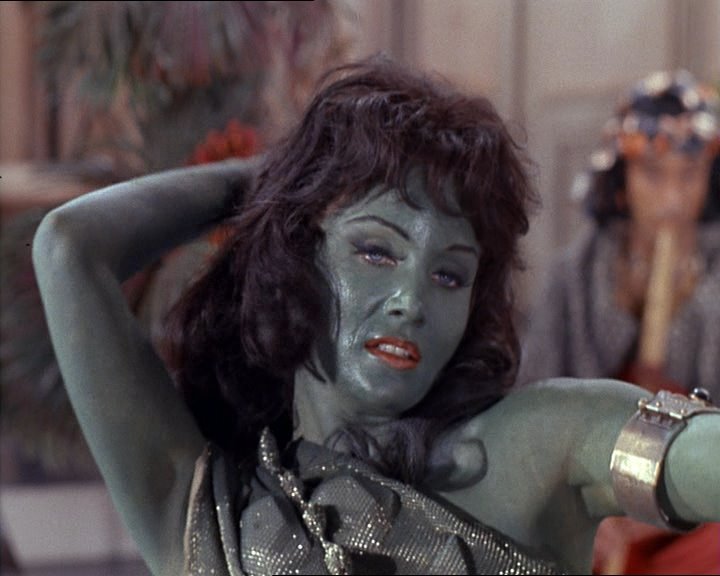
The winsome Vina (Susan Oliver) is still hanging around Pike, but he’s having none of it. She continues to tempt him in a series of guises though, the most memorable being a green-skinned Orion slave girl (due to its regular use on the end credits during series one it has to be one of Star Trek‘s most indellible images).

Susan Olivier is excellent as the vulnerable Vina. She certainly provides a sharp contrast to the more straight-jawed antics of Jeffrey Hunter.

If the first part of The Menagerie was mostly new material with elements of The Cage dropped in towards the end, then part two is mainly comprised of the pilot footage. We do pop back to the trial room on a regular basis, but most of these short scenes do little to advance the plot (they seem to be included purely to give Kirk something to do).

And then The Menagerie rather stutters to a conclusion. The audience has been told several times that Talos IV is strictly off limits  (by setting course there Spock has invited the death penalty). This is later waved away in a rather casual manner (very disappointing). Also slightly staggering is the reveal that Mendez is nothing but an illusion created by the Talosians.

So the whole trial was a fake …

It’s obvious that Spock wasn’t going to be put to death, but this move does negate a great deal of the drama from the last few hours. It’s all slightly baffling  but let’s be generous and assume that Roddenberry was working against the clock.

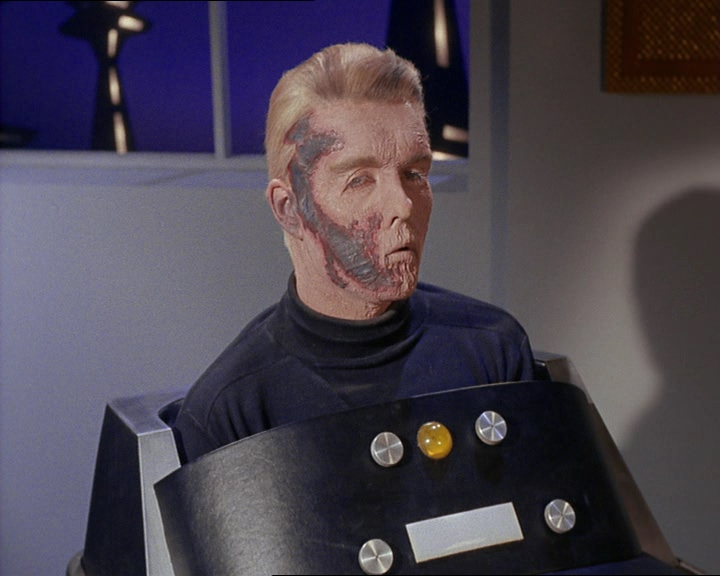
The wheelchair bound Pike (one beep for yes, two beeps for no) is another of those enduring Star Trek images. Although the story’s message (the chronically disabled can’t possibly enjoy any sort of fulfilling life) hasn’t aged well.

Dropping Pike off on Talos IV, to be reunited with the aliens who tortured him (in order that he can live in peace there in an imaginary paradise) seems a strange sort of resolution. But it was never going to be easy to wrap a logical covering story around the pilot footage.

The Cage is best sampled on its own terms, but back in the sixties and seventies that wasn’t possible, so The Menagerie was the next best option. It’s a little bit bloated (and as discussed, the logic of the linking scenes rather disintegrates in this concluding episode) but for all its faults it’s still a memorable story.

Star Trek – The Menagerie (Part One)

I’ve never been one for replacement CGI. Both Star Trek and Doctor Who have received CGI effects makeovers which please many, but I’ll always stick with the originals

The opening shot of The Menagerie part one is a case in point. The matte effect may look a little artificial, but it’s also rather beautiful. The other thing which caught my attention during the pre-credits teaser was Bill Shatner’s little acting choices. The way Kirk slightly bumps his knees when he, Spock and McCoy beam down immediately focuses your eye on him. Say what you like about Shatner, he always knew how to grab the limelight. The lecherous look Kirk gives a young and pretty female Federation walk-on is also something of a stand out. I doubt that was in the script …

It’s well known today that The Menagerie was a mid season cheapie, written purely to recycle material from the unaired pilot. I don’t think this was common knowledge back in the seventies through. At that time I simply accepted that the scarred and mute Christopher Pike was the same man (and the same actor) we later see in the lengthy flashbacks.

The early part of the episode sets up an intriguing mystery. Why has Spock gone rogue? Duffing up the workers on Starbase 11, faking Kirk’s voice to convince Uhura and the others that they have a new mission, hijacking the Enterprise to ferry Pike to a planet called Talos IV. It all seems a tad out of character.

Whilst Spock is skulking about and putting his plans into operation, Kirk and McCoy – also both still on Starbase 11 – are exchanging harsh words. Kirk’s beside himself that someone’s interfering with the smooth running of his ship and decides to take it out on Bones. It’s unusual that they part with their differences still unresolved – normally their brief spats only last a few minutes.

I do love the notion of Spock comanderring the Enterprise, leaving Kirk stranded on the Starbase in the process. The tension then slowly ramps up as McCoy becomes more and more suspicious (this is resolved only after Spock finally admits that he illegally stole the Enterprise and requests that he be put under arrest).

Quite why Kirk and Commodore Mendez (Malachi Throne) decide to pursue the Enterprise in a titchy shuttlecraft isn’t quite clear. But maybe this was all part of Spock’s plan.

With Kirk and Mendez now onboard the Enterprise, but with the ship still locked on course to Talos IV, the stage is set for Spock (standing trial for mutiny) to present his case. Why they’ve decided to hold the court martial here and now is a mystery (although obvious in story terms).

Will Spock be able to tell a convincing tale by the time the Enterprise reaches Talos IV? I’ve a feeling he can …

The Cage segments give us a glimpse into a Star Trek universe that might have been. Jeffrey Hunter is a bit stiff as Pike, but remember this was only the pilot. Over time would he have softened and shown a little more light and shade? Maybe, but I think we got the better deal with William Shatner.

Star Trek – The Galileo Seven

gal1

The Enterprise, carrying vital medical supplies for the New Paris colony, makes a detour to study a Quasar-like formation called Murasaki 312.  But instead of the Enterprise scanning the Quasar from a safe distance, a shuttlecraft (the Galileo) is loaded up and sent out into space.  This seems to be a rather reckless move, but had it not happened then we wouldn’t have a story ….

The Galileo quickly spins out of control and crash-lands on the only planet in the region capable of supporting life (a remarkable slice of luck that).  Spock is the ranking officer, with six others – Bones, Scotty, Latimer (Rees Vaughan), Kelowitz (Grant Woods), Boma (Don Marshall) and the lithesome Yeoman Mears (Phyllis Douglas) under his command.

The Galileo Seven places Spock front and centre for the first time. Whilst Kirk remains onboard the Enterprise, carrying out a desperate search for the missing Galileo, Spock is in the thick of it – using logic in an attempt to find the answer to their predicament. But he discovers that this approach isn’t always appreciated by the others.

In the original draft, Kirk was in command of the Galileo. Changing to Spock helps to give the story an extra twist, although Leonard Nimoy considered it was something of a failure. Without the character of Kirk to bounce off, he felt that Spock’s effectiveness was reduced.

Spock doesn’t get off to the best start after he states that three crewmembers will have to be left behind (without their excess weight, the shuttlecraft stands a better chance of leaving the planet).  We never learn how Spock would have made this choice (only that it would have been logical).  Of course, you can always guarantee that on an alien planet the landing party will be thinned out thanks to the efforts of the unfriendly locals.

Latimer is the first to bite the dust – skewered by the biggest spear I’ve ever seen.  The ape-like creatures who infest the planet (thankfully they’re only glimpsed briefly) are pretty large, but quite how they managed to find the strength to impale this spear into the unfortunate Latimer’s back is a bit of a mystery.  Whenever we see them chuck spears later on they don’t do any damage at all.  A lucky first shot maybe?

Kelowitz and Boma are growing more irritable by the minute, their anger not helped by Spock’s decision that officiating at Latimer’s funeral would be a waste of time.  The pair are then keen to mow down the natives, but Spock favours shooting to frighten rather than kill.

This is an interesting part of the episode – Kelowitz is left on guard after they’ve driven off the creatures, although Spock is convinced that having displayed superior force they are not in immediate danger.

Spock’s sadly mistaken and the result is that Kelowitz perishes. His logic has lead him astray and this causes him to reflect on his actions. “Step by step, I have made the correct and logical decisions. And yet two men have died.” It probably wasn’t very logical to leave poor Kelowitz all on his own – as soon as that happened I had an inkling his days were very numbered.

Boma is now openly mutinous but it’s more surprising that McCoy also strongly questions Spock’s command decisions.  That he chooses to do so in Boma’s company (rather than seeking a one on one conversation with Spock) does feel slightly off.

By contrast, Scotty is his usual no-nonsense self.  He spends most of his time tinkering away in the innards of the Galileo, but whenever he emerges he’s always utterly supportive and loyal to Spock.  As for Yeoman Mears, she doesn’t really contribute a great deal. She seems to be there for decorative purposes only (if the Yeoman has any strong feelings about Spock’s handling of the crisis then she keeps them to herself).

Spock’s rigidity and total inability to listen to the advice of others is key to the episode, but we also see that he saves the day by making an illogical act.  Although he’s quickly able to explain this away – an illogical move was the only logical option ….

Several plot contrivances are brought into play in order to raise the stakes. Firstly, the Enterprise has to search for the missing shuttlecraft without the aid of sensors.  And secondly, they only have a limited time as Commissioner Farris (John Crawford) is constantly at Kirk’s elbow, reminding him about his duty to deliver the drugs to New Paris.  Crawford’s performance is merely adequate (it seems strange that Farris appears to be smirking on certain occasions).

Notwithstanding a few plot flaws, The Galileo Seven is a decent episode. Leonard Nimoy is – as you’d expect – excellent.  I especially love the middle part of the story which sees Spock start to exert his authority with a raised voice.

Don Marshall (probably best known for Land of the Giants) has the pick of the guest roles although how Boma escaped censure is anybody’s guess.  But if you accept that the tie-in novels are canon then (in Dreadnought by Diane Carey) he was later court-martialled.

Generally the production looks pretty glossy (the full-sized shuttlecraft and miniature effects are especially noteworthy) but there are a few signs that the episode had slipped behind its shooting schedule. The painfully lightweight rock which we’re invited to believe has trapped Spock is a case in point. A retake here might have made thIs scene seem slightly less comic.

For those interested in firsts, this is the first episode to conclude with Spock looking dignified whilst the rest of the bridge crew dissolve into giggles. Whether that’s something to be celebrated or not is down to personal preference I suppose.

gal2

Star Trek – The Conscience of the King

king1.jpg

The Conscience of the King is a fascinating, layered episode which operates in a much more morally ambigious universe than many Star Trek stories.

Dr. Thomas Leighton (William Sargent), an old friend of Kirk’s, calls the Enterprise to Planet Q. Leighton is convinced that the noted Shakespearian actor Anton Karidian (Arnold Moss) is actually Kodos the Executioner. The former governor of the Earth colony of Tarsus IV, Kodos was responsible for the massacre of over 4,000 people twenty years earlier (both Leighton and Kirk were eyewitnesses).

There’s a notable WW2 analogue which seeps through the episode. Kirk initially believes that Kodos is dead, although Leighton is far less sure (“a body burned beyond recognition?”). That’s a clear link to Hitler, although the notion of Kodos masquerading under a new identity also points towards any number of senior ex-Nazis who fashioned new lives for themselves after the fall of Berlin in 1945.

There are several disconcerting moments. The first occurs right at the start – instead of the familiar opening shot of the Enterprise zooming through space, we focus in on Karidian performing on stage as Macbeth. And the fact that Leighton’s first few scenes always shows him in profile seems at first to be a directorial choice, but this is not so …

After struggling a bit with Miri, Shatner’s back on top form today. He’s gifted plenty of good moments – for example, Kirk’s conflict with Spock. After Spock gently reminds him that he’s taken the Enterprise off course, Kirk snaps back that he’s well aware of this and “If my memory needs refreshing, Mister Spock, I’ll ask you for it”.

Although Kirk’s autocratic command style has been touched upon before, today’s episode digs even further into this topic. With Kirk still traumatised by the events of twenty years ago, he’s disinclined (at first) to listen to either Spock or McCoy.

That Spock is forced to seek Bones’ opinion is a nice little wrinkle (they’ve yet to really begin their games of one-upmanship but the tension between their differing approaches – logic on one side, emotion on the other – is still clear to see).

The atmosphere of The Conscience of the King is ramped up by having the key events take place at night. It’s a slightly strange concept and although Kirk explains that this is because the Enterprise duplicates the Earth conditions of night and day, it does seem hard on those working at “night”, since everything’s always going to be much gloomier for them ….

The strains of deep space exploration is mentioned several times.  Kirk admits that since the crew has been on patrol for a long time, the arrival of a group of theatrical players would help to break the monotony. Karidian’s daughter, Lenore (Barbara Anderson), later queries whether living inside the Enterprise has fundamentally changed the female crew (“made them just people instead of women?”).

Lenore might not be the best-drawn female guest character the series has ever seen, but she has her moments.  By now the viewer would have been primed to expect that she and Kirk would engage in a romantic liaison. And so they do, but there’s a sting in the tale – she’s clearly manipulating him to serve the best interests of both her father and herself (after the romantically manipulative Kirk of Miri, it’s slightly refreshing to see Jim outmanouvered for once).

Mind you, the leer he gives when he first claps eyes on her makes it hard to be that sympathetic towards him …

That both are dissembling throughout their relationship is another of those small touches which strengthens the episode.

We’re kept waiting for a while before Kirk and Karidian meet face to face. And although you know that eventually Karidian will be unmasked as Kodos (otherwise the story would lack a certain dramatic impact) this predictability isn’t a story flaw for me.

But if one were being picky, you could argue that it’s a staggering coincidence that one of the few remaining eyewitnesses to the massacre – Lt Riley – now serves aboard the Enterprise. Jim attempts to protect him (Leighton has already been murdered by this point) by moving him down to Engineering. But since someone nips down there and poisons his drink, maybe Kirk should have surrounded him with a group of redshirts instead …

The sparks which fly between Kirk, Spock and McCoy help to make this a top-tier series one episode. The Kirk/Lenore relationship might be a bit drippy on the surface, but that was the clear intention.

Arnold Moss’ performance veers towards the overblown (as does Barbara Anderson’s) but their broad playing feels at home in an episode which has a stage background. Kodos playing Karidian playing Macbeth ….

king2


Star Trek – Miri

miri 1.jpg

Given how large the Universe is, you have to marvel at the number of planets encountered by the Enterprise which look very similar to Earth. Miri‘s teaser goes one better as Kirk and co stumble across a planet which matches Earth perfectly (even down to the landmasses). But having established this intriguing mystery, the episode then promptly ignores it.  This is a slight irritation ….

After a run of studio-bound stories it’s nice to get out into the fresh air (even if it’s only as far as the studio backlot).  Kirk, Spock, McCoy, Rand and a few anonymous red shirts beam down in answer to an automated distress signal.

Miri is an odd one as it manages to be both ridiculous and unsettling at the same time.  There’s something disturbing about the idea of a desolate town overrun by a horde of feral children (although as we’ll learn they’re not actually children – they just seem to be).

But there are also a fair number of scenes which are pretty ripe – such as the moment when Kirk phasers and kills a teenage girl. It should be horrific, but we’re left with a strong sense of the absurd (such as the way that the girl latches herself onto Kirk’s back as she fruitlessly attempts to attack him).

This episode is noteworthy for featuring the last major appearance of Janice Rand (she’d pop up briefly in the next episode before disappearing).  As touched upon before, Rand has been an incredibly undeveloped character – existing mainly to serve Kirk coffee, swoon over him or fight off unwelcome advances from various lustful males.

Miri is a late attempt to beef her character up and it works pretty well, which makes it all the more frustrating that she was already on the way out.  As Rand and the others succumb to a strange virus, she tells Kirk that “back on the ship, I used to try to get you to look at my legs. Captain, look at my legs”. At the moment they don’t look so good ….

Although this might be another scene where Janice is positioned as a decorative object first and foremost (it implies that she spends most of her time aboard the Enterprise desperately attempting to attract Kirk’s attention) it’s also quite plaintively delivered.

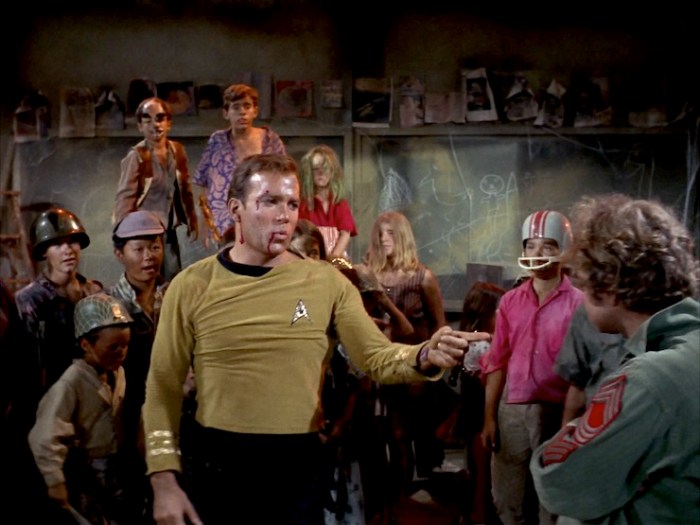
Shatner’s laying on the ham today. The conflict between the grown ups (“grups”) and Miri and the other children (“onlies”) gives Kirk the opportunity to step up and deliver an impassioned speech. And Shatner doesn’t disappoint, wringing every last drop of emotion out of it.

All right. I dare you, I double-dare you. Look at the blood on my face. Now look at your hands. Blood on your hands. Now who’s doing the hurting? Not the Grups, it’s you hurting, yelling, maybe killing, just like the Grups you remember and creatures you’re afraid of. You’re acting like them, and you’re going to be just .. like … them. Unless you let me help you. I’m a Grup, and I want to help you. I’m begging you, let me help you or there won’t be anything left at all. Please.

The fact that the children then meekly decide that Kirk has a point (which stands in sharp contrast to the havoc they earlier wreaked on the Enterprise crew) is another of those moments where it seems that the script needed a few more drafts to make the action seem a little less jerky and contrived.

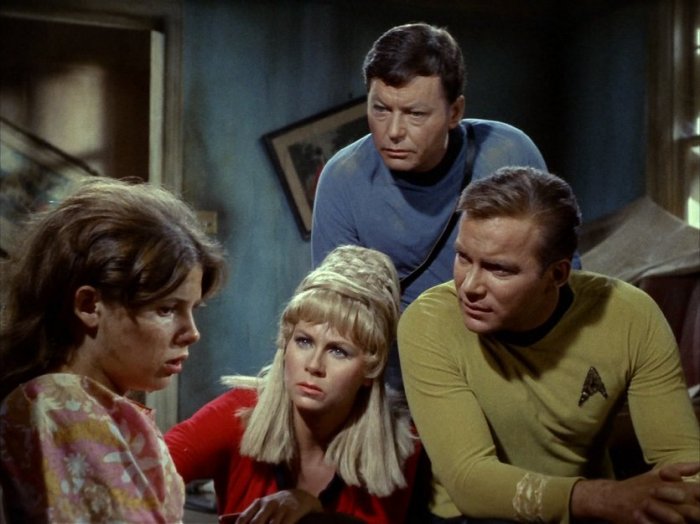
Kirk’s relationship with Miri (Kim Darby) feels somewhat problematic today. Since Miri only looks about sixteen years old, the way that Kirk interacts with her (“you want to go some place with me?”) feels a little icky.

Although Kirk is shameless about manipulating Miri, it’s easy to see that he’s doing it with the best of intentions.  Even so, you can’t help but squirm a little as he ladles on the famous Kirk charm (telling Miri that she’s becoming a young woman, for example). Miri’s jealousy of Janice briefly sets up a rather odd, but entertaining, romantic triangle.

Although the BBC broadcast Miri in 1970, they then skipped it during the numerous re-runs which occurred during the next few decades (it didn’t receive another airing until the early 1990’s). Along with The Empath, Whom Gods Destroy and Plato’s Stepchildren, the four were deemed to be unsuitable for broadcast because they “dealt most unpleasantly with the already unpleasant subjects of madness, torture, sadism and disease”.

Miri doesn’t really hold up to intense scrutiny but provided you’re prepared to go with the flow it does contain items of interest. Never a favourite, but there are worse ones out there.

miri 2.jpg

7 – 63 UP. Network BD/DVD Review

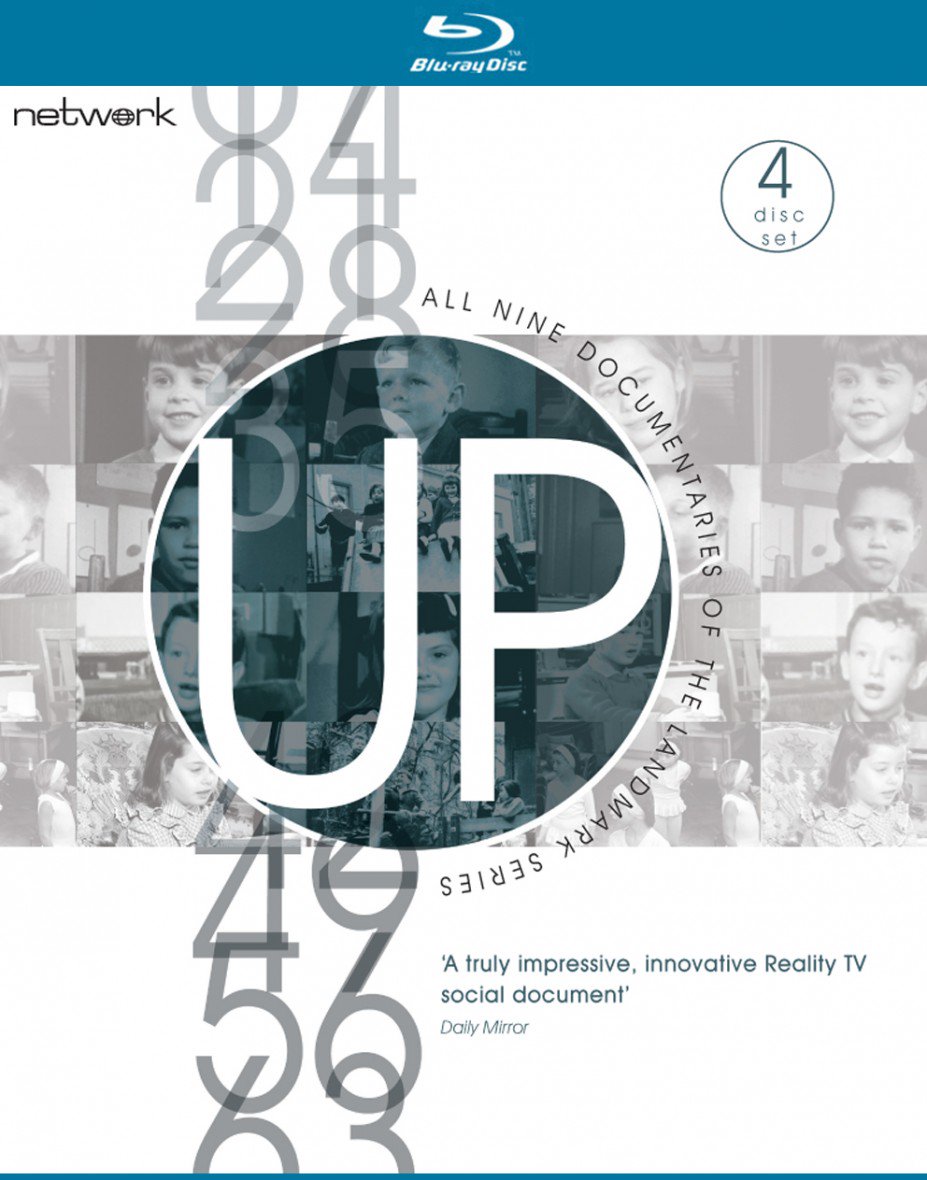
Seven Up! was a World In Action special broadcast in May 1964. Planned as a one-off, it looked ahead to the far-off year of 2000 AD, reasoning that the seven year olds of 1964 would be forty three in 2000 and by then many would be key members of society (“executives and shop stewards” as the narrator puts it).

World In Action editor Tim Hewat had a jaundiced view of the British class system – wondering if someone’s social and economic background predetermined their future, even from a very young age.  Deliberately choosing a diverse mix of boys and girls from various parts of the country and different economic backgrounds, Seven Up! quizzed these voluble youngsters about subjects which included life, love, marriage, fighting, education and their plans for the future.

One of the unusual things about Seven Up! is the fact it was directed by a drama director (Paul Almond).  He was at Granada waiting to do something else and stumbled across Seven Up! almost by accident. Michael Apted (a researcher on the original programme) took over directing duties from the second edition onwards, maintaining this drama link.

What’s remarkable is how many of the subjects kept on returning once it was decided to make a new programme every seven years.  Charles dropped out after 21 Up in 1977, never to return, whilst others (John, Symon, Peter) have skipped certain ones but later came back (Suzy didn’t contribute to the most recent – 63 Up).  Lynn is the first to have passed away, dying in 2013 after a short illness.

Given that the original research process was fairly random and haphazard (no long term contracts or agreements were signed as no thought was given to the possibility of future programmes) the fact that most have come back again and again is testimony to the relationship they’ve forged with Michael Apted through the decades.

There has been a certain amount of tension though.  Apted himself has admitted that on occasions that he was tempted to “play God” and mould the interviews and programmes in a certain direction to tell a predetermined story.  The unbalanced male/female split (ten to four) is something else Apted now regrets, whilst only one contributor – Symon – is mixed race, another missed opportunity.

Taken in isolation, Seven Up! is a really interesting and entertaining watch.  The introduction of Andrew, Charles and John (all pupils in the same expensive Kensington pre-prep school) is unforgettable – along with the rest of their class they perform Waltzing Matilda in Latin.

Jackie, Lynn and Sue all attended the same primary school in East London (a slight pity that three of the four girls were plucked from the same area, but as previously discussed nobody was anticipating a long-running series at this point).

Although a fair number of the children were London-based, Neil and Peter hailed from Liverpool whilst Nick was raised on a farm in Yorkshire.

There’s plenty of amusement to be found in Seven Up! (John loathing the Beatles’ haircuts) as well as more reflective moments (Bruce wishing more than anything to see his Daddy again, who was six thousand miles away). 

When Seven Plus Seven was made in 1970, things really began to get interesting (as the process of comparIng and contrasting the people they are now to the people they were then could begin). This of course is the main strength of the series as it developed, especially with those who have had the most troubled or colourful lives.

Paul has had an especially chequered journey. A lively and amusing child at seven, by the age of 21 he’d dropped out of college and was living in a squat. Still homeless at 28, by the time of 35 Up he’d slowly begun to turn his life around and during the last few decades has become a local councillor as well as contesting several General Elections.

The stories of some of the others, such as Andrew, whose lives have progressed in a much more orderly fashion are still of interest – not least for the initial shock of seeing how they’ve aged when each new programme appears.

In order to contrast the current individual with their past self, liberal use has always been made of their archive interviews. This is understandable (especially during the early broadcasts, where the audience would otherwise have struggled to remember all the faces from seven years earlier) but it does mean that there’s a certain amount of repetition in each programme. Therefore the series is best sampled at irregular intervals rather than via a box-set binge-watch.

But however you view it, the Up series is an unmissable slice of social history. The format has subsequently been copied by various other countries, but the original is still the best. Enlightening, moving, amusing and deeply thought-provoking, this is British documentary making at its very best. Highly recommended.

The Programmes 

Seven Up! (39″ 35′)

Seven Plus Seven (51″ 56′)

21 (99″ 50′)

28 Up (61’05” and 73″44′)

35 Up (115″ 02′)

42 Up ( 59″ 40′ and 72″ 31′)

49 Up (70″ 27′ and 70″ 19′)

56 Up (46″ 58′, 46″ 57′ and 50″ 01′)

63 Up (47″ 40′, 47′ 45″ and 47′ 44″ )

Special Features

Michael Apted at Granada (21″ 41′)

Ir Was Only Going To Ever Be One Film (13″ 36′)

28 Up Commentary Track

7 Up and Me (46″ 32′). 2019 documentary narrated by Joanna Lumley in which celebrities discuss what the Up series means to them.

7 – 63 Up is available now from Network. The Blu Ray edition can be ordered here and the DVD is available here

Star Trek – Dagger of the Mind

When beaming cargo up from a penal colony, if it’s large enough to conceal a human being you should probably approach it with caution ….

Dagger of the Mind is a really interesting episode. It may feature a huge dollop of sexism (which of course isn’t a rarity for the original series) but there’s also a wonderfully cynical streak running throughout it.

As I’ve touched upon before, the Star Trek universe is often held up to be a shining utopia, but on closer inspection (especially during these early episodes) that’s not really the case at all.

Tantalus V is a rehabilitation centre for the criminally insane. Kirk has only heard good words about such places (likening them to holiday resorts) although McCoy is more cautious. “A cage is a cage, Jim”.

Dr Tristan Adams (James Gregory) runs the facility and has been a highly respected professional for decades. And yet it’s discovered that his work revolves around patients being subjected to mind-bending rays and other (unspecified) treatments which appear to leave them little more than docile vegetables.

Only one inmate – Lethe (Susanne Wason) – is allowed a voice. Apparently completely rehabilitated, she’s now employed as a therapist. We’re told that her treatment has merely suppressed troubling areas of her mind – which feels a little disquieting.

Adams doesn’t appear to have suddenly gone mad. Which suggests that his work during the last twenty years or so has received the tacit approval of the authorities. This is uncomfortable, as is the fact that we never learn exactly why each intimate has been sent there – just who has decided that they’re criminally insane? 

Had Adams’ number two,  Dr. Simon van Gelder (Morgan Woodward), not stowed away on the Enterprise then it seems unlikely that any of this would have come to light. In space no-one car hear you scream.

Quite why Adams and van Gelder fall out isn’t made clear although it may be that van Gelder recognised just how dangerous the neural neutralizer could be (when Adams is killed and van Gelder returns to the colony, Kirk is told that it’s been destroyed).

If that’s meant to suggest that all will now be well it doesn’t quite do the trick. Even though Kirk and McCoy share an end of episode smile to reassure the watching audience ….

Morgan Woodward rachets the intensity up to eleven during most of his scenes. It’s a remarkable performance – all bulging eyes and sweat – and plays in sharp contrast to James Gregory’s remarkably controlled Dr Adams. Of course the fact that Adams is so nice and accommodating can’t help but set the alarm bells ringing.

This week’s space totty is Dr Helen Noel (Marianna Hill). Kirk isn’t pleased to learn that McCoy has picked her to accompany him to the planet’s surface. Something obviously happened between them at the last Christmas party, but it’s not made clear exactly what.

I love the idea that the Enterprise has Christmas parties! There’s so much scope for interesting stories there …

Helen, of course, is devastatingly beautiful. But despite being a fully qualified professional, most of the episode finds her written down in the sort of patronising way that was typical of the series. The fact that she doesn’t pick up on the strange vibes all around her (zombie-like patients walking through the corridors) is a mark against her.

Her hero worship of Kirk is also a little eye-opening. This part of the story does give Shatner the chance to score some nice comic reaction shots, but it doesn’t help to stengthen Helen’s character.

The moment when she uses the neural neutralizer to implant a romanticised vision of herself and Kirk in his mind is also noteworthy. Although Kirk’s overactive libido has become one of the series’ running jokes, at this point of the show’s history he’s been very restrained. True, he does later give Helen a good old snog, but then he was under the influence at the time.

She finally redeems herself by disabling the force-field, allowing Spock and a troupe of red shirts to beam down. I love the casual way Kirk sends her off on this life or death mission, telling her that if she touches the wrong wire then she’s likely to be fried!

The original drafts featured Janice Rand rather than Helen Noel. It’s quite easy to see how Janice would have fitted in – especially since it’s already been established that she carries a torch for Kirk.

Later script rewrites by Gene Roddenberry rather obscured the reasons for Adams’ actions (one of the reasons why Shimon Wincelberg asked for the pen-name of S. Bar-David to be used).

Dagger of the Mind doesn’t feel totally satisfying, mainly because we’re left with the impression that little has changed on Tantalus V by the end of the episode. But the episode does generate plenty of food for thought during its fifty minutes.

Star Trek – What Are Little Girls Made Of?

Exo-III is familiar early Star Trek planet – home to a once great civilisation, it’s now (apparently) barren, save for a few human interlopers.

One of these is Dr Roger Korby (Michael Strong), a brilliant scientist and – by a remarkable coincidence – Christine Chapel’s long lost fiance. The pre-credits sequence does lay on Korby’s research endeavours and general high standing a bit thickly, but I daresay this info-dumping was a necessary evil. 

The few first minutes also features a fair amount of Christine looking teary and wistful. The last communication with Korby was some years ago, so will he still be alive or has he perished in the icy wastelands? By a miracle Korby seems fine – hurrah!

But this is Star Trek remember and it quickly becomes clear that something isn’t quite right ….

What Are Little Girls Made Of? gives Majel Barret a major role, although Christine is fairly passive throughout. Nurse Chapel and Kirk beam down to the planet’s surface together, but they’re never as engaging a team as Kirk and Spock or Kirk and McCoy would have been. The fact that Spock and McCoy remain on the Enterprise does weaken the story a little. Indeed, we don’t see Bones at all, which is a shame.

Sherry Jackson (as Andrea) makes a memorable first appearance (her costume has something to do with this). Christine’s hackles instantly rise when she spies the nubile young Andrea – had they spent a few minutes alone together I’m sure Nurse Chapel would have started to scratch her eyes out.

After a fairly slow beginning the pace rapidly picks up. Korby reveals himself to be a highly unstable type whilst Kirk has no compunction in using Andrea as a human shield (or zapping Korby’s assistant, Brown). But the arrival of the imposing Ruk (Ted Cassidy) temporarily stops Kirk in his tracks. Kirk pinned to the wall by Ruk is an arresting sight.

Both Brown and Andrea are androids. Golly. Andrea is a remarkably pretty sort of android, although Korby maintains that he has no feelings for her (and vice versa). Then why make her so drop dead gorgeous?

Kirk being copied is a wonderfully pulpy sci-fi moment – a naked Jim (save for a covering to conceal his modesty) is strapped to a revolving table whilst a shapeless form lies next to him. After a few minutes the object gradually turns into a duplicate Kirk. So does this mean that there was there a real Andrea once upon a time?

Even this early on in the series’ history, What Are Little Girls Made Of? feels like archetypal Star Trek. An ersatz Kirk, a respected Federation man gone rogue, an attractive femme fatale, a dead civilisation which holds the key to untold knowledge and power. But whilst it’s all very familiar, it’s also great fun.

Kirk attempting to attack Ruk with the most phallic stalictite you’ve ever seen is an unforgettable moment. It surely had to be intentional, although how they got that past the censors is anybody’s guess. Oh, and Kirk’s plan to instruct the android Andrea in the ways of human love is another of those moments where it’s hard not to smile …

The first of Robert Bloch’s three Star Trek scripts, this one is probably also his best. It received an uncredited rewrite from Gene Roddenberry, but at this point in the series’ history it looks like Roddenberry’s script tinkerings were beneficial (this wouldn’t always be so).

Bloch may be best remembered today as the author of Pyscho (later filmed by Alfred Hitchcock) but he had written a fair number of pulp sci-fi stories in his younger days, which helps to explain the tone and style of this episode.

Although What Are Little Girls Made Of? seems to be little more than good, clean goofy fun there are some interesting philosophical questions bubbling away close to the surface. I daresay the late twist won’t take anybody by surprise but this is another S1 favourite for me.

Star Trek – Balance of Terror

Balance of Terror is a key Star Trek building block. The previous episodes have tended to concentrate on civilisations either long dead or dying. But today for the first time we encounter a race – the Romulans – who are a similar size to the Federation and also have an interest in space exploration.

Mind you, at this point the Federation has yet to be formally introduced (that wouldn’t occur until A Taste of Armageddon). But what Balance of Terror does so well is to dig into the Earth/Romulan conflicts of old.

At a single stroke, we learn that the Earth is not a newcomer to space exploration – indeed, having fought battles against the Romulans in the past, old resentments still linger. These attitudes are articulated by Lt. Stiles (Paul Comi) who directs his bitterness towards Mr Spock (due to the shared Vulcan/Romulan heritage).

Whilst Stiles is a character type we’ve seen before – a loose cannon aboard the Enterprise – his racist and xenophobic attacks on Mr Spock still have an impact. Not only because by now the viewer has come to embrace Spock as a key member of the crew, but also because they help to shatter the commonly held view that the Star Trek universe is one where such attitudes no longer exist.

As has been observed in the past, Balance of Terror plays out like a WW2 submarine movie. Two equally matched captains – Kirk and the unnamed Romulan Commander (played by Mark Lenard) – engage in a tense game of cat and mouse.

Lenard is, of course, excellent and it’s easy to see why the series was keen to have him back as soon as possible. Spock might describe the Romulans as warlike, cruel and treacherous but that’s a far from accurate portrait of Lenard’s Commander, who is honourable, poetic and world weary.

Unlike his junior officer Decius (Lawrence Montaigne), the Commander has no stomach for war – suggesting that unlike his superior Decius has yet to encounter a real battle. 

The Romulan Commander may not wish to fight, but he is honour bound to do so. That doesn’t mean that he has to relish the prospect though (unlike Decius). “No need to tell you what happens when we reach home with proof of the Earthmen’s weakness. And we will have proof. The Earth commander will follow. He must. When he attacks, we will destroy him. Our gift to the homeland, another war.”

It’s plain that this “gift” is something which will bring only death and destruction, not the glory that Decius seeks.

Had Star Trek gone down the more obvious route, portraying the Romulans as the bloodthirsty types Spock believes they are, then Balance of Terror would still have been a fine episode. But Mark Lenard’s multi-layered performance raises the story up several notches. One of the best – if not the best – Star Trek episodes.