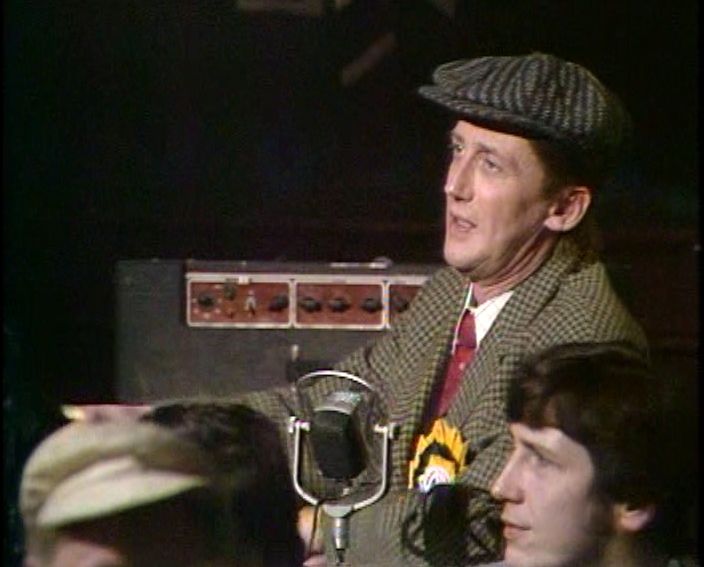
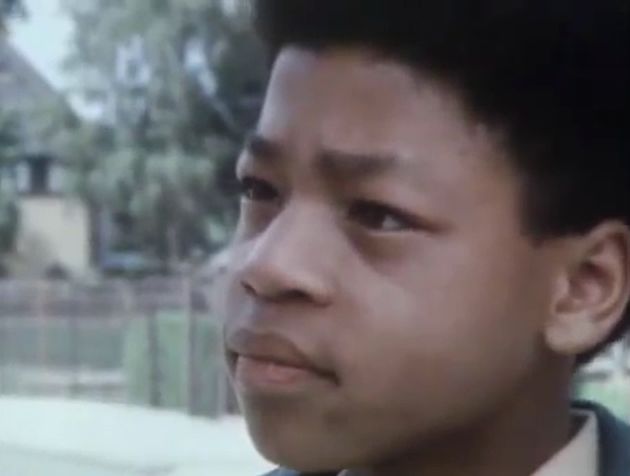
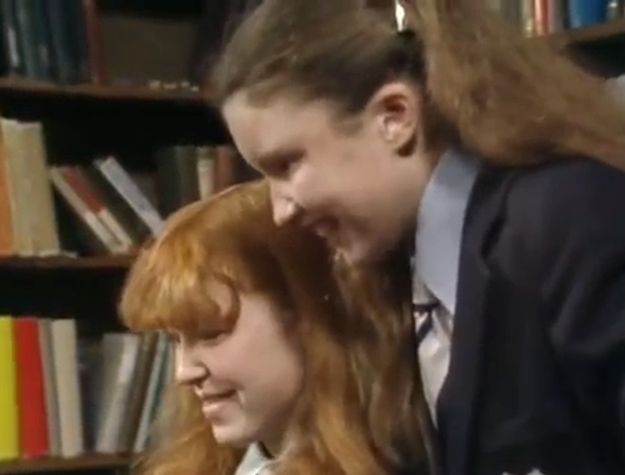
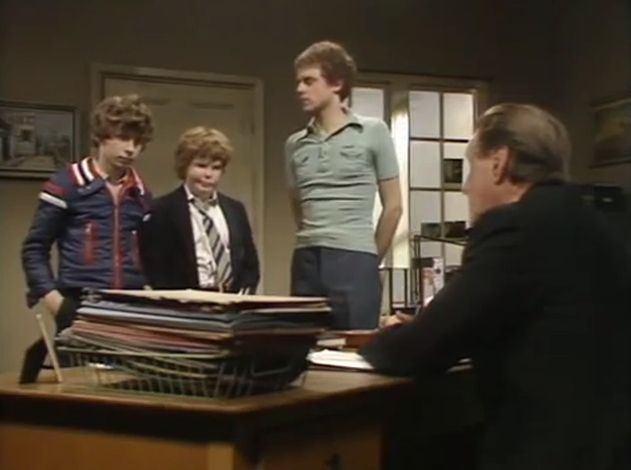
Grange Hill. Series Three – Episode Fifteen

grange hill s03e15

Written by Alan Janes. Tx 26th February 1980

I don’t know what the mortality rate of Grange Hill is, compared to other schools in the UK, but I’d guess it’s a great deal higher. Deaths, of course, are a staple in any soap opera – they help to create interest, ratings and spark debate.

The deaths in Grange Hill are sometimes, but not always, designed with a specific point in mind – they can be morality tales with a clear message. In this case we’re told that dares can be dangerous and potentially fatal.

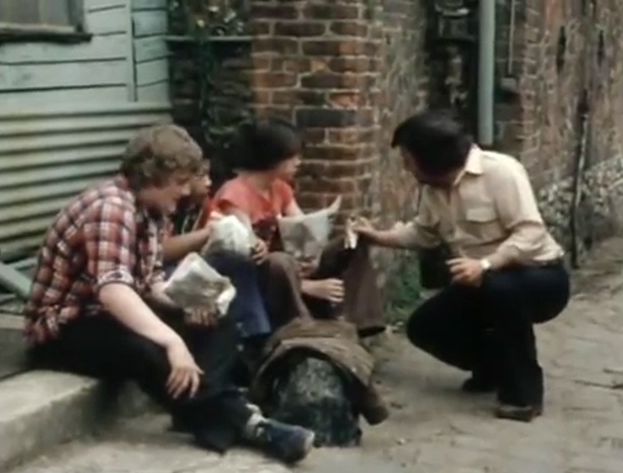
A craze of dares is sweeping the school and at the same time there are running fights between Grange Hill and Brookdale pupils. Since these often take place at the local shopping centre, it’s placed out of bounds (and teachers are sent on patrol there).

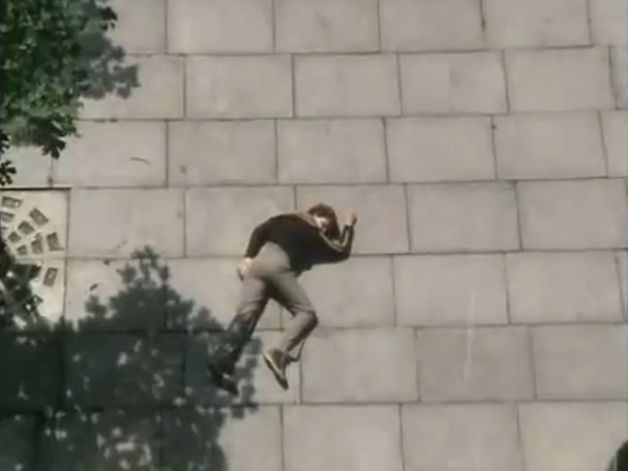
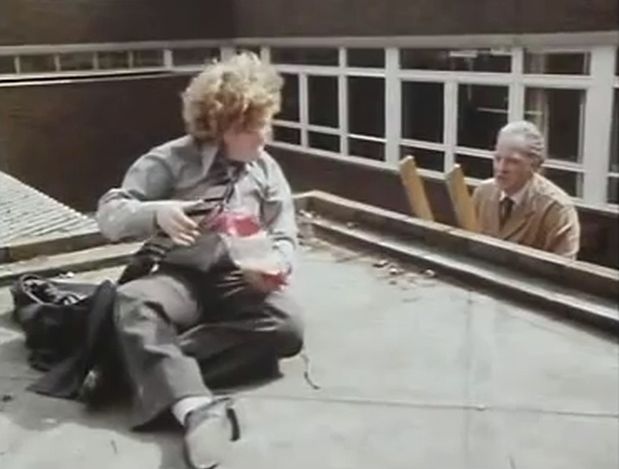
Naturally, many of the kids, including Tucker and Alan, happily ignore this order and they’re lucky not to be caught by Mr Baxter. But tragedy strikes when Antoni Karamanopolis (Vivian Mann) is dared by Billy Phillips (Tony London) to walk along the rooftop of the shopping precinct – he falls and is killed instantly.

Antoni was a typical supporting Grange Hill character. He appeared in a handful of episodes during series two and three, sometimes just in the background but occasionally with a few (usually not vital) lines. He was clearly the ideal person to be sacrificed – someone who would be familiar to the audience, but not one of the central characters.

Of course, this does lessen the impact of his death (imagine if it had been, say, Benny) and apart from one casual mention in a later episode he doesn’t appear to be greatly missed – there’s certainly no attempt to plant a tree in his memory, ala Danny Kendall.

Mr Baxter’s pursuit of the children through the shopping centre does provide us with an awkward moment as he follows them into the toilets and proceeds to try and look under the toilet doors. He becomes aware that he’s being observed (by a traffic warden) and tries to shrug it off by telling him that he’s looking for some boys. It’s played as a comedy moment, but it’s hard to imagine something similar being done today!

Grange Hill. Series Three – Episode Fourteen

grange hill s03e14

Written by Alan Janes. Tx 22nd February 1980

The third years take a trip to work on the Outdoor Centre. Tucker inadvertently puts the girls’ tents up over an ants nest, Alan and Susi continue to work on their Judo, whilst Cathy puts her foot through a rotten floorboard in the upstairs part of the building and has to be taken to hospital.

The realisation that the floorboards are rotten causes concern. How much will it cost to repair them? As might be expected, money is tight and it looks as if the plans for the Outdoor Centre will have to be abandoned. Eventually a rescue plan is worked out later in the series (they decide to share Brookdale’s Outdoor Centre instead) but since it’s never seen again it’s a plotline that doesn’t go anywhere. A pity, since the odd trip to the Outdoor Centre could have been used to break up the (naturally) school-dominated run of episodes.

This is Alex Kingston’s final appearance as school-bully Jill Harcourt. Once Susi uses some of the Judo moves on her that Alan taught her, she’s no longer a threat and limps away.

Blakes 7 – Cygnus Alpha

cygnus 01

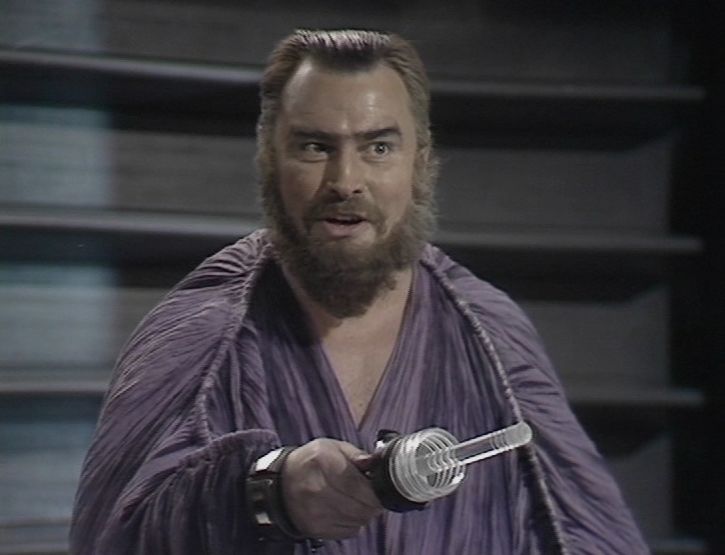
Once Blake, Avon and Jenna have learnt a little about the new spaceship they’ve “acquired” (and also tangled with the mysterious super-computer Zen) they set a course for the prison planet Cygnus Alpha.  Once there, Blake is keen to free as many of the prisoners as he can – he needs a crew to start fighting the Federation.  But the charismatic ruler of Cygnus Alpha, Vargas (Brian Blessed), needs new recruits to serve his god and he isn’t going to give them up without a fight …..

Cygnus Alpha is a story of two halves.  Later we explore Cygnus Alpha and Vargas’ weird religion, but to begin with we follow Blake, Avon and Jenna as they start to evaluate the Liberator and slowly begin to understand its capabilities.  Blake remarks that the design is alien – it certainly doesn’t appear to be of Federation origin.  In story terms of course, it’s handy for Blake’s small group to have such an advanced ship – otherwise their battle against the Federation would have been rather brief.

If you accept this as a dramatic requirement, then you also have to turn a blind eye to the fact that the Liberator has a well stocked arsenal of weapons and a teleport system which means they never have to land the ship, handy that!  At this point, they can only remove one gun each (“single function isomorphic response” as Avon puts it) although this is a convention that’s later blithely ignored.

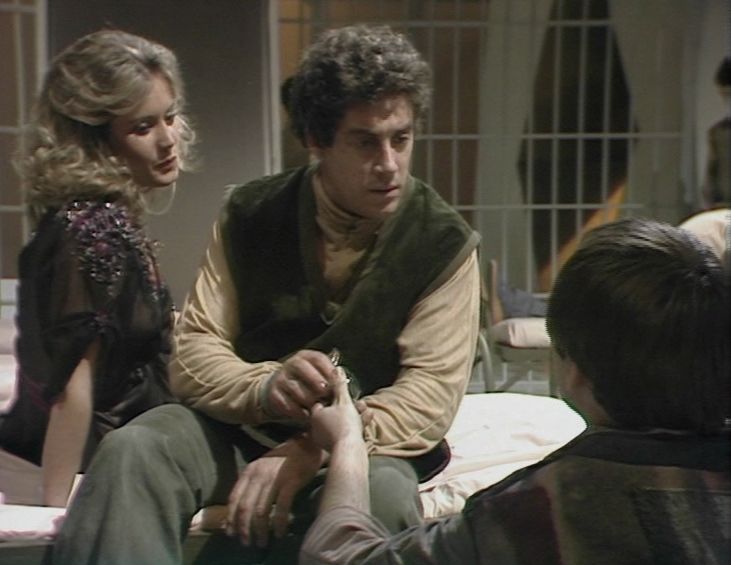
The teleport system is the closest link to Star Trek – and as in the American series it’s a device that is frankly just too useful.  The ability to teleport anybody out of danger at any time is a problem, so during the course of the series we’ll see various ways used to limit its power.  Sometimes the Liberator will be forced to leave teleport range (because of incoming Federation ships) and on other occasions, like here, the loss of a teleport bracelet will prevent a quick escape.

One oddity in this story is that at the end there appears to be two teleport areas.  We see Blake, Vila and Gan appear in the usual one and then Vargas seems to materalise in another teleport area on the opposite side.  Although it’s possible this is just a bad piece of editing, since this secondary teleport area (if that’s what it is) is never used again.

Shortly after finding the guns they encounter Zen (voiced by Peter Tuddenham) for the first time.  As he’s got such a clear personality it’s no surprise that Blake later claims him as one of the seven.  But as the following exchange illustrates, Zen has boundaries that he’s not prepared to cross.

BLAKE: Zen, how does the teleport system work?
AVON: Would its function be injurious to our species? Have you the necessary data?
ZEN: Wisdom must be gathered, it cannot be given.
AVON: Don’t philosophise with me you electronic moron. Answer the question.

Zen doesn’t answer Avon’s question which infuriates him no end.  Avon vows to reprogram the computer, but it’s probable that he’s met his match.

cygnus 02

Down on the surface of Cygnus Alpha things are grim – as might be expected of a penal planet it’s a pretty bleak environment.  There is a smidgen of civilisation though – led by Vargas and Kara (Pamela Salem).  They, and the others, worship their god in a quasi-medieval setting.  New prisoners (or as Kara refers to them “new souls for the faith”) are therefore always welcome – though it may not come as a surprise that Vila’s far from keen.  When Gan spies a building, he asks Vila what he thinks.  “The architectural style is early maniac” he responds.

Apart from Gan and Vila, we see a couple of new prisoners – Arco (Peter Childs) and Selman (David Ryall).  Well, I say new, but they must have been aboard the London, so we have to assume they were always just out of shot in the previous episode. Either of these actors would have livened up Blake’s crew (I certainly would have taken Arco over Gan).

Whilst Blake’s recruiting members for the cause on Cygnus Alpha, Jenna faces a moral dilemma aboard the Liberator.  She’s discovered a room with untold riches, which certainly appeals to Avon.  He’s keen to take the money and run as he tells her that Blake would “look upon all this as just one more weapon to use against the Federation. And he can’t win. You know he can’t win. What do you want to be, rich or dead?  We might never have this opportunity again.”

Jenna agrees, although she decides to wait for an hour to see if Blake contacts the ship.  But when it comes to the crunch she can’t leave him – and neither, it appears, can Avon.  Why Avon doesn’t jump ship at the next available port with as much wealth as he can carry?.  Could it be that he too is beginning to believe in Blake’s crusade?  It seems improbable, but Avon’s motivations aren’t always easy to read (compared with how transparent Blake is) so it’s hard to say for sure.

The surface of Cygnus Alpha might only be a quarry, but the location benefits from extensive night shooting, atmospheric dry ice and some decent matte effects.  The interiors are more conventional and look like they could have been drawn from stock, but are reasonably solid.

Just two episodes after the nihilistic opener, we’re into something totally different here. Cygnus Alpha is much more conventional adventure series fare – complete with an over-the-top villain in Vargas. Brian Blessed could do this sort of performance in his sleep (possibly he did!) and whilst he’s undeniably a powerful actor, it’s hard to take Vargas very seriously as we know it’s only Brian Blessed dialing it up to eleven.

By the end of the story, Blake has been able to rescue Vila and Gan, so his band of brothers has got slightly bigger. It still seems that they’re very few to be thinking about launching an all-out attack on the Galactic Federation, but for a true fanatic like Blake that’s not something that’s going to bother him.

cygnus 03

Grange Hill. Series Three – Episode Thirteen

grange hill s03e13

Written by Alan Janes. Tx 19th February 1980

Duane, Michael and Tracy have to brave an interrogation by Mr Keating.  His first appearance in this episode is a memorable one – we hear him clear his throat in a very ominous way – making it clear that he’s not in a very good mood!  All three children give him a different reason for their presence in school at half term (Tracy’s is the correct one) but it’s obvious he’s unsure which of them to believe, so he tells them he’ll see them all later.

Having learnt that Mr Humphries might have some materials to donate to the Outdoor Centre, Mr Hopwood pays him a visit.  He spies a very serviceable van, which Mr Humphries was considering selling, and manages to grab it at a very decent price.  It’s instructive to watch the artful way Mr Hopwood is able to strike a bargain by playing on Mr Humphries’ good nature (but since it’s all in a good cause that’s fair enough).  It’s also amusing to hear Mr Humphries ask for cash, rather than a cheque, since a cheque would have to go through the books (thereby adhering to the cliche that all small businesses like to fiddle their tax!)

Susi finds herself persecuted by Jill Harcourt (Alex Kingston) who pressurises her to complete her homework.  Jill’s not the first school bully we’ve seen in the series, but it’s not until Gripper’s reign of terror in series five and six that we actually see a bully who carries out a concerted series of attacks over a sustained period.  Like Jackie Heron in series one, Jill Harcourt’s villainy is rather negated by the fact it’s so brief (she’s vanquished in the very next episode).

As for Duane, Michael and Tracy, Mr Keating eventually discovered that Tracy was the one telling the truth – but although they submitted multiple competition entries (and all the answers were correct) they didn’t win the minibus since their entries reached the paper the day after the competition closed.  But the paper was interested enough to interview them, although the resulting article is a great disappointment since it didn’t even mention their names.

Susi continues to feel the pressure from Jill, but she doesn’t have to suffer for very long as Alan’s spotted what’s been happening and is prepared to give her extra Judo lessons so she can defend herself against Jill’s bullying.

Blakes 7 – Spacefall

spacefall 01

Blake and the rest of the prisoners have started their eight-month journey to the prison planet Cygnus Alpha on the ship London.  Blake doesn’t waste any time in attempting to work out a way to take control of the ship – but he’ll need the co-operation of Avon (Paul Darrow).  Whilst Blake and the others plot, they have to contend with the sadistic second-in-command Raiker (Leslie Scofield) who places little value on any of their lives.  After an aborted attempt to hijack the ship, the appearance of a highly advanced and apparently abandoned spaceship seems to offer an escape route ……

One of the interesting things about watching Spacefall for the first time is pondering who will survive to join Blake on his crusade.  Since Vila and Jenna were introduced in the previous episode, it’s a fair bet that they’ll make the cut.  And from his opening appearance it’s quite clear that Avon is going to be a significant character.  He’s an expert in his field – computers – and is easily able to explain to Blake how the security doors operate.  “It’s simple enough. All authorised personnel have their palm prints filed in the computer. The blue sensor plate reads the print. If it conforms, the computer opens the door.”

Later Blake asks him if he could open all the doors on the ship.  Avon, who we’ll soon discover is never one to suffer from false modesty, tells him that “I could open every door, blind all the scanners, knock out the security overrides, and control the computer. Control the computer and you control the ship.”

Even this early on there’s a nice bite to the scenes between Thomas and Darrow.  Avon’s highly dismissive of the small group of people that Blake has been able to recruit – Vila, Jenna, Gan (David Jackson) and Nova (Tom Kelly).  “You’ve got an army of five, Blake. Five and HIM!”  The “him” is Vila – even the short time that Avon and Vila have spent together seems to have been enough for Avon to have formed a healthy loathing of him!  Although it’s true this is rather negated later on when he realises just how talented Vila is at opening any kind of locked door or security system.

So what of the other two potential recruits to Blakes 7 – Gan and Nova?  It’s quite a while into the episode before we hear Gan speak, until then it’s quite possible to imagine he’s just another non-speaking extra (like the majority of the prisoners).  Nova seems quite a personable chap, but he doesn’t last very long.  He suffers a rather grim fate – trapped in the ship’s infrastructure during a meteorite attack, he’s suffocated by the sealing foam triggered to repair the breaches to the ships hull.

Thanks to Avon’s efforts, Blake is able to take control of the ship – but can he keep control?  Glyn Owen gives a wonderfully weary performance as the London‘s commander, Leylan.  He’s a fair man who doesn’t want any trouble, unlike his subordinate Raiker who’s happy to kill off the prisoners at thirty second intervals until Blake, Jenna and Avon give themselves up.

spacefall 02

Blake, of course, sees no alternative but to surrender – whilst Avon naturally takes the opposite view and later makes this point very forcefully to Blake.  “What a fiasco. You could take over the ship, you said, if I did my bit. Well, I did my bit, and what happened? Your troops bumble around looking for someone to surrender to, and when they’ve succeeded, you follow suit.”

Before they surrender, Blake, Avon and Jenna discuss what they’ll do if they manage to escape. Blake tells them he wants to return to Earth and explains why.

BLAKE:  They butchered my family, my friends. They murdered my past and gave me tranquilized dreams.
JENNA:  At least you’re still alive.
BLAKE:  No! Not until free men can think and speak. Not until power is back with the honest man.
AVON:  Have you ever met an honest man?
JENNA:  [Glances at Blake] Perhaps.
AVON:  Listen to me. Wealth is the only reality. And the only way to obtain wealth is to take it away from somebody else. Wake up, Blake! You may not be tranquilized any longer, but you’re still dreaming.
JENNA:  Maybe some dreams are worth having.
AVON:  You don’t really believe that.
JENNA: No, but I’d like to.

Blake wants to fight and nothing will stop him.  Avon lacks Blake’s idealism and simply wants a quiet life, once he’s stolen enough money to live comfortably.  Jenna doesn’t share Blake’s views, but there’s something in what he says which strikes a chord in her.

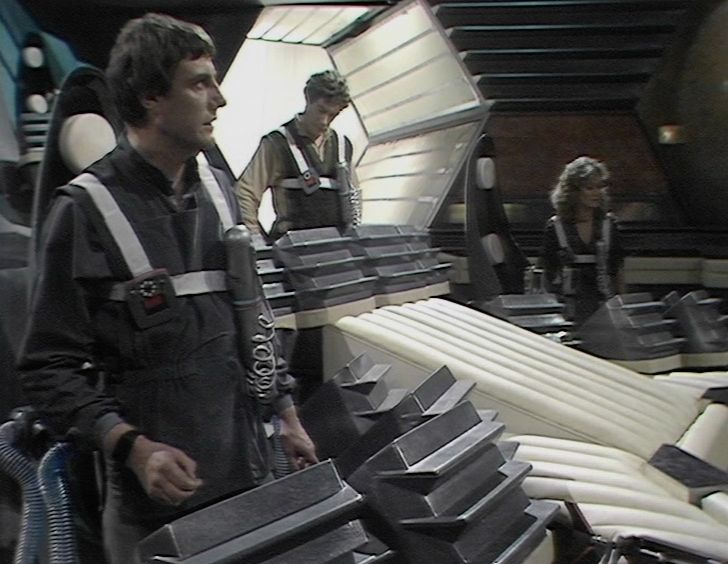
After Blake and his friends are recaptured, it does seem like they’ve blown their only chance.  But all this changes when a fantastically advanced spaceship drifts alongside the London.  The first appearance of the Liberator in space (complete with Dudley Simpson’s fanfare) is an impressive moment.  And the first scene on the Liberator‘s flight deck is another moment of wonder – especially after the bleak, utilitarian decor of the London.

After only one of the ship’s crew sent over to explore the strange ship comes back (and he appears to be quite mad) it’s decided by Raiker and Leylan to send Blake, Avon and Jenna over to explore.  Yes, it’s probably not the wisest move to send the three of them over to the ship unsupervised.

How were Blake, Avon and Jenna able to survive the ship’s defences which killed the others?  Blake was the only one of the three who was able to realise that the images created were an illusion – maybe his recent traumas and the retention of his suppressed memories had something to do with it?

Whatever the reason, they were able to survive and take control of the ship.  And with a ship like that they could go anywhere in the Universe – but Blake wants to head to Cygnus Alpha.  He plans to free the other prisoners – once he’s done that he’ll have a full crew and can really start fighting back.

spacefall 03

Grange Hill. Series Three – Episode Twelve

grange hill s03e12

Written by Alan Janes. Tx 15th February 1980

It’s half term and Tucker, Alan and Benny have gone to work for Alan’s father at his builders yard.  Whether this is work experience or simply a way for the three of them to earn a little extra pocket money isn’t clear, but it’ll probably not come as a great surprise to learn that things don’t quite go to plan.

The day doesn’t get off to a good start when one of the workmen trick the trio into removing a large selection of timber that had already been correctly racked up.  As the irritated Mr Humphries later tells them, they should have been putting the loose timber into order – not removing what had already been sorted.  It’s very clear that Mr Humphries is an intimidating character – even the normally ebullient Tucker is rather subdued in his presence.  When he later asks Alan how he copes with a father like that, Alan airily tells him that his mother is worse!

Another misadventure sees them larking by a van with a fire extinguisher.  When they spy Mr Humprhies approaching they find the only cover available – the back of the van.  Unfortunately for them, the van is on the way to the tip – which is miles away from the yard.  Quite why they didn’t wait until the van slowed down before jumping off is a bit of a mystery (surely three rough-and-tumble characters like Tucker, Alan and Benny could have braved a few bruises?!).

Alas, they have to walk all the way back to the yard, but the ever eloquent Tucker is able to spin an elaborate tale about how his mother was rushed into hospital with “acute something or other” but is thankfully feeling much better now.

Elsewhere, Duane along with Benny’s younger brother Michael (Mark Bishop) pops round to see Tracy.  There’s a competition in the local paper to win a minibus – if they win, says Duane, it could be donated to the school, since they need one for the proposed Outdoor Centre.  The only problem is that there’s ten tough questions to be answered, so they need to use Tracy’s encyclopedias.  Ah, those far-off pre-internet days, when answers weren’t simply available at a click of a button!

Sadly their fact-finding is brought to an abrupt end when Tracy’s mother returns home.  She’s clearly not happy to find Michael in the house and tells her daughter that he has to leave.  The conversation occurs outside the living room, but it’s loud enough for Michael to hear – and we see the camera slowly close in on his hurt face.  It presumably wouldn’t have been the first time in his young life that he’d suffered discrimination due to the colour of his skin, but this scene (understated though it is) does have something of an impact.

Although Tracy lives in a nice house and her mother appears to be a pleasant-enough person, her casual, inflexible racism would have been very common in the late 1970’s and early 1980’s and it still packs quite a punch to hear such views expressed in a children’s tea-time series.

With Tracy’s encyclopaedias out-of-bounds, the trio decide to break into school and find the information they need there.  For some reason, Mr Keating is about and catches them – since they’re not prepared so say why they’re on school premises he tells them to report to him on Tuesday morning.

If Tucker, Alan and Benny’s morning didn’t quite go as planned, they do knuckle down to some work in the afternoon.  This impresses Mr Humphries and when the trio discover that one of his staff is pinching materials he’s even more impressed.  He gives them twenty five pounds as a reward (watch their faces fall though when he says, after a beat, that it’ll be donated to the Outdoor Centre!)

Blakes 7 – The Way Back

way 01

Blakes 7 was certainly a programme of its time.  For example, some of the topics covered in The Way Back (Blake’s arrest on trumped-up child abuse charges) and his ongoing crusade against the federation during the first two series (which resulted in casualties too numerous to mention) would surely be highly problematic for modern television executives.  Given this, you might have assumed that The Way Back was broadcast in a post-watershed slot, but this wasn’t the case – it went out at 6.00 pm on the 2nd of January 1978.  Truly, it was a different era.

Were Blake and his associates freedom fighters or terrorists?  That depends which side of the fence you’re on, which is one of the reasons why the series remains fascinating today.  Blake (largely) remained unswerving in his convictions and most of the others – Jenna, Vila, Gan, Cally – were content, to a greater or lesser extent, to follow his lead.  Avon was always his most outspoken critic, although ironically he could also be the one who’s the most supportive when it comes to the crunch.  These interlocking character dynamics help to explain the continuing appeal of Blakes 7.

Although Britain in the 1970’s had suffered numerous terrorist attacks from the IRA, there still seemed to be something romantic about foreign terrorists.  This would explain why Chris Boucher, when penning his Doctor Who script The Face of Evil, named Leela after the Palestinian terrorist Leila Khaled.  Boucher would also later admit that the activities of various South African revolutionaries inspired his work on Blakes 7.

All thirteen scripts of series one of Blakes 7 were penned by series creator Terry Nation.  It’s often been suggested that Nation’s draft scripts were fairly short, meaning that script editor Chris Boucher had to work intensively on them in order to bring them up to scratch.  Although the precise truth of this is hard to establish for certain, it’s easy to assume that The Way Back, given its importance as the series opener, was mostly the work of Nation and it’s the later scripts that would have had more Boucher input.

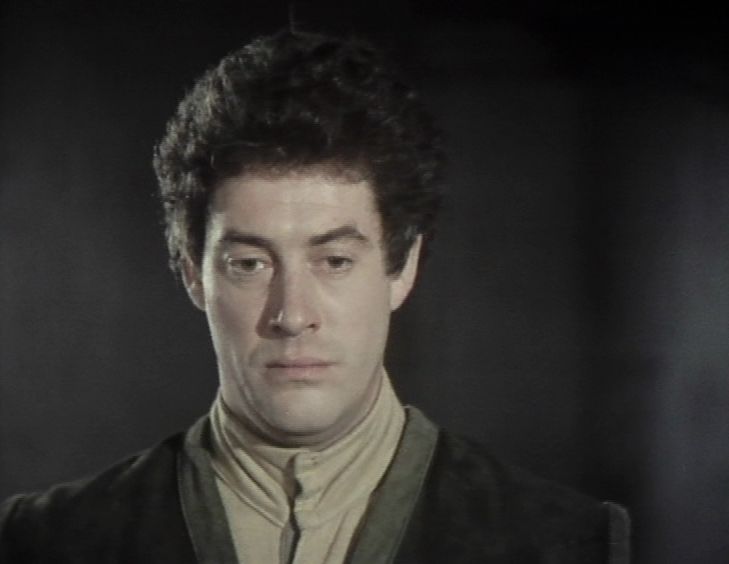
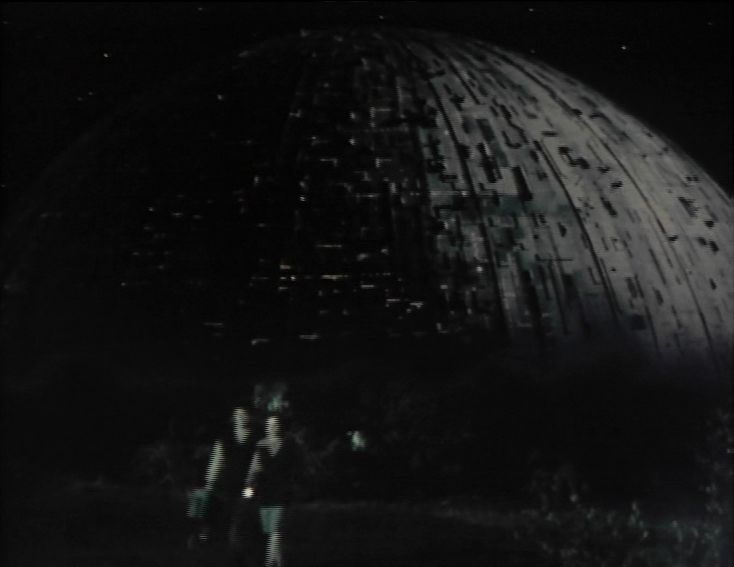
The Way Back has an unsettling dystopian atmosphere.  At the start, Roj Blake (Gareth Thomas) appears to be an average sort of person – but it quickly becomes clear that the last few years of his life has been nothing but a sham.  A trip outside the Domed community (which is strictly forbidden) leads to a meeting with Bran Foster (Robert Beatty).  Foster is able to break the bitter truth to Blake.

Four years ago, there was a good deal of discontent with the Administration. There were many activist groups. But the only one that really meant anything was led by Roj Blake. You and I worked together. We were outlawed and hunted. But we had supporters and we were making progress. Then someone betrayed us, I still don’t know who. You were captured. So were most of our followers. They could have killed you. But that would have given the cause a martyr. So instead they put you into intensive therapy. They erased areas of your mind, they implanted new ideas. They literally took your mind to pieces and rebuilt it. And when they’d finished, they put you up and you confessed. You said you’d been “misguided”. You appealed to everyone to support the Administration, hound out the traitors. Oh, they did a good job on you. You were very convincing. And then they took you back and erased even that.

One major problem with the episode is the way that all of Blake’s suppressed memories seem to come back shortly after Foster speaks to him.  Given the time and effort taken by the Administration to reprogram him, it’s rather bizarre that somebody telling him the truth can seemingly reverse all of their treatments (although it is mentioned that a sudden shock could cause Blake to regain the areas of his mind that were previously blocked).  It would have been more dramatically satisfying for Blake to slowly recover his memories over the course of the first series, but I assume it was felt that they needed a resolute (and not confused) central character in place by the end of episode one.

way 02

Foster and his friends have been betrayed by Dev Tarrant (Jeremy Wilkin)  and everybody, except Blake, is massacred.  This early example of the ruthlessness of the Administration provides Blake with yet another reason to fight.  The outside sequences, all shot on film, are nicely directed by Michael E. Briant – especially the moment when Blake returns to the meeting place and finds dozens of lifeless bodies strewn about the floor in a haphazard fashion.  This scene is also notable for the lack of music underscoring what we see – the picture (and the stark silence) speaks for itself.

We’ve already learnt that Blake wasn’t killed four years ago because the Administration feared his death would turn him into a martyr.  This is presumably also why his life is spared now (although if we accept this, can we also accept that Foster and all the others were completely dispensable?).  This time they don’t decide to brainwash him, instead he’s arrested on charges of child abuse – which is a much more insidious way to discredit and silence him.

Of course, if the Administration wanted to be sure of an easy conviction, why didn’t they brainwash Blake into believing he’d committed the crimes, in the same way that the children had been conditioned?  It also seems a bit lax to have given Blake an honest man as his defender.  Varon (Michael Hasley) is persuaded, after Blake’s urgings, that he may be telling the truth after all – but it’s all to no avail as both he and his wife are quietly disposed of.

Although we never see the children and the crimes are only mentioned in passing, the whole notion (as well as the probability they’ve been implanted with false memories) is a chilling one.  But despite Blake’s conviction, which you’d assume the Administration would have broadcast fully, I can’t recall a single person that Blake later meets who ever mentions the case.  As a piece of propaganda it therefore seems to have failed totally.  Surely somebody would have believed it?

With Blake now a convinced criminal, he faces a eight-month journey to the penal planet Cygnus Alpha.  Before lift-off, he meets several other prisoners – Vila (Michael Keating) and Jenna (Sally Knyvette).  As the ship blasts off, Blake takes a last despairing look at the Earth and vows to return …..

The Way Back is an effective opener.  Gareth Thomas manages to make an immediate impression as Blake, although it won’t be until the following episode, where we meet Avon, that the dynamic for the first few series is firmly established.  There’s some very decent model shots, especially of Blake and the others leaving the Dome, and a number of familiar faces (Robert Beatty, Robert James) in supporting roles.  It is slightly concerning that even this early on some of the sets look fairly tatty – my favourite are the doors which have a “swoosh” sound effect put on them.  This is to sell the illusion that they’re somehow more sophisticated than the bog-standard doors they actually are.  Naturally, this doesn’t work!

Sally Knyvette and Micheal Keating only have a limited amount of screen time, but both impress with the little they have to do.  Knyvette is presented as a tough and bitter character, but we’ll come to see that she does possess a heart – and will take a very definite shine to Blake (this becomes even more obvious when Cally joins the crew!).  As the series progressed Vila would become more of a comic figure, but here he’s rather sinister and unsettling – it’s a pity that this characterisation didn’t last for longer.

way 03

Grange Hill. Series Three – Episode Eleven

grange hill s03e11

Written by Phil Redmond. Tx 12th February 1980

Fund-raising for the Outdoor Centre continues and culminates in a tug-of-war between the pupils and the staff.

But the most interesting part of the episode is the confrontation between Pogo and Karen. Pogo’s at his most obnoxious here – breaking the toast-rack that Karen made in woodwork for no other reason than he felt like it. For a character who’s later usually positioned as a positive one, it seems an incredibly mean and spiteful thing to do.

Karen gets her revenge though as she enlists the help of some older girls to steal Pogo’s trousers! No, it’s not a particularly sophisticated storyline, but it’s amusing nonetheless. Thanks to Miss Mooney’s prompting he does get them back though.

Elsewhere, Mr Baxter continues to victimise Benny because he chose to play for the district, rather than the school team. Michael Cronin’s always good value as the belligerent sports master, especially during the cross-country run which sees Tucker, Alan and Benny decide to take the bus, rather than complete the course in the usual way. You would have thought that by catching the bus they would have been amongst the first to finish, but they end up being the last, which is rather odd.  But for once they manage to outfox Bullet, which is a rare victory for them.

The Wheeltappers and Shunters Social Club – 27th April 1974

wheel s01e03

Tonight’s Turns:

Stephane Grappelli and Diz Disley Trio
Little and Large
Tony Brutus
The Barcias
Terri Rogers
Lonnie Donegan

Another typically eclectic Wheeltappers show opens with Stephane Grappelli.  His lengthy career saw him play with a wide variety of fellow musicians – including Pink Floyd, Duke Ellington, Oscar Peterson, Paul Simon, Yo Yo Ma as well as Yehudi Menuhin (the pair recorded several well-received albums).  It’s hard to imagine a less likely artist to grace the bill of a working man’s club, but once you accept the incongruity of his appearance, it’s a very enjoyable (albeit brief) turn.

From the sublime to the, well, rather less sublime.  At their peak (during the late seventies and well into the eighties) Little and Large were one of television’s top-rated attractions – their BBC shows generated very good ratings which turned the pair into major stars.  But in the decades since, their stock has plummeted – so much so that today they’re mostly forgotten or held in barely disguised contempt by those who do remember them.

Does their turn here hint at any forgotten greatness?  Not really no, although it’s probably an accurate snapshot of the act they’d honed playing many similar club gigs during the years prior to their big television break (they formed in the 1960’s, so the pair had spent a long time slogging around the unforgiving club circuit).  Syd attempts to sing a song but finds himself interrupted by Eddie in numerous ways (Quasimodo impressions, using his electric guitar as a sledgehammer, etc).  Personally, I saw them live in 1985 and thoroughly enjoyed their show, so maybe they were an act that worked better in the live environment.  On television their limitations were possibly more easily exposed.

Strongman Tony Brutus attempts to lift both Bernard Manning and the local Mayor off the ground.  This is an impressive, albeit brief, feat.  The specialty acts continue with the Barcias, who display some decent feats of agility.

Next up is vent act Terri Rogers.  Rogers was an interesting character – she was born male but underwent a sex-change operation in the early 1960’s.  This naturally enough generated a certain amount of publicity, but it didn’t prevent her from enjoying a lengthy career as both a magician and a ventriloquist – mainly in the clubs, although in later years she notched up appearances in Las Vegas and on American television.

The contrast between the highly coiffured Rogers (complete with tiara) and the somewhat tatty, slightly foul-mouthed doll is the best part of her turn, even though she may not be the greatest technical ventriloquist ever (I suspect the large microphone was strategically placed at times to obscure her moving lips!).

The show ends with a bona fide British showbusiness great – Lonnie Donegan, the King of Skiffle.  He was an influence on virtually every aspiring British musician in the 1950’s (including, most famously, The Beatles).  His later musical career was less successful, as tastes changed, so it’s not difficult to imagine him in this sort of club setting during the mid 1970’s.  Like the rest of the turns, he’s only got a few minutes to make his mark, but his energetic act certainly brings this edition of the Wheeltappers to an impressive end.

Grange Hill. Series Three – Episode Ten

grange hill s03e10

Written by Phil Redmond. Tx 8th February 1980

There’s quite a lot going on in this episode. Penny is unhappy that she can’t contribute to the school magazine (following her article on Doyle) but perks up when she realises that Susi can contribute material they can write together.

Andrew Stanton’s parents continue to have marital problems – it’s a piece of incidental story colour that doesn’t seem to be developed at this time, but will eventually pay off in series four when it’s revealed that Andrew’s father has left (taking Karen with him).

There’s also more discussion about the proposed Outdoor Centre, but most of the running time revolves around Benny’s participation in the trials for the district football team. His hopes for selection aren’t helped by the fact that they’re being run by Mr Wainwright (Bernard Kay) who is clearly favouring his own pupils from Brookdale.

It’s always a pleasure to see Bernard Kay of course and the football sequences also paint an interesting picture of late seventies inner-city London life. Location-wise, Grange Hill would change over the years as production moved to different areas (most dramatically, of course, when it moved to Liverpool for the last few series). The match also takes up a fair few minutes and the only dialogue we have to guide us are Gary Hargreaves’ off-camera comments and criticisms.

Benny gets picked but he then has face a dilemma from Mr Baxter – does he choose to play for the district or the school?

The recent (far too early) death of Terry Sue Patt gives this episode an extra poignancy. Benny would tend to fade into the background (or not even appear at all) during series four, so this is one of the last Benny-centric episodes we’ll see.

Grange Hill. Series Three – Episode Nine

grange hill s03e09

Written by Phil Redmond. Tx 5th February 1980

The episode opens with Mr Sutcliffe and Miss Mooney having a rather public argument (which amuses Cathy and Trisha no end!).  Later, we see Mr Hopwood rather dismayed at the lack of interest shown by the pupils in discussing plans to set up the Outdoor Centre – only six people turn up.

But the bulk of the episode concerns itself with Penny Lewis’ crusade to expose Michael Doyle’s corruption and disinterest as a school rep.  She learns from Andrew and Justin that Doyle asked for fifty pence before raising the topic of the Outdoor Centre at the next school council meeting.  With Susi by her side she pens an incendiary article for the school magazine. Naturally, she doesn’t clear it with the teachers first, so both she and the editor have to face the music.

Doyle isn’t best pleased of course and confronts Penny and Susi – but luckily Alan and Tucker are around to see them off. Alan’s chivalrous action is another hint that he’s interested in Susi – a slow burn plot-line that will develop well into the fourth series.

It’s been stated before, and is again here, that as Doyle’s father is a local councillor (and also on the board of Governors at Grange Hill) his opinions tend to carry more weight than an ordinary parent. This is obviously unfair, but it’s something that Michael Doyle manages to use to his advantage and the teachers seem unable or unwilling to challenge this state of affairs.

The episode ends with a rather nice shot of a tearful Penny vowing to get even with Doyle. This is another plot-line that’s clearly not over yet.

Grange Hill. Series Three – Episode Eight

grange hill s03e08

Written by Phil Redmond. Tx 1st February 1980

The attempt to establish a permanent Outdoor Centre picks up a little pace in this episode.  Mr Hopwood has found the perfect place (the pupils already visited there in episode three).  The owner of the property was impressed by the way the pupils helped to put out the fire during their last visit (although if he knew they were responsible for starting it in the first place he may not have been quite so understanding!)

But since he remains in ignorance, he’s happy to let the property for a nominal fee for the next year – provided the school can find the money to repair the derelict building.  This, of course, is where the problems begin.  Funds for extra-curricular activities have always been difficult to come by – and the early 1980’s was an especially cash-fraught time.  Mr Keating, deputising for the (by now always) absent Mr Llewellyn doesn’t dismiss the plan out of hand, but it’s obviously going to be a considerable struggle to bring these plans to fruition.

The main part of the episode revolves around Pogo’s money-making plan to establish his own school tuck shop (since the official one still hasn’t been approved).  This does mean turning his mother’s kitchen upside down in order to keep making all the cakes he needs in order to fulfill his orders.  When poor Mrs Patterson surveys the mess she says that whilst she was happy for him to make a few cakes she didn’t realise he’d be attempting to rival Mr Kipling!

Pogo and Duane’s free enterprise did have the tacit approval of Mr Sutcliffe, who was also a willing customer.  In fact, the original clamour for alternative food arose after Mr Sutcliffe blocked Mr Garfield from arranging the tables in the canteen for lunch.  Mr Sutcliffe was taking a drama class at the time and didn’t understand why the caretaker had to disrupt his class when it was only mid-morning.  Mr Garfield, being the inflexible man he is, was happy to walk away and do it later – though this meant delaying the start of lunch and thereby creating a whole group of willing customers for the few cakes that Pogo and his friends already had on them (which they made earlier on in their cookery class).

Sadly, Pogo’s tuck shop comes to an ignominious end after Mr Keating becomes aware of it.  He starts by giving a dressing down to Mr Sutcliffe, who he says should really have known better, but then he has some good news.  The school tuck shop will be going ahead – and Mr Sutcliffe, Pogo and Duane seem like the ideal people to help run it (they’re clearly not in a position to refuse).

And Mr Keating also has some not-so good news for Pogo and Duane – a series of detentions as well as an essay to be written by them entitled “the problems of private enterprise in an authoritarian society”!

Grange Hill. Series Three – Episode Seven

grange hill s03e07

Written by Margaret Simpson.  Tx 29th January 1980

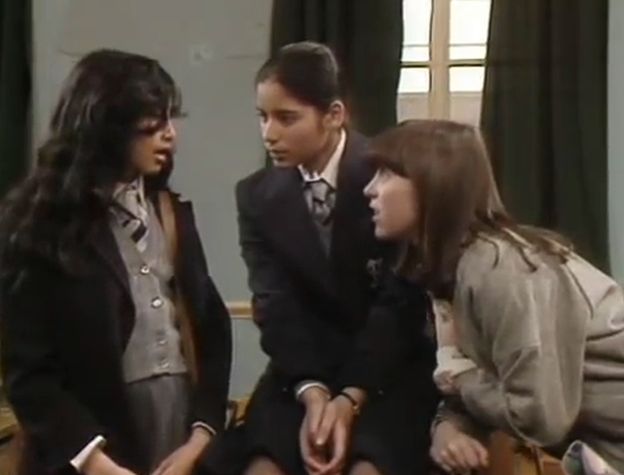
A new girl, Fatima Bibi (Belgit Gill), is placed in the care of Sudhanami Patel (Sheila Chandra).  This seems to be because Fatima doesn’t speak any English and the assumption appears to be that Sudhanami will be able to communicate with her.

But it becomes clear very quickly that Sudhanami isn’t going to make any headway.  Mrs Conrad (Margaret Stallard), the teacher responsible for working with pupils who need to increase their English language skills, is quick to grasp the gulf between Fatima and Sudhanami.  Sudhanami comes from Uganda and Fatima hails from East Pakistan.  The unconscious racism on the part of the other members of staff who’d obviously assumed they’d be able to communicate is never directly commented upon, but is clear enough.

Grange Hill has, from the first episode, been a multi-cultural school, but it’s rarely something that’s been a central part of any ongoing story.  True, Benny did receive taunts about the colour of his skin in some of the early episodes, but he was also bullied because his family was poor.  This episode is therefore notable since it attempts to deal with two thorny topics at once – the problems of how those newly arrived (like Fatima) integrate into British society but also how the people already established (like Sudhanami and her family) adapt to the culture around them.

Fatima is a one-shot character and won’t be seen again after this episode.  This it’s a bit of a shame, since there would have been some mileage in showing her develop.  But Sudhanami does remain a semi-regular for a while (up until the end of series four).  She’s rarely central though, so this is really the one episode where she moves to the heart of the story.

Her father, Mr Patel (Minoo Golvala), wants to transfer her to an all girls school.  He seems to be almost a caricature of a traditional Indian father – he hates the fact that she goes to school with boys, listens to pop music, etc.  All this does rather beg the question as to why he allowed her to go to Grange Hill in the first place.

Although a strict traditionalist (he expects her to help in the shop and is reluctant to allow her to spend time with her friends outside of school hours) it’s clear that he does genuinely love her and has (or at least he believes he has) her best interests at heart.  As for Sudhanami herself, she’s somewhat submissive and is happy to follow her father’s directions.  If he decrees that she will take part in an arranged marriage sometime in the future, then that’s what will happen.

This may be an accurate, although not terribly progressive, portrait of the times – but it’s notable that as the series progresses we’ll tend to see children who will be much less prepared to toe the family line.  Instead they’ll be keen to embrace all that Western culture can offer, irrespective of what their parents may say.

Although this is a fairly serious episode, there are a few lighter moments.  Trisha and Cathy are aghast to find that Miss Mooney and Mr Sutcliffe are engaged – Cathy earlier remarked that Mr Sutcliffe “wouldn’t marry a thing like that”!  Trisha and Cathy also attempt to teach Fatima some useful phrases such as “Flippin’ ‘eck” and “Shut yer mouth”.

Tucker’s artistic flair is put to good use again when he designs a cut-out figure for the school fair.  The teachers line up to put their heads through the opening and have to suffer wet sponges being thrown at them.  It’s all for a good cause, so they can’t complain, and naturally the pupils are delighted for the chance to take their revenge – especially on Mr Baxter!

Grange Hil. Series Three – Episode Six

grange hill s03e06

Written by Margaret Simpson.  Tx 25th January 1980

The bicycle thefts are still continuing. Pogo decides to take the law into his own hands and organises a watch on the bike sheds (inevitably he ends up getting caught by Mr Garfield). Meanwhile, the girls are pursuing a more fruitful line of enquiry – they decide to visit the bike shop on the high street to see if any of their bikes are there.

Their presence is enough to spook the shop owner (who, as we have seen, has been receiving the stolen bikes) and it eventually sets in motion the chain of events which leads to the bike thieves and Madelin Tanner getting caught.

This takes place via a lovely film sequence. Tucker and his friends, with Mr Baxter, are returning from a cross country run whilst Pogo and his classmates are also returning to the school from the opposite direction (after a field trip to the local park). Spotting Tanner and one of the thieves (although they weren’t actually in possession of a stolen bike at the time, so it’s difficult to see what actual evidence could have been used to convict them) the two groups of children converge on the hapless pair.

Tucker manhandles Madelin Tanner, whilst Mr Baxter rugby-tackes the man and realises that he’s an ex-pupil. This would be Lesley Woods’ seventh and final appearance as Madelin Tanner and apart from three uncredited appearances on the Benny Hill Show she doesn’t appear to have made any further film or television appearances.

Grange Hill. Series Three – Episode Five

grange hill s03e05

Written by Margaret Simpson.  Tx 22nd January 1980

This episode is the first indication that the theft of Duane’s bike wasn’t an isolated incident.  David Mitchell (Michael Mannion) proudly shows the others his new bike.  It’s not actually brand-new – it was bought second-hand from a local bike shop – but it does look as good as new.

Duane is initially impressed, although he’s perturbed when he spots a familiar looking dent.  The early evidence would indicate that the shop is receiving the stolen bikes, respraying and customising them, then selling them on.  It seems rather foolish to sell the stolen bikes in the same area (and indeed this is a point made by the shop owner in the next episode – concerned that the bikes he’s receiving are local) but if they had been sent further afield then the plot couldn’t have been wrapped up so quickly.

It turns out that Madelin Tanner is involved, helping the thieves to steal the bikes.  Although quite why they need her help isn’t clear, since all the bikes are parked in the bike shed and are ripe for the picking – even the ones with chains.

This is quite a busy episode, as apart from setting in motion the bike plot (which will be concluded in the next episode) we’re also introduced to Chris (Jonathan Warren) , the editor of the school magazine.  He’s chairing a meeting with Mr Curtis who although he’s keen to stress that the school magazine is very much the pupil’s responsibility, still wants to see everything due for publication before the magazine is sent to the printers.

Naturally this doesn’t go down very well and cries of censorship are heard.  It’s interesting that the school magazine appears to have been going for a while and was originally set up by the pupils with no staff interference or involvement.  Quite how this happened is a bit of a mystery (presumably it can be explained as one of Mr Llewellyn’s more progressive policies) but now the staff are keen to ensure that no embarrassing material makes it into the public domain.  We’ll come back to this story-line later in the series.

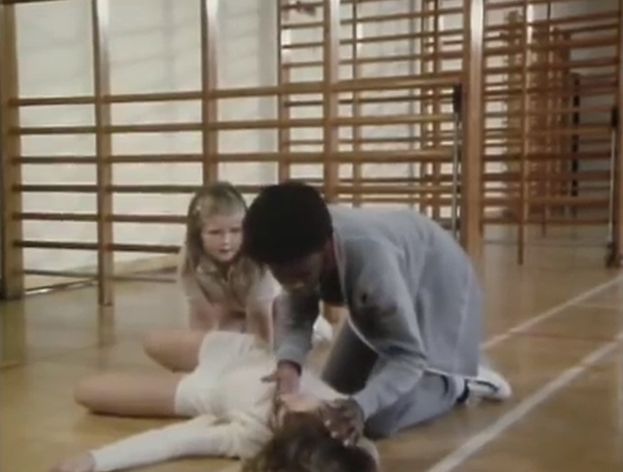
Lastly, Sally is taken ill during Miss Peterson’s gym class and rumours (spread by the irresponsible Anita) state that she’s dead.  It’s been threaded through the early episodes that Sally hasn’t been well, so her fall from the gym bars doesn’t come as a complete surprise.  Just prior to her accident, the soundtrack switches to an ominous heartbeat – it’s a familiar dramatic device, but even though it’s a bit of a cliche it still works well.

The question is, was Miss Peterson responsible?  We’ve already seen that she pushes the girls hard – she doesn’t accept any excuses for non-participation in games (telling them that she expects them to still join in even if they have a broken leg!).  This doesn’t please the games-shy Anita (Joanne Boakes) who mutters that she’ll tell her Gran about this (which seems to be her stock response to almost everything).

Happily, Sally turns out to be fine and we find out in the next episode that she has a weak heart which meant that an attack could have happened at any time and therefore Miss Peterson wasn’t to blame.  And now that her plot-line is concluded, Sally vanishes, never to be seen again.  Not an uncommon occurrence in Grange Hill (think of Simon Shaw from series two).

We also get our first look at Jill Harcourt (Alex Kingston) although she’s very much in the background here and won’t emerge into prominence until later in the series, when she starts menacing Susi to complete her homework.

Star Cops – Little Green Men and Other Martians

little

Why has the respected investigative journalist Daniel Larwood (Roy Holder) travelled to Moonbase?  It may have something to do with the persistent rumours that something has been discovered on a recent Mars expedition.  Is there really life on Mars?  Although possibly he’s more interested in a drugs smuggling ring that’s uncovered after a shuttle pilot is killed in a crash.

With Theroux on leave and Nathan soon to depart for Mars, it leaves the Star Cops rather stretched as they try and make sense of the various pieces of the puzzle.  But all this is forgotten when the shuttle carrying Nathan en-route to Mars explodes …..

After a run of four episodes by other writers, Little Green Men and Other Martians saw the welcome return of Chris Boucher.  Roy Holder is perfect casting as the crumpled journalist Larwood whose arrival is greeted with some dismay by Kenzy (the pair of them have history).  It’s implied they had a relationship when Kenzy was younger (Larwood at the time was writing an article about her and her friends).  The article clearly didn’t turn out well – Kenzy was upset to be painted as a student militant, although Larwood counters that Kenzy and her friends weren’t actually as radical as they appeared to be.

As the interest in the Martian finds increases, more journalists start to arrive.  Susan Caxton (Lachelle Carl) has a memorable first meeting with Nathan.  Unknown to him, she enters the office as he’s talking on the RT to Devis.  Colin is transporting two suspects in the drugs case in one of the Moon Rovers and Nathan is happy to play along with Devis’ suggestion that he takes them outside for a walk and leaves them there.  And since they’re miles from anywhere it’s certain they’ll die – so Nathan suggests recording their deaths as spacesuit failures

Afterwards, Caxton asks Nathan if he was joking, although Nathan’s completely unrepentant.  This firmly places him alongside old-school coppers like Jack Regan of The Sweeney who were perfectly happy to put whatever pressure they could on suspects in order to get the information they needed.  For Nathan, the rights of the individuals would appear take second place compared to the misery that drugs cause.  Carl’s first appearance in the episode was via a news report on-screen and many modern viewers would probably instantly recognise her since she had a similar newscaster role in numerous episodes of Doctor Who between 2005 and 2010.

The news that Nathan’s on his way to Mars to set up a new Star Cops base was clearly laying the ground for the projected second series (one that sadly never came).  But if it had, you could imagine this episode might have ended on a cliff-hanger showing the shuttle explosion and Nathan’s apparent death.

As it was, the shock of Nathan’s death doesn’t last very long before it’s revealed he wasn’t on-board the shuttle after all.  But before he returns from the dead it’s quite obvious how his “death” has affected Kenzy.  The increasing affection between the pair of them is also demonstrated earlier on when Nathan leaves for the shuttle.  Nathan, being typically British, offers to shake Kenzy’s hand but she decides she wants a hug instead.

It does seem strange that Nathan tells her he’ll be gone for several years.  If so, why isn’t he taking anybody else with him – how can he establish the Star Cops on Mars all by himself?  This does then seem to be contradicted at the end of the episode when Nathan asks the others if they’d like to come with him and set up the Martian base.

Star Cops had to contend with many difficulties and several of them came towards the end of the production block.  One whole episode, Death on the Moon, was never made to due to industrial action and this episode also had serious problems.  Erick Ray Evans succumbed to Chicken Pox shortly before the story was due to go into the studio, so the script had to be hastily rewritten – with virtually all of Theroux’s lines given to Kenzy.

This wasn’t necessarily a bad thing, as it gave us one more opportunity to see the Nathan/Kenzy partnership in action – surely something which would have been developed even further if the Mars-based series two had ever gone into production.

Although Little Green Men and Other Martians was a complex and confusing story at times, it was still a strong closer to a series that has plenty to recommend it.  Alas, a summer BBC2 slot at a less than ideal time sealed its fate as ratings struggled to reach two million.  VHS and DVD releases (although now long deleted) helped to bring the series to a new generation and whilst the 1987 vision of 2027 is undeniably clunky at times, it’s still a programme which has aged remarkably well and is well worth tracking down.

Star Cops – Other People’s Secrets

secrets

Living in an enclosed environment, like the Moonbase, can be highly stressful for a number of reasons.  Recognising this, Krivenko has invited Dr Angela Parr (Maggie Ollerenshaw) to the Moon.  Dr Parr is a psychiatrist who is working on a project about space psychology.  From Krivenko’s point of view it will allow Moonbase personnel to talk about any psychological problems they may be suffering from and Dr Parr will gain valuable research material.

But not everybody welcomes the idea of strangers snooping into their private lives.  Kenzy, in particular, is violently opposed to meeting a psychiatrist.  So when Nathan insists that all of the Star Cops have attend a meeting, it’s fair to say that Kenzy’s not best pleased.

But maybe Dr Parr has come at just the right time, since Moonbase has been suffering from a series of niggling technical breakdowns.  At first it just seems like wear and tear, but the increasing regularity causes Nathan to wonder if it’s deliberate sabotage.  Hooper (Barrie Rutter) is the highly overworked senior maintenance man who appears to be cracking under the strain of keeping the base operational.  Could he be responsible?

Also making a visit is safety inspector Ernest Wolffhart (Geoffrey Bayldon), who’s far from impressed with what he sees.  And when a major incident causes a decompression of Moonbase, there’s a real danger that lives will be lost.

Other People’s Secrets is the episode of Star Cops that most resembles Moonbase 3 (this is a compliment by the way!).  Because Star Cops was a more wide-ranging series (it made frequent trips back to Earth as well as several off Moon excursions) it lacked the claustrophobic nature of Moonbase 3.  In the earlier series it did seem that each week somebody was going to crack under the strain of living and working in such an unnatural environment.

This theme, full of dramatic potential, is developed quite well here.  There are several suspects as Nathan and Theroux hunt for the saboteur, but it’s not really a whodunnit as the guest cast is rather limited.  Barrie Rutter is very beardy and perpetually angry as the maintenance wizard Hooper.  He tends to vent his anger on the nearest available target, which in this case is his unfortunate assistant Beverley Anderson (Leigh Funnell).

Star Cops never really had a reputation of attracting familiar names as guest stars, but Other People’s Secrets is an exception as Geoffrey Bayldon (Catweazle himself) gives a lovely performance as Wolffhart.  Bayldon provides us with a good character study of a man who appears to live for his work (he’s already past retirement age, but he’s still working).  When we learn that he’s a widower, this seems to make sense – although it later becomes obvious that Wolffhart is a flawed man who shouldn’t be working in Space.

I wonder if the inclusion of Dr Parr was a tribute to Moonbase 3‘s own Dr Helen Smith?  I’d love to think that it was a genuine homage, but it’s probably just a coincidence, although they are similar characters in several ways.  Perhaps the most ironic similarity is that both of them find it impossible not to get involved with their subjects – Dr Smith had several dalliances, whilst Dr Parr is shocked to discover Colin Devis is amongst the Moonbase crew (they used to be married).

When the Moonbase decompression accident occurs, everybody has to find shelter in the nearest room, which is then sealed tight.  With only a limited oxygen supply, there’s nothing that the occupants can do except wait to be rescued.  Although Devis, who finds himself locked up with his ex-wife, has another idea.  “Fancy a game of hide the sausage?” he memorably asks her.

It’s perhaps predictable that Nathan and Kenzy find themselves trapped together, but sex isn’t on their minds (or at least it isn’t on Nathan’s).  Instead, in a key piece of character development he tells her about his father.  Nathan’s father worked as a computer salesman and was the best that the company, Recondite, ever had.  But it later became clear that he was stealing blueprints from his company and eventually he was caught by a keen young copper.  It’s never explicitly stated, but the inference is that it was Nathan who arrested his own father.  Both Calder and Newton are once again excellent in this scene.  Calder has the bulk of the lines but it’s Newton’s reactions that really help to sell the intensity of what we see.

Easily the best of the non-Boucher scripted episodes, Other People’s Secrets is memorable for several reasons – most notably the Nathan/Kenzy heart-to-heart but also for the fine guest appearance of Geoffrey Bayldon.

Grange Hill. Series Three – Episode Four

grange hill s03e04

Written by Margaret Simpson. Tx 18th January 1980

It’s time for the school council elections.  Penny Lewis is the current rep but some people, like Trisha and Doyle, aren’t happy with her.  Trisha and Penny are totally opposite characters – which brings a healthy dose of conflict into their relationship.

Trisha and Cathy are irritated about having nowhere to go during the lunch-breaks, so that’s one of the reasons why Trisha decides to stand as a council rep.  If elected, she’ll request that the third-formers have access to common rooms, like the fifth-formers.

Doyle later makes the reasonable point to Miss Peterson that since there’s more girls than boys, any boy rep doesn’t stand much of a chance of getting elected.  Miss Peterson counters that surely sex wouldn’t be the first consideration, whilst Trisha mutters that it’s all the boys ever think about!

But Doyle’s in the right place at the right time, as it’s been decided that having both male and female reps in each year would be fair.  Doyle is elected third year boy rep (much to the disgust of Penny) whilst both Penny and Trisha are beaten by an unknown outsider.  All of Doyle’s policies are good – they should be, since they were pilfered from both Penny and Trisha.

Before the results come in, there’s an epic fight between Penny and Trisha (Penny calls Trisha “a nasty two-faced bitch” which kicks off proceedings).  Tucker has nothing to do whilst the argument between Penny and Trisha is bubbling away – but Todd Carty’s facial expressions are a delight and he goes a long way to stealing the scene.

Doyle’s victory will continue to rankle with Penny for the rest of series three, which makes it a fruitful source of conflict between the pair of them.

Elsewhere, Miss Mooney appears to be the worst possible science teacher.  She finds herself distracted by the loss of her glasses (which were on her head all the time).  Whilst she’s fretting about her glasses, there’s a small fire, which Tucker manages to put out.  He’s later berated for this – yes he did put the fire out, but he started it in the first place!  This seems a little unfair, as it was an accident, and if the pupils aren’t adequately supervised surely some of the blame should rest with the teacher.

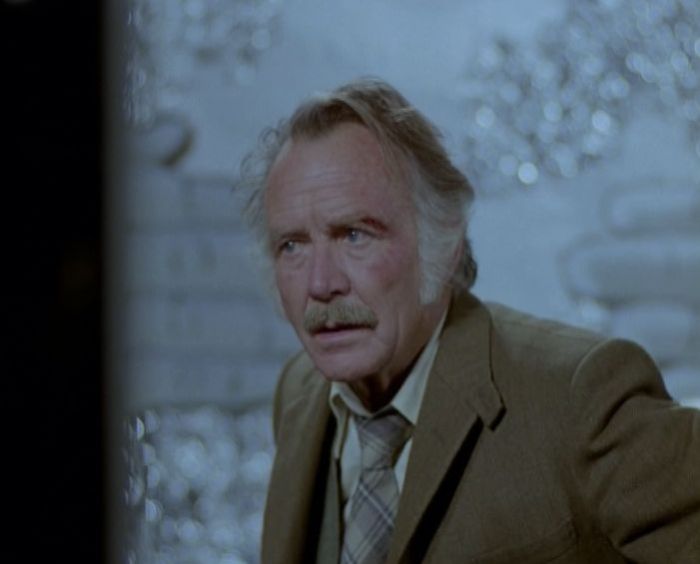
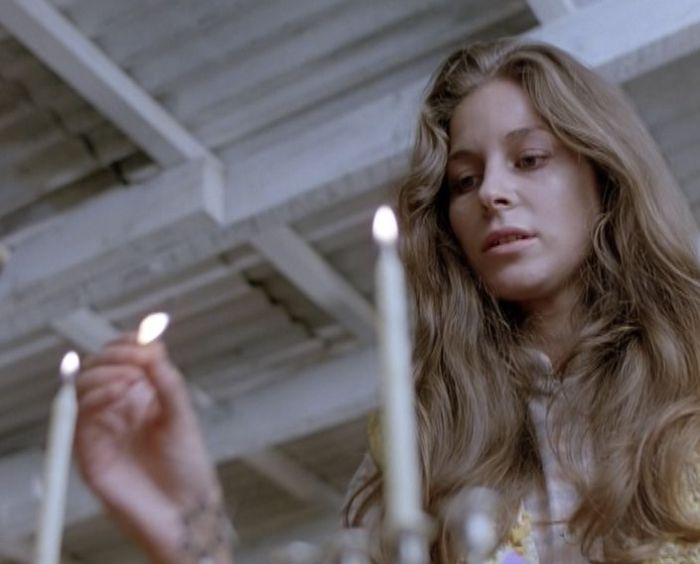
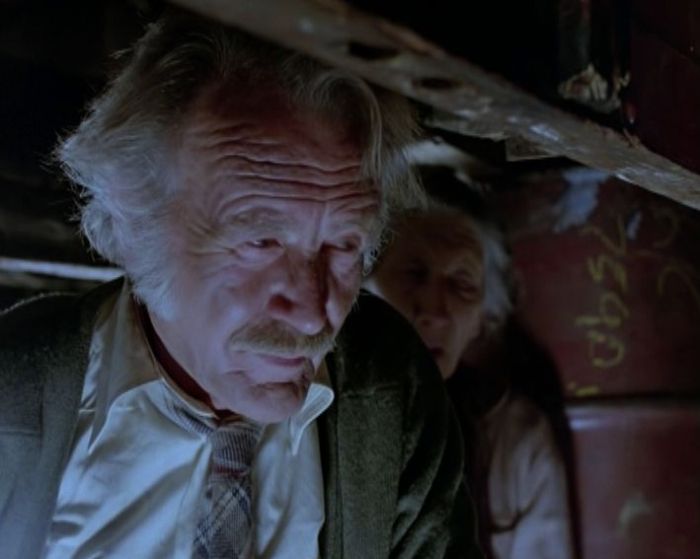
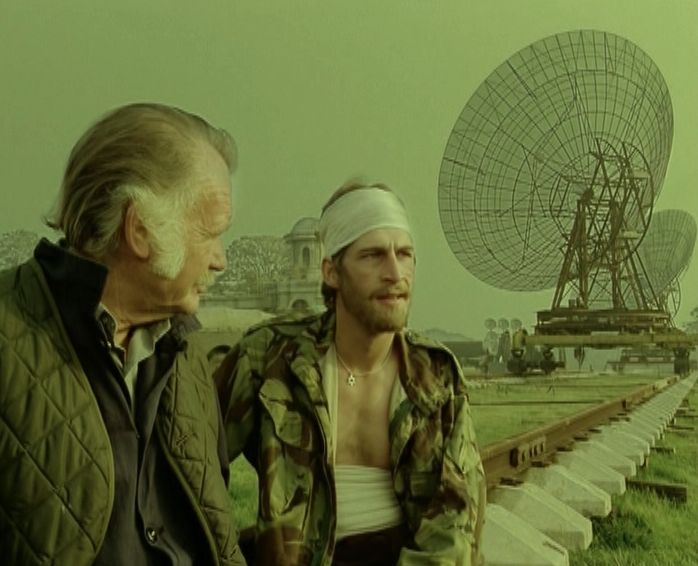
Quatermass (John Mills 1979) – Network BD/DVD Review

quatermass titles

After rewatching Euston Films’ 1979 production of Nigel Kneale’s Quatermass a few months ago I mused that it would be nice if Network were able to acquire the rights and release a restored version on BD.  And just to prove that wishes do sometimes come true, Quatermass will be released by Network on BD and DVD on the 27th of July 2015.  It’s especially welcome since the previous release, long since deleted, was only available on DVD and the picture quality left more than a little to be desired.

Quatermass was an unusual project for British television at the time, due to the fact it was filmed on 35mm.  Filmed programmes were becoming more common, but by the late 1970’s they tended to be shot on 16mm.  Because Euston wanted to recut the series for theatrical release in the US, it was obviously decided that it was worth investing the extra money to shoot on 35mm stock and that’s very good news.  Network have already released several impressive BDs sourced from 16mm material (The Professionals, The Sweeney, Robin of Sherwood) but since this was a 35mm series the resulting PQ will be even better.

Network were able to access the original film elements (the ClearVision release was only sourced from a 16mm print).  It’s interesting to compare screen caps from the ClearVision DVD against the Network BD.  Greg Bakun’s From The Archive blog has a number of examples and looking at the caps, the colours on the Network BD seem to be very muted compared to the ClearVision DVD.

Having watched the BD in motion I’m now more reassured – it is a less vibrant grade but it suits the nature of the story.  Quatermass was a bleak, post-apocalyptic tale so it shouldn’t really look bright and summery (and it’s probable that the ClearVision DVD was over-saturated anyway).  Colours on the BD look natural, which is the most important thing.

I’ve already written quite extensively on the programme starting here, so we’ll move on to look at the special features.  The key one is the 100 minute movie edit, The Quatermass Conclusion.  This basically cuts the running time in half (most of episode three is excised, for example) and it also includes some alternative footage and music.  It’s displayed in what I assume was the original theatrical ratio of 1:78:1 and it’s therefore interesting to compare some of the same shots against the 1:33:1 framing of the television series.  Possibly Network could have released the series in 1:78:1 as well, but since they’re sticklers to keeping to the original A/R it’s no surprise they didn’t (and it’s the right call, in my opinion).

The Quatermass Conclusion obviously loses some detail and character development, but on its own terms it works very effectively.  It’s certainly a very different proposition from the “movie edits” of series such as UFO, which bolted several unconnected episodes together and attempted to paper over the cracks with new incidental music.

Textless titles, (mute) episode recaps and a mute trailer for The Quatermass Conclusion are inessential, but nice to have anyway.  The image gallery runs to 2:51 and contains a varied selection of on-set photographs as well as some behind the scenes pictures.  Music only tracks across all four episodes are a very welcome extra as is the thirty-six page booklet of production notes by Andrew Pixley.  As might be expected, Pixley has been able to unearth a wealth of fascinating production detail.

The bleak tone of Quatermass might not be to everybody’s tastes but I’m glad that it’s finally back in circulation (and with such good picture quality) so that people can experience it for themselves.  A few more special features (commentaries, documentaries) would have been welcome but it’s still a very decent package at a good price (especially when ordered direct from Network) and is warmly recommended.

Star Cops – A Double Life

double 1

The Star Cops investigate an unusual kidnapping.  Three embryos belonging to the wealthy and influential Madame Assadi (Nitza Saul) are removed from a facility on the Moon.  All the evidence (including a genetic fingerprint) points to James Bannerman (Brian Gwaspari) being responsible.  He has a watertight alibi though – at the time the crime was committed, Bannerman (a noted concert pianist), was giving a recital at the Royal Albert Hall.

After Bannerman is abducted by Madame Assadi he seems fated to suffer a traditional Arab punishment for theft (the loss of his hand).  Nathan has discovered the true culprit, but time’s running out to save Bannerman from a life-changing fate ….

There’s an awful lot wrong with A Double Life, especially the plot which is so full of holes that it really doesn’t hold up to any sort of close examination.  For example, when Nathan hears that the embryos have been stolen he orders an immediate lock-down of Moonbase.  This is reasonable, although it’s less clear why he decides to keep two exits open – surely until a thorough search has been completed there should be no movement out of the base?

His next bad move is to assign Anna Shoun to guard one of the checkpoints.  The mysterious kidnapper is easily able to overpower her and make his escape.  Anna is naturally distraught but Colin has no sympathy at all for her – in his eyes she lacks the strength to be a decent officer.  Although Theroux and Kenzy react angrily to Colin’s statement, it’s hard not to agree with him – but her failure here is simply laying the ground for the climax of the episode.  We later see her team up with Colin to track down the kidnapper and after Colin is captured, she has to save the day.  This helps her gain Colin’s respect and cements her place in the team (not the most subtle piece of character development, but it works after a fashion).

After the kidnapper had got past Anna, it becomes confusing as to whether he’s still on the Moon or has somehow returned to Earth.  Considering how powerful Madame Assadi is, it’s difficult to credit that Krivenko wouldn’t have ordered a complete cessation of travel until the embryos were located (especially since we later learn that both his and Nathan’s jobs might be on the line if a successful resolution isn’t found).

A number of ransom demands are broadcast, but the Star Cops are unable to track their location.  That is, until the last ten minutes of the episode when Theroux suddenly realises that the signal’s originating from a disused mine on the Moon.  Had he twigged this earlier then the episode would have been a lot shorter!

The revelation that Bannerman’s father, a noted geneticist, created a clone of Bannerman provides the solution about how he can apparently be in two places at once.  His clone brother, Albi, is everything that James Bannerman isn’t – bitter, twisted and poor.  Alas, this doesn’t help Bannerman, who never even knew he had a brother, and will be the one to suffer since Madame Assadi is unable to lay her hands on Albi.

Although the plotting is more than a little suspect, the major pleasure of the episode is the developing relationship between Nathan and Kenzy.  There’s still a slight edge to their conversations, but it lacks the anger of their earliest encounters.  And when Nathan travels Earthside to negotiate with Madame Assadi, he decides to take Kenzy with him.  They make a marvelously mismatched pair – Nathan is precise and logical, whilst Kenzy is impulsive and emotional.

But it’s Kenzy’s approach that works when they are finally granted an audience with Madam Assadi.  Nathan’s appeals to see Bannerman are refused and it’s Kenzy’s more direct, angry approach that wins the day.  Although Nathan tells her, tongue in cheek, how smooth she was, she did get the job done, which was the main thing.  Also of note is her oh-so Eighties dress sense – complete with rolled up sleeves.  Maybe by 2027 they will have come back into fashion!

The studio-bound nature of the production is another problem.  It would be easy to imagine that this was a fairly low-budgeted episode in order to balance out the other, more SFX heavy, ones.  Some of the CSO shots – Bannerman performing in the Albert Hall, the outside of Madame Assadi’s mansion – really don’t look convincing.

But even though it’s quite flawed, I still can’t regard it as a total write-off. Possibly my affection for Star Cops in general has always meant I’ve cut it some extra slack, but whatever the reason, if you don’t dwell on the plotting and the cheapness of the production there are some good moments to be found.

double 2