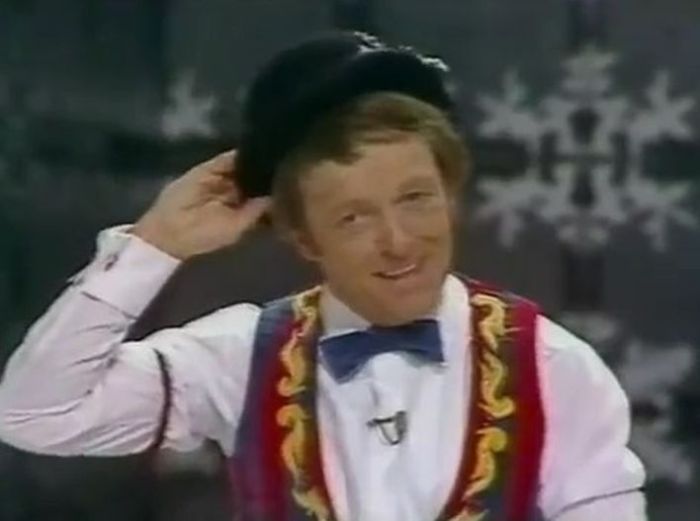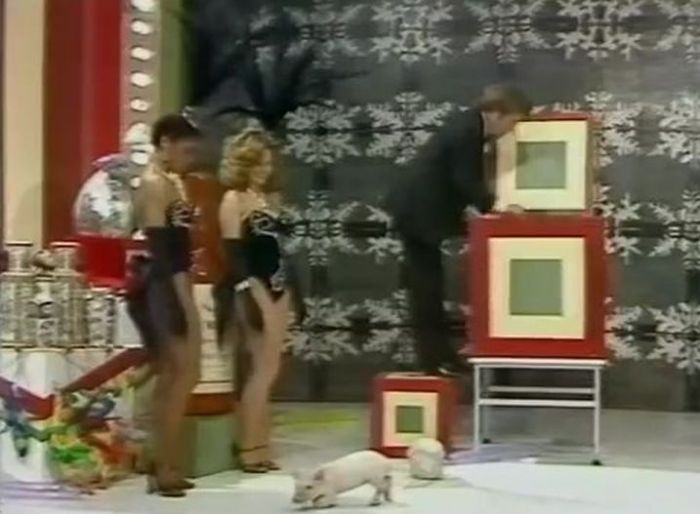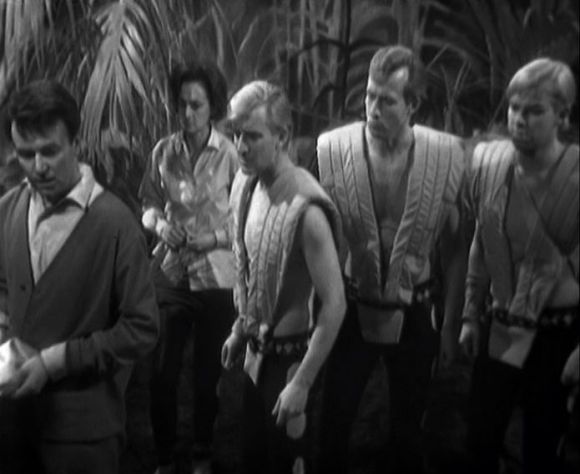
Grange Hill. Series Eleven – Episode Four

gh s11e04-01.jpg

Written by David Angus.  Tx 15th January 1988

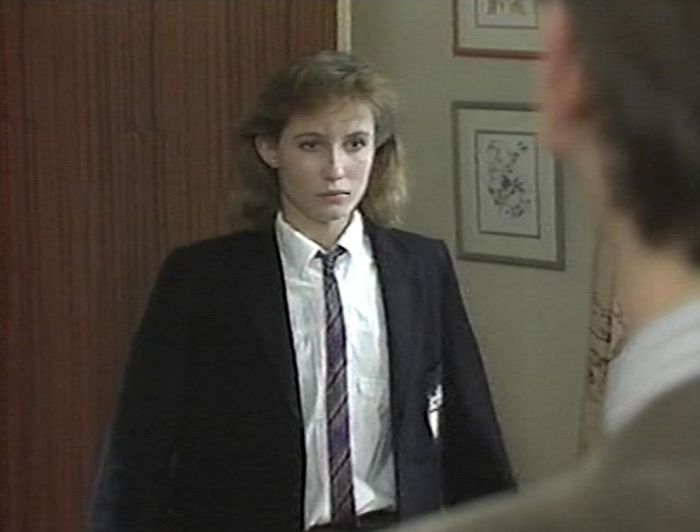
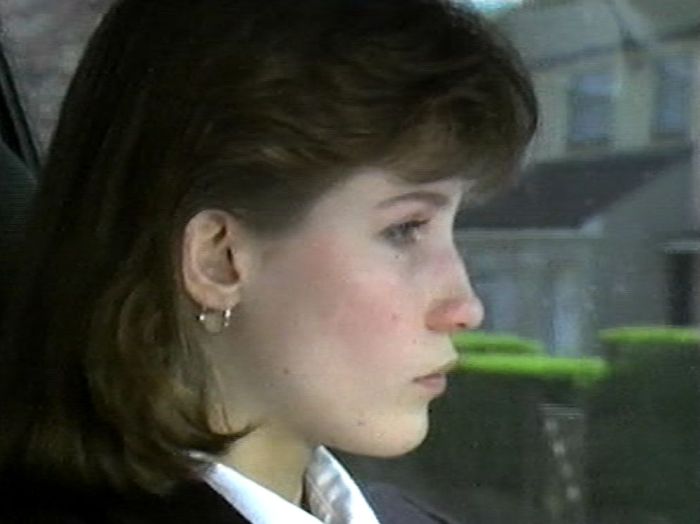
Mrs Reagan is driving her daughter to school.  She comments approvingly that Matthew’s mother has dropped him off a street away from the gates (and also wonders if eventually she’ll detach him from her apron strings totally and let him catch the bus).  Of course, since she’s driving Laura to school this seems like an odd double standard.

Laura’s face is still set in the same expression she’s worn whenever she’s been in her mother’s company recently.  Think of someone sucking a lemon and you won’t be too far from the mark.

Helen and Georgina’s latest dare is to kiss all the boys in the playground.  This causes old-before-her-time Ronnie to tut in a disapproving manner whilst Ziggy is sanguine about the fact that girls are always throwing themselves at him!  Wisely they both decide to give Danny a wide birth – he’s still radiating despair and irritation at being pushed down a year.  He doesn’t pull his punches when Mrs McClusky innocently asks him how he’s getting on.  “The staff don’t know whether to treat me as an invalid or retarded”.

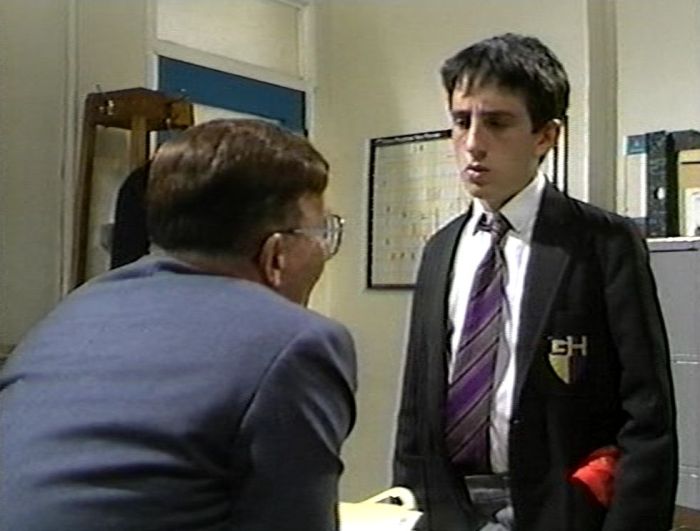
Danny’s returned to his series nine persona.  An uncommunicative individual, unwilling to accept that any of the school rules relate to him.  The first stirrings of the later conflict between Danny and Mr Bronson can be seen after the senior teacher discusses the boy’s wandering ways with Mr Robson.  Mr Bronson believes that they can no longer put his erratic behaviour down to his illness as he’s – apparently – now fully recovered.

Having forgotten his PE kit, Gonch is forced to borrow a strip from Mr Robson.  This leads to a lightbulb moment as he tells a slightly nonplussed Robbie and Ziggy that they should run a PE reminder service (and offer to hire out strips for anybody who forgets to bring theirs).  The only flaw in this wonderful scheme is that Mr Robson already supplies kit – for free – to anybody who’s forgotten to bring their own, so why should anybody pay for the privilege?

Mauler and his ridiculous crew are once again roaming the school corridors, looking for pint-sized first years to use as American footballs.  Tegs seems like the obvious choice but a militant Justine is having none of it.  He finds it hard to say thank you though – as a loner the words don’t come easy – but Justine continues to shadow him nonetheless.  Clearly there’s something about Tegs (his thieving ways?) which fascinates her.  He later shows his gratitude in a non-verbal way.  This is a moment clearly set up to later address Teg’s fondness for taking things which don’t belong to him.

Meanwhile, Matthew’s absent father (he’s working aboard at a secret location apparently) continues to be an object of innocent interest for the others.  It’s plain that there’s rather more to this than meets the eye as Matthew may be many things, but a fluent liar he isn’t.  Possibly this is connected to his, as yet, unspecified home-life issues.

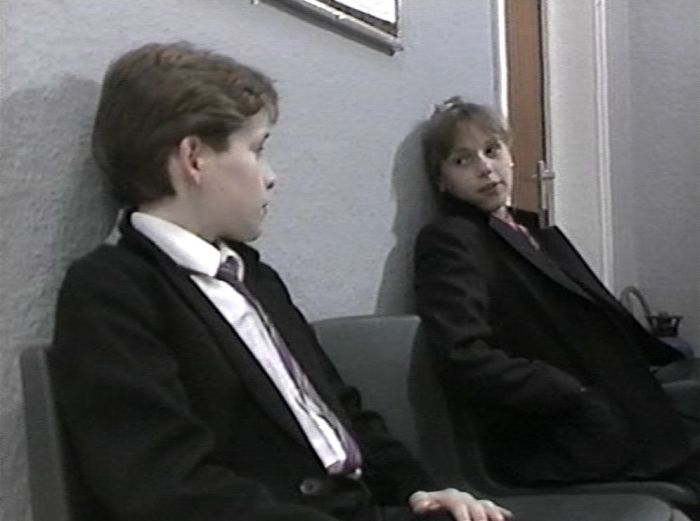
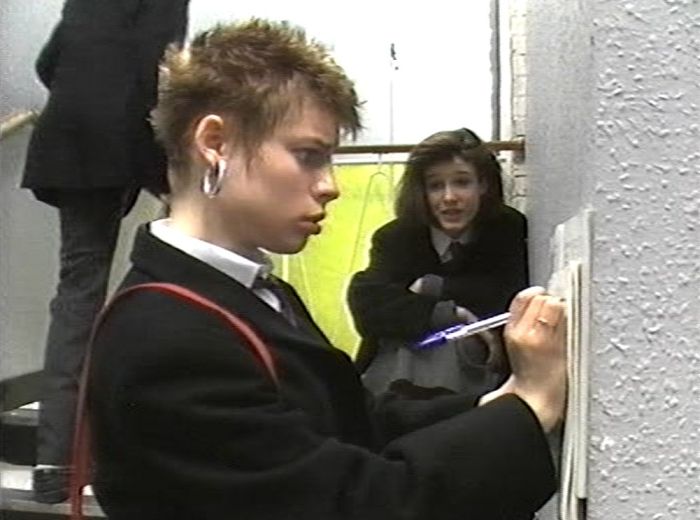
Fiona and Ronnie now venture further afield for their ration of hip-hop tunes.  They’ve gone to a local club, where they run into Danny who’s painting a mural on the wall.  Fiona is keen to get up on stage and perform, and her hip-hop ambitions intrigue the other two – even Danny, who’s rarely shown an interest in anything this year.  Ronnie’s blossoming friendship with Fiona has started to isolate her from her long-term friend Calley, although this means that Jane – reduced during the last few series to a character with only a handful of lines – has now moved slightly more into prominence (she’s now operating as Calley’s confidant).

gh s11e04-02.jpg


Grange Hill. Series Eleven – Episode Three

gh s011e03-01.jpg

Written by David Angus. Tx 12th January 1988

It’s surprising that Ronnie and Gonch’s on-off relationship still seems to be just about on (I’d have assumed she would have dumped him by now). It’s the same old story from last year – she’s constantly exasperated that he never shows her any attention (mini-mogul Gonch is too concerned about where his next fortune is coming from).

Calley’s interest in all things astrological is still one of her main character traits. This has been constant since she first appeared in 1985 – which is either decent continuity or a sign that, as yet, nobody’s been able to think of anything better to do with her. Her latest fad is reading bumps – although Jane suddenly becomes less keen to be her guinea pig after Ronnie acidly tells her that it looks as if Calley’s checking for nits ….

Vince is always keen though (and keen to believe) so when Calley tells him that his bumps suggest he’s due a close encounter with something or someone from America he swallows it hook, line and sinker. Calley isn’t being deliberately malicious – it’s simply that other people’s expectations are greater than her own competence. And what does Trevor think of it all? He’s not impressed.

Although Vince and Trevor briefly teamed up in the first episode, they’ve now regressed to their more combative S10 personas – with Trevor keen to ridicule Vince at every opportunity. But some of Trevor’s sting has been drawn by the arrival of Mr Robson (a teacher that he finds impossible to bait in the same way as Mr Scott). This episode Trevor has regained his posse of silent hangers-on. He briefly had a similar in the previous series, but they vanished after an episode or two.
Helen and Georgina had a brief walk-on appearance in episode one, but this is the first time this series that we’ve been able to get reacquainted with them. Imelda might be long gone, but the remaining members of the Terrahawks still possess a sense of mischief (albiet playful, rather than malicious). Georgina dares Helen to tell Mr Bronson the true reason why her homework is incomplete (she was watching a good film starring Clint Eastwood) and Helen duly obliges. This scene was an obvious gift for Michael Sheard – the way that Mr Bronson slowly and unbelievably repeats the words “Clint Eastwood” are worth the price of admission alone.
Helen then dares Georgina to drop something into the lunchtime baked beans. She duly obliges with a bottle of salt and the inevitable hilarity ensues when some Louise later asks for beans and is less than impressed with her salty fare.

Ziggy and Robbie, like Gonch, are strapped for cash – so Robbie suggests a merger. Neither Ziggy or Gonch are keen, but eventually they agree. With three great business brains now working together in perfect harmony, what can possibly go wrong? Let’s wait and see.

Madeline Church makes her first appearance as Miss Stone, a fairly background teacher who appears throughout this series and a few episodes of the next. Miss Stone is keen as mustard to join Mrs Reagan’s keep fit class, whilst Mrs McClusky and Miss Booth are far less enthused (although eventually they’re shamed into attending). Gonch, Ziggy and Robbie – already debating how to make their first fortune – decide to stay in the gym and spy on them.

This is an odd little scene, although it doesn’t seem to be that the boys are perving (they’re simply being mischievous, I think). Their wonderful hiding place? Inside the vaulting horse, of course. Everything’s going swimmingly until the teachers leave and Mr Griffiths locks the gym!

The school disco is still going and there’s a sense that the series is attempting to keep up with the times when Ronnie asks the DJ to pop a hip-hop track on. This meets with the approval of Fiona (Michelle Gayle). From small acorns to the birth of Fresh ‘n’ Fly. The Hip-Hop advisor for the series was the late Mike Allen, at the time a DJ on Capital Radio.

Mr Griffiths is supplied with some top comedy moments – baffled at Calley’s head readings (convinced that she’s checking the others for nits), grumbling at the way his screwdrivers keep getting pinched and (of course) pursuing Gonch, Ziggy and Robbie around the school. He seems to have forgotten that he and Ziggy were allies last year, meaning that they’ve slipped back into their old roles.

gh s11e03-02.jpg

Grange Hill. Series Eleven – Episode Two

gh s11e02-01

Written by Chris Ellis. Tx 8th January 1988

Freddie’s continuing to play the lovesick martyr. Positioning himself at a handy point on the route to school, he presents an abject picture of misery as Laura and Louise pass by. It’s all part of his master plan to ensnare Laura of course (quite why he’s suddenly decided that Laura is the only girl for him is a mystery). His cunning ways weren’t well received by his younger sister earlier on though. Chrissy tells him that he’s “disgusting” before stomping off to school by herself! Laura’s well aware of the game he’s playing, but she’s content to let him carry on for now. There’s a vague element of humour here, but it’s all rather laboured.

Matthew and Clarke’s friendship continues to bloom. Matthew seems to have decided that Grange Hill isn’t as bad as he’d feared …. and that’s when Mauler McCaul turns up. Like the rest of his gang, he roams the school corridors in full American football gear (like Freddie’s moping this seems less than credible) looking for vulnerable youngsters to use as a ball. Is this going provide us with S11’s Harriet the Donkey moments? Hopefully it gets, ahem, kicked into touch soon.

A little more dramatic meat is provided by a continuing spate of thefts. Miss Booth – with no evidence – seems to believe that Tegs is responsible whilst the new head of the first year – Mrs Reagan – seems much more relaxed about the whole affair. So far we’ve seen very little of Tegs, although we’ve heard quite a lot about him. Most of the accounts have been negative – meaning that his card already seems to have been marked by some of the teachers (especially Miss Booth who, despite her free and easy air, has been shown in the past to be rather dogmatic and inflexible). That his character has been sharply defined in his absence is an interesting touch – the question is, will he live up to these low expectations?

Gonch still hasn’t given up on his money-making exercises (even if his right-hand man Hollo has disappeared – never to be spoken of again). This episode he’s giving the first years a guided tour of the building and, complete with his rolled up umbrella, he’s the epitome of a cheerful tour guide. The moment when he introduces Mr Griffiths as one of Grange Hill’s finest ancient moments is a proper laugh-out-loud moment.

That pair of juvenile delinquents – Tegs and Justine – find their relationship developing. Both are cooling their heels outside Mrs McClusky’s office – Tegs because of his poor attendance (and it’s only day two) and Justine because of her shocking pick blouse.

There’s a cracking cliffhanger. Laura returns home to find out the reason why her mother has had in a spring in her step recently. She’s got a new boyfriend, the oily, moustachioed Simon (Peter Meakin). His opening line is a classic. “So this is the lovely Laura. But not quite as lovely as her mother”. I think the way he rubs the back of Mrs Reagan’s neck whilst saying this is what makes the moment just a little off-putting.

I think we’re going to have trouble with this new arrival ….

gh s11e02-02.jpg

Grange Hill. Series Eleven – Episode One

gh s011e01-01

Written by Chris Ellis. Tx 5th January 1988

This episode saw the debut of a new title sequence and a re-arranged version of Chicken Man. Although both moves might have upset some old-timers, you can’t really argue that it wasn’t overdue. The original titles may have been iconic, but they always looked rather old fashioned, even back in the seventies. The new titles are more frenetic (Phil Cool, remember him?) but not as distinctive. In some respects they seem like a placeholder between the originals and the more successful nineties efforts.

A new group of first years are rapidly introduced. For those who like to compare the new arrivals to old boys and girls (looking for archetypes) then Chrissy Mainwaring (Sonya Kearns) and Susi Young (Lynne Radford) fit very nicely as the new Trisha/Cathy, Fay/Annette or Calley/Ronnie. Throw in Justine Dean (Rachel Victoria Roberts) as a fashion rebel very similar to Trisha and it’s plain that – to begin with – the series was treading familiar ground with these new characters.

But Matthew Pearson (Paul Adams) and Clarke Trent (Darren Cudjoe) are hardly in the mould of Tucker/Alan, Zammo/Jonah or Gonch/Hollo. Matthew is positioned more as a Justin Bennett type – a fish out of water at Grange Hill – whilst poor Clarke (you possibly won’t be surprised to learn that he receives a few Superman jibes) seems to exist mainly to line feed his new friend.

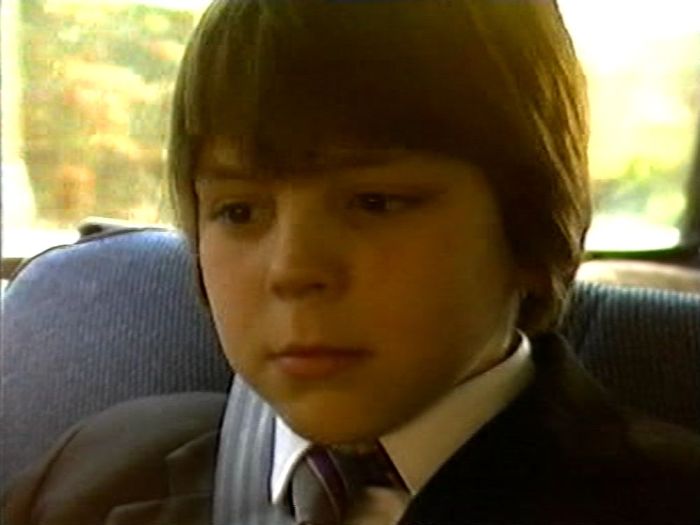
Our first sight of Matthew sees him looking longingly at the comfort and security of home from the back seat of his mother’s car as she drives him and his sister to school. If the point that he’s an unwilling new pupil needs to be hammered home, then luckily his annoying younger sister is on hand to tell him exactly what awaits him (namely that his head will be shoved down the toilet on a regular basis!).

For the loveable bad-boy quotient, you have to look to Tegs Ratcliffe (Sean Maguire). Out of the newcomers, Tegs makes the most immediate impression. Grange Hill might have had its fair share of tearaways in the past, but Tegs is a little unusual. He’s sold to us as a positive character, even though his background is a dubious one (his family are comprised of unsuccessful petty criminals whilst he’s already racked up an impressive criminal record as well).

In time we’ll see how the isolated Tegs forms a bond with Justine which – again – is an uncommon move for the series. It wasn’t totally unheard of (Trisha and Simon Shaw for example, or Duane and Tracy/Clare) but those examples demonstrate that friendships between first year boys and girls hadn’t happened for some time.

Series eleven also saw the introduction of Mr Robson (Stuart Organ). He was by far the longest serving cast member (notching up 264 episodes) although I doubt few would have predicted back in 1988 that he would become such a fixture (he eventually left in 2003, shortly after the show relocated to Liverpool).

A few older pupils suddenly pop up without warning later on this year (an occasional hazard at this school). Fiona Wilson (Michelle Gayle) slots in neatly with the other fourth form girls whilst Mauler McCaul (Joshua Fenton) and Ted Fisk (Ian Congdon-Lee) initially exist solely to cause grief to the younger pupils.

Fair to say that Mauler’s not exactly a bully in the Gripper class (or even Imelda, come to that). He’s played much more for laughs with Ted operating as his even dimmer sidekick. But for those prepared to stick with the series, Ted’s character will undergo something of a transformation in the years to come …..

The opening few minutes plays out in a predictable way as we see various characters making their way to school – some willingly, some not. The old hands – Ziggy and Robbie – are quite casual whilst some of the younger pupils – like Susi – are more anxious. Luckily, she’s got a confident friend in Justine, who tells her that the horror stories she’s heard (about getting beaten up and having her dinner money pinched) are all rubbish. Justine’s positive attitude is therefore shown to be in sharp contrast to Matthew’s more negative viewpoint (like Susi he seems to think that everybody’s looking at him – hence the way he flinches when his mother attempts to give him a goodbye kiss).

It’s an old trick, but during these early scenes with Matthew, the camera is placed low – at his level – which makes the sudden arrival into the frame of Trevor and Vince (keen to make Matthew’s first day extra special) a little more impactful. A pity that Paul Adams seems to be registering amusement more than fear during this scene, but no doubt this was down to inexperience (although he did have a few credits prior to GH).

A few golden oldies from years gone by are given another airing – such as when Trevor and Ziggy send the first years the wrong way to the assembly hall. Another rehash from the first episode back in 1978 finds Matthew left alone in the assembly hall (everyone else has been assigned a form apart from him). Whilst this is almost certainly an intentional homage, it’s probably not a moment tailored for long term fans. Indeed, GH‘s core audience was no doubt self-renewing (new ones joining as the older ones moved on to the likes of EastEnders) so this would have seemed fresh to most of the viewers.

Both Chrissy and Justine seem to be channelling Trisha Yates. Chrissy has an overbearing older relative also at the school (in her case, Freddie) whilst Justine has a highly relaxed attitude to school uniform, which is sure to get her into trouble.

Poor Freddie is bereft to learn that Julia won’t be coming back to Grange Hill. Sorry? Considering the way that he’s burned his way through the female population at GH, it’s hard to take his sorrowful persona very seriously. But with Julia gone (and Banksie too) that leaves the way open for Freddie and Laura to hook up …..

Mr Robson lays down a marker with E4 right from the moment he first walks into the room. With a stentorian rant, he instantly silences them (easy to see that he’s not going to be a walkover like Mr Scott last year).

Mr Bronson and Danny pick up where they left off. Maybe it’s the fact that I’m growing older, but I now find it much easier to side with Mr Bronson than I do with Danny. The boy’s clearly aggrieved at being kept down a year, but since – due to his illness – he’s missed a considerable amount of coursework it’s easy to see why the decision was taken. Unlike his earlier targeting of Zammo and Ant, there doesn’t seem to be any malice – at present – from Mr Bronson’s side of the table.

gh s011e01-02.jpg

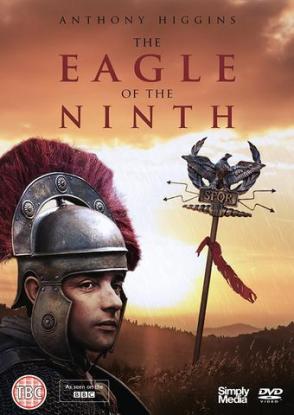
The Eagle of the Ninth – Simply Media DVD Review

eagle.jpg

The year is 119 AD.  Former Roman officer Marcus Flavius Aquila (Anthony Higgins) is haunted by the fate of his father’s legion, the Ninth.  Four thousand men had been dispatched to fight the Caledonian tribes in Northern England, but they all vanished without trace.  Adopting the disguise of a Greek oculist and accompanied by the faithful Esca (Christian Rodska), Marcus is determined to locate the Ninth’s Golden Eagle, which symbolises the honour of the legion, and bring it back home.

Originally published in 1955, The Eagle of the Ninth was a children’s historical adventure novel written by Rosemary Sutcliff.  A prolific author, The Eagle of the Ninth has to rank as one of her most enduring works.  And although the bulk of her output was written for a juvenile audience, Sutcliff once stated that she wrote “for children of all ages, from nine to ninety”.

That her stories had universal appeal is demonstrated by this adaptation, which ran for six episodes during 1977.  Broadcast in the Sunday Classic Serials slot, there’s no sense that it was specifically tailored for a younger audience.  As was usual for adaptations from this era, it sticks pretty closely to the original source material (whereas the recent film – The Eagle, starring Channing Tatum – took more liberties and therefore rather diluted the impact of Sutcliff’s tale).

Episode one opens twelve years after the disappearance of the Ninth.  Marcus arrives in Britain to take up charge of an isolated garrison.  He’s still a little touchy about his father’s fate, but the rebellious Britons massing outside the fort might be more of an immediate problem.

eagle 01
Anthony Higgins

There’s some familiar faces lurking inside the garrison, such as the blunt Drusillus (played by Bernard Gallagher).  Gallagher, probably best known for appearing in the first few series of Casualty, gives Drusillus an entertaining dose of weary cynicism – he’s an older and a much more experienced soldier than Marcus, but it’s Marcus who’s in charge.

This first episode – Frontier – also boasts an early television appearance from Patrick Malahide, as Cradoc.  You may have to look twice to find him though, as he’s almost unrecognisable thanks to an impressive wig and beard.  Marcus attempts to foster good relations with Cradoc, a notable local, but his friendly entreaties are in vain.

Anthony Higgins impresses right from the start.  Marcus might be young and inexperienced, but he’s also honest and heroic, so it therefore seems natural that we immediately side with him against the influx of hairy tribesmen.  The episode has a generous film allocation, although the scenes of the tribesmen attacking the fort do look slightly comic (and tight camera angles have to be used in order to hide how few extras were available).  The hand to hand fighting is nicely directed though.

The injuries suffered by Marcus during the attack have left him unable to walk which means that his time as a soldier has come to an end.  Whilst recuperating at his uncle’s farm, they both elect to visit the local amphitheatre.  It’s not the coliseum, but it does introduce us to two important characters –  Esca and Cottia (Gillian Bailey).

eagle 02
Gillian Bailey

Esca is toiling in the pit – locked into a fight to the death with another slave – whilst Cottia, like Marcus, is a slightly queasy spectator (both were perturbed by the sight of a bear being gored to death).  When Esca is beaten, the crowd – overcome by bloodlust – all place their thumbs downwards, signifying that Esca should be put to death.  We can forgive this anachronstic moment – since it was widely believed to be accurate at the time – although quite how Marcus was able to persuade the crowd en-masse to spare Esca is a bit of a mystery.

Marcus needs a body slave and buys Esca.  Their relationship is a key part of the story and the interaction between Higgins and Rodska works well throughout the serial.  Esca is initially reserved and bitter, but it isn’t long before the pair form a tight bond.  Gillian Bailey also impresses as the proud Cottia.  She rails against being forced to act like a Roman maiden, rather than the Iceni tribeswoman she actually is.  There’s a lovely moment when, anxious to see the ill Marcus, she bites the arm of a slave blocking her way!

The second half of the serial sees Marcus and Esca set out to find the Eagle of the Ninth.  This quest results in Marcus suddenly gaining a rather unconvincing beard (but then fake face fungus can be found in most classic serials of this era).  He’s also haunted in his dreams by the long-dead soldiers of the Ninth – in his imaginings they’re a legion of walking skeletons (a brief, but quite effective nightmarish scene).

The Eagle of the Ninth was made in the usual way for a production of this era – film for the exteriors and videotape for the interiors.  Picture quality is as you’d expect for something that’s forty years old – some of the early film inserts are a little grubby and the studio scenes are a little soft – but overall it’s quite watchable.  Production design is very sound throughout, especially the studio farmhouse which features in several episodes (nicely designed by Campbell Gordon).

Although the serial features a number of battle scenes, this isn’t an action story – it’s more of a reflective, character-driven drama.  According to this webpage, Rosemary Sutcliff not only loved the adaptation, but was so taken with Higgins’ performance that she kept a photograph of him on her writing desk for decades afterwards.

It may be true that some of the tribal antics (and beards) are a little unconvincing, but overall this is a literate and well acted production which transcends its limited budget.  Running for six 30 minute episodes (spread across two discs) it’s released by Simply Media on the 16th of January 2018 and can be ordered directly from them here.  RRP £19.99.

eagle 03
Christian Rodska

The Rag Trade – Christmas Box

rag 01

Like the later LWT Christmas Rag Trade, this is a programme you can’t imagine receiving a repeat these days – with this one it’s due to the fact that the girls have been making golliwogs on the side.

Although Fenner (Peter Jones) constantly bemoans the poor productivity of his staff, this never seems to be a problem when they’re working on their own initiative.  It’s very impressive that they’ve been able to knock up several hundred golliwogs over the last few days, although since they’ve used Fenner’s materials without his knowledge they have to keep him in the dark …..

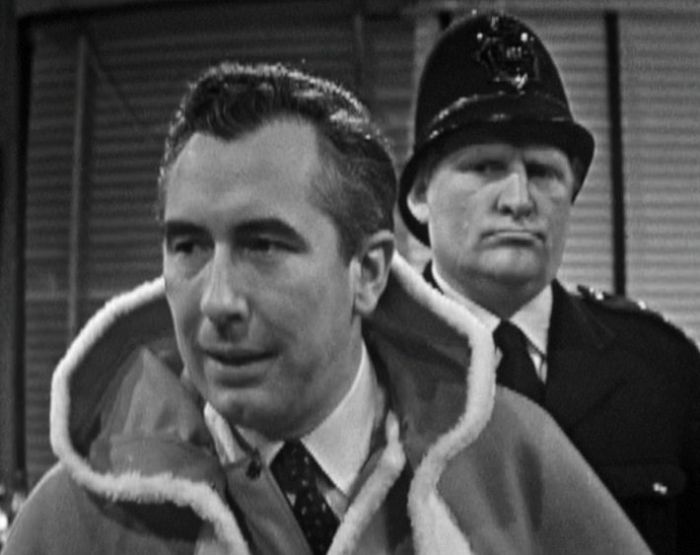
Poor Reg (Reg Varney) is deputised to dress up as Father Christmas and is sent out to flog the golliwogs from a street corner, but he runs foul of the law – in the formidable shape of Colin Douglas.  Always good to see Douglas and he’s his usual stolid self as the constable.  This officer may not be the brightest of chaps, but he’s certainly dogged in his determination to run the rogue Father Christmas to justice.

Reg, in haste, has to ditch the Father Christmas costume and so he gives it to Fenner.  It’s not hard to work out what happens next – the constable spies Fenner dressed as Father Christmass and arrests him.  But surely Fenner’s staff will vouch for him?  Mmm, not so.  They have a buyer for the golliwogs coming round and so it suits their purpose for the boss to be out of the way for a few hours.

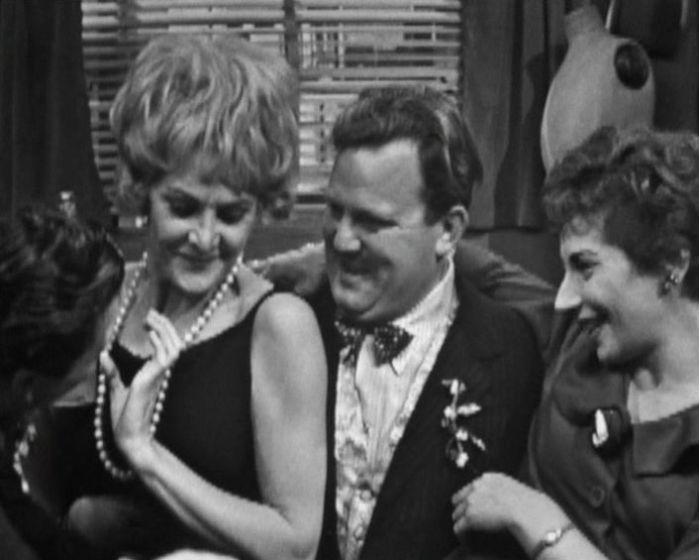
This seems a tad cruel, especially the way Peter Jones milks the moment.  Fenner can’t even get through to Reg (we learn that they attempted to join the army together but were refused for the same reason – flat feet).  Once Fenner’s been carted off, Fenner’s Fashions undergoes a rapid transformation to become Union Toys!  This may be slightly hard to swallow, but it’s still amusing – especially the way that Reg quickly steps into the role of the boss and Paddy (Miriam Karlin) and Carole (Sheila Hancock) transform themselves into femme fatales as they prepare to use all of their wiles to persuade the hapless buyer that he really should purchase their golliwogs.

The fact that the buyer, Terence Nutley, is played by Terry Scott is something of a bonus since it ensures that every possible bit of comic potential will be wrung from these scenes.  As the girls ply Terence with drinks, he becomes more and more insensible, which creates something of a problem once Fenner returns ….

As with the rest of The Rag Trade, this one’s highly predictable from start to finish, but since everybody attacks the material with such gusto I’ve never regarded this as a problem.  Sheila Hancock is delightful as the dippy Carole whilst Esma Cannon can’t help but steal every scene she appears in (she plays the even dippier Lily).

The ending is quite neat.  After Fenner discovers the toys, the girls are forced to lie and pretend that they’ve made them for the kiddies at the local hospital.  Fenner, touched by this, happily promises to drop them off to the hospital on the way home.  So the workers don’t benefit by their pilfering, instead the only victors are the children – which seems appropriate for a Christmastime story.

rag 02

dinnerladies – Christmas

dinner 01

Following directly on from the previous episode, Christmas finds the relationship between Bren (Victoria Wood) and Tony (Andrew Dunn) deepening – although the dramatic cliffhanger from last time (Tony and Bren enjoyed their first kiss, only to be interrupted by Bren’s estranged husband) has to be addressed first.

Although the first series of dinnerladies was traditional sitcom fare (in that each episode had a fairly linear plot) it’s clear that Victoria Wood had more ambitious plans for the second and final series.  Sitcoms with continuing storylines aren’t unique (Brass is a good example of a show with a strong serial theme) but they are unusual.

The growing attraction between Tony and Bren is one of the major plot-threads of series two, but all of the main characters have their own individual story arcs which peak at different times.  Drama mixes with comedy here, as Bren finds herself plagued by self doubt.  She can see a possible future with Tony, but her life to date (exemplified by her disastrous first marriage) makes her convinced that she’ll “bugger it all up” somehow.

Tony initially reassures her that nothing’s changed between them, but then later he becomes distant and distracted – which suggests that he’s lost interest.  He hasn’t of course (instead he’s rushing around attempting to organise an impressive Christmas and Birthday treat for her).  It has to be said that this is a slightly clumsy piece of plotting, since it demands that Bren has to jump to the wrong conclusion several times.

dinner 02.jpg

With Victoria Wood doing the heavy-lifting, drama-wise, the rest of the cast get all the best jokes.  Anita (Shobna Gulati) has her usual stream of bizarre conversational non sequiturs (today involving Disco Monks, thoughts of Michael Aspel, Sooty’s suitability as James Bond and bacon) whilst Jean (Anne Reid) and Dolly (Thelma Barlow) continue their gentle game of one-upmanship.  Jean’s latest attempt to roll back the years (she’s wearing an all-in-one bodyshaper but is having a spot of trouble with the studs) causes much merriment amongst those waiting for bacon – most notably Bob (Bernard Wrigley).

Bob later returns with Jane (Sue Devaney) for a spot of singing and dancing which draws a round of applause from the studio audience.  The unexpected arrival of Bren’s mother, Petula (Julie Walters), also – as always – entertains the audience.  With Janette Krankie in tow as her equally down-at-heel friend, Janice, Petula causes her usual amount of strife and discord, although there’s a nice sense of community as everybody else – in Bren’s absence – elects to send her packing.  If Bren has commitment issues then it’s in no small part due to her mother, who dumped her at an orphanage when she was a child (“I had her too early, there was too much going on. You can’t jive with one hand on a pram handle”).

There’s not a great deal of Stan (Duncan Preston) in this one, which is a shame, although he does have one lovely and typically bizarre monologue.  “Did I ever tell you about the day I had to go to casualty with a dart in me head? If you take my head as a dartboard it went in here (pointing to his chin) low score. Double top I’d have been dead”.  Although there’s method in his madness as he’s attempting to distract Bren, who’s on the verge of leaving Tony and the canteen forever.

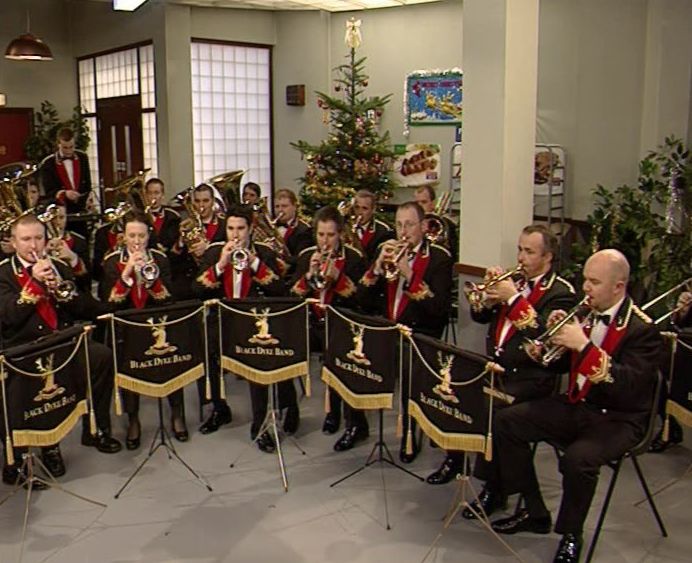
But then it’s revealed that Tony hadn’t forgotten to get her a present – in fact he’s managed to smuggle the Black Dyke Band into the canteen ….

This is another of those moments where you have to suspend your disbelief somewhat – not only that Tony could persuade the Black Dyke Band to give up their Christmas Eve but also that they were able to get Bren out of the way just long enough to sneak them all in.  Well it’s Christmas, so let’s be generous.

Slightly iffy plot mechanics aside, it’s still a touching moment and had the series ended here then it would have seemed like a natural conclusion.  But there were four more episodes to come, meaning that everybody’s stories still had a little time to run.

dinner 03.jpg

Telly Addicts – 1989 Christmas Special

telly 89

Back in those far off, pre-internet days, Telly Addicts was required viewing since it offered brief, tantalising glimpses into a television past that was otherwise pretty much off limits (look! A clip of Arthur Haynes …).  Today, of course, the archive clippage is less compelling, but it’s still an entertaining quiz.

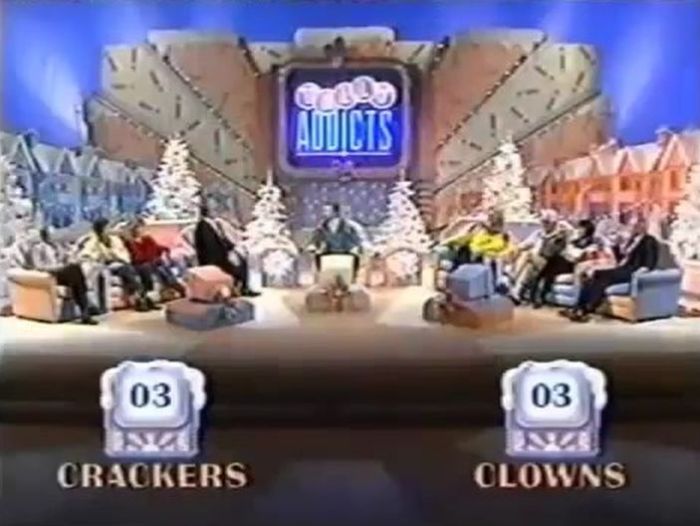
As was usual, the Christmas special is something of a celebrity fest.  The Crackers (Graeme Garden, George Layton, Liza Goddard, Frank Carson) find themselves locked in a bitter battle with the Clowns (Chris Tarrant, Barry Cryer, Jessica Martin, Jim Bowen).  For some reason (self indulgence maybe) Noel Edmonds dubs each of them with a fictitious soap opera name.  Cryer is gifted the moniker Hugh Jampton, and no doubt he – and the older members of the audience – would have immediately understood the reference.

Memorable rounds include Guess Who, which sees ordinary members of the public stopped in the street and asked to describe a television favourite.  This sounds fair enough, but pretty much everyone picked looks a little, well … odd.  You have to assume that the television crew let the ordinary looking people pass by – it was the nutters they wanted ….

Sing the Sig is also good fun, whilst a clip from the Golden Girls seems to demonstrate that nobody on the Clowns team ever watched it.  We also get to see just the mildest amount of needle between Chris Tarrant and Noel Edmonds whilst Frank Carson (for him) is fairly subdued – although his exasperation in the final round (“why ask me? What’s wrong with them?”) is a joy.

The Paul Daniels Christmas Magic Show – 1985

paul 85-01.jpg

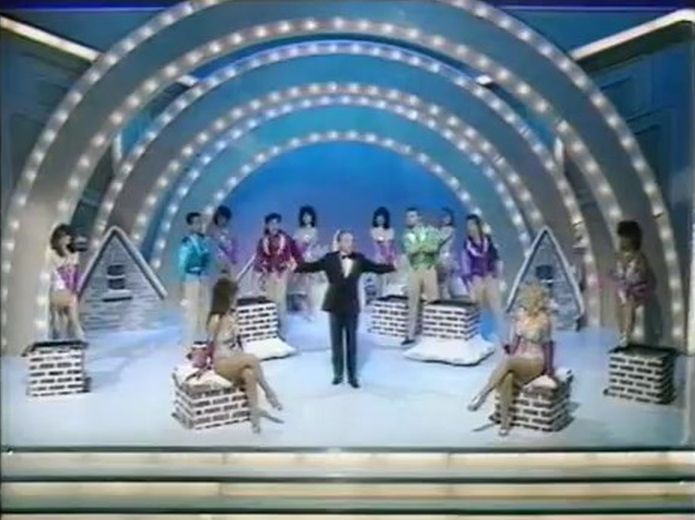
Right from the start, the 1985 Christmas Special suffers from something of a dance overload.  Paul introduces us to his two assistants (Kate Bellamy and Donald Waugh.  Yes, Hughsey from Grange Hill) who he proceeds to lock into two individual cabinets which have been made to look like chimneys.  So far, so predictable.  But then Paul ambles off the stage as the Brian Rogers dancers move onstage and proceed to leap about in a highly energetic manner.  They add a bit of glamour – albeit on the cheesy side.

As the orchestra grinds out a version of Slade’s Merry Christmas Everybody, the dancers take over the illusion – some of  them start to slice the cabinets up whilst the more attractive lady dancers are content to preen themselves.  This is all very odd, although there is a reasonable payoff when we see Paul – clearly deciding that he should get a little more involved in proceedings – mildly berating them for mixing up the boxes.  This means that the assistant’s clothes are revealed to have been swopped once the boxes are reassembled (a neat extra trick to go with the puzzle of where they disappeared to in the first place).

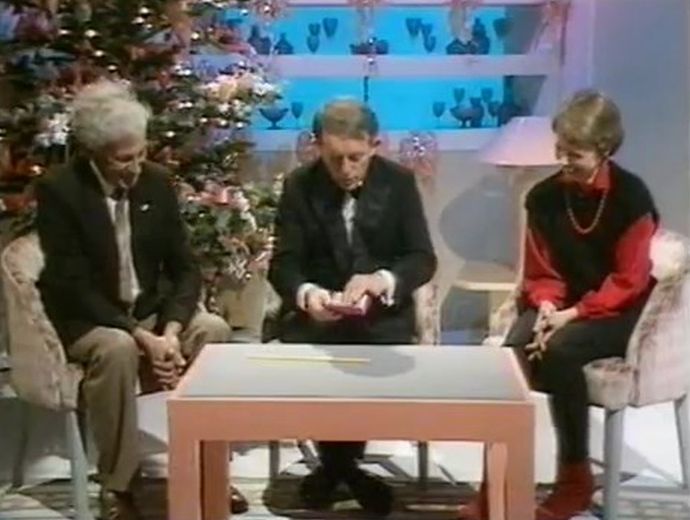
If Paul largely sits this one out, then it’s fair to say that he doesn’t really contribute a great deal to the remainder of the show.  There’s a few close-up illusions – the three card trick (done with four cards!) and a trick with a fifty pound note – but otherwise he’s fairly inactive until the end of show spectacular.  More on that in a minute.

paul 85-02.jpg

The Jazzy Jumpers come from America and are a young, energetic skipping troupe.  Not the most exciting of speciality acts, but undeniably skilful.  Lance Burton (direct from Las Vegas) offers us a reasonably good performance of the substitution trunk (created by Maskelyne, popularised by Houdini) although it’s odd that we never actually see the person inside the trunk who Burton had swopped with. Zhou Shurong offers eye-watering feats of flexibility.

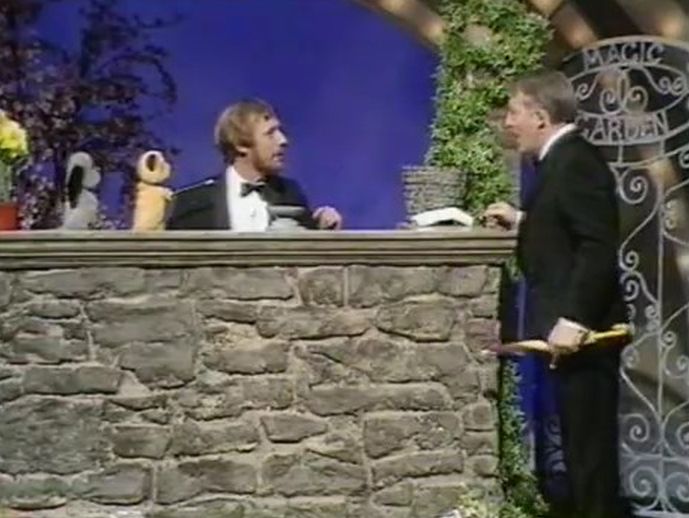
It’s always fun when two great magicians meet – and so it is here as Paul comes face to face with Sooty.  Yes it’s Sooty, making a rare return to the BBC (and mistaking Paul for Terry Wogan – easy to do) whilst causing havoc with a miniature fountain.  This is apparently a scaled down version of an illusion performed by Dante and although it’s only a bit of throwaway fun it’s still appealing.  It was nice to see Sweep as well (oh, and Matthew Corbett).

paul 85-03.jpg

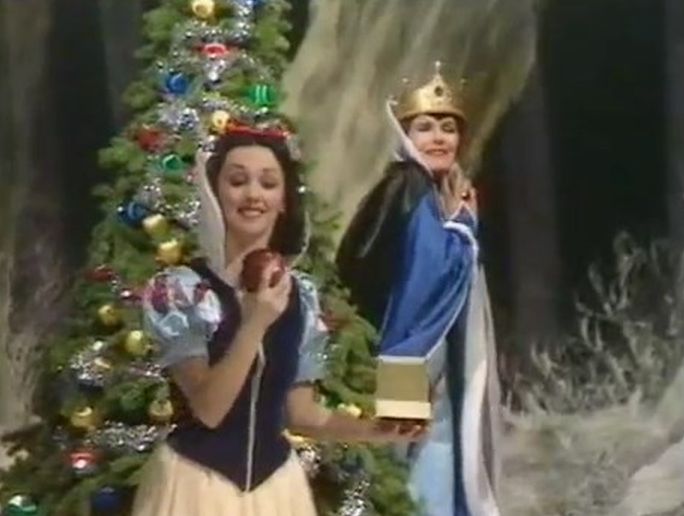
We then have a cutesy overload as Paul proceeds to tell a young chap called David all about Snow White. David looks too neat and scrubbed up to have been pulled out of the audience, so presumably he was selected well in advance (not that this really matters, as David’s main function is to react with wonder as the story of Snow White comes to life).

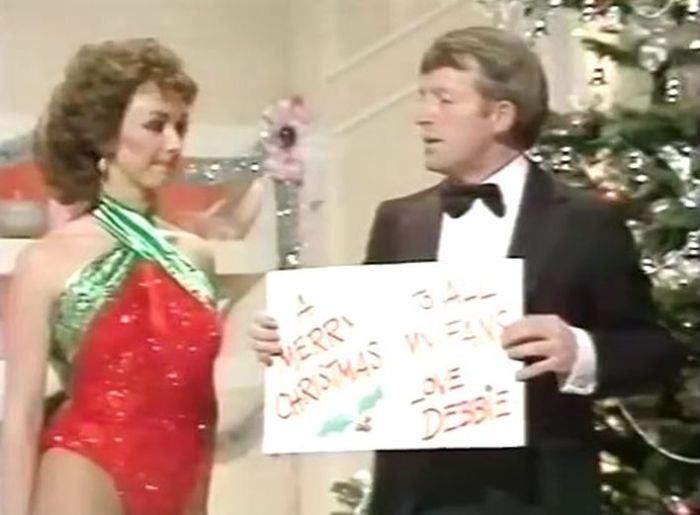
This is the cue for the return of the Brian Rogers dancers and there’s more dancing to come as we meet Snow White – who just happens to be played by Debbie.  It’s hard not to come to the conclusion that the whole closing sequence had been designed in order to show off her dancing talents (you may not be surprised to hear that Snow White gets the chance to do a spot of hoofing).  A few illusions are thrown in but they’re all rather secondary to the showbizzy razzle dazzle (the seven dwarfs are played by children, for that extra awww factor).  It’s nice to see Fenella Fielding as the wicked Queen though.

The showbiz feel is maintained right until the end as each performer returns to the stage in order to take their bows.  As a Christmassy extravaganza this is decent enough fare, but as a magic show it’s something of a disappointment.

paul 85-04.jpg

The Paul Daniels Christmas Magic Show – 1984

paul 84-01.jpg

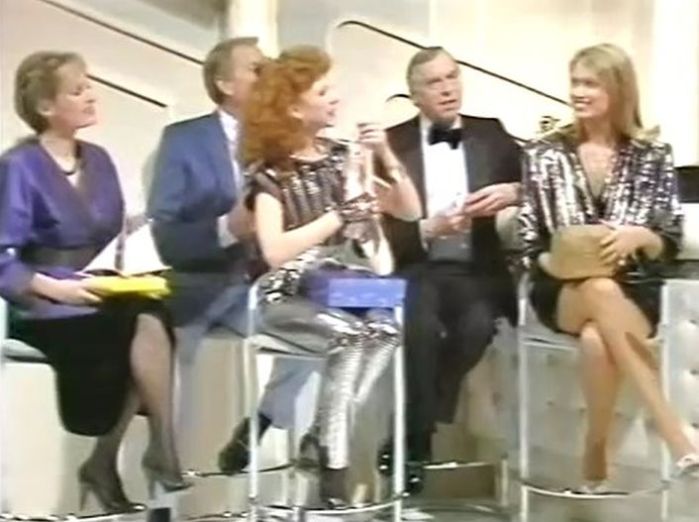
The 1984 Christmas Show comes front-loaded with celebrities as Clare Francis, Anneka Rice, Bonnie Langford, Val Doonican and Larry Grayson are brought on for a spot of banter and magic.  All receive a warm reception from the studio audience but it’s Grayson who generates the most whoops and cheers by far.

Both Bonnie and Anneka are very eye-catching (Bonnie sports a silver pair of trousers whilst Anneka has a sparkly top and a  very short skirt).  Paul was never slow in appreciating female beauty, so it’s no surprise that he seems a little smitten with Anneka (“lovely leg, shame about the other one”).  Although I’m not sure whether his mispronunciation of her first name was deliberate or not ….

paul 84-02

This is a nice, relaxed opening to the show – allowing the likes of Larry Grayson to camp it up a little (unsurprisingly).  He’s also selected to wear a bag on his head (in order to check that when Paul puts it on, he can’t see out of it).  Given that Paul’s still wearing the wig, I was slightly concerned they’d be an accident, but everything passes off without a hitch (although it’s noticeable that when Paul removes the bag, he does instinctively check that everything’s still in place).

There are two speciality acts on the show.  Both are perfect for Christmastime viewing (maybe one day somebody might decide that a variety show on Christmas day would be a good idea – stranger things have happened).  First up is Kris Kremo.  I love a juggler, and they really don’t come any better than Kremo – who not only juggles with his hands but also his feet to begin with.  His act climaxes with the juggling of three cigar boxes – a familiar sight, but Kremo’s dexterity is something special.

George Carl has to slowly work the audience – his style of silent clowning proves to be something of a slow burn – but by the end he seems to have won everybody over (at the start, laughter is more sporadic – meaning that it’s possible to pick out several very distinctive hearty laughing types).

Debbie is now a part of the show.  She doesn’t have a great deal to say, but it’s plain that she’s higher up in the pecking order than Paul’s previous assistants (she appears in one of the six picture boxes on the end credits).

When I wrote about the 1980 special, I mentioned that there were no big illusions.  That’s redressed here, as Paul contrives to vanish one million pounds under the watchful eyes of Owen Rout (the general manager of Barclays Bank) and Robert Maxwell.  Maxwell’s later misdeeds gives this whole illusion something of a bleak irony.  It certainly proves hard to take your eyes off him.

When Paul announces that the money is shortly to enter the studio, it’s impossible to miss the way that Maxwell’s eyes light up.  Maxwell also can’t prevent himself from getting involved every step of the way (instinctively reaching for the safe key, constantly wanting to touch the money, etc). And then there’s the moment when Paul refers to Rout and Maxwell as men of integrity ….

As an unashamed television geek, one of the reasons I love this part of the show is that the cameras are allowed to shoot off the edge of the set.  So we get to see the studio cables, monitors and doors as well as the orchestra (who rarely, if ever, appeared on screen).  The money arrives in the studio to the strains of The A Team (no, me neither) and then the long process begins – opening the safe, extracting another safe containing the money, checking that the money is genuine, moving the safe with the money into a clear Perspex container.

This is one of those illusions where you know right from the start what’s going to happen (and also that it’ll only take a few seconds) but in order to have any impact the whole thing has to build very slowly.  Therefore some twenty minutes (the climax of the show) is spent on this trick – a considerable amount of time, but it never feels drawn out.  Luckily, after all the preamble it turns out to be a baffling mystery – no doubt if I searched hard enough I could find the solution, but discovering how tricks work is much less enjoyable than wondering how it was achieved.

paul 84-03.jpg

The Paul Daniels Christmas Magic Show – 1980

paul 80-01.jpg

Paul Daniels notched up fifteen consecutive Christmas Specials on the BBC between 1979 and 1993, a staggering feat which no other performer has come close to matching (unless I’ve missed someone blindingly obvious).   Daniels’ sometimes abrasive performing style (forged in the white heat of the Northern Working Mens Clubs) and his outspoken opinions on numerous subjects always ensured that he seemed to be as loathed as he was loved, but there’s no denying the influence he had on modern magic.

Following his death, most of the great and good of the magic world queued up to pay tribute – although it’s also fair to say that many were equally as fulsome when he was alive.  This clip from Penn and Teller: Fool Us never fails to bring a smile to my lips, not least for the obvious respect that both Penn and Teller – but especially the ebullient Penn – had for Paul.

Rewinding back to 1980, this was Daniels’ second BBC Christmas Special and the first to be transmitted on Christmas day itself (surprisingly he’d only manage this feat a further three times – in 1981, 1982 and 1985).  It’s the early days of the series, so the lovely Debbie McGee has yet to appear on the scene.  Daniels’ assistants here are equally as attractive – and sport some remarkable costumes – but are never allowed to speak.  Paul’s wig is still very much in evidence (as is, in the opening few minutes, a remarkable red velvet suit).

Another feature of these early series was “the jury” – a group of handpicked members of the studio audience who were allowed to get up close and personal (their job was to try and work out exactly how the tricks worked).  But it was also useful in another respect, as it meant that Paul didn’t have to trudge out to the wider studio audience in order to find his next hapless victim.

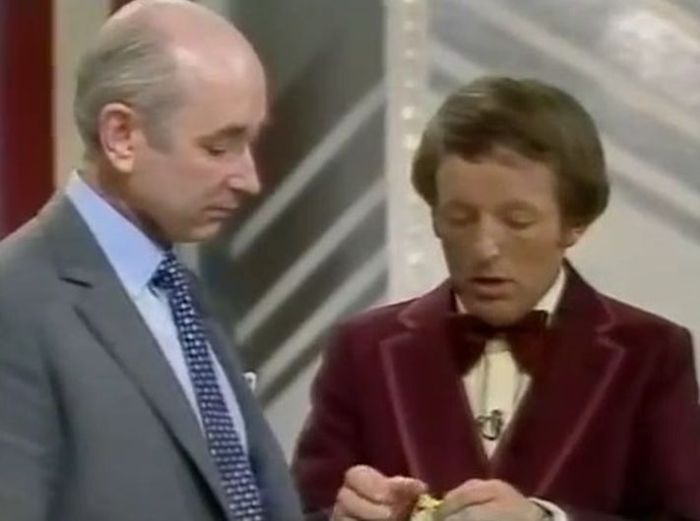
The first trick – involving Peter and his watch – is typical Daniels.  He borrows Peter’s watch in order to do a clever trick which inevitably goes wrong.  All appears lost and Peter seems resigned to losing his precious timepiece, until Paul miraculously pulls it out of the middle of a Christmas cracker (well this is a festive show).  Although Paul gives his victim a slightly hard time, you know that everything will work itself out in the end, so the joshing never seems particularly cruel or unkind.

I like the mentalism trick which he performs with a rather attractive young woman from the jury.  It’s another neat piece of close-up magic and doesn’t outstay it’s welcome.  Paul’s next turn – in the Christmas Bunco Booth – is possibly the most memorable part of the show.  Not because it’s a decent trick (in fact, there’s no trick at all) but simply because it demonstrates how some things never seem to change …..

paul 80-02.jpg

Paul opens by bemoaning the fact that since the economy is going through something of a rough patch, plenty of people are feeling the pinch (which plays equally as well in 2017 as it did in 1980).  But then he tells us his solution – separate Scotland from England and give the Scots their own currency.  Eerily prescient stuff.  As I said, there’s no trick here – just a clever piece of number juggling which allows him at the end to turn to camera and tell Mrs Thatcher and Geoffrey Howe that’s how they should be running the country!

Guest-wise, Lilly Yokoi’s bicycle act is very impressive (a pity it wasn’t a little longer).  Whereas during Michael McGiveney’s quick change act I did wish it was a little shorter.  There’s no denying the ability of McGiveney (acting out a scene from Olivier Twist, playing all the characters) but after you’ve seen one quick change you’ve seen them all (and it’s fair to say that McGiveney’s a better quick change artist than he is an actor).  Compagnie Philippe Genty offer diverting, but not riveting, puppet fun.

paul 80-03.jpg

Paul never seemed threatened by other magicians, as the appearance here of Harry Blackstone suggests.  Blackstone performs the sawing a woman in half trick – although by using a circular saw it creates a heightened sense of anticipation.  It’s the one major illusion in the show, which makes it all the more surprising that Paul didn’t perform it – but he was obviously happy doing the smaller stuff.  Other illusionists might have been tempted to throw in blood and screams, but Blackstone – possibly mindful of the Christmas Day audience – keeps it clean.  The camera’s close enough to see the saw apparently slicing through flesh though, so it’s still slightly disquieting.

Paul ends the show by pulling out a bewilderingly large number of Christmas presents from a very small box.  It’s a cute ending (although I’m not sure that they’d get away with using live animals today) and although there’s no staggering illusions in this 1980 Special it’s still a very convivial way to spend fifty minutes.

paul 80-04.jpg

Doctor Who – The Edge of Destruction. Episode Two – The Brink of Disaster

brink.jpg

The previous episode ended with the Doctor being attacked by a mysterious assailant.  It’s therefore something of a letdown to learn that it was only Ian – trying to warn the Doctor not to touch the controls, as they would have given him an electric shock.

Ian had two choices of course.  Choice number one would have seen him tell the Doctor not to touch the controls whilst choice number two is to throttle the Doctor into submission.  Yes, he goes for choice number two.

But why Ian would think the controls would be dangerous (and how he managed to awake from his drugged sleep) is a bit of a mystery.  Yes, Susan was attacked by the console in the previous episode, but we saw the Doctor touch the controls later on with no ill effects.

For a few minutes, the Doctor is still convinced that Ian and Barbara are the cause of his problems, but eventually the penny drops that something is wrong with the ship.  Barbara decides that the TARDIS has been trying to warn them.  “We had time taken away from us and now it’s being given back to us because it’s running out” is just one of her baffling utterances which make no sense at all.

And the reason why the TARDIS acting so oddly? The Fast Return Switch was broken (a faulty spring!) and is hurtling the ship towards destruction. But rather than issue a conventional warning, the TARDIS decided that a series of oblique and bizarre moments would be just the ticket.  Also, it’s impossible not to love the fact that somebody has written “fast return switch” in felt-tip on the console!

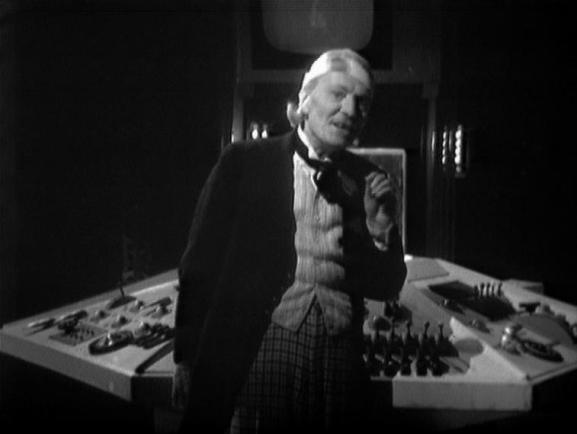
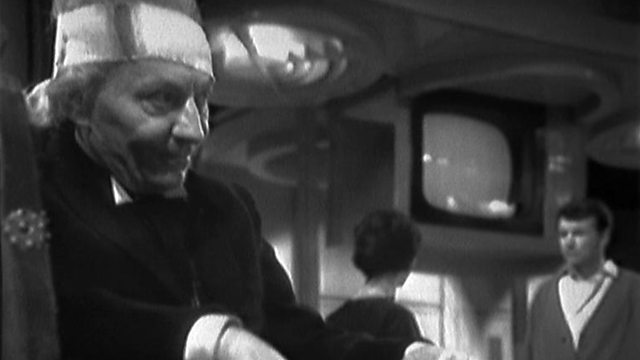
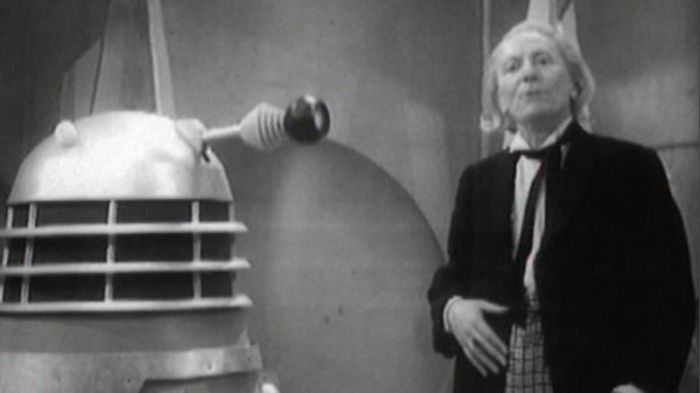
Hartnell has quite a long monologue which is designed to wrap the mystery up.  Even at this early stage he was never keen on lengthy speeches – due to the worries he had with remembering lines.  He is a bit wobbly in this story from time to time, but he’s pretty much perfect when it comes to this sequence.  Although his reaction when receiving the script (“Christ! It’s bloody Hamlet!”) strongly implies that he needed some persuading to learn it!

I know. I know. I said it would take the force of a total solar system to attract the power away from my ship. We’re at the very beginning, the new start of a solar system. Outside, the atoms are rushing towards each other. Fusing, coagulating, until minute little collections of matter are created. And so the process goes on, and on until dust is formed. Dust then becomes solid entity. A new birth, of a sun and its planets.

It was very possible that this would have been the final episode of Doctor Who.  If so, then it would have ended with a more mellow Doctor finally beginning to appreciate his two new companions.

DOCTOR: I’d like to talk to you, if I may. We’ve landed on a planet and the air is good, but it’s rather cold outside.
BARBARA: Susan told me.
DOCTOR: Yes, you haven’t forgiven me, have you.
BARBARA: You said terrible things to us.
DOCTOR: Yes, I suppose it’s the injustice that’s upsetting you, and when I made a threat to put you off the ship it must have affected you very deeply.
BARBARA: What do you care what I think or feel?
DOCTOR: As we learn about each other, so we learn about ourselves.
BARBARA: Perhaps.
DOCTOR: Oh, yes. Because I accused you unjustly, you were determined to prove me wrong. So, you put your mind to the problem and, luckily, you solved it.

It also reinforces the notion that all four members of the TARDIS crew have something to contribute.  It was Barbara who solved the mystery in this story, Susan returned to the TARDIS to fetch the anti-radiation drugs in The Daleks, Ian made fire in An Unearthly Child, etc.

This might be something of a ramshackle story, but at only two episodes it doesn’t outstay its welcome and apart from a few decent character moments it’s mainly memorable for the subtle reshaping of the Doctor’s character.

Doctor Who – The Edge of Destruction. Episode One

edge

This is odd.   A mysterious explosion in the TARDIS has robbed everybody of the ability to act.  William Hartnell’s the luckiest, as he spends the first ten minutes unconscious on the floor whilst Jacqueline Hill doesn’t come off too badly (she’s been positioned as the sensible one since the first episode and that carries on here).

It’s William Russell and Carole Ann Ford who get the rough end of the stick.  Whether it was as scripted or Russell’s choice, but for the first half of the episode Ian’s lines are spoken in a numbing monotone whilst Ford enjoys violent mood swings as Susan goes somewhat loopy.

There’s a number of bizarre moments, but one of my favourites is at 7:21 when Susan tries the controls of the TARDIS and extravagantly plummets to the floor.  “She’s fainted” says Ian afterwards, blindingly stating the obvious.

This was the first story to use stock music rather than specially composed tracks.  Eric Siday was the composer and one of the cues should be familiar (as it was later reused in The Moonbase).  But the problem is that there’s not enough music and ambient sound effects used – meaning that for long stretches there’s nothing but the raw studio sound.

A prime example is when Susan comes back into the console room and notices that the TARDIS doors are open.  This is clearly a dramatic moment – the ship hasn’t landed so it shouldn’t happen – but it’s played out to a totally dead atmosphere – no music, no effects.  It’s possible that this was intentional (to highlight something was wrong with the TARDIS).  Or possibly not.  It all depends how generous you want to be, I guess.

After fainting, Susan threatens Ian and later stabs her bed with a pair of scissors in a notorious scene which was somewhat controversial at the time.  Why Susan is acting irrationally (and why Ian doesn’t seem to be acting at all!) is never made clear – was this due to the explosion at the start or is it part of the TARDIS’ defence mechanisms (which we’ll discuss during the next episode).

This is an interesting exchange –

SUSAN: I never noticed the shadows before. It’s so silent in the ship.
BARBARA: Yes. Or we’re imagining things. We must be. I mean, how would anything get into the ship, anyway?
SUSAN: The doors were open.
BARBARA: Yes, but, but where would it hide?
SUSAN: In one of us.

It’s a red herring as nothing did get into the ship, but the concept that an alien invader might be hiding in one of them is a powerful and disturbing one.

The Doctor’s now up and about and is convinced that Ian and Barbara have sabotaged the TARDIS. It’s not possible to say for certain that the Doctor is acting irrationally (like Susan) because he’s been a very changeable character since episode one.

I think it was simply the Doctor being his usual suspicious, arrogant self – but it gives Barbara the chance to tell him some well deserved home truths. Jacqueline Hill is wonderful in this scene, as she is throughout the episode. Whilst the others have been erratic, Barbara remains strong.

BARBARA: How dare you! Do you realise, you stupid old man, that you’d have died in the Cave of Skulls if Ian hadn’t made fire for you?
DOCTOR: Oh, I.
BARBARA: And what about what we went through against the Daleks? Not just for us, but for you and Susan too. And all because you tricked us into going down to the city.
DOCTOR: But I, I.
BARBARA: Accuse us? You ought to go down on your hands and knees and thank us. But gratitude’s the last thing you’ll ever have, or any sort of common sense either.

Frankly it’s worth sitting through the episode for that exchange alone.

We end with the Doctor having drugged(!) the others so he can examine the TARDIS in peace. But somebody then attacks him. Or do they? Possibly it’s just a very contrived cliffhanger.  All will be revealed when we reach The Brink of Disaster.

Doctor Who – The Daleks. Episode Seven – The Rescue

rescue

The literal cliff-hanger from last time saw Antodus fail to jump the ravine – which means he’s plunged down a bottomless cavern and Ian (tied on the other end of the rope) is slowly losing his grip on him.  There’s something rather casual about this sequence – why Ian doesn’t call for help from the others?  And even when Ganatus does pop up, neither of them are very quick to twig that a little more assistance would be a good thing.  With Kristas and Barbara also holding onto the rope they should have been able to pull Antodus up.

As it is, Antodus settles the matter by cutting the rope and plunging to his death.  This is a moment that can be taken several ways – was it a noble act of self sacrifice (saving Ian’s life) or did Antodus (who was convinced they’d all die) commit suicide because he didn’t have the nerve to carry on?

Although Ian tells Ganatus that his brother died to give them a chance, it’s not really a credible statement.  Alydon and the rest of the Thals just seem to stroll into the Dalek City, which makes the efforts of Ian, Barbara, Ganatus and Kristas seem somewhat futile (why make all that effort to gain access via the caves when they could have just walked in through the front door?!)

Meanwhile, the Doctor and Susan are prisoners of the Daleks.  Hartnell has a great line – “this senseless, evil killing” – which helps to give the Doctor a sense of morality that hasn’t always been present in the episodes to date.
The climax of the story is a little bit of a damp squib – the Daleks’ control room is invaded by the Thals and after the briefest of battles the Daleks all die.  Their power has (somehow) drained away, exactly how is never really explained.  After seven episodes it would have been nicer to have a more considered conclusion.

In Nation’s original draft, it was revealed that a third party had engineered the war five hundred years ago between the Daleks and the Thals for their own benefit.  This mysterious alien presence then returns to Skaro and the Daleks and Thals team up to destroy it.  Although the televised ending is a little abrupt, I certainly prefer that to the original draft which poses more questions than it answers (why did the aliens decide to return to Skaro after so long?)

Hartnell’s Doctor has another small, defining moment. “I might just say this to you. Always search for truth. My truth is in the stars and yours is here.”  It’s character scenes like this where Hartnell really excels.

So if the conclusion is a little disappointing (as is well known, Terry Nation wrote the seven scripts very quickly – for him it was just another job.  “Take the money and fly like a thief”) then there’s still enough memorable moments from the earlier episodes to always make this a rewarding rewatch.

Doctor Who – The Daleks. Episode Six – The Ordeal

ordeal.jpg

An aptly named episode this.  The Ordeal is the point where the wheels start to come off as the story begins to splutter to a conclusion which will continue in the following episode.  The main problem with episode six is that the bulk is taken up with the efforts of Ian, Barbara and the Thals to break into the Dalek City – and this is very, very dull.

It can’t help but feel very padded out – had there not been seven episodes to fill then no doubt it wouldn’t have taken so long to find a way in.  Alas we have to follow them for almost the whole episode as they explore the very small cave sets very slowly.

There’s the odd moment of interest though.   There seems to be something of a romantic spark between Barbara and Ganatus which Ian is oblivious to.  Although Ganatus’ comment that they won’t use one of the customs of her planet – ladies first – is baffling (just how long have they had to discuss the Earth?)  When David Whitaker novelised the story he elected to make Barbara very antongistic and distant to Ian as they attempted to breach the city – it was a surprise to me that this wasn’t a part of the television original.  I mourn for the glass Dalek as well …..

Antodus continues to be the weak link in the group –

ANTODUS: Ganatus. I want to go back.
GANATUS: What for?
ANTODUS: I can’t go on any more.
GANATUS: You must.
ANTODUS: No. We’re going deeper, deeper all the time. We’ll be trapped in the mountain, I know we will. Please, Ganatus, let me go back.
GANATUS: You can’t.
ANTODUS: But you don’t really need me, not really. I could, well, I could go back and signal to the others that we’ve managed to get as far as we have.
GANATUS: Antodus, we go on together.
ANTODUS: Why? Why are you making me do all these things? Even if we do get through, we’ll never defeat the Daleks. Ganatus, we’re all going to be killed.
GANATUS: We can’t turn back now.
ANTODUS: The others can’t, but we could. Listen, they’re going to die anyway. We could just go back and tell the others that the Daleks killed them.

Alas, the next line is fluffed by Philip Bond (Ganatus) when he says that Antodus has to go back, rather than go on. But there’s nothing to do but press on, hope the audience hasn’t noticed and luckily an unconvincing rock-fall causes a distraction.

There’s not much Hartnell in this one, but he does have a lovely scene where he disables a control panel outside the city.  He spends so much time crowing about this (“a superior brain”) rather than taking Susan’s advice that they should leave, that the pair end up getting caught by a group of Daleks!

The first time, but by no means the last, that the plot has to come to a virtual halt to fill the episode count. Often there’s enough decent character interaction to make it more bearable, but The Ordeal (with its sub 1940’s adventure serial atmosphere) doesn’t have a great deal going for it.

Doctor Who – The Daleks. Episode Five – The Expedition

expedition.jpg

The Expedition opens with Ian ranged against the Doctor and Barbara.  The fluid link needs to be retrieved from the Dalek City, but Ian is reluctant to ask the Thals to help them (“What victory are you going to show these people when most of them have been killed? A fluid link? Is this what you’re going to hold up to them and say, ‘Thank you very much. This is what you fought and died for’?”).

The Doctor has no qualms in asking for the Thals’ help – he needs the fluid link back and they’re a ready made fighting-force, so it’s of no concern to him whether they all die in the attempt.  Barbara is equally keen to retrieve the fluid link and escape from Skaro – she’s convinced that the Daleks will find a way to travel out of the city and kill them all (“Oh, they’ll find a way. They’re clever enough. They’ll find us and kill us, you know that as well as I do.”)

There’s no evidence to support this though (is she simply playing on Ian’s fears for their safety?) and he remains resolute.  It’s a key part of the story and it’s a little surprising to find this debate in a Terry Nation story – his yarns tended to be drawn in more clearly defined shades of black white.  In the end Ian does persuade the Thals to help – by making them see that they will also be guaranteeing their own survival.  At one point Barbara complains that Ian is only playing with words and there’s more than a kernel of truth in this.

In the Dalek City there’s some interesting things going on, thanks to Christopher Barry’s direction.  A group of Daleks have elected to take the Thals anti-radiation drugs (inducing death).  We see one of the Daleks die from their POV, in a slightly trippy, drug-induced way.  The moans emanating from the Dalek do sound slightly comic, but it’s another reminder that in this story they’re not portrayed just as mindless killing machines.  These signs of vulnerability, together with their more conversational mode of speech, would later be dropped as the Daleks lose any spark of individuality (except maybe for David Whitaker’s two Troughton stories).

It does feel a little contrived that the Daleks only now realise the anti-radiation drugs don’t  work since they’ve become conditioned to radiation and need more of it to survive.  Therefore they intend to release another bomb which will also have the pleasing side effect of wiping out of Thals.  The war ended five hundred years ago, why have the Daleks only just twigged that radiation is essential to their survival?

The Doctor elects to mount a two-pronged attack – one group to distract the Daleks on the city wall whilst the others attempt to break into the city from the rear – braving the jungle and the lake of mutations.  This is the first of Terry Nation’s Doctor Who jungles and despite it’s small size is effectively realised.  Partly this is due to Brian Hodgson’s sound design which creates a real sense of unease (Ian beating off a clip of stock footage is less impressive).

The monster that rises out of the swamp is another decent moment, although it does slightly look like a rubber ring with two glowing eyes.  As previously mentioned, on the lower resolution televisions of the time this no doubt would have looked more convincing.  Although I’m quite convinced now – maybe I’m easily pleased?

Ian and Barbara are accompanied by five Thals – although their party is quickly reduced by one when the hapless Elyon is sucked into the lake at the end of the episode (via another decent inlay shot).  Antodus complains to his brother Ganatus that they’re all doomed, doomed (a theme which will continue into the next episode).

Doctor Who – The Daleks. Episode Four – The Ambush

ambush

The range of camera effects at the disposal of the Doctor Who production team in 1963/64 was incredibly limited, but The Ambush has some very effective shots (which were also quite easy to achieve).  Inlay effects are used to show the Dalek lift moving up and down and also a section of wall scorched by a Dalek gun.  Simple stuff, compared to what can be achieved today, but it works very well.

The Doctor’s capacity for self-preservation is still very much to the fore –

DOCTOR: Lets get back to the ship.
SUSAN: No, no, I must warn the Thals.
DOCTOR: Susan.
SUSAN: We can’t let them walk into a trap.
DOCTOR: The Thals are no concern of ours. We cannot jeopardise our lives getting involved in an affair which is none of our business.
BARBARA: Of course it’s our business. The Thals gave us the anti-radiation drug. Without that, we’d be dead!

The ambush scene is a little odd. Before the Thals arrive there’s a creepy scene showing the Daleks slowly backing into the alcoves. If they had stayed there and killed the Thals from the shadows this would have made sense. But instead, as Temmosus makes his impassioned speech about working together, the Daleks move out into the open. Since the Thals would have expected to meet the Daleks, why would they hide themselves?  It makes the moment a dramatic one, but that’s about all.

Also, why does Ian just stand there waiting as the Daleks move into position? He seems certain that the Daleks mean the Thals harm, so it’s baffling that he doesn’t speak until after the Daleks have opened fire.

This is very much Ian’s episode and it goes without saying that William Russell is very solid. And as the Doctor spends his time researching the history of Skaro (seemingly caring little for the modern-day plight of the Thals) it falls to Ian to try and make them understand that they may have to fight to secure their future.

ALYDON: If only I knew why the Daleks hated us. If I knew that, I, I could alter our approach to them, perhaps.
IAN: Your leader, Temmosus.
ALYDON: Yes?
IAN: Well, he appealed very sensibly to them. Any reasonable human beings would have responded to him. The Daleks didn’t. They obviously think and act and feel in an entirely different way. They just aren’t human.
GANATUS: Yes, but why destroy without any apparent thought or reason? That’s what I don’t understand.
IAN: Oh, there’s a reason. Explanation might be better. It’s stupid and ridiculous, but it’s the only one that fits.
ALYDON: What?
IAN: A dislike for the unlike.
ALYDON: I don’t follow you.
IAN: They’re afraid of you because you’re different from them. So whatever you do, it doesn’t matter.
DYONI: What would you have us do? Fight against them?
IAN: I didn’t say that. But you must teach them to respect you. Show them some strength.
DYONI: But you really believe we ought to fight.
IAN: Yes, I think it may have to come to that.
DYONI: You understand as little about us as the Daleks do!

Barbara later comments that “I don’t understand them. They’re not cowards, they don’t seem to be afraid. Can pacifism become a human instinct?” But the Doctor’s not concerned about the fate of the Daleks and the Thals and is keen to leave.  Ian, Barbara and Susan may feel more invested in the Thals’ fate, but they also agree with the Doctor that it’s time to move on.

Indeed, at the end of this fourth episode it does feel that the story has come to a conclusion. We didn’t witness the fate of the Tribe of Gum, so would there have been an expectation of the audience back in 1964 that this story would have been any different?

The Doctor’s missing fluid-link is the only reason that he decides to stay – ensuring that he’s forced to help the Thals (although as we’ll see, he’s ruthless in using them to help himself).

Doctor Who – The Daleks. Episode Three – The Escape

escape-01

The Escape opens with Susan meeting Alydon (John Lee).  Born in Tasmania, Australia, Lee didn’t have a trace of an Australian accent and instead spoke in the RP tones that were so prevalent during this era of British television.  Every line he intones is spoken with deadly seriousness (and note how, in his initial scene with Susan, he stays remarkably still).  It’s the sort of performance that can so easily seem wooden and unnatural, but Lee manages, just about, to give Alydon a spark of life.

Much more naturalistic is Philip Bond as Ganatus.  Bond (father of Samantha) has more to play with in the script, since Ganatus has a mocking sense of humour as well as a questioning nature.  If their leader Temmosus (Alan Wheatley) is inclined to think the best then Ganatus is a more reflective character.

Temmosus might well have had cannon fodder written on his forehead.  He’s no fool, but it seems clear that the Daleks have no intention of helping the Thals – and that he’s ill-suited to lead them in the struggle that will follow.

TEMMOSUS: I believe the Daleks hold the key to our future. Whatever that future may be, we must accept it gracefully and without regret.
ALYDON: I wish I could be as objective as you. We’ve lived for so long a time.
TEMMOSUS: Perhaps we have lived too long. I’ve never struggled against the inevitable. It’s a vain occupation. But I should always advise you to examine very closely what you think to be inevitable. It’s surprising how often apparent defeat can be turned to victory.

Ganatus’ brother Antodus in mentioned, but we don’t see him in this episode (although he’ll play a key part later on in the story). The suggestion that he’s a flawed character is established when Dyoni (Virginia Wetherell) wonders if he’s still afraid of the dark. A small point, but it helps to sow a seed of doubt about his ability to deal with stressful situations.

escape-02

Terry Nation never really excelled when writing for female characters (except, maybe, for Servalan in Blakes 7 – and that was probably only because she was originally written as a man) and Dyoni is no exception.  Wetherell spends most of her time in this episode pouting and reacting jealously to any mention of Susan.  Dyoni’s comment that Alydon should have given the drugs to a man, not Susan, are slightly wince-inducing.  As we’ll see, Dyoni’s only value to the plot seems to be her relationship to Alydon (she’s the lever that Ian later uses to persuade the Thals to fight the Daleks).  Apart from this, she’s very much a cipher.

And what of our four heroes?  They remain prisoners, but they work together to devise a plan to escape.  These scenes are particularly interesting because all four characters contribute to the debate.  In years to come it’ll mainly be the Doctor who has the solution – with everybody else relegated to sitting on the sidelines.  But the Doctor doesn’t have all the answers here, and it’s only after they pool their resources that a workable plan is produced.

DOCTOR: Let’s concentrate on the Daleks. Have you noticed, for example, that when they move about there’s a sort of acrid smell?
SUSAN: Yes, yes, I’ve noticed that.
BARBARA: I know. A fairground.
IAN: That’s it. Dodgems.
DOCTOR: It’s electricity. I think they’re powered that way.
IAN: Yes. But just a minute. They have no pick-up or anything. And only the base of the machine touches the floor. How do they complete the circuit?
SUSAN: Batteries?
DOCTOR: No, no. I believe the Daleks have discovered a way to exploit static electricity. Very ingenious, if I’m right.
BARBARA: What, drawing power from the floor?
DOCTOR: Precisely. If I’m right, of course.

This is a good episode for Carole Ann Ford. She’s typically wide-eyed and appealing in her initial meeting with Alydon and later has an excellent scene with the Daleks when they dictate a letter promising to help the Thals. It’s plain that they don’t intend to keep their promise though, reinforced by the push one of them gives to Susan with their sucker arm once the letter is written. It’s just a throwaway moment (possibly worked out in rehearsal) but it helps to give the Daleks more of a human touch.

The scene where the Doctor and the others disable a Dalek and remove the creature (in fact, nothing more than a joke-shop gorilla hand) is a memorable one and it leads into a strong-cliffhanger as Ian (inside the Dalek) leads the others out into the corridors as they attempt to make their escape.

escape-03.jpg

Doctor Who – The Daleks. Episode Two – The Survivors

survivors.jpg

Once the Doctor eventually realises that the planet is contaminated with a very high level of radioactive fallout it’s chilling to see how keen he is to abandon Barbara to her fate –

IAN: We’re not leaving until we’ve found Barbara.
DOCTOR: Very well. You may stay and search for her if you wish, but Susan and I are going back to the ship. Now, come along, child.
IAN: All right, carry on, fine. How far do you think you’ll get without this? (he shows him the fluid link)
DOCTOR: Give that to me.
IAN: Not until we’ve found Barbara.
DOCTOR: Give it to me, I say.
IAN: No! It’s time you faced up to your responsibilities. You got us here. Now I’m going to make sure that you get us back.

The point’s a moot one anyway as they shortly all end up prisoners of the Daleks. The iconic nature of this episode is pretty much self evident – the first meeting between the Doctor and the Daleks – although it’s understandable that the mythos would only be added in later years. Nobody really expected in 1963 that the Daleks would ever be anything more than a one-shot monster (especially since the series was struggling for survival) so they’re presented here not as a universal menace, but simply as a group of frightened, scarred survivors.

The Daleks are all that remains of a civilisation who fought a deadly war with the Thals.  So Galactic conquest isn’t their aim – that would be difficult anyway, since they can’t move out of their city – they just want to survive. But their survival doesn’t include the Thals and this is how the story will develop.

As in An Unearthly Child, the four time-travellers are prisoners.  Thanks to radiation sickness they’re in a pretty wretched way and Ian (after a tussle with the Daleks) is unable to walk.  A mysterious package of drugs left outside the TARDIS by an unknown hand might be their salvation and suspiciously the Daleks are keen for one of them to bring them back to the city.

But who will get it?  Ian is keen to go – there’s an unspoken sense that he should, since he’s a man (why send a woman or a child out, when he’s there?) – but since he can hardly walk it seems impossible.  Both the Doctor and Barbara have been badly hit by radiation, so that leaves Susan.  She doesn’t want to face the terrors of the forest (we’ve seen how she was affected by a brief encounter with a stranger in the previous episode) but it’s clear that their survival depends on her.

Christopher Barry certainly makes the most of his limited resources and the scenes of Susan’s return to the TARDIS are memorable – thanks to close-ups of her frightened face and the flashes of lightening in the forest.  And the occasional flash of light only serves to make the forest more, not less, intimidating.

So far the story has had an interesting structure – in episode one we concentrated on the four regulars, episode two has introduced the Daleks (with mention of the disgustingly mutated Thals) and episode three will see the arrival of the Thals proper.  With seven episodes to play with, it makes sense to hold back certain elements for a while – but once we get to The Escape there’s the sense that the story can really begin.

Doctor Who – The Daleks. Episode One – The Dead Planet

dead.jpg

The Daleks was the second William Hartnell story I watched, a mere eight years after the Five Faces screening of An Unearthly Child.  The year was 1989 and BBC Video had released a double-pack of The Daleks on VHS.  With every existing episode now accessible at the touch of a button it’s difficult to describe just how exciting it was to own this story – something I could watch again and again (and those early Doctor Who VHS’s did get many, many plays!)

As part of the generation who became fans in the period before the programme was widely available, I’d grown up with a distinct picture of many stories via the Target novels and articles in DWM.  The Daleks had also featured in Jeremy Bentham’s lavish 1986 book Doctor Who – The Early Years.  I’d pore over the numerous photographs and Ray Cusick’s designs for hours, wondering whether I’d ever get the chance to see these episodes.

David Whitaker’s novelisation is a must read and equally recommended is the talking book read by William Russell.  Although it compresses the seven episodes down to about a hundred pages (the first few chapters are basically an alternative version of An Unearthly Child – lots of fog, Barnes Common, lorries, everlasting matches, etc) nothing vital from the teleplay is omitted and for me the book was instrumental in painting a vivid picture of the story.

But before that, my first exposure to this tale was via the Peter Cushing movie Doctor Who and the Daleks.  BBC Genome confirms my memory that it received an airing on my birthday (the 10th of June 1978) and although the film strips away much of the subtlety of the orignal, the vivid comic-strip nature of the film was very much what this seven-year old wanted.

Therefore, watching The Daleks for the first time I was approaching it with a good deal of baggage – the same way I initially viewed every story from the first three Doctors.  I knew how the stories should look (the images were crystal clear from the Target books) and there was sometimes disappointment when things didn’t match up.  No doubt I’ll touch on this again, probably when we get to Day of the Daleks, but over the years I’ve come to love the series for what it was and not what I’d expected it to be.

One thing that’s always slightly irked me about The Dead Planet is the way the Doctor never even considers that the planet might be radioactive.  There are not-so subtle hints (“The heat must have been indescribable. Look at this soil here. Look at it. It’s all turned to sand and ashes.”)  I do love the way that the TARDIS radiation meter only flashes that it’s dangerous once everybody leaves the console room (and presumably stops flashing as soon as they re-enter!).  Is this an early example of the TARDIS’ sentience and had it therefore decided to kill them all?!

Ian and Barbara are still very unwilling adventurers –

BARBARA: Ian, where are we?
IAN: I don’t know.
BARBARA: Well why doesn’t he take us back?
IAN: I’m not sure that he can.
BARBARA: What, ever?
IAN: I hate it as much as you. I’m just as afraid. But what can we do?

This is a far cry from 21st Century Who, especially the RTD incarnation, where the TARDIS at times seemed to be similar to Starfleet – only the brightest and best are allowed.  Contrast this to the original series – the likes of Ian, Barbara and Tegan were abducted against their will, Vicki, Victoria and Nyssa were orphans taken in by the Doctor since they had nowhere else to go, Leela and Adric were stowaways, etc.

At this point in the series there’s a compelling sense of dramatic tension as Ian and Barbara are positioned against the Doctor.  The Doctor is now firmly established as an explorer with an unboundless sense of scientific curiosity.  He wants to explore, but Ian is unhappy (if anything happens to the Doctor, who will operate the ship?)   This is of no concern to the Doctor, he has little interest in Ian and Barbara’s opinions and is determined to get his own way.  This plot-line could only really happen right at the start of the series, very soon we’ll see that everybody will be keen to explore any new location and no thought is ever given to how dangerous it might be.

Terry Nation.  The series owes him a great debt (without this serial the programme might very well have come to an end after just thirteen episodes) although there’s no doubt that he collected this debt – these seven scripts, written in a great rush, were instrumental in making him a very rich man.  Often mocked by fandom (sometimes affectionately, sometimes not so) for his reliance on rehashing his own scripts, The Daleks is where it all began.  If you want to see it again then there’s always Planet of the Daleks in 1973 (was this a homage by Nation, paying tribute to the series’ 10th anniversary, or simply another lazy plundering of past glories?  With Nation, it’s not always easy to tell).

The cliches start here though, especially when the four decide to split up to explore the strange city.  The division is distinctly odd though – Barbara goes one way and the other three head off in the opposite direction.  This doesn’t seem plausible at all – there’s no way that Ian would allow Barbara to go off by herself (but it had to happen, so we could have that cliffhanger).

Mention must be made of Raymond Cusick’s design work and Tristram Cary’s music.  Cusick, along with Barry Newbery, would define the early years of Doctor Who and it’s staggering to see what they achieved with so little money.  In this episode we have the petrified forest, impressive model-shots of the city and our first brief glimpse at the city itself.  Yes, the painted backdrops do look a little obvious (although they would have been less so on the lower resolution televisions in 1963) but it’s the small details that impress – such as the cameras that focus in on the increasingly distraught Barbara.

Cary’s series of cues were impressive enough to be used in three more stories (although it’s also possible to argue that this was a cost-saving measure).  But I’d like to think they were used again because they were so good – they certainly help to create a sense of unease and tension which climaxes as Barbara is menaced by a threatening sink plunger.