Back to April 1977 (25th April 1977)

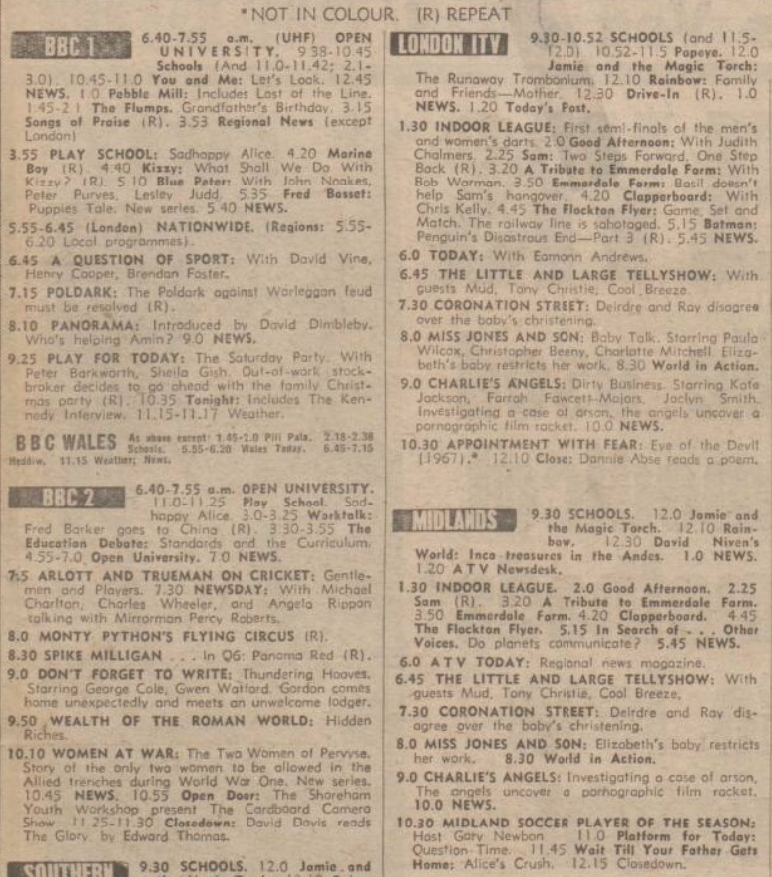
I’ve fired up the Randomiser, which has taken me back to 1977 to spend a week riffling through the television schedules. Hope there’s some good programmes to watch ….

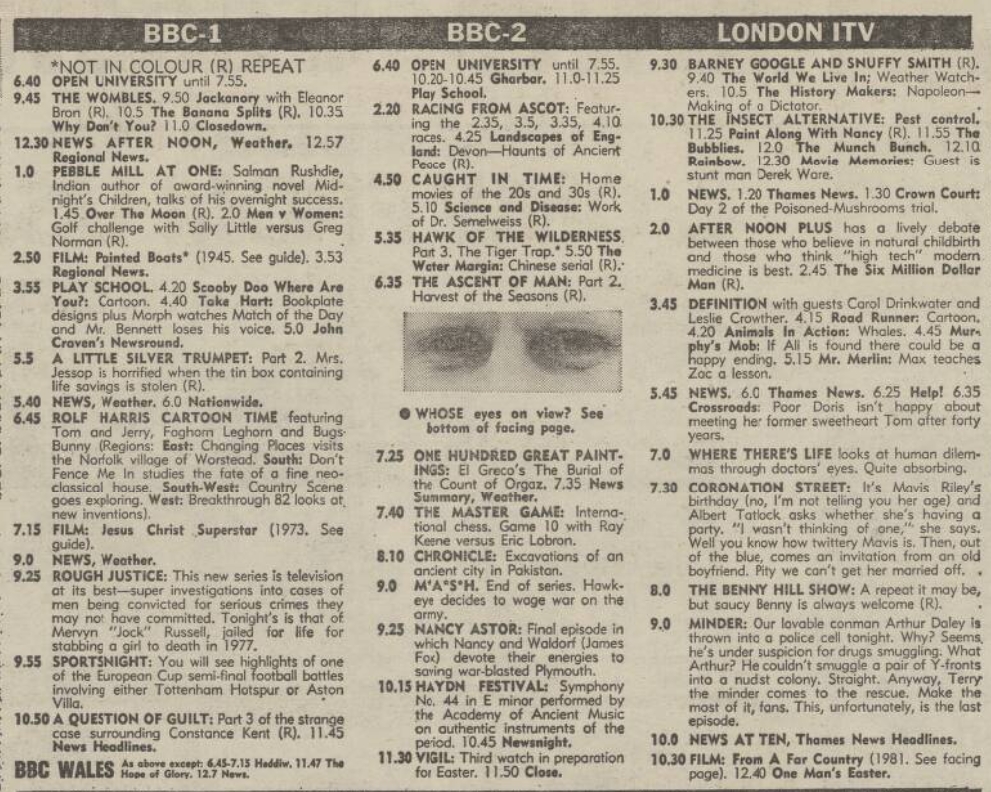
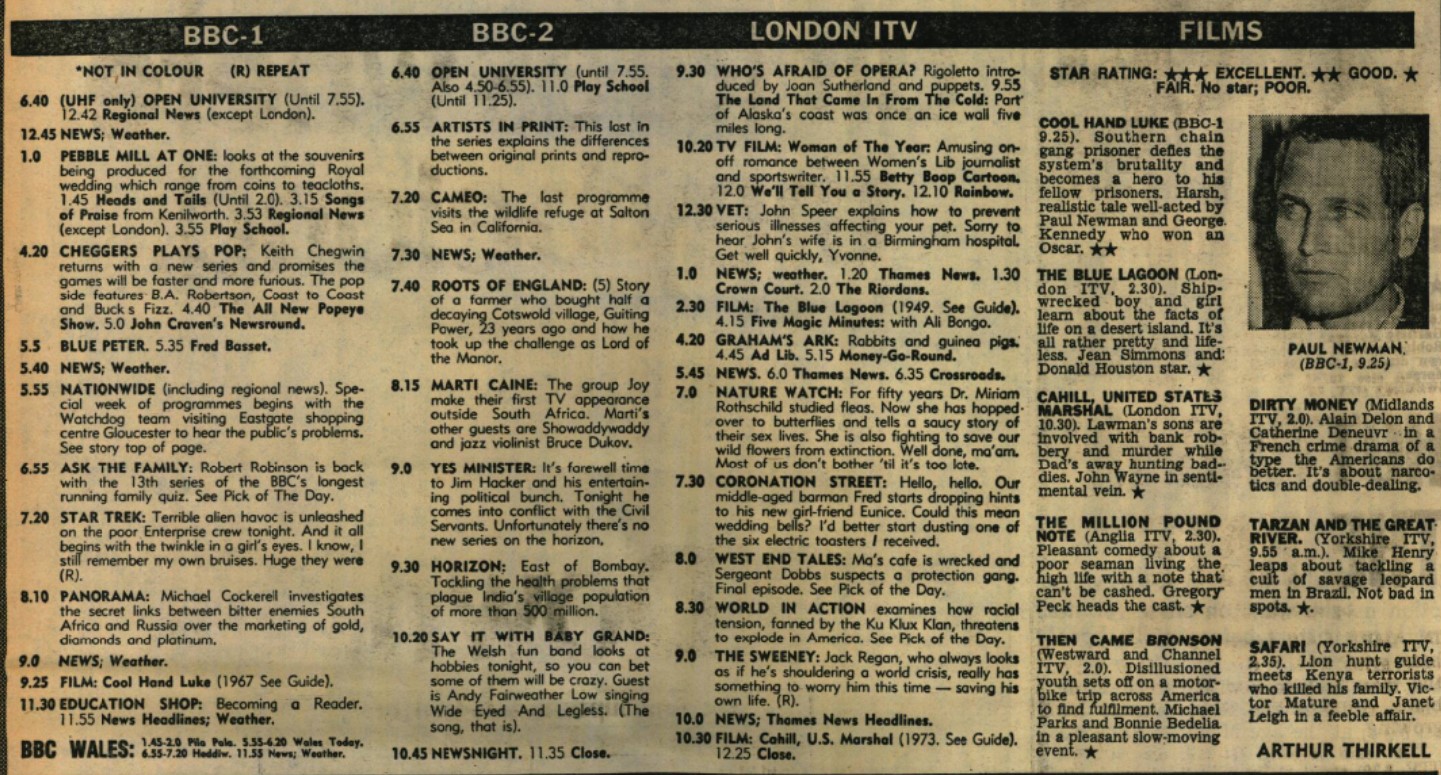
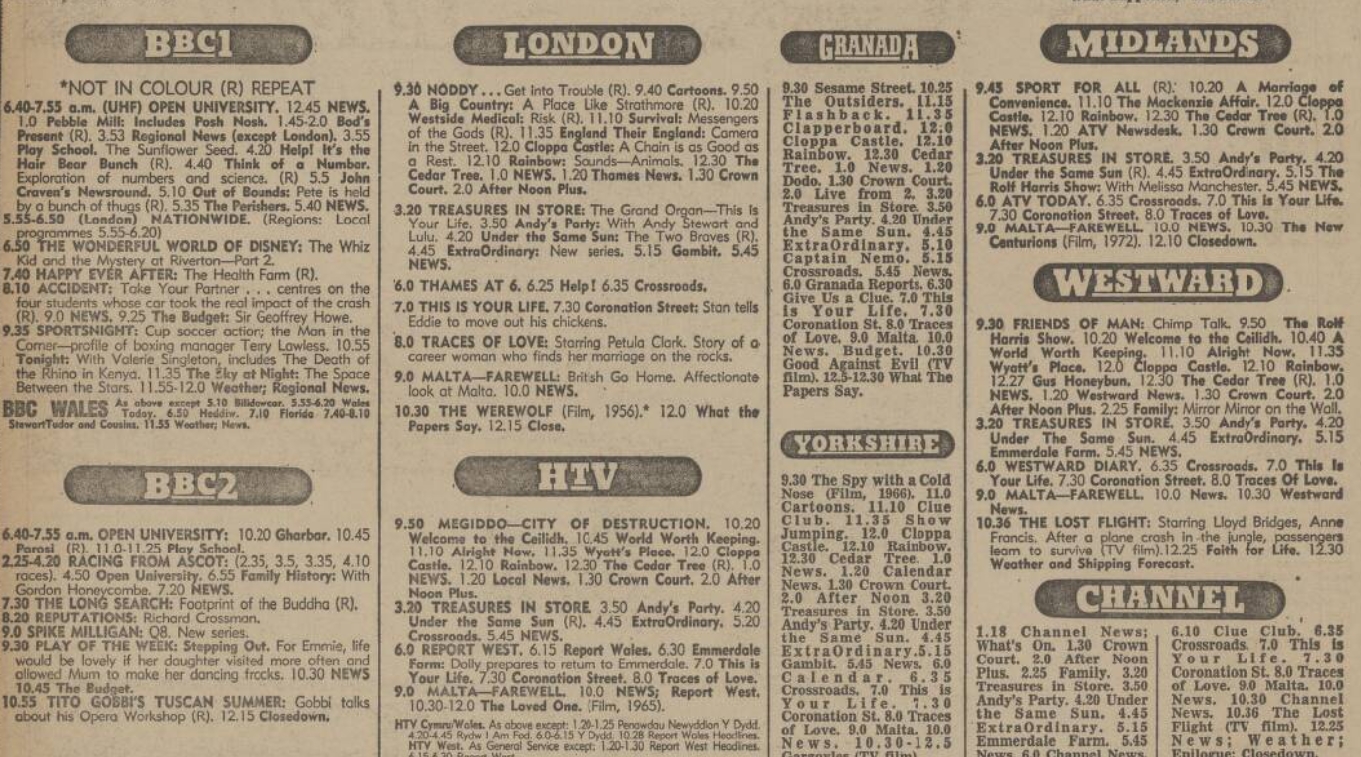
There’s something pleasing about Monty Python and Q6 sitting next to each other on BBC2 (especially since the Pythons were always quick to acknowledge the debt they owed to Spike). Today’s edition of Python hails from the first series (Man’s Crisis of Identity in the Latter Half of the Twentieth Century) which is fine by me, as it’s probably the run of episodes I return to the most.

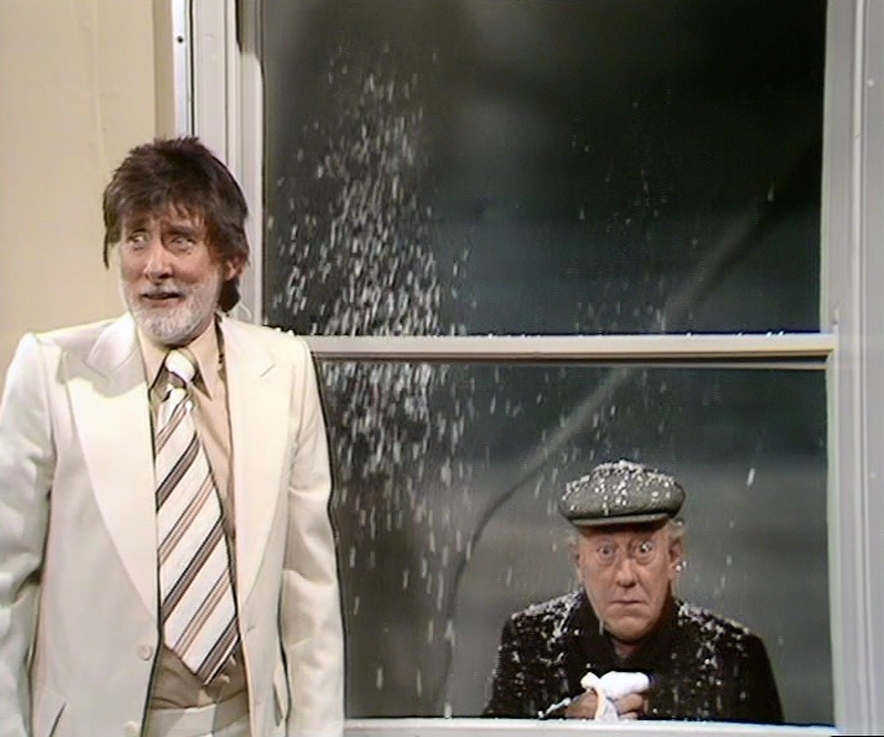
Given the lengthy gap between Q5 and Q6, Milligan was on top form throughout most of Q6 (later series tended to crop up more regularly and were much more bitty).

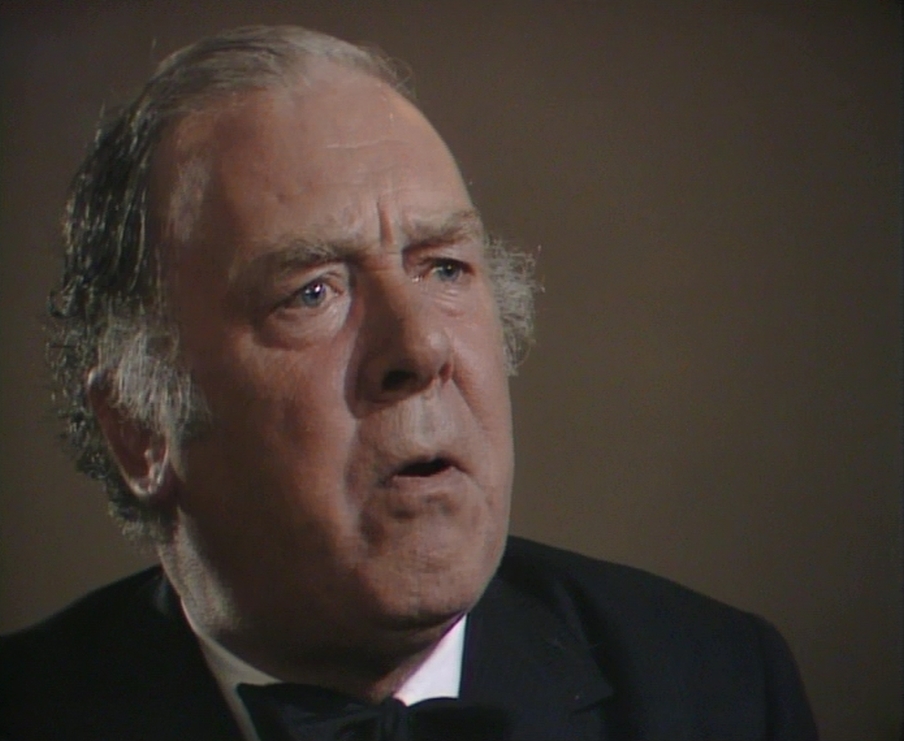
I’ve just started rewatching Don’t Forget to Write! so that’s going on the list. This programme always has a slightly odd feel for me – it could easily have fitted into a 30 minute sitcom slot, but instead was a 50 minute non-audience drama/comedy. George Cole, Gwen Watford with Francis Matthews head the cast.

The BBC schedules are stuffed with repeats today. Apart from Python and Q6 on BBC2 there’s also Poldark and Play for Today on BBC1. The Play for Today repeat makes sense as the sequel to this play will be broadcast tomorrow, so I’ll be tuning in for both of them (anything with Peter Barkworth is worth a look).

All of this means that I won’t have much time over on ITV, although if I’ve a spare half hour then there’s always Coronation Street.

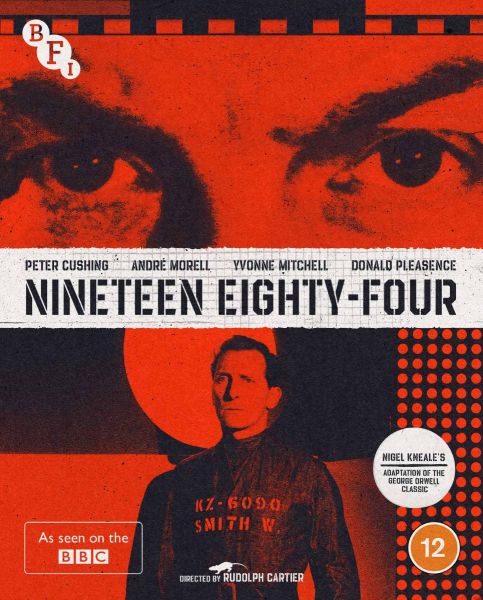
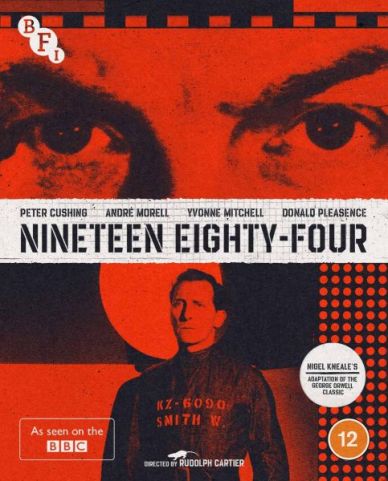
Nineteen Eighty-Four – BFI BD/DVD review

The Sunday Night Theatre adaptation by Nigel Kneale of George Orwell’s Nineteen Eighty-Four (originally transmitted by the BBC on the 12th of December 1954) is a highly significant milestone in the development of British television drama.

Before looking at the programme itself, it’s worth taking a moment to consider the state of British television in 1954. The BBC had launched its television service in 1936, although its reach was initially extremely limited – only 20,000 viewers (those close to the single transmitter at Alexandra Palace) were able to receive the early television transmissions.

The outbreak of World War 2 in 1939 meant that the fledgling BBC TV output was suspended and it wouldn’t resume until June 1946. However, plans for the return of television had been discussed as early as 1943 and one of the major issues to be tackled was how to ensure that the whole of the country – not just those living in London – could view the service.

More transmitters were the answer. Sutton Coldfield in 1949, Holme Moss in 1951 and Kirk O’ Shotts and Wenvoe in 1952 ensured that a further twenty eight million people up and down the country could now access television. There were still gaps in coverage, which would be plugged as the decade progressed, but by the time Elisabeth II was crowned in Westminster Abbey on the 2nd of June 1953, BBC television had firmly established itself nationwide. By 1954 there were 3.2 million television licenses (a sharp increase on the 763,000 licenses registered by 1949).

The launch of ITV in 1955 and BBC2 in 1964 were future milestones which would increase viewer choice – but when Nineteen Eighty-Four was broadcast in December 1954, British television was a one channel service, which meant that the BBC enjoyed the uninterrupted attention of the viewership.

Nineteen Eighty-Four was adapted by Nigel Kneale and produced and directed by Rudolph Cartier.

Nigel Kneale’s (1922 – 2006) earliest BBC credits were on the radio. He appeared several times in the late 1940’s reading his own stories, such as Tomato Cain and Zachary Crebbin’s Angel. Graduating from RADA, Kneale continued to write in his spare time while pursuing an acting career.

After winning the Somerset Maughan award in 1950 for his book, Tomato Cain and Other Stories, he decided to give up acting to become a full-time writer. In 1951 he was recruited by BBC television to become one of their first staff writers. This meant that he would be assigned to work on whatever projects were in production – adapting a variety of books or plays for television broadcast. In 1952 he provided additional dialogue for a play called Arrow To The Heart. The play was adapted and directed by Rudolph Cartier and it would mark the start of a successful working partnership between the two.

Rudolph Cartier (1904 – 1994) was born in Vienna and initially studied architecture before changing paths to study drama at the Vienna Academy of Music and Dramatic Art. Cartier worked for German cinema from the late 1920’s onwards, first as a scriptwriter and then later as a director. After Hitler came to power, the Jewish-born Cartier moved to America to continue his film career.

However his success there was limited, so in the mid 1940’s Cartier moved to the United Kingdom and restarted his career by working as a storyliner on several British films. In 1952, Michael Barry was appointed head of Drama at the BBC and interviewed Cartier for a post as a staff television producer/director. Cartier was of the opinion that the current BBC drama output was “dreadful” and that a new direction was needed to turn things around. Fortunately Barry agreed and Cartier was hired.

After Arrow To The Heart, Kneale and Cartier would next work on The Quatermass Experiment (1953). This six part serial, scripted by Kneale and produced and directed by Cartier, would prove to be an enormous success. Its reputation has endured down the decades – The Times’ 1994 obituary of Cartier highlighted it as “a landmark in British television drama as much for its visual imagination as for its ability to shock and disturb.”
Kneale and Cartier would go on to make two further Quatermass adventures for the BBC – Quatermass II (1955) and Quatermass and the Pit (1958/59). Their other collaborations included another Kneale original, The Creature (1955), as well as adaptations such as Wuthering Heights (1953) and Moment of Truth (1955).

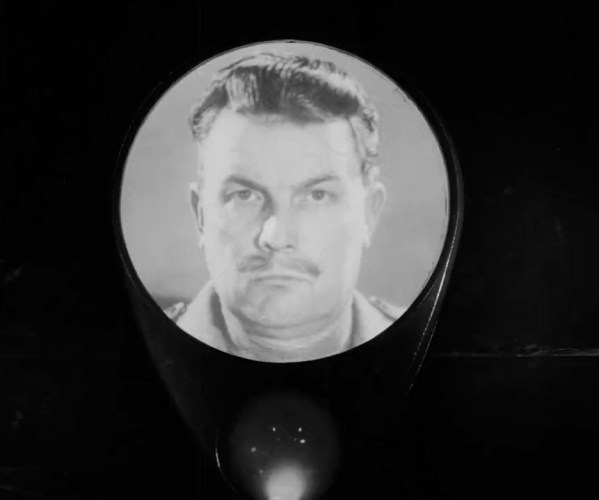
Published in 1949, Nineteen Eighty-Four by George Orwell offers a bleak dystopian picture of the future. The book is set in Airstrip One (formally Great Britain) which is part of the state of Oceania (there are two other states in the world – Eurasia and Eastasia). Oceania is constantly at war with one state whilst allied with the other. But since the allegiances are constantly changing, Oceania’s history has to be regularly re-written in order to maintain the omnipotence of Big Brother.

Winston Smith is a worker in the Ministry of Truth, rectifying “errors” in Big Brother’s previous pronouncements in order to ensure they now accurately record the “truth”. Winston’s desire to investigate the real past leads him to rebel against the state.

A popular and critical success when it was first published, Nineteen Eighty-Four was also a highly controversial book. So it was always going to be a difficult piece to adapt for television, particularly during the early 1950’s.

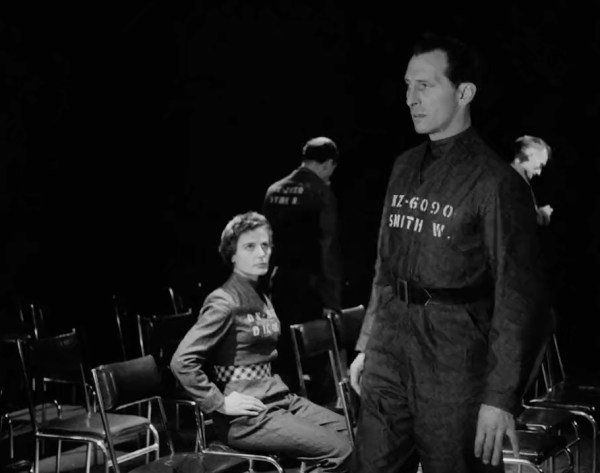
Peter Cushing (1913 – 1994) was cast by Cartier in the main role of Winston Smith. Cushing notched up an impressive series of television roles during the 1950’s, which would lead to Hammer Films approaching him towards the end of the decade to star in their adaptations of Dracula and Frankenstein, thus ensuring his celluloid immortality.

Yvonne Mitchell (who had appeared in the Kneale/Cartier Wuthering Heights) was cast as Julia, Andre Morell (later to play Professor Quatermass in Quatermass and the Pit) was O’Brien whilst the supporting cast included notable performers such as Donald Pleasance and Wilfred Brambell.

The music was composed by John Hotchkis. Cartier disliked recorded music, so the score was conduced live by Hotchkis in Lime Grove Studio E, next door to where the play was being performed. Hotchkis viewed the performance via a monitor in order to ensure that the music stayed in sync with the drama.

Prior to the first live performance on the 12th of December 1954, there was some pre-filming – initially on the 10th of November with additional filming taking place on the 18th of November. Pre-filmed inserts served several purposes – they could be used to present sequences that were impossible to realise in the studio but they were also useful for more practical reasons (allowing the actors time to move from one set to another or for them to make costume changes). The filming also helped to “open out” the drama, for example showing Winston moving through the prole sectors or Winston and Julia’s meeting in the woods.

Kneale’s adaptation remained pretty faithful to the original book, with only a few changes made (such as dropping the section where Julia, working in the PornoSec department, reads an excerpt from one of the erotic novels created by the machines).

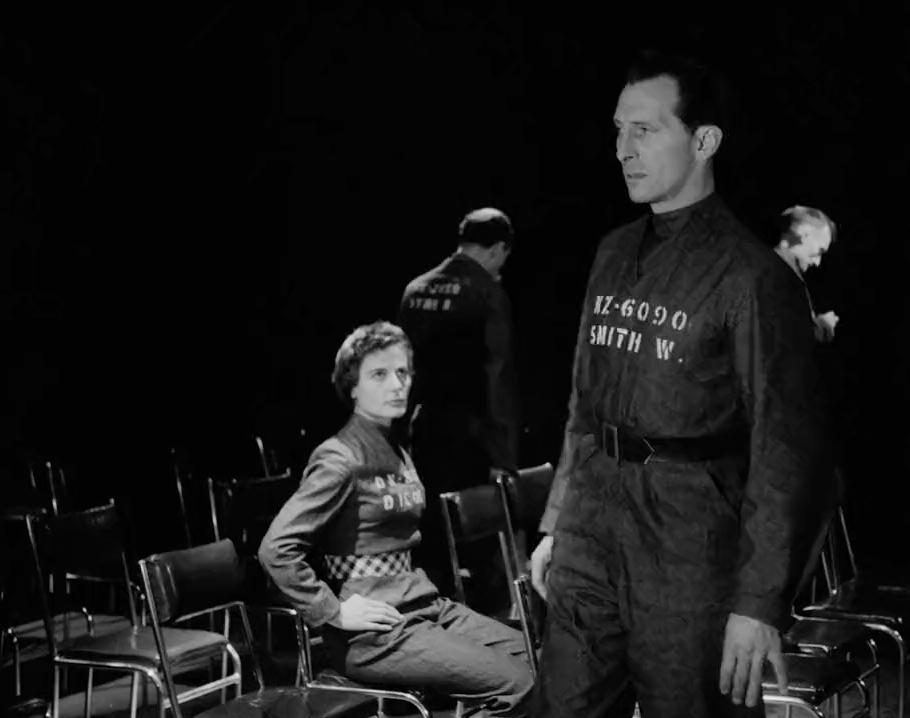
Given the limitations of live production, this remains a striking piece of television. Cartier’s use of close-ups on Cushing (along with his pre-recorded thoughts) during the scenes where Winston is struggling to hide his “thought-crime”, allows the viewer an insight into his mind. And this is enhanced by Cushing’s fine performance – throughout the play he is never less than first rate.

He is matched by Andre Morell who as O’Brien exudes an air of cool detachment in all of his scenes (most famously during the torture sequence) which contrasts perfectly with Winston’s doomed humanity.

Probably the most striking aspect of the production, Winston’s torture is another part of the production handled very well by Cartier. The passage of time is signified by numerous fade-ins and fade-outs which helps to create the illusion that a considerable amount of time has passed.  During these scenes, Morell is quiet, calm and reasonable, which is truly chilling.  When the broken figure of Winston, stripped of all dignity, is led away it’s a shocking moment.

Following transmission, there was something of an outcry in certain quarters. Five MPs tabled an early motion, deploring “the tendency, evident in recent British Broadcasting Corporation television programmes, notably on Sunday evenings, to pander to sexual and sadistic tastes.”

However, an amendment to this motion was tabled, in which another five MPs deplored “the tendency of honourable members to attack the courage and enterprise of the British Broadcasting Corporation in presenting plays and programmes capable of appreciation by adult minds, on Sunday evenings and other occasions.”

The play did have supporters in high places though, as the Queen and Prince Philip had watched and enjoyed the production (although this wasn’t made public at the time) and newspaper commentary – from both columnists and viewers – ultimately evened out at around 50% in favour and 50% anti.

Videotape recording was still in its infancy at this time and whilst some telerecordings had already been made of live productions they weren’t always of rebroadcastable standard. For example, the first two episodes of The Quatermass Experiment had been telerecorded, but the results were judged to be disappointing and so it appears that recordings were not made of the subsequent four episodes.

The original transmission of Nineteen Eighty-Four was not recorded so, as was usual at the time when a repeat of a play was required, it was performed again.  We are fortunate that the repeat was telerecorded, enabling us to have a record of the production.

A BD/DVD release of Nineteen Eighty-Four in the UK has been a long time coming. The story begins in 2004, when DD Video issued a press release, stating that a restoration of “exceptional quality” would shortly be issued on DVD. Then everything went quiet – reportedly the Orwell estate had exercised their veto to block the release.

Fast forward ten years to 2014, and this time a press release was issued by the BFI – as part of its Days of Fear and Wonder SF season, a restored DVD was reported to be on its way. But once again it never materialised, leaving us with the assumption that the Orwell estate had also blocked this one.

But since their copyright expired last year, they no longer have the power of veto – hence Nineteen Eighty-Four has eventually appeared on shiny disc.

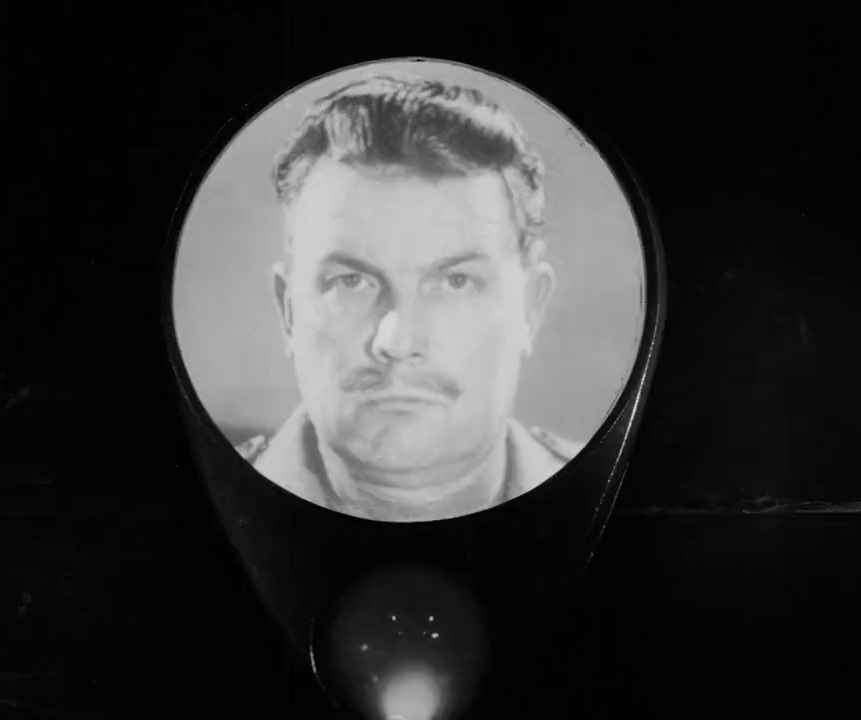
Like Quatermass and the Pit, the 35mm film elements of Nineteen Eighty-Four still exist and, suitably cleaned up, they now look absolutely gorgeous (albeit with some intermittent tramlining). But it’s worth stating that the film element of the play is fairly minor, so the bulk of the production is obviously never going to look as good as the film work. The telerecording has scrubbed up pretty well though – there’s no doubt that it offers an upgrade from what’s previously been in circulation via the BBC2 and BBC4 repeats and foreign “bootleg” DVD releases.

This new restoration is enhanced by a number of special features.  Jon Dear, Toby Hadoke and Andy Murray provide an entertainingly chatty commentary track which is packed with insight. Hadoke and Murray then return for a 72 minute in-vision discussion about Nigel Kneale and his legacy.

Slightly more digestible in a single sitting is The Ministry of Truth (24 minutes) a discussion between Dick Fiddy and Olivier Wake, in which the pair dispel some of the myths which have grown up around this adaptation of Nineteen Eighty-Four.

A 25 minute excerpt from Late Night Line-Up (1965) is of special interest – reuniting key members of the cast and crew for a roughly tenth anniversary retrospective. The package is rounded off with a handful of production stills, a PDF of the script and (available in early pressings of the disc only) an illustrated booklet with several short but informative essays. There’s also one other brief bonus feature, which wasn’t listed and therefore came as a very pleasant surprise.

Given the technical limitations of live performance as well as the primitive nature of a mid 1950’s telerecording, Nineteen Eighty-Four is still an incredibly compelling piece of television, thanks to all the performers, but particularly Cushing, Morrell and Yvonne Mitchell. Its place in the development of British television drama is a key one and anyone who has the slightest interest in the history of British television should snap it up.

Nineteen Eighty-Four – a dual BD/DVD release – is available now from the BFI and can be ordered via this link.
Back to April 1986 (10th April 1986)

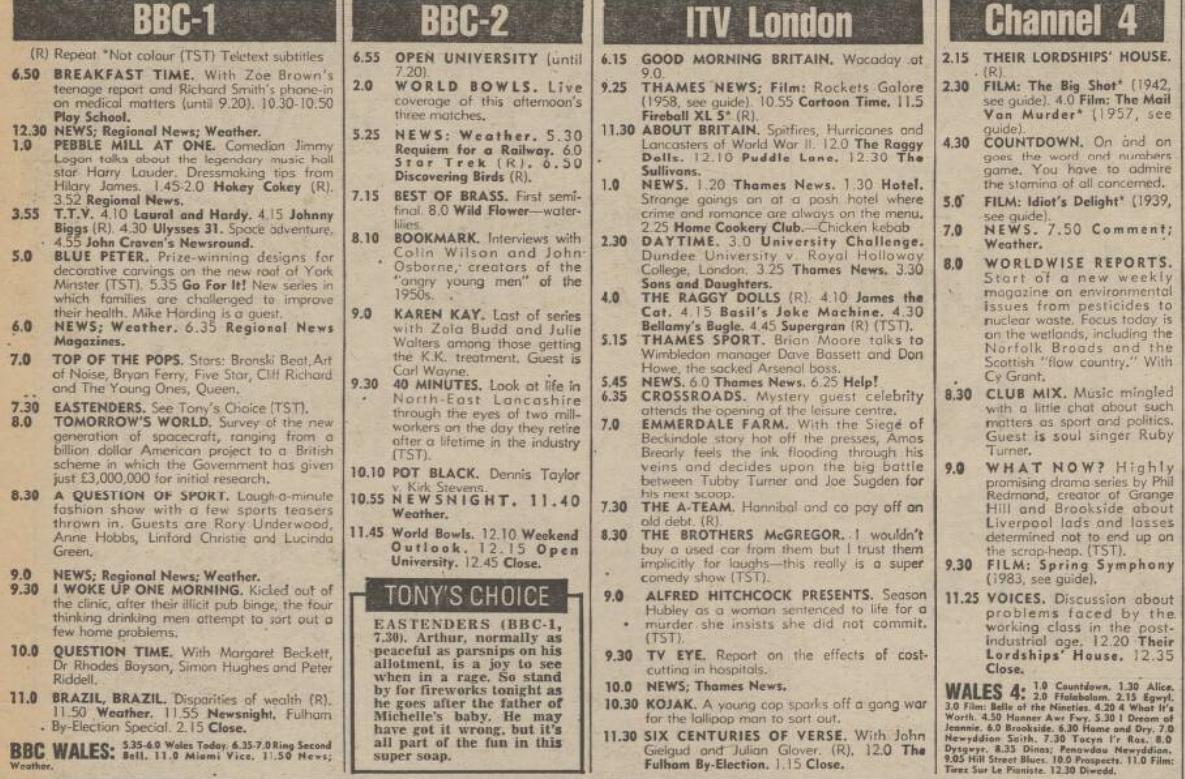
TOTP, EastEnders and I Woke Up One Morning are all tempting on BBC1. EastEnders is still in the middle of the who fathered Michelle’s baby saga, so sparks look likely to fly – especially when the normally mild-mannered Arthur finds his dander is well and truly up.

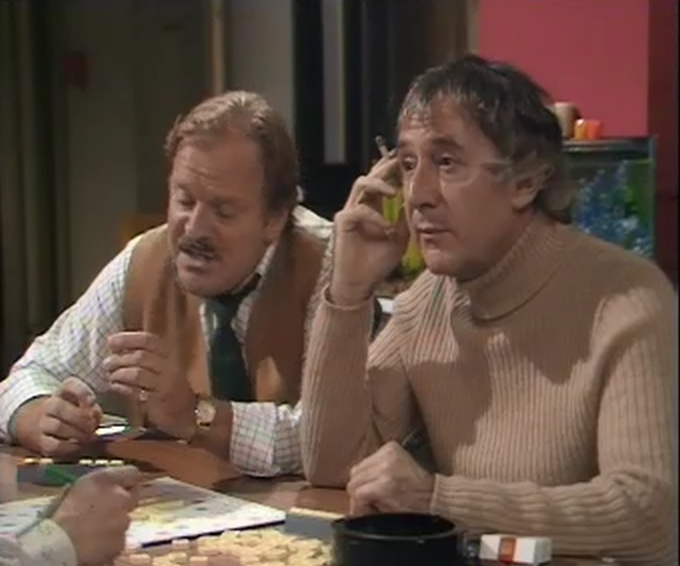
I Woke Up One Morning is one of those programmes that seems to have totally slipped from view – despite a first-rate cast and sharp scripts by Carla Lane. The series’ theme (it’s centered around the travails of a group of recovering alcoholics) doesn’t look like it promises merriment but it manages to be wryly amusing (although bleakness is never too far away).

I might catch the repeat of Star Trek on BBC2 whilst bemoaning the lack of Karen Kay’s show online. Rounding things off with an episode of Kojak on ITV that’s a pretty full evening.

Back to April 1985 (9th April 1985)

Skipping 1984 (which had fairly slim pickings) I’ve moved onto 1985 which looks a little more promising.

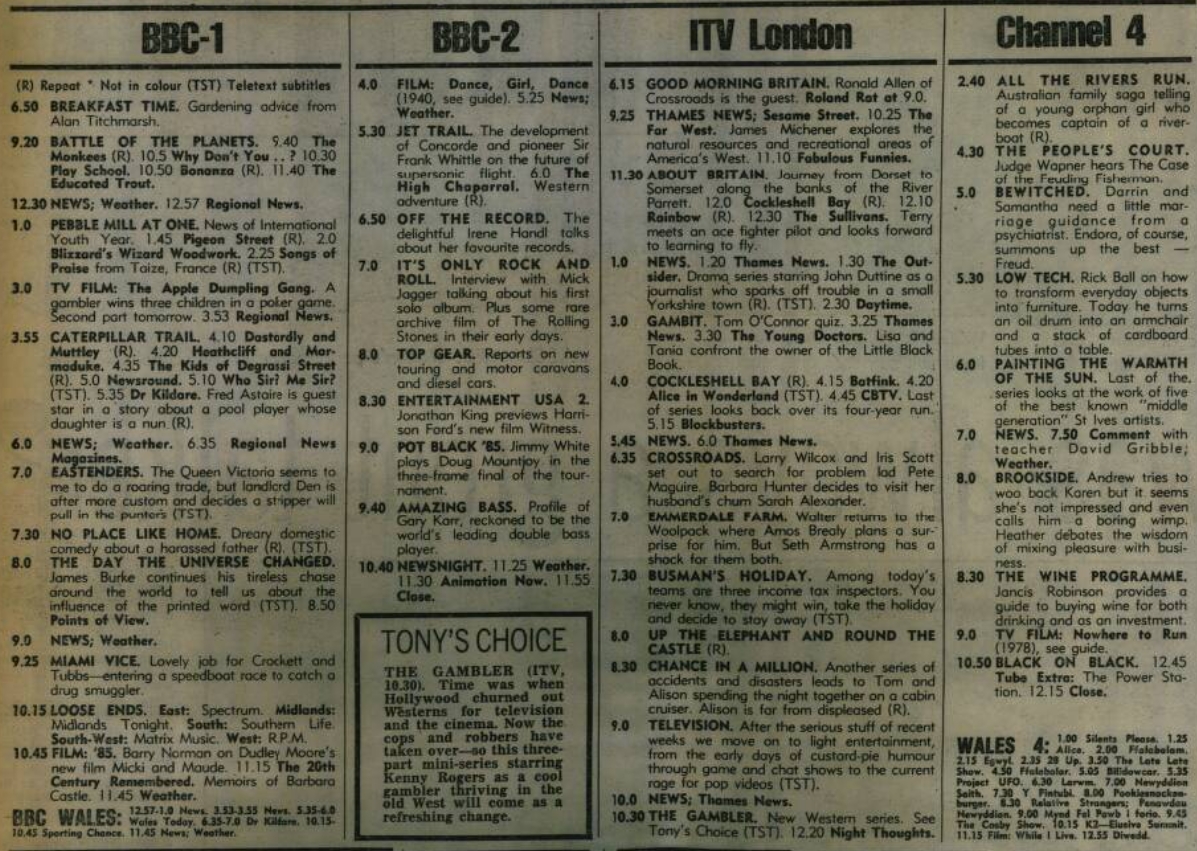
EastEnders, No Place Like Home and The Day The Universe Changed offers a pretty decent early evening lineup on BBC1.

I continue to pine about the scarcity on Pot Black online. Maybe one day there might be a stash added to the iPlayer – we can but dream. Tonight’s 1985 match isn’t available, but there’s another from the same series close at hand, so that will have to do.

There are a few possibilities on ITV, but the only thing that really appeals is the repeat of Chance in a Million.

Back to April 1983 (8th April 1983)

A repeat of Innes Book of Records on BBC2 is a must-watch (although I’m having difficulty in pinpointing which episode it is – Genome doesn’t have any records of 1983 repeats).

ITV offers a couple of possibilities – Pig in the Middle and the first part of Death of an Expert Witness. I’ve had the Roy Marsden/Adam Dalgleish boxset sitting on the shelf for a while but I haven’t made a great deal of headway with it. I’ve no problem with drama series which take their time, but these P.D. James adaptations seem too leisurely even for me (DoaEW clocks in at an overgenerous seven episodes).

Still, this debut story does feature a vey watchable guest cast (Ray Brooks, Barry Foster and Geoffrey Palmer amongst others) so they might help me to make it through to the end (and after a few episodes I might even stop staring at Marsden’s very obvious hairpiece).

I’ll round off the evening with a piece of ephemera – The Very Hot Gossip Show – which the curious can find on YouTube.

Back to April 1982 (7th April 1982)

There’s nothing sourceable for me on BBC1, whilst BBC2 offers The Ascent of Man and M*A*S*H as possibilities.

ITV’s a happier hunting ground – there’s the always reliable Coronation Street (Derek Wilton making his first appearance since April 1979) followed by a repeat of The Benny Hill Show. I’m not sure whether I’ll attempt to track down exactly which one it is, as you’d no doubt get the gist from any of his shows at this point ….

Undoubted highlight of the evening is In – the final episode of Minder‘s third series. There’s a grimmer tone to this one – Arthur’s behind bars and desperate whilst Terry, still on the outside, attempts to clear his friend’s name.

This was one of Leon Griffiths’ last scripts for the series. Several writers (Tony Hoare especially) very effectively developed and broadened Griffiths’ original concept, but there’s always something satisfying about watching something written by Minder‘s creator.

Featuring a typically strong supporting cast (Brian Cox, Frederick Jaeger, Diane Langton, Russell Hunter) it’s the sort of episode that makes me want to go back and rewatch the whole series in order.

Back to April 1981 (6th April 1981)

BBC1 is my first stop for Star Trek and The Lights of Zetar. It’s a series three episode, which is the cue for disappointment for some (although I’ve never found the later episodes to be that bad). And since this is the only one co-written by Shari (Lamb Chop) Lewis, it’s worth a look for that reason alone. According to Genome, it was previously broadcast in 1971 and 1973, so Zetar fans have had quite a wait to see it again.

Today’s Coronation Street is slightly ahead of my current rewatch, but I think I’ll dip in to see what’s going on (possible romance for Fred, according to the Daily Mirror blurb).

Undoubted highlight of the day is Yes Minister on BBC2 at 9.00 pm. The final episode of series two, A Question of Loyalty is as sharp today (if not more) than it’s ever been.

If there’s time, I might catch the repeat of The Sweeney over on ITV. Ranald Graham’s Nightmare is the episode getting another airing today.

Back to April 1980 (5th April 1980)

I’ll be sticking with BBC1 today. First there’s Wonder Woman, with the series three episode The Starships are Coming. An everyday tale of alien invasion (or is it?). By this point the show was beginning to run out of steam, but this is a decent one – very silly of course, but that’s the appeal of WW.

A sharp change of pace next, for All Creatures Great & Small. Big Steps and Little ‘Uns is a key episode – the final episode of series three (which at the time seemed to spell the end of the series) it ends on a sombre note as James and Siegfried, with WW2 looming, both face the prospect of leaving the security of the Dales for an unknown future. This is obviously the cue for a series of emotional farewells which the regulars play pitch-perfectly.

I’ll round off the evening with a double dose of Dallas, which sees Jock stands trial. My Dallas rewatch has somewhat run aground during the last year, so possibly dipping in here might reignite my enthusiasm to pick it up again.

Back to April 1979 (4th April 1979)

During the next seven days I’ll be sampling April’s schedules between 1979 and 1985. As before, I’m only going to choose programmes that I can actually source from my archive, so anything which looks intriguing but I don’t have will have to be sadly passed over. Let’s dive in ….

BBC1 offers a repeat of Happy Ever After which is followed by a repeat of Accident (no doubt the high preponderance of repeats was irritating certain viewers).

Accident has reached episode two, Take Your Partners. It’s an interesting series, which focuses on the ramifications of the same event (a multi vehicle accident) from different perspectives. This gives it a similar feel to Villains (LWT, 1972). There’s no shortage of good actors across the series’ eight episodes and this was one of three directed by the always reliable Douglas Camfield.

Over on ITV, there’s chicken issues in Coronation Street (a short-lived but nevertheless amusing plotline which sees an initially reluctant Hilda transformed into a doting fowl lover). Later I’ll be crossing over to BBC2 for the start of a new series – Q8. By this point, Spike Milligan’s idiosyncratic sketch show defies any sort of description – but, if you’re in the right mood, there’s usually some nuggets of gold still to be found.

Travelling Man – Sudden Death (12th December 1984)

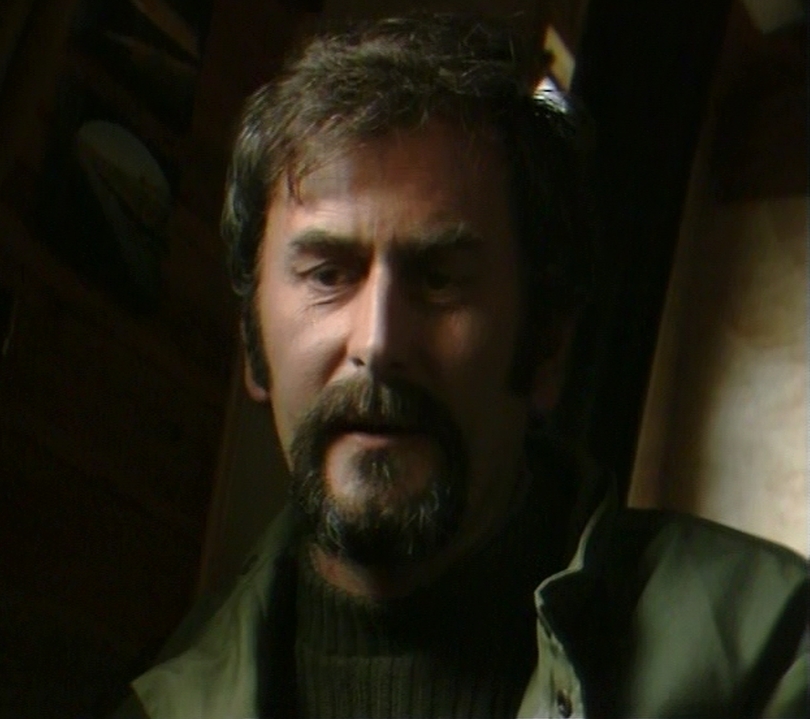
Lomax’s quest for his son (not to mention finding out who framed him) is halted temporarily when he returns to London to attend his mother’s funeral. Afterwards, he resumes his targeting of Pember (Colin Jeavons) – a man who might be able to help him clear his name ….

Although the previous episode, Moving On, ended on something of a cliffhanger, the ongoing story halts temporarily as Lomax says farewell to his mother and attempts to rebuild bridges with his still somewhat bitter father (played by Patrick Godfrey).

Their scenes together help to bring the character of Lomax into sharper focus, although the picture that emerges isn’t an especially flattering one. Lomax Snr (he’s not given a Christian name, merely credited as ‘father’) remains comically disapproving about the flashy way Lomax dressed during his police days (Lomax tries to explain that he was undercover at the time, but that doesn’t seem to sink in).

Rather more telling is Loman Snr’s disapproval about his son’s philandering ways. Was this the reason why his wife left him? Lomax Snr also believes that having an ex-convict in the family is a source of great embarrassment (Lomax continues to protest his innocence, but his father – an experienced policeman of the old school – has heard it all before and doesn’t believe a word of it, even from his own flesh and blood).

Another fascinating moment occurs when Lomax wonders why his father didn’t let him see his mother during her final days. Lomax Snr’s initial response – he wanted his son to remember his mother as she was – is swiftly followed by a throwaway comment that she died of shame (because of Lomax’s conviction?) Lomax quickly picks up on this, but his father doesn’t seem to realise the import of his words (or decides he’s gone too far) and the conversation moves on.

They part on reasonable terms, although Lomax later admits that his previously held respect for his father has all but faded away. This strained father/son relationship seems to run parallel to what may be an equally fractious relationship between Lomax and Steve. It’s later revealed that Steve attended his grandmother’s funeral incognito. This confirms that he’s fine and had he wanted to speak to his father then he could have done so at any time during the last few months.

Later Lomax looks up Maureen (Bobbie Brown) for an afternoon of champagne, sex and Earl Gray tea. Their scenes together are, like the meeting with his father, designed to shine more of a light on Lomax’s character. And again it’s not flattering, as Maureen (shortly to be married) tells Lomax that she can’t see him any more – but wanted this one last time in order to use him the way he’s frequently used her.

After this mild battering to Lomax’s psyche, he gets back on the trail of Pember. More information is now shared with the audience – there were eight officers, including Lomax and Pember, involved in the operation which led to Lomax’s conviction. He’s convinced that Pember and someone else (as Pember seems to be too weak-willed to have masterminded things on his own) were responsible for framing him.

Lomax continues his psychological reign of terror (phoning up Pember in the middle of the night) although when they actually meet the dynamic between them has subtly shifted and Pember seems more in control. By this point, Pember has also made contact with Martin (Tony Doyle). If Colin Jeavons made a good career out of playing weaselly types then Doyle’s stock in trade was that of the implacable enforcer. The relationship between the two is skewed in Martin’s favour, although Pember (as long as he stays alive) has something of a hold over him.

And this is the point of the story where you realise that Pember’s a weak link who isn’t long for this world. Alas, Lomax is a little slower on the uptake and can’t prevent his murder. Given that he suspected Pember wasn’t working alone, surely he should have realised he was vunerable?

Ah well, that sets things up nicely for the second series. Especially when Lomax leafs through a series of photos of Pember and Martin and doesn’t react at the two of them together, which tells us that Martin isn’t known to him.

So across the course of six episodes we’ve seen two recurring plotlines developed, although neither have reached their conclusion. Hopefully the second series will offer closure. Time will tell …

Travelling Man -Moving On (5th December 1984)

For once the peripatetic Lomax seems content to stay in the same place for a while (he’s taken a job at the local pub). This doesn’t please Neil Pember (Colin Jeavons) who knows Lomax of old and is keen for him to move on as soon as possible. So Pember engages the services of Kenny (Jeffrey Hardy) to sort this out – using any means necessary ….

The last two episodes of series one are the point where Lomax’s desire to find out who framed him really begins to come to the fore (although I assume that Roger Marshall already knew he’d been commissioned for a second series as everything is left dangling at the end of the next episode).

Colin Jeavons plays to type as Pember. He’s a somewhat nervous and devious person, although he does have a hard streak (challenging Kenny to an arm wrestle but placing his open lighter under Kenny’s arm).

I’m not sure if it’s a story flaw, but had Pember simply done nothing then I’m sure Lomax would have moved on when the time was right (as he’s still searching for his son). So by engaging Kenny, Pember has simply drawn attention to himself and sown the seeds of his own destruction.

Although I suppose you could argue that given it’s a fairly small place Lomax and Pember would probably have run into one another eventually, so maybe Pember decided it was worth trying get rid of Lomax by force.

Is Kenny the man for the job though? He seems something of a lightweight and given all we’ve seen of Lomax so far this series, there only seems like one winner in the battle between them. This might be another miscalculation by Pember, or possibly Lomax has grown harder following his stay in prison. Since we have no knowledge of the old Lomax it’s hard to say for sure – but today’s episode once again demonstrates that he’s happy to use violence to resolve a situation (if he was like that during his police days then it’s a wonder he didn’t get drummed out of the force earlier).

Remaining in mild niggle mode, it’s remarkable that so many people met by Lomax on his travels have seen Steve. Today it’s the turn of Susie (Kate Hardie), who appears on the surface to be a friendly teenager with no particular agenda. We’re forced to revise this opinion later on after Kenny asks her to plant some drugs on Lomax’s boat (having then tipped off the police, this is his first attempt to get rid of Lomax).

If you can swallow that Susie has met Steve, more swallowing is required when she becomes embroiled in the episode’s main plotline. This is a little hard to take (unless Kenny knew that Lomax and Susie had already met). When the police – in the form of Inspector Jakeman (Richard Ireson) – come calling, Lomax is remarkably nonchalant. He’s already disposed of the drugs so no problem there, but doesn’t seem in the least concerned about the fact he’s been entertaining an underage girl on his boat (although it’s true that they’ve done nothing more than enjoy a cup of tea).

Jakeman is one of the more comical coppers to cross Lomax’s path. He’s easily bamboozled by the ex-detective and is forced to leave empty-handed.

Kenny steps up his efforts by using his crop dusting helicopter (that’s a handy occupation) to buzz Lomax’s narrowboat as it wends its way down the canal. This is the closest that the series came to a car chase, and although it’s low in speed it’s still an impressive scene.

By this point Lomax is angry (and you don’t want to make him angry) so he plots his revenge in a typically single-minded fashion. He uses a club to knock Kenny unconscious, drags him to a shed and proceeds to almost run him over with a handy threshing machine. Hopefully Lomax was just bluffing, but looking into his eyes it’s difficult to be sure. As touched upon earlier, this outcome was always on the cards – so the question wasn’t who would win, but how Lomax would win.

Now that Lomax knows that Pember was behind Kenny, everything’s nicely set up for the series closer. And this episode ends on an ominous tone with a silent Lomax simply watching the increasingly frantic Pember. Like a cat playing with a mouse, Lomax is content to bide his time and engage in a spot of psychological warfare.

Travelling Man – The Grasser (28th November 1984)

Lomax’s latest parking place for his narrowboat seems idyllic enough – but his peace is abruptly shattered when several bullets are fired in his direction. He initially assumes he’s the target, but upon further investigation that turns out not to be the case ….

The shooter – Thomas (Paul Chapman) – is the centre of attention during the opening part of the story. Arriving in the UK on Concorde, it’s plain that he’s a professional arriving to do a specific job. We’re misdirected into assuming that this is to kill Lomax, but it quickly becomes obvious that isn’t so (his practice shots in the woods simply went rather wide of the mark and hit Lomax’s narrowboat by mistake).

For a well paid assassin, you have to say it slightly beggars belief that he’d be quite so inaccurate in his shooting (it’s also a clumsy way to get Lomax involved in the story, but any other way would probably have seemed just as contrived, so we’ll have to let it go).

Thomas is staying in a small hotel which overlooks a palatial house where Jimmy Nolan (Bernard McNamara) is currently resident. It seems unlikely that Nolan would own the house and the slightly mocking tone of his companions provides us with another clue – they’re police officers who have the job of minding him (the episode title will tell you why).

Nolan might be a very minor villain, but he has had the knack of listening into conversations with major league offenders. So delivering him safely into the witness box wouldn’t be pleasing for many in the underworld (hence Thomas’ presence). McNamara would always do you a nice line in seedy villainy (he was a regular in Hazell as Cousin Tel, for example).

Lomax calls his regular newspaper contact – Robinson (Terry Taplin) – who intercedes with the police on his behalf. This means we’re graced with an appearance from the always dependable David Saville as Superintendent Richards who, rather surprisingly, spills the beans about this delicate operation to Robinson.

Once Lomax knows Nolan’s life is in danger you’d assume he’d warn the officers guarding him, but that doesn’t happen. It’s slightly hard to work out why, but maybe Lomax wanted the kudos of defeating Thomas personally.

If so, his plan backfires spectacularly as Thomas knocks him out and holds him hostage at gunpoint. Until this point, the episode’s two main characters – Lomax and Thomas – have been essentially solitary (interacting with others, but only on a surface level).

The point when they’re brought together is where The Grasser really begins to build momentum. Paul Chapman is given some interesting dialogue which fleshes out Thomas’ character significantly – he may in part be the dispassionate assassin of cliché but he’s also gifted some more unusual character traits. Thomas invests the money he receives fron successful hits into sheep. “Last job was an Italian vineyard owner. Good value. 150 females and five rams”.

The downbeat ending (although I suppose how downbeat you regard it depends on which side of the law you’re on) is effective. And it’s worth noting that by the end Thomas has emerged as a far more interesting and sympathetic character than Nolan (maybe partly as played, but presumably mostly as scripted). But whatever the outcome, Lomax ends up bruised, battered and inside a police cell – although the always dependable Robinson is on hand to bail him out.

Travelling Man – The Watcher (21st November 1984)

Lomax’s continuing search for his son has brought him to an isolated Welsh village. The welcome he receives in the hillside is a somewhat lukewarm one, which doesn’t improve after a young girl goes missing and suspicion inevitably falls on the stranger in their midst ….

There’s something of a telefantansy feel about the opening of The Watcher as Lomax wanders through the deserted village. The puzzle deepens after he enters the primary school which is also devoid of people (and a list of drug terms on the blackboard is a jarring thing to find in such surroundings).

The mystery is quickly dissipated though – everyone is at the chapel, listening to the fire and brimstone proclamations of Morgan Rees (Freddie Jones). As Rees employs virtually the whole community they clearly feel an obligation (however unwilling some may be) to hear him expound at length on the evils of modern society.

As the episode continues, you can’t help but wonder what the Welsh viewers watching at home made of this one. We’re told that the village is something of a throwback, a tightly knit community where strangers are far from welcome. Although Lomax does encounter the odd friendly face, a general air of hostility is the order of the day – which hardly paints a very flattering picture of the country.

Although relatively few members of the village are given speaking roles, at times they seem to operate en masse in a hostile way towards Lomax (especially at the end, which we’ll come to later). Rees’ financial hold over them helps to partly explain their actions though.

Although the cast was, as you’d expect, peppered with Welsh actors, the main guest role fell to an Englishman, Freddie Jones. He tackles a Welsh accent with aplomb and has considerable presence as the florid and autocratic Rees, whose grip on his people becomes more and more tenuous as time creeps on.

Meg Wynn Owen (possibly best known for playing Hazel in Upstairs Downstairs) has a decent part as Gwen Owen, a schoolteacher who initially befriends Lomax but – due to pressure applied – is later persuaded to lay false claims of assault against him.

Hubert Rees made a good career out of playing ineffectual authority figures, so Geoff Watkins (the village’s police representative) was a role well within his comfort zone. Watkins, a man totally under Rees’ thumb, makes a half-hearted attempt to move Lomax on. But Lomax isn’t someone to take fright easily and certainly not when pressure is applied from the likes of Watkins.

Other familiar Welsh actors – Davyd Harries and Aubrey Richards – help to fill out the cast. Alan (Harries) is one of those convinced of Lomax’s guilt (although whether this is due to a desire to please Rees, a genuine belief of wrongdoing or simply a dislike for the English is never made clear).

Richards has a memorable cameo as a draughts player who delights in beating Lomax in what appears to be a friendly pub game. Once he’s celebrated victory, the mood darkens when he refuses to take a drink with Lomax. It’s a brief but telling moment and clearly comes as a jolt to the visitor.

Norman Jones (another non-Welsh actor) is the episode’s other major guest star. He plays DCI Jenkin, brought in to coordinate investigations after the girl’s dead body is discovered.  Like Rees, Jones is playing a familiar part today (Coronation Street and Inspector Morse are just two other series where he can be found in detective mode).

Jones gives an excellent performance and the relationship between Jenkin and Lomax helps to propel the second half of the episode to its conclusion. Unlike some of the policeman we’ve met so far in the series, Jenkin (although he wearily regards Lomax’s presence as a distraction) doesn’t actively despise him and, indeed, they work together in order to uncover the truth.

The episode isn’t a whodunnit. The audience is told who fairly early on and the reason why isn’t too much of a mystery. Other writers may have attempted to put a twist into the story or placed Lomax in more active trouble with the police (although he’s accused of murder, his innocence is quickly established) but Marshall seems to content to let things play out as they are.

After the matter is finally settled, Lomax prepares to leave in his narrowboat – but is startled to see a large portion of the village assemble on the hilltop to watch him go. Apart from Gwen, friendly faces are scarce, and the effect is decidedly unsettling, although you have to wonder just how realistic it would be for so many people to act in a gestalt fashion like this.

Mind you, as the identity of the murderer has brought about a seismic change in the village and the outsider Lomax is probably seen by many as the man to blame, I suppose it’s not entirely impossible. And of course it’s a memorable way to conclude the episode ….

Travelling Man – The Collector (14th November 1984)

Lomax is targeted by Naylor (Michael Feast), who’s come to collect the fortune he believes Lomax has stashed away. But with Lomax absent, he stalks Andrea instead ….

No time is wasted in establishing that Naylor is somewhat on the psychotic side. He begins by purchasing a gun from a selection offered in a car boot at a multi-story car park (even this early on, it’s easy to believe that Naylor – although he didn’t – could have killed the seller after the deal was collected). He then picks up some protection money from an arcade, doing what turns out to be his signature move (rattling a box of matches).

Someone – we don’t know who – has commissioned Naylor to retrieve up the money it’s believed Lomax collected before he went inside. But although Naylor might appear as an intimidating figure to Andrea, everything we’ve seen in the series so far suggests that he’ll be no match for Lomax.

And that’s how it later turns out, which is one of the weaknesses of the episode. Had Lomax not been urgently called away then I’ve a feeling the story would have been a lot shorter ….

The reason for Lomax’s absence – his mother is ill – does feel slightly contrived, especially since we never actually see her or his father. Lomax’s father, a policeman of the old school, still intensely disapproves of his son’s fall from grace and has shut him out of their lives. Some sort of meeting would have carried a dramatic punch, so it’s slightly surprising that it didn’t happen (although since his mother’s illness features later in the series it can’t be dismissed as simply a MacGuffin).

With Lomax away, the field is clear for Naylor to creep aboard the narrowboat where Andrea is sleeping, douse her bedclothes in petrol and then wake her up – all the time rattling his box of matches in a menacing fashion. Michael Feast would always do you a nice line in unhinged types and he doesn’t disappoint today – playing off against Lindsay Duncan in this key scene very well. The moment when an apparently satisfied Naylor leaves Andrea (only to casually throw a lighted match towards her) is quite a jolting one.

A shaken Andrea, recovering in hospital with burns that thankfully aren’t too serious, is visited by a concerned Lomax but as soon as he leaves her room up pops Naylor to taunt her again. That’s a slight story contrivance but I think we can let it go.

So far the episode has kept Lomax and Naylor apart – he searches, but fails to find him, in the hospital – but eventually of course they have to meet. And then things go the way you’d expect with Naylor proving to be no match (ahem, no pun intended) for the remorseless Lomax. Which, as touched upon before, is the episode’s main flaw – had Naylor contrived a way to get Lomax out of the way so he could deliberately target Andrea then that might have just tightened things up.

That’s only a minor quibble though, as The Collector is another strong episode which doesn’t feel padded.

It’s the end of the line for Lomax and Andrea though, as she decides that his life is just too dangerous for her. So he loads up the narrowboat and sets course for a new destination ….

Travelling Man – First Leg (7th November 1984)

Travelling Man was a thirteen part series/serial written by Roger Marshall, broadcast between 1984 and 1985. After scripting the Survivors episode Parasites (tx 2nd June 1976) Marshall began to mull over the possibility of a series where the central character traversed the country in a narrowboat. Given the slowness of this form of travel, it certainly offers a change of pace from most action/adventure series where high speed car chases are usually the order of the day ….

Marshall initially offered the series to the BBC, with John Thaw earmarked as the lead character Lomax. They turned it down and several ITV companies also rejected it before it finally found a home at Granada. By that point Leigh Lawson had been cast as Lomax and although only a few years separated Thaw and Lawson, it’s hard to imagine Thaw playing the character as written (or convincing in some of the stunt set pieces). But possibly Marshall tailored the scripts to suit Lawson and had Thaw taken the role, Lomax would have been subtly different.

This opening episode, First Leg, has an echo of the Public Eye episode Welcome to Brighton? (Marshall, the co-creator of Public Eye, wrote all seven episodes in the series’ fourth run which began with this episode). Both Lomax and Public Eye‘s Frank Marker open their respective episodes as inmates awaiting release after serving a prison sentence for a crime they didn’t commit.

It quickly becomes clear that Lomax is a loner like Frank Marker, although they’re very different character types. Marker has long been a loner out of preference but prior to his conviction, Lomax had a wife, a son, a house and a job. All of these have now been taken away from him, which forces him into the life of a solitary (although he still possesses an approachable charm, so it’s easy for him to make friends).

The search for his son, Steve, is one of the motors which drives the series. And it’s also a handy dramatic device, providing Lomax with a good reason to always keep moving (plus when he turns up in a new place there’s invariably some problem that needs to be sorted out). Also bubbling away close to the surface is the mystery of his conviction – Lomax used to be police officer and is rumoured to have walked away with a fortune following an aborted drugs bust. He denies this, but as we’ll see in the second episode not everyone is ready to believe him.

Lomax’s character is quickly delineated – before the opening credits have run in fact. Taking a shower after returning from a prison work party, he’s approached by a prison officer who offers to take special care of him after he’s released. It’s an offer which Lomax declines in a violent fashion, leaving the prison officer on the floor nursing a broken hand. This gives us a short, sharp insight into the man he is – clearly not someone you would wish to cross lightly. An unfortunate drug dealer (played by Peter Faulkner) discovers this later in the episode.

First Leg effectively sets up the premise of the series. Derek Newark essays a memorable cameo as DCS Sullivan, a former colleague who makes it plain that Lomax should move on with all haste. Morag Hood (as Sally Page) plays an unlikely drug addict whose plight forms a key part of the episode. And Lindsay Duncan (as Andrea) forms an instant connection with Lomax which will spill over into the second episode.

Everything’s working well then – throw in Duncan Browne’s haunting theme and incidentals and you’ve got a series which hits the ground running.

Danger Man – The Lovers

Drake has little love for the current Baravian government or its president, Pablo Gomez (Ewen Solon). But when he’s told that an attempt might be made on Gomez’s life during a visit to London, he immediately springs into action ….

Miguel Torres (Michael Ripper), an old adversary of Drake’s, requests his help in protecting the president. The always dependable Ripper essays an entertaining cameo as a possibly untrustworthy new ally (although given there’s a fair bit of plot to get through, Torres remains a fairly undeveloped character).

Given that the autocratic Gomez seized power after a violent uprising, there’s no shortage of dissidents (forced to flee Baravia and now living in the UK) who may wish him and his wife Maria (Maxine Audley) harm. But the fact they’re dealt with in a very abrupt manner (we see quick cutaway shots of Drake interviewing several people) makes it clear that they’re not going to feature.

Gomez is kept in the background for most of the episode, with Maria foregrounded much more (she’s the one who deals directly with Drake to begin with). It’s a nice performance from Maxine Audley who effectively manages to tease out Maria’s disenchantment with the current situation in her country. By the end of the episode we’re left in no doubt that she possesses a core of steel which will hopefully help to bring about positive change.

The other major guest appearance comes from Martin Miller as Stavros. Miller is a twitchy, ingratiating delight as a bomb maker who offers to tell Drake all he knows – for a cool ten thousand pounds.

As has happened before, mid-way through the episode is the point where the story begins to collapse. I can accept that Stavros has been commissioned to build a bomb and that he knows the time it will go off, but how does he know who ordered it?

For those who don’t know the ending please look away now …..

Gomez was responsible – his plan was to place the bomb in his car and at the last minute be called to an urgent phone call (meaning that his wife would be driven away and shortly afterwards be blown to smithereens). Wouldn’t it just have been easier to ask for a divorce?

It beggars belief that Gomez approached Stavros directly (surely he could have used an intermediary?) and when Stavros – arriving at Paddington station to receive the cash from Drake – is shot dead, it’s even harder to credit that Gomez was lurking somewhere on the platform with a gun. Given there had been a threat on his life, would he have been allowed to walk around on his own?

Looking for the positives, Stavros’ death scene (in the ambulance, clutching the money he never got a chance to spend) is a nice touch and there’s some brief travelogue shots of London (although McGoohan was obviously doubled for the Paddington location shoot).

If you can suspend your disbelief, then The Lovers (an obviously ironic title) isn’t a bad way to spend twenty five minutes.

Danger Man – The Blue Veil

Posing as a drink-sodden desert rat, Drake visits a small town on the Arabian coast. There he meets the autocratic ruler, the Moukta (Ferdy Maine), a man allegedly implicated in the local slave trade ….

When I cued up this episode on Network’s DVD, my first thought was that I’d played the previous episode (The Nurse) by accident again, as both open with a shot of a helicopter hovering over what’s supposed to be a stretch of desert. But no, this is a different story even though the setting is pretty much the same.

The Blue Veil takes pains to establish that we’re in a society which would be totally alien to many of those in the West – it’s a land still firmly fixed in the Middle Ages, where justice is brutal and women are very much secondary citizens. The episode doesn’t really explore the problems of the locals though as most of Drake’s time is spent interacting with two Europeans – Spooner (Laurence Naismith) and Clare Nichols (Lisa Gastoni).

Spooner, an Englishman, has totally assimilated himself into the local culture and views the arrival of Drake with extreme disfavour. Naismith is excellent – managing to radiate a calm malevolence that’s very effective. Clare is today’s damsel in distress, desperate to return to civilisation and hopeful that Drake will help her.

Drake’s reluctant to break cover, so he has to be cool with her for a while. There’s a fascinating scene where she seems to see right through him – declaring that even though his outward appearance is disheveled, there’s goodness within. Either she has a sixth sense or Drake’s play-acting isn’t as good as he’d hoped.

Another small, but telling, moment comes after she learns of Drake’s apparent links with the slave trade. Her disgust seems to cause him a spasm of pain.

Rounding out the small guest cast is Joseph Cuby as Hassan, a young lad who befriends, betrays and then comes to serve Drake. Cuby offers an appealing turn, although the moment when Drake threatens Hassan with a knife does feel a little disquieting. We know that Drake would never use it, but even so.

There’s some Secret Agent gadgets used today. Drake has a miniature camera (which of course doesn’t look all that small today, but back in 1960 would have been more impressive). And for safety’s sake, he keeps the film in a hollow compartment in his shoe.

Drake uses the camera when he visits the Moukta (it’s hidden in his water bottle, so when he takes a swig of water he’s able to snap a few shots). I’m not sure why he does this and it slightly beggars belief that the Moukta didn’t notice anything. Let’s be generous and assume he was distracted by Clare.

The bulk of the episode is set in the town, but this turns out to be just preamble as Drake concludes his mission when he travels to the Moukta’s diamond mine and photographs the unhappy slaves kept prisoner. This is the main flaw in the episode – it seems that Drake already knew about the mine, so there seems no reason why he didn’t ask the helicopter to drop him there in the first place (which would have saved all that faffing about in town).

I like the way Drake pole-vaults over the electric fence which is keeping the slaves in captivity. Although it’s amazing that that guard who passed by a few seconds earlier seems totally oblivious.

Summing up The Blue Veil, you can’t fault the performances (Naismith especially) but the plotting somewhat lets it down. Apart from Drake’s runaround interlude in the town, it’s hard to believe that the United Nations (even with Drake’s photographic evidence) will be able to do anything. Drake might confidently assert that the Moukta and Spooner are now in deep trouble, but who will bring them to justice is never made clear.

Danger Man – The Nurse

Drake is back in the Middle East, in an unnamed state suffering a violent uprising. The entire Royal Family (who have been sympathetic to the West) appear to have been massacred but it turns out that an infant – now heir to the throne – escaped from the turmoil with his Scottish nurse, Mary MacPherson (Eileen Moore). In a land where few can be trusted, Drake has to somehow lead them both to safety ….

The Nurse opens with a not terribly thrilling pre-credits sequence – a man and a woman are slowly making their way across the desert plains. Once the credits have rolled they’re revealed to be the American consul and his wife, fleeing from the fighting. Despite the danger, both are impeccably dressed (her gloves still look gleaming white).

Having located them in a chopper, Drake and the pilot prepare to ferry them away. But then Drake learns that a British nurse is hiding out at a farmhouse nearby and decides to go there alone. This is a definite mark in his favour – at this point nobody knows about the baby (and the possible benefits to the West if a sympathetic ruling class can be restored) so he’s motivated purely by the thought of helping someone in need.

Drake and Mary are quickly forced to go on the run and a bond forms between them. Drake, never usually one to thaw when in close contact with a female, does seem almost human as the pair hide from their pursuers in the dunes. Eileen Moore, probably best known for playing Sheila Birling in the Alastair Sim film version of An Inspector Calls, offers a strong performance. Mary’s honest, uncomplicated goodness and her obvious devotion to her infant charge might be the reasons why Drake seems a little less harsh than usual.

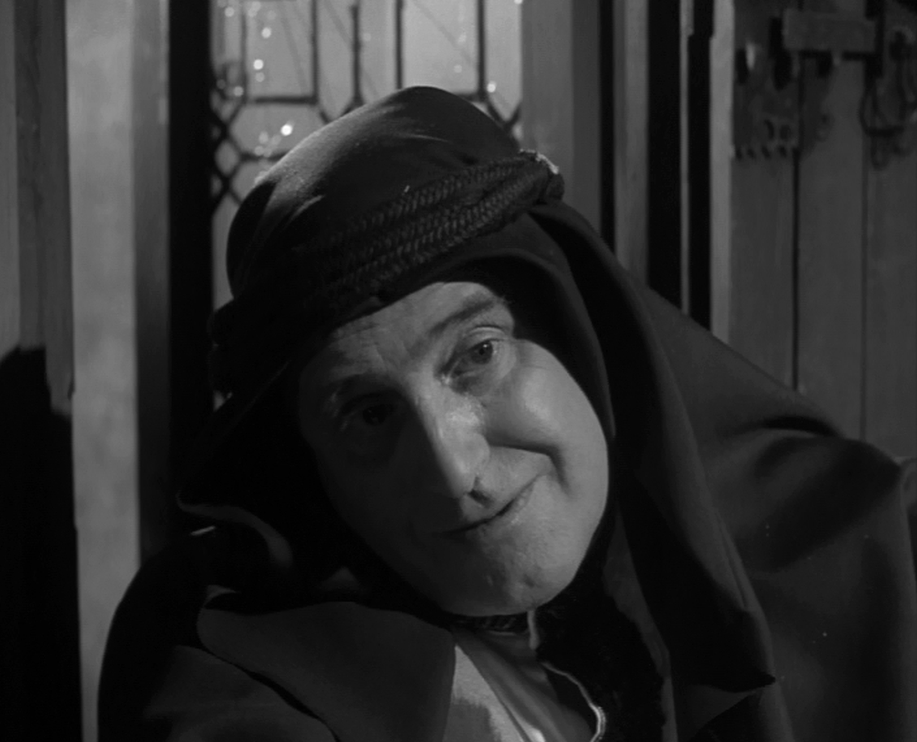
Reaching the nearest town they take refuge at the inn, but the innkeeper (Eric Pohlmann) seems rather untrustworthy. Pohlmann doesn’t have a lot to do but he manages to radiate a low-level of malevolence. Jack MacGowran as Launcelot Prior, has a little more to play with. The British-born Prior works for the local ruler, the Moukta, and his initial geniality is quickly stripped away to reveal something far less appealing.

Harold Kasket, a man who racked up a long list of television and film credits, is one of a number of British born actors playing Middle Eastern types today. He’s convincing enough as the autocratic Moukta, although as ever during the first series there’s rarely the time to really dig into characters.

Mid-way through the story is where the plot starts to go a little awry. Drake, Mary and the baby are summoned to the Moukta’s presence. Drake decides it’s not safe for them all, so he goes alone. But surely it would have been better had they stayed together, as by this point it’s become public knowledge that the young prince has escaped. Once Drake leaves, the Innkeeper focuses his beady eye on Mary and the baby.

Following his short and not terribly sweet meeting with the Moukta, Drake is driven away to meet his fate. But inexplicably he’s not killed, simply duffed up slightly and dumped on the outskirts of town. This means that it takes him no time at all to return to the Moukta, who by now has Mary and the child in his clutches.

With rebel forces – keen to kill the young prince – apparently closing in, the situation looks grim. But Drake manages to save the day by forging a proclamation from the rebels and circulating it around the town (it declares that the prince can be identified by a heart shaped mark on his leg). Of course the prince doesn’t have one, so Drake is able to convince the Moukta that the baby is simply an innocent child.

We briefly see the note and it doesn’t look that impressive (there’s no seal, for example). This rather convenient plot resolution is swiftly negated anyway after it’s revealed that the town has just been secured by forces loyal to the Royal Family (so Drake’s spot of forgery turned out to be superfluous). Why they didn’t just use one of these two possible endings and stick to it is a bit of a mystery.

Fairly routine stuff then, but as always it’s fun to spot familiar faces (Heather Chasen, Andrew Faulds, Maxwell Shaw) making brief appearances.

Danger Man – The Traitor

Drake is tracking a traitor, Blatta (George A. Cooper), across Northern India. He knows that Blatta is passing secrets to the enemy, but he doesn’t know how. Then on their arrival in Karaz, Blatta makes contact with an Englishwoman called Louise Goddard (Barbara Shelley) …

Based on the episode title, I was expecting George A. Cooper to feature strongly. But in fact he never gets to utter a word and the traitor of the title turns out to be someone else completely.

Before this reveal, there’s some preamble to attend to. Drake’s contact in Karaz is Banarji (Warren Mitchell). He’s one of two actors browned up for the episode although Mitchell’s performance is a little subtler than it might first appear. Banarji, a marketplace hawker, begins by giving it the full Peter Sellers “goodness gracious me”, but once he’s happy that he and Drake can’t be overheard, this act is dropped and he becomes much more businesslike.

The Traitor is another largely studio-bound story, although the marketplace set is very effective thanks to a number of extras milling about and several convincing backdrops. Add in a few brief establishing shots via stock footage and overall the illusion that we’re in India is well done.

Jack Watling offers a decent cameo as Rollo Waters, an amiably alcoholic garage owner. Rollo’s connection to the plot is fairly tenuous – it’s at his garage that (by a remarkable coincidence) Drake first spots Louise Goddard.

Drake learns that Louise lives in the mountains with her husband. On arrival there he’s instantly befriended by Noel Goddard (Ronald Howard) who offers Drake the run of the house, telling him that due to their remote location they very rarely see anyone.

Goddard’s hysteria at the thought that Drake might not stay is the first chink in his character, as otherwise he radiates an aura of urbanity. Howard essays an excellent performance as does Barbara Shelley – the relationship between the Goddards and the way they deal with Drake the interloper is nicely teased out.

Although I’ve had some harsh words previously about Danger Man’s plotting, there’s little to complain about here. For example, the puzzle as to why Goddard stays isolated in the mountains and never ventures down to the city is eventually answered and proves to be the crux of the episode.

The confrontation between Drake and Goddard after both their identities are revealed – Drake the NATO agent, Goddard the spy – crackles with energy. Goddard’s reasons for spying are ideological, not money-based, so Drake finds it impossible to break his resolve. Louise Goddard stays more in the shadows, but it’s plain she was a devoted helper (but resumably because she wanted to help her husband rather than out of any strongly held convictions).

It’s interesting that Louise, despite her complicity, doesn’t seem to pique Drake’s interest – it’s only Goddard that he’s interested in. This is about the only plot niggle I can see, apart from wondering why Goddard’s servant Panah (Derek Sydney – the other actor browned up) later attempts to kill him. Maybe Panah was in the pay of the foreign power.

Goddard’s failing health is revealed to be the reason why he remains in the mountains – if he travels down into the heat of the city then his life expectancy will be short. Drake realises this, but is still determined to bring him to justice. This concludes the episode in a suitably downbeat way and, apart from the last melodramatic musical sting, it’s a very effective closer.

I’ve had a quick look at the two reviews on IMDb and was slightly surprised to see that both were quite negative. For me, The Traitor is a top-notch effort – thanks to McGoohan, Howard and Shelley. It’s possible to argue that there’s little tension in the episode as you never believe for a minute that Goddard will be able to fulfill his orders to eliminate Drake. But then Goddard isn’t that sort of traitor – he’s a detached, intellectual sort of spy, so it entirely fits his character for him to quietly accept his fate.

Danger Man – Sabotage

Drake arrives in South East Asia to assist an old friend, Peta Jason (Maggie Fitzgibbon). Mrs Jason is the owner of a small airline which has lost several planes recently. Sabotage would seem to be the most likely reason, but if so who and why?

As so often, we find ourselves in a politically unstable part of the world where a nameless government (today they’re referred to simply as the new regime) are in power. Are the new regime responsible for blowing up the planes? If not, maybe one of their embittered opponents are doing their best to ensure that they take the blame.

It turns out to be the latter, although there’s no real clues or evidence offered – we’re told that’s the case and it turns out to be so. Since this part of the story isn’t much of a whodunnit we’ll pass on to more meaty matters.

Drake decides the best way to get to the bottom of things will be to join the cabin crew as a steward. He then acts as a drunken and corrupt one (all the better for attracting any criminal elements lurking close at hand). Patrick McGoohan’s drunk acting is something of an acquired taste – if you’re a fan then you’ll certainly enjoy his over the top antics early on (although I will concede that Drake’s ability to suddenly return to his usual cold, focused persona once he’s alone is effective).

For once, the cast doesn’t feature too many familiar faces. Alex Scott (as Benson, one of the airline’s loyal pilots) is probably the most recognisable. Yvonne Romain gives a good performance as Giselle Simon, a femme fatale who attempts to ensnare Drake (but proves to be no match for our Secret Agent). R. Bobby Naidoo as the corpulent and vocally high-pitched crime boss Chin Lee also makes an impression.

Despite the joint efforts of Michael Pertwee and Ian Stuart Black, the storyline never quite clicks for me. Even though she’s lost several planes, Mrs Jason doesn’t seem terribly bothered (neither do any of her flight crews – you’d have assumed they’d all be anxiously looking for safer jobs elsewhere). The pre-credits sequence focuses on a tea urn in one of the unfortunate planes – making it plain that’s where the bomb is (which rather negates any later mystery or tension).

True, Drake does force open another tea urn later on to reveal a gold bar (just as well that one didn’t contain a bomb, otherwise his heavy handed handling would have had explosive consequences) but this revelation only muddies matters somewhat. The gold smuggling is a subplot that could have been deleted without harming the story too much.

The climax (Drake lures the mastermind onto a plane he knows is due to carry a bomb) also falls a little flat as it’s obvious Drake has left the bomb behind and substituted it for a real tea urn.

So not the most thrilling or satisfying of stories, but the acting’s good and there’s some decent back projection shots which almost convince us we’re not on the studio backlot. A fair to middling effort then.